
Quick answer
US gold jewelry carries a karat (10K through 24K) or fineness number (417 through 999). Silver uses “Sterling,” “925,” or “800.” Platinum shows “PT950” or “PLAT.” Pieces marked GP, HGE, or GF are plated or filled and hold little melt value. Counterfeit stamps exist on base metal, so treat any unfamiliar mark as a starting point for testing, not a final verdict on what you own.
What Is a Jewelry Hallmark?
A hallmark is a stamp or engraved mark applied to a metal object that states the purity of the precious metal it contains. In the United States, hallmarking is regulated by the Federal Trade Commission under 16 CFR Part 23 (Guides for the Jewelry, Precious Metals, and Pewter Industries), which sets minimum fineness thresholds for calling an item “gold,” “silver,” or “platinum.” In the United Kingdom and much of Europe, hallmarking is mandatory by law under the Hallmarking Act 1973 and must be applied before a qualifying article can be sold.
Marks generally appear in a discreet location: inside a ring band, on the clasp of a necklace, or on the reverse of a pendant. A jeweler’s loupe at 10x magnification is the standard tool for reading them. Two categories of marks appear on most pieces: purity marks (which state the metal content) and maker’s marks (which identify the manufacturer or retailer).
US Gold Marks: Karat Stamps and Fineness Numbers
The United States uses two parallel systems for marking gold. Karat stamps (10K, 14K, 18K, 22K, 24K) express purity as parts of gold out of 24. Fineness numbers (417, 585, 750, 916, 999) express purity as parts per thousand of gold. Both mean the same thing and a piece may carry one or both formats.
| Karat mark | Fineness mark | Gold content | Common use in the US |
|---|---|---|---|
| 10K | 417 | 41.7% | Fashion jewelry, lower-price settings, class rings |
| 14K | 585 | 58.5% | Most US fine jewelry and engagement rings |
| 18K | 750 | 75.0% | European fine jewelry; high-end US market |
| 22K | 916 | 91.6% | Coin jewelry, South Asian wedding gold |
| 24K | 999 | 99.9% | Bullion bars and coins; too soft for most wearable jewelry |
Under 16 CFR Part 23, the FTC requires that any piece sold as “gold” in the United States be at least 10 karat (41.7% pure). Items below that threshold cannot legally carry the “gold” label in commerce. The National Gold and Silver Stamping Act of 1906 established the original federal framework; the FTC subsequently absorbed and updated these rules. For a detailed breakdown of how karat fractions translate to alloy composition, see our guide on the gold karat system explained.
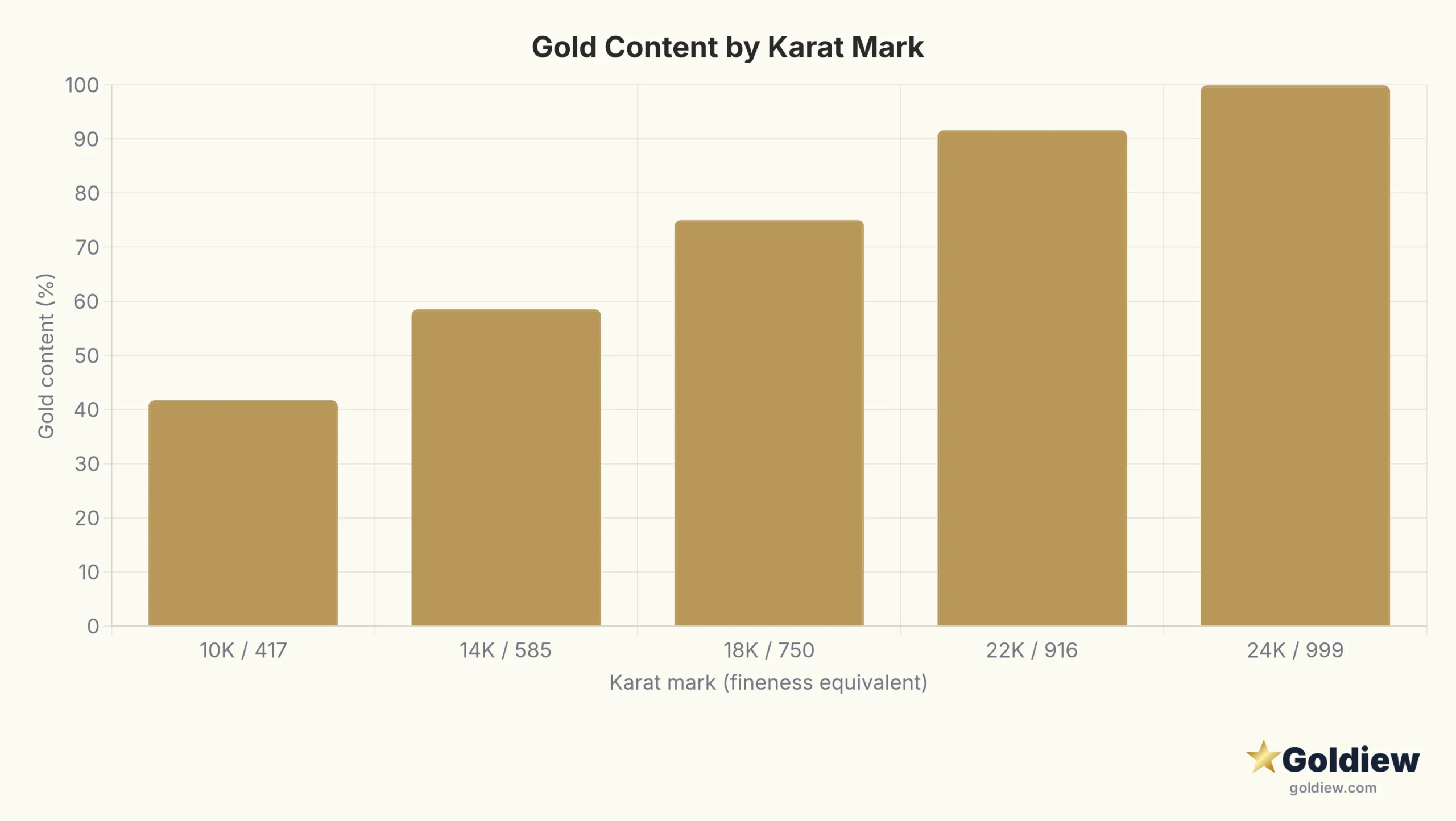

The melt value of a gold piece scales directly with its karat. An 18K ring weighing 5 grams contains 3.75 grams of pure gold (5 × 0.75). At a gold spot price of $3,000 per troy ounce (31.1035 grams), that ring holds approximately $362 in raw gold content. A 10K ring of the same weight contains 2.085 grams of pure gold, worth roughly $201 at the same spot price. The stamp does not capture gemstone value, craftsmanship premium, or maker’s mark collector value.
US Silver Marks
Silver stamps follow similar conventions. The most common marks encountered in American jewelry, flatware, and hollowware are:
| Mark | Silver content | Notes |
|---|---|---|
| Sterling / STER | 92.5% | US standard for fine silver; legally requires 925 parts per 1,000 |
| 925 | 92.5% | International fineness equivalent of Sterling; same metal, different notation |
| 900 / Coin Silver | 90.0% | Pre-1965 US coinage alloy; common in antique flatware and American spoons |
| 800 | 80.0% | Continental European standard; frequent on imported 19th-century pieces |
| Nickel Silver / German Silver | 0% | Copper-zinc-nickel alloy with a silver-like appearance; contains no silver whatsoever |
“Nickel silver” is one of the most common sources of confusion in estate jewelry. The name refers to the silvery appearance of the alloy, not its metal content. A piece marked “Nickel Silver” or “German Silver” contains zero precious metal. The FTC prohibits selling nickel silver as “silver,” but the mark appears on old flatware sets and candlesticks manufactured long before the current rules were enforced. Coin silver (900) is another mark worth knowing: pieces from American silversmiths working before the Civil War era often carry it, and the alloy is genuine silver with real melt value, just at 90% rather than 92.5%.
For a practical guide on telling sterling apart from silver plate without relying on the stamp, see our article on sterling vs. silver plate identification.
Platinum and Palladium Marks
Platinum and palladium carry their own stamping conventions. Under FTC guidelines at 16 CFR Part 23, any item sold as “platinum” must be at least 500 parts per thousand (50%) platinum. Items at or above 950 fineness may be marked simply “Platinum” or “PLAT.” Items between 500 and 949 fineness must include the specific fineness number alongside the designation.
| Mark | Metal content | Notes |
|---|---|---|
| PLAT | 95.0%+ platinum | Used alone only when fineness is 950 or higher (FTC rule) |
| PT950 / Plat950 | 95.0% platinum | Most common modern platinum jewelry standard |
| PT900 / Plat900 | 90.0% platinum | Common in vintage and Japanese platinum jewelry |
| PT850 / Plat850 | 85.0% platinum | Older standard; less common today |
| PD950 | 95.0% palladium | Palladium, not platinum; lighter and currently less expensive per gram |
White gold and platinum are visually nearly identical in photographs and in casual inspection, but they differ significantly in density and in long-term maintenance needs. White gold is typically rhodium-plated to maintain its bright white appearance and will need re-plating over time. Platinum is naturally white and requires no coating. The practical test for distinguishing them is weight: a platinum ring is noticeably heavier than a white gold ring of the same dimensions. Our guide on white gold vs. platinum identification covers the full range of at-home and professional tests.
Gold-Filled, Plated, and Vermeil Marks
Many pieces carry gold-colored stamps that indicate layered or coated products rather than solid gold. These are legal designations under FTC rules, but they carry a small fraction of the melt value that an equivalent-weight solid gold piece would hold.
| Mark | What it means | Melt value implication |
|---|---|---|
| GF / Gold Filled | A gold layer comprising at least 1/20 of total item weight, bonded by heat and pressure to a base metal core | Small but recoverable; refiners process GF in bulk lots |
| GP / Gold Plated | Thin electroplated gold layer over a base metal; no minimum thickness is specified in FTC rules | Negligible; the base metal core dominates the total weight |
| HGE / Heavy Gold Electroplate | A marketing term for a thicker electroplated layer; “heavy” has no legally defined minimum thickness | Minimal; treat as plated, not filled |
| EP / Electroplated | Generic electroplate designation; thin gold-colored layer, base metal core | Negligible melt value |
| GEP / Gold Electroplate | Same as EP; the word “gold” refers to the color and composition of the layer, not a solid gold piece | Negligible melt value |
| VGP / Vermeil | A gold layer of at least 2.5 microns thickness (gold at minimum 10K) bonded over a sterling silver base | The sterling base has real melt value; the gold layer adds a minor premium |
Gold-filled items deserve careful attention when sorting an estate. A mark like “1/20 12K GF” means the gold layer is 12-karat gold and constitutes exactly one-twentieth of the total item weight. On a large bracelet weighing 30 grams, that means 1.5 grams of 12K gold, which contains 0.75 grams of pure gold. Refiners will recover this metal in bulk lots, but the per-piece value is low. Vermeil is the most valuable of the plated categories because the sterling silver base gives it genuine precious metal content regardless of the condition of the gold layer.
The British Hallmark System
British hallmarking is mandatory by law for gold, silver, and platinum items sold in the UK above specified minimum weight thresholds. The Hallmarking Act 1973 requires qualifying items to be assayed and stamped by an approved assay office before they can be sold. This independent assay is the key distinction from the US system, where makers generally self-declare purity without third-party verification.
A full British hallmark contains up to five components. The most important for identifying and valuing a piece are the fineness mark and the assay office mark.
| Component | What it shows | Required? |
|---|---|---|
| Sponsor’s mark | Manufacturer or importer who submitted the piece for assay | Yes |
| Fineness mark | Parts per thousand of the precious metal (e.g., 375 for 9K gold, 750 for 18K, 925 for Sterling) | Yes |
| Assay office mark | Identifies which of the four UK assay offices tested and stamped the piece | Yes |
| Date letter | Alphabetical letter identifying the year of assay; optional since 1999 but widely used | Optional since 1999 |
| Traditional fineness mark | Older symbolic mark (e.g., crown for 18K gold, lion passant for Sterling silver) | Optional |
Four assay offices currently operate in the United Kingdom:
| Assay office | Symbol |
|---|---|
| The Goldsmiths’ Company (London) | Leopard’s head |
| The Assay Office Birmingham | Anchor |
| Edinburgh Assay Office | Castle |
| The Assay Office Sheffield | York rose |
For definitive and current information on British hallmark standards, consult the Assay Office London or the Birmingham Assay Office directly. UK hallmark requirements are subject to periodic legislative updates, and the official assay offices publish the current requirements. A British piece with a complete hallmark set carries a stronger authenticity baseline than an unmarked or informally marked piece, because an independent lab rather than the maker self-assessed the metal content.
Maker’s Marks vs. Purity Marks
A purity mark (also called a quality mark or fineness mark) states the metal content of the piece. A maker’s mark identifies who manufactured or retailed it. In the United States, maker’s marks are voluntary on jewelry and take many forms: company initials, a logo, or a registered trademark. On British pieces, the maker’s mark (called the sponsor’s mark) is a required component of the full hallmark set.
Maker’s marks matter for valuation in two distinct ways. Pieces from recognized brands such as Tiffany, Cartier, or Georg Jensen typically carry a significant premium over melt value that has nothing to do with metal content. An old or obscure maker’s mark on an antique piece can sometimes be researched through reference resources such as the 925-1000 Silver Marks Encyclopedia or through certified appraisers who specialize in antique jewelry. Consulting an appraiser who holds credentials from the Gemological Institute of America (GIA) or the American Society of Jewelry Appraisers is the most reliable path for positively attributing unfamiliar marks on high-value pieces.
Gold and coin dealers, jewelry buyers, pawn shops, and estate sale specialists across the US who regularly work with hallmarked pieces are listed in the Goldiew business directory. If you need a local expert to read a difficult mark in person, searching the Goldiew directory by your area can connect you with verified professionals.
Counterfeit Stamps: What a Real Mark Does Not Prove
A hallmark is evidence of a claimed purity, not an independent guarantee of it. Counterfeit stamps are applied to base metal pieces and sold through informal markets, some online auction platforms, and certain estate sales. The most frequently counterfeited marks are 925 (on base metal that contains no silver) and 14K or 18K (on brass or copper alloys).
The following tests go beyond reading the stamp and give a more reliable picture of what a piece actually contains:
- Acid test: A small amount of nitric acid applied to a file scratch produces a characteristic color reaction for gold and silver at various karats. Gold acid test kits are widely available and are the standard quick screen used at coin shops and pawn shops. The test is slightly destructive but leaves only a small scratch.
- XRF (X-ray fluorescence) analysis: A handheld XRF instrument identifies the elemental composition of the metal surface within seconds without damaging the piece. Results are accurate to fractions of a percent. Many established dealers, refiners, and assay labs use XRF as their primary verification tool.
- Density test: Gold (19.3 g/cm³), silver (10.5 g/cm³), and platinum (21.4 g/cm³) each have characteristic densities. Weighing a piece in air and then suspended in water allows calculation of its actual density, which immediately flags obvious substitutions with lighter alloys.
- Magnet test: Real gold, silver, and platinum are not ferromagnetic. A piece strongly attracted to a neodymium magnet is not solid precious metal. This test only catches certain substitutions; non-magnetic alloys such as brass also pass it, so a “pass” does not confirm authenticity.
If a piece carries a suspicious stamp, or if the price being offered seems inconsistent with the metal content it claims, the most reliable step is an independent assay from a lab or established dealer. The acid test or XRF provides a same-day answer in most cases. Our guide on how to tell if gold is real covers acid testing, the magnet test, and XRF in plain steps.
Worn or Missing Marks on Antique Pieces
Antique jewelry frequently carries no legible mark, either because it was never stamped or because decades of polishing have worn the mark away. In the United States, mandatory gold quality marking under federal law dates only to 1906. Pieces made before that date may be genuine high-karat gold with no stamp at all. Similarly, British date letters and some traditional fineness marks on Victorian-era pieces can fade to illegibility.
A missing mark does not mean a piece is not precious metal, and it does not mean it is. The only reliable determination for an unmarked antique is acid testing, XRF analysis, or a formal assay by a qualified professional. Appraisers certified by the GIA or members of the American Society of Jewelry Appraisers are qualified to conduct this work and to produce written reports suitable for insurance, estate distribution, or sale purposes. Our guide on estate appraisals for gold collections explains what type of appraisal is appropriate for each purpose and what to expect from the process.
What Each Mark Means for Melt Value
Melt value is the intrinsic value of the precious metal in a piece at current spot prices. It represents the practical floor below which a piece should rarely trade in a competitive market. The formula is straightforward:
Melt value = (gross weight in troy oz) × (fineness decimal) × (spot price per troy oz)
One troy ounce equals 31.1035 grams. To convert grams to troy ounces, divide the gram weight by 31.1035. For example: a 14K gold chain weighing 8 grams contains 8 ÷ 31.1035 = 0.2573 troy oz of total metal. Multiply by the fineness decimal (0.585 for 14K) to get 0.1505 troy oz of pure gold. At $3,000 per troy ounce, the melt value is approximately $451.
If you need to run live calculations on a specific piece before deciding whether to sell it, our gold value calculator and silver value calculator let you input the exact weight and fineness for a current estimate.
| Mark type | Relative melt value (10g piece) | Notes |
|---|---|---|
| 24K / 999 gold | Highest (99.9% of weight is recoverable gold) | Bullion-standard; very soft, rare in wearable jewelry |
| 18K / 750 gold | 75% of 24K equivalent | Common European and luxury US fine jewelry mark |
| 14K / 585 gold | 58.5% of 24K equivalent | Most common US fine jewelry mark; good durability |
| 10K / 417 gold | 41.7% of 24K equivalent | US legal minimum for “gold” designation under FTC rules |
| Sterling / 925 silver | Based on silver spot; far lower absolute dollar value than gold | Silver trades at a significant discount to gold per ounce |
| GF (Gold Filled) | Approximately 1/20 of the surface-layer weight in gold | Requires bulk refining; low per-piece recovery |
| GP / HGE / EP (Plated) | Negligible | Base metal dominates; refining cost exceeds gold recovered |
For pieces that are inherited or sourced from estate sales, a professional evaluation before selling ensures you are not trading a valuable maker’s mark or collector piece at scrap prices. Condition, completeness, and provenance all affect what a buyer will actually pay, sometimes well above and occasionally below the melt floor.
Selling Jewelry After Identifying the Hallmarks?
Once you have confirmed the marks on your piece, Goldiew’s free request tool at /sell-gold/ connects you with up to 15 verified buyers who submit sealed offers on your item. There is no obligation and no fee. You can also browse current offers on the Goldiew marketplace to see what buyers are paying for similar pieces right now.
Do You Buy, Appraise, or Sell Jewelry Professionally?
Gold dealers, coin dealers, pawn shops, jewelers, and jewelry buyers who work with hallmarked pieces every day are listed in the Goldiew business directory. If your business is not yet listed, claim your free Goldiew profile or register a new listing to reach buyers and sellers in your area who are looking for verified local professionals. More details at /for-business/.
Frequently Asked Questions About Jewelry Hallmarks
What does 925 mean on jewelry?
The stamp 925 indicates that the piece is made of sterling silver: 92.5% pure silver and 7.5% other metals (typically copper) for durability. Sterling and 925 are interchangeable designations under both US FTC guidelines and international standards. The 925 stamp is never used on gold jewelry; it refers exclusively to silver.
Is 14K or 18K gold better for resale value?
At scrap prices, 18K gold yields more per gram because it contains 75% pure gold versus 58.5% for 14K. On a 10-gram ring at $3,000 per troy ounce spot, the difference is approximately $50 in raw metal value. For estate sellers, the more important factor is often the spread offered by the buyer. A piece with a desirable maker’s mark or in excellent condition may trade above either melt figure regardless of karat.
What does HGE mean on jewelry?
HGE stands for heavy gold electroplate. It describes a gold-colored electroplated layer applied over a base metal core. The word “heavy” is a marketing term with no minimum thickness defined by FTC regulations. HGE pieces carry negligible precious metal melt value; the base metal (typically brass) constitutes nearly all the weight. Do not confuse HGE with GF (gold filled), which has a substantially thicker gold layer that constitutes at least one-twentieth of total item weight.
Can a hallmark be counterfeit?
Yes. Counterfeit stamps, particularly 925 on base metal and 14K or 18K on brass alloys, do appear on pieces sold through informal markets and some online platforms. A stamp is evidence of a claim made by the maker or importer, not an independent assay result. Acid testing, XRF analysis, or a professional assay are the reliable methods for confirming actual metal content when a stamp’s authenticity is in question.
What does PLAT or PT950 mean on a ring?
PLAT used alone indicates the item is at least 95.0% platinum by FTC rules. PT950 or Plat950 specifies exactly 95.0% platinum fineness. Platinum is significantly denser than gold (21.4 g/cm³ vs 19.3 g/cm³), so a heavy ring marked PT950 contains more metal by weight than it might appear. Platinum does not tarnish and requires no rhodium coating, unlike white gold.
How do I read a British hallmark?
A full British hallmark includes up to five marks: the sponsor’s (maker’s) mark, the fineness mark (a number in a shaped cartouche such as 375, 585, 750, or 925), the assay office mark (London uses a leopard’s head, Birmingham uses an anchor, Edinburgh uses a castle, Sheffield uses a rose), an optional date letter, and an optional traditional fineness symbol. The fineness mark and assay office mark are the most useful for confirming metal content and verifying independent testing. Current UK hallmarking requirements are governed by the Hallmarking Act 1973 and maintained by the four active assay offices.
What is a maker’s mark and does it affect value?
A maker’s mark identifies the manufacturer, designer, or retailer of a piece. In the US it is voluntary; on British pieces it is the mandatory sponsor’s mark. Maker’s marks affect resale value significantly when they represent recognized luxury brands or historically significant workshops. A 14K ring by Tiffany and a plain 14K ring have identical melt value but very different collector and resale prices. Unknown maker’s marks on antique pieces can be researched through silver and gold marking reference databases or a certified appraiser.
What does “coin silver” mean?
Coin silver refers to a 90.0% silver alloy (marked 900 or “Coin”) that was the standard used for US coinage before 1965. American silversmiths frequently melted down worn coins to make flatware and hollowware, giving the alloy its name. Coin silver is genuine silver with real melt value; it is slightly less pure than sterling (92.5%) but the difference in value per ounce is small. Coin silver marks are most common on American antique spoons, forks, and serving pieces from the 18th and 19th centuries.
Sources
- Federal Trade Commission. Guides for the Jewelry, Precious Metals, and Pewter Industries, 16 CFR Part 23. ecfr.gov
- UK Parliament. Hallmarking Act 1973. legislation.gov.uk
- The Assay Office London (Goldsmiths’ Company). Hallmarking guidance. assayofficelondon.co.uk
- The Assay Office Birmingham. bham.assay-office.co.uk
- Federal Trade Commission. How to Buy Jewelry (consumer guide). consumer.ftc.gov
- Gemological Institute of America. Jewelry Appraisals FAQ. gia.edu