
Quick answer
Almost every ring sold in the United States since the late 1970s carries a hallmark inside the band that answers the question in seconds. A stamp reading PLAT, PT950, PT900, or a bare number like 950 identifies platinum. A stamp reading 14K, 18K, 585, or 750 identifies white gold. When no stamp is legible, the density test is next: platinum is roughly 40 percent heavier than 18-karat white gold of the same physical dimensions. At current spot prices, 18-karat white gold carries higher melt value per gram than platinum, which surprises most owners.
Two white metals, one common mix-up
A well-maintained platinum ring and a freshly rhodium-plated white gold ring can look identical. Both are bright white. Both feel cold and solid. A jeweler with two decades of experience may still pause and reach for a loupe before answering. That’s not a gap in knowledge. It reflects a genuine visual similarity between two chemically unrelated materials.
White gold is gold, alloyed with white metals (typically palladium, nickel, or silver) to dilute its natural yellow color, then almost always coated in a thin layer of rhodium to produce a bright white finish. 14-karat white gold is 58.5 percent gold by mass; 18-karat is 75 percent. The rest is the alloying metals. Platinum is a separate element entirely (atomic number 78) with a naturally white-gray color. A ring stamped PT950 contains 95 percent pure platinum and 5 percent other metals, usually ruthenium or cobalt added for hardness.
Getting the identification right matters before you sell, resize, repair, or insure a piece. A jeweler quotes platinum repair rates only for platinum. A buyer calculating melt value needs the correct metal to run the math. And that math, as the section below shows, often produces results that contradict what most owners expect.
Start with the stamp
The fastest and most reliable identification method is also the most obvious: look for the hallmark. Almost every piece sold in the United States since the late 1970s carries one, usually stamped inside the band at or near the 6 o’clock position. A jeweler’s loupe at 10x magnification reads it clearly.
| Stamp on the piece | What it means | Metal type |
|---|---|---|
| 14K or 14KT | 58.5% gold content | White gold |
| 18K or 18KT | 75% gold content | White gold |
| 585 | 58.5% gold (European millesimal marking for 14K) | White gold |
| 750 | 75% gold (European millesimal marking for 18K) | White gold |
| 417 | 41.7% gold (10-karat; uncommon in fine jewelry) | White gold |
| PLAT or PLATINUM | At least 95% platinum (FTC standard for bare designation) | Platinum |
| PT950 or 950PLAT | 95% platinum, 5% other metals | Platinum |
| PT900 or 900PLAT | 90% platinum, 10% other metals | Platinum |
| PT850 | 85% platinum, found on older and some industrial pieces | Platinum |
| IRIDPLAT | Platinum-iridium alloy (vintage jewelry and dental pieces) | Platinum |
Under the Federal Trade Commission’s jewelry guides (16 CFR Part 23), any piece sold in the US as “platinum” must contain at least 50 percent platinum. Pieces between 50 and 95 percent platinum must state the actual percentage alongside the designation. A piece marked simply PLAT or PLATINUM, with no purity number, legally represents 95 percent or better. That regulatory requirement makes the stamp one of the most reliable identification tools a non-specialist can use.
For a comprehensive reference on all types of jewelry hallmarks, including maker’s marks, assay office stamps on European pieces, and vintage American marks, see the jewelry hallmarks identification guide.
Stamp not visible? Check at the 6 o’clock position inside the band under a loupe or strong magnifying glass. Older estate pieces (pre-1960), handmade jewelry, many international imports, and rings that have been sized multiple times may have a stamp in an unusual location or none at all. Sizing operations can grind directly through a stamp if the jeweler didn’t check first.
The density test: weight tells the story
When a stamp is missing, faded, or unreadable, density is the next reliable check. Platinum is among the densest metals used in jewelry. A PT950 ring and a white gold ring of identical design do not weigh the same, and the difference is large enough to feel.
| Metal | Density (g/cm³) | Weight vs. 14K white gold baseline |
|---|---|---|
| Platinum (PT950) | 21.4 | Approx. 54% heavier |
| 18K white gold | 15.2 | Approx. 10% heavier |
| 14K white gold | 13.9 | Baseline |
| Sterling silver (.925) | 10.4 | Approx. 25% lighter |


In practical terms: a plain 5mm wedding band in platinum weighs roughly 50 to 60 percent more than the identical band in 14-karat white gold. That gap is noticeable when you hold both. A digital postal scale plus a simple water displacement test turn the impression into a number you can compare against the table.
How the Archimedes method works at home: weigh the dry ring on a scale that reads to at least 0.01 grams. Then hang the ring from a thin thread, submerge it fully in a container of water sitting on the scale, and record the weight reading with the ring submerged (the increase equals the displaced water in grams, which is the ring’s volume in cubic centimeters). Divide the dry weight by that volume. A result near 21 points to platinum; near 15, to 18K gold; near 14, to 14K gold. The Goldiew value calculator can help you work through the numbers once you have both figures.
Limitation of the weight test: Density works reliably for solid plain bands. Rings with large stone settings, hollow shanks, or sections of different materials produce unreliable displacement readings because the stones add mass and vary in how they interact with water volume. For complex pieces, use the stamp method or professional XRF testing instead.
How each metal ages: wear patterns as a secondary check
If you’re examining a ring someone has worn daily for five or more years, the condition of the piece offers a secondary indicator. Platinum and white gold age differently enough that the physical state of a used ring can support or challenge what you expect from the stamp.
White gold over time
- Yellows as the rhodium plating wears through, typically within 1-2 years of daily ring wear
- Scratches remove metal permanently, slowly reducing mass over decades
- Fine engraved details soften and blur with long wear
- Restores fully to bright white with re-plating, typically $60-150 at a jeweler
- More workable for resizing: gold alloys respond readily to a jeweler’s tools
Platinum over time
- Keeps its white-gray color permanently without plating or treatment
- Scratches displace metal sideways rather than removing it (a characteristic called “flow” that preserves the ring’s mass)
- Can be polished back to a high shine repeatedly across the life of the piece
- Develops a matte satin patina; some owners prefer it, others find it dull compared to freshly plated white gold
- Requires a jeweler experienced in platinum for resizing; the process is more demanding than gold
The yellowing test: hold the piece under natural daylight (not incandescent bulbs, which shift everything warm). White gold that has lost its rhodium coat shows a cream or champagne tint in high-contact areas: the inner shank, around prongs, along the top of the band. Platinum never shows this. A piece that is still bright white in those exact wear zones is either platinum or recently re-plated white gold.
The patina test runs the other way. Platinum that has developed its satin finish looks similar to brushed steel in flat sections. Scratches run in many directions and give the surface a soft, diffuse sheen rather than a sharp reflection. White gold scratches appear as shinier grooves against a potentially duller surrounding area, because the intact rhodium coating around each scratch still reflects differently than the exposed alloy within it.
When the stamp is missing: professional testing
Estate pieces, handmade jewelry, some international imports, and rings that have been substantially altered sometimes arrive with no readable stamp. Three professional options exist, ordered from least destructive to most:
XRF analysis (X-ray fluorescence)
Non-destructive. The analyzer fires X-rays at the metal surface; the energy returned identifies every element present and its percentage, accurate to within 0.1 percent. Results take roughly 30 seconds. Cost: $25-75 at most jewelry buyers and jewelers, sometimes included at no charge in an overall assessment. A platinum ring reads as 95 percent Pt immediately. A white gold ring reads as gold plus palladium or nickel in the expected ratios. XRF is now the standard first-line test at most professional buyers because it is fast, conclusive, and leaves the piece undamaged.
Touchstone acid test
Minimally destructive (takes a small streak of metal on a black basalt stone). The jeweler rubs the piece against the stone, leaving a thin streak, then applies a drop of testing acid. The reaction, or absence of one, indicates the metal content. Standard gold testing acids do not affect platinum at all; confirming platinum requires a separate aqua regia solution (hydrochloric acid mixed with nitric acid). Experienced jewelers still use this method as a quick secondary confirmation, though XRF has largely replaced it as the primary test.
Fire assay
Fully accurate, fully destructive. A small sample is removed from the piece, melted, and chemically analyzed. Accuracy reaches four decimal places. Refiners use fire assay before purchasing significant quantities of metal and need a certified purity figure. For identifying a single ring, fire assay is unnecessary. A refiner will run it automatically as part of purchasing the metal once you decide to sell.
For a single piece you’re trying to identify before a sale, XRF at a local jeweler is the right call. The $25-75 cost produces a written reading you can present to any buyer as documentation of the metal content. Some precious metals buyers offer XRF at no charge as part of their assessment; call ahead to ask before driving over.
Which metal is worth more right now?
Most people expect platinum to be the more valuable metal. For much of the 20th century, that assumption was correct: platinum traded comfortably above gold for decades. That relationship reversed around 2011 and has remained reversed since. As of mid-2026, gold commands a significant premium over platinum per troy ounce, and that gap directly determines which metal in your jewelry is worth more per gram.
The calculation below uses illustrative prices. Verify current spot rates before any transaction through a live price feed or the Goldiew gold value calculator, since spot prices fluctuate daily:
| Metal | Purity | Approx. spot ($/troy oz) | Melt value per gram of ring |
|---|---|---|---|
| 18K white gold | 75% gold | ~$2,450 | ~$59/gram |
| 14K white gold | 58.5% gold | ~$2,450 | ~$46/gram |
| PT950 platinum | 95% platinum | ~$1,050 | ~$32/gram |
| PT900 platinum | 90% platinum | ~$1,050 | ~$30/gram |
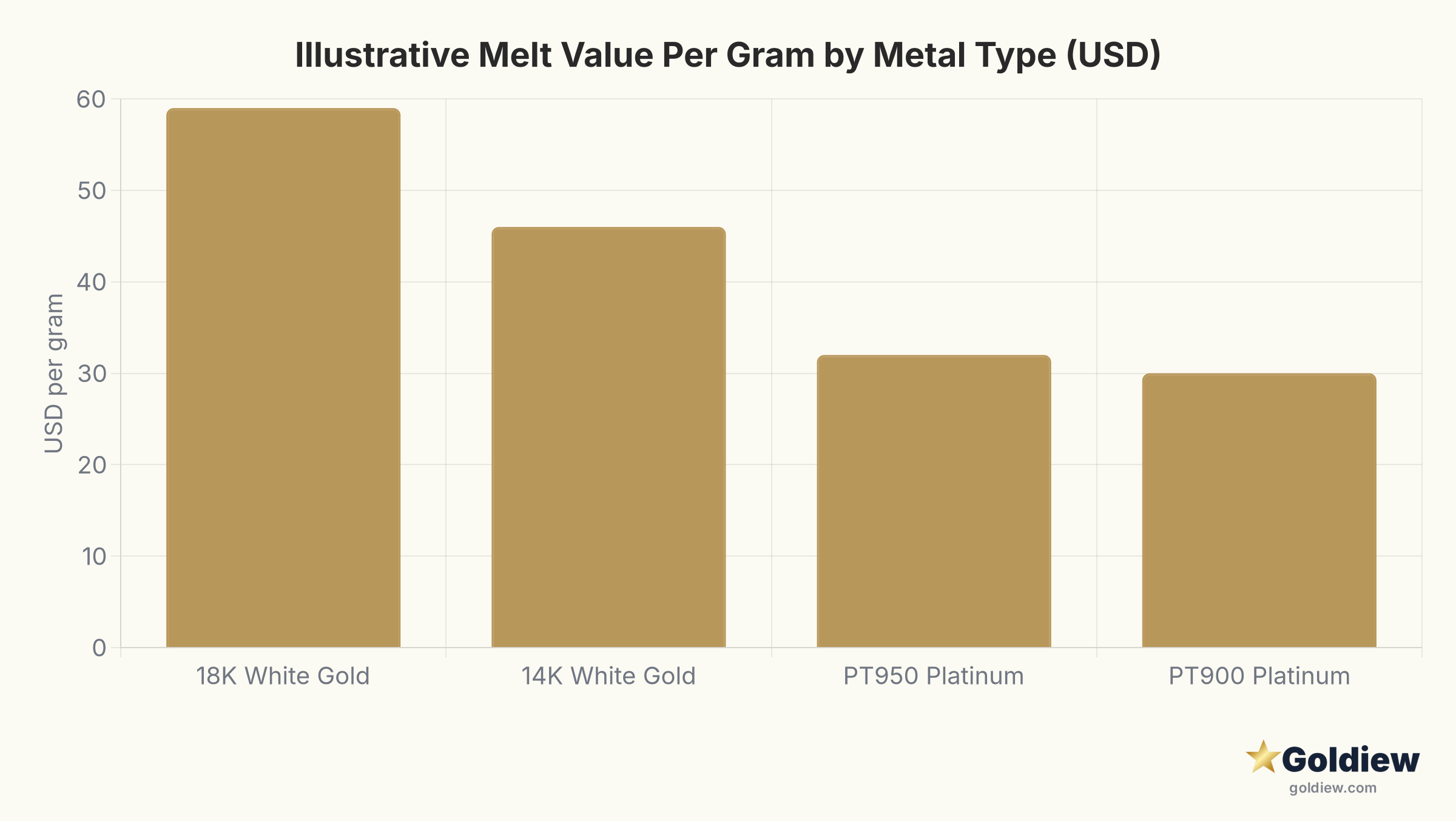

A 10-gram 18-karat white gold ring carries roughly $590 in gold content at these illustrative prices. The same 10 grams in PT950 platinum carries about $320 in platinum content. The white gold piece has nearly twice the melt value per gram, despite platinum’s weight advantage. This is the result that surprises most people walking in expecting their heavy platinum piece to be the winner.
Why has platinum fallen so far below gold? The causes involve industrial demand shifts (palladium displaced platinum as the preferred catalyst metal in gasoline engines), concentrated supply from South African mines, and the investment premium that has favored gold since the 2008 financial crisis. For the full market history, why platinum now trades below gold covers the price relationship in detail.
Melt value is a floor, not a ceiling. A well-made vintage platinum ring from a recognized period or maker (Art Deco, Edwardian, mid-century signed pieces) can sell well above melt value to collectors and estate buyers. The melt value calculation tells you the minimum your metal content is worth on the open market; design, condition, age, and provenance can raise the actual sale price significantly. For engagement rings specifically, the guide to selling an engagement ring covers the full picture of factors that affect what a buyer actually pays.
Before you sell: getting the right price
Once you know what you have, the practical problem is finding a competitive offer for it. Dealers, jewelers, and pawn shops apply different buy margins, weight design differently from metal content, and serve different buyer pools. A buyer who specializes in estate jewelry may pay a meaningful premium for a fine Art Deco platinum setting that a metal refiner would simply weigh and melt. Presenting your identified piece to one buyer tells you nothing about whether that number is competitive.
Post one free request on Goldiew’s sell-gold platform to receive competing sealed offers from up to 15 verified precious metals buyers, without cold-calling dealers or accepting the first number you’re given. You need only the metal type and approximate weight to start the process.
Get competing offers from verified buyers
Post a single free request on Goldiew’s sell-gold platform and receive sealed, competing offers from up to 15 verified precious metals buyers. There is no obligation to accept any offer, and the process is free. Whether your piece turns out to be 18-karat white gold or PT950 platinum, knowing the metal lets buyers quote accurately. Browse active buy requests on the Goldiew marketplace to see current buyer demand before you decide to post.
Frequently asked questions
Can white gold pass an acid test as platinum?
No. Standard gold testing acids (nitric acid solutions calibrated for 10-karat, 14-karat, and 18-karat gold) and platinum testing acid (aqua regia, a mixture of hydrochloric and nitric acid) are chemically different. White gold reacts to gold testing acid in the way its karat rating predicts. Platinum does not react to standard gold testing acids at all, which is itself a diagnostic indicator. A properly administered acid test using the correct solution for each metal type cannot confuse the two.
My ring has no stamp. Does that mean it’s not real gold or platinum?
Not necessarily. US hallmarking requirements cover pieces sold domestically after a certain period, and coverage is not universal across all eras and types. Older estate pieces, handmade jewelry, international imports from countries with different marking traditions, and rings that have been resized multiple times may carry no visible stamp. Absence of a stamp does not indicate counterfeit metal. It means you need XRF or acid testing to determine composition. A legitimate jeweler or buyer will test the piece rather than dismiss it. Ask for the XRF printout in writing if you pursue that route.
Is white gold real gold?
Yes. White gold is a gold alloy. The gold content matches exactly what the karat marking states: 14-karat white gold is 58.5 percent gold by mass, 18-karat is 75 percent. The remaining percentage is typically palladium, nickel, silver, or zinc, added to make the alloy paler and harder than pure gold. The rhodium coating that creates the bright white surface is a separate surface treatment applied after casting. The gold inside a white gold ring is chemically identical to the gold in a yellow or rose gold piece of the same karat.
Which is better for an engagement ring: platinum or white gold?
It depends on the wearer’s priorities. Platinum needs less ongoing maintenance: no re-plating, no yellowing, and the metal retains its mass through wear rather than abrading away. It is also hypoallergenic, which matters for people sensitive to nickel, a common white gold alloying metal. White gold typically costs 40 to 60 percent less for a comparable design, is easier to resize, and looks indistinguishable from platinum when freshly plated. For a daily-wear piece from someone without nickel sensitivity who values lower upfront cost and straightforward future resizing, 18-karat white gold is a practical choice. For someone who wants zero maintenance and long-term durability without periodic trips to the jeweler, platinum holds up better across decades. Neither is universally the right answer.
Does platinum tarnish or change color with age?
Platinum does not tarnish in the chemical sense. It develops a matte patina from surface scratches over years of wear, which gives it a satin finish rather than a high-polish shine. That patina is not discoloration: the metal beneath is chemically unchanged. Many owners come to prefer the patina. A jeweler can restore a high polish in about 30 minutes. Platinum is not affected by most household chemicals, pool chlorine, or normal exposure conditions. Its color is permanent.
If platinum is denser, why doesn’t a heavy ring confirm it’s platinum?
Weight alone is not conclusive. An 18-karat white gold ring with a thicker shank or heavier prong construction can weigh more than a slender platinum band. The density test requires both the dry weight in grams and the water displacement volume in cubic centimeters, which together produce grams per cubic centimeter: the figure that identifies the metal. A result near 21 is platinum; near 15, 18K gold; near 14, 14K gold. Without both measurements, a ring simply feeling heavy tells you there is more metal by design, not by composition.
Can I test for platinum at home without chemicals?
The Archimedes density test (dry weight divided by water displacement volume) is the most reliable home method without chemicals, though it requires a scale accurate to 0.01 grams for useful results. A magnet test provides a quick initial screen: neither platinum nor gold is magnetic, so a piece that sticks firmly to a rare-earth magnet is neither. But the magnet test only rules out iron or steel with a surface plating. It cannot distinguish platinum from white gold. For a conclusive result, XRF testing at a local jeweler typically costs $25-75 and takes 30 seconds. Some buyers include it at no charge as part of the selling assessment.
Sources
- Federal Trade Commission. Guides for the Jewelry, Precious Metals, and Pewter Industries. 16 CFR Part 23. Governs minimum platinum content for use of the PLAT/PLATINUM designation and purity disclosure requirements.
- Gemological Institute of America (GIA). GIA Education: Platinum Properties and Identification. Industry reference covering platinum density, the metal’s wear characteristics, and comparison to gold alloys.
- Jewelers of America. Jewelry Metals Education. Industry reference on karat marking conventions and US hallmarking practices for gold alloys.
- United States Geological Survey (USGS). Platinum-Group Metals: Statistics and Information. Supply, production, and demand context for platinum pricing.
- London Bullion Market Association (LBMA). Precious Metal Prices. Reference methodology for gold and platinum spot pricing; verify current rates at time of any sale transaction.