
Quick answer
A 14K ring contains 14 parts pure gold and 10 parts other metals, which works out to 58.3% gold content. An 18K piece is 75% gold. The United States Federal Trade Commission sets 10K (41.7% gold) as the legal minimum an item must meet before a seller can call it gold. Anything lower is not legally gold in the US, regardless of what the stamp says.
The complete karat reference table
Every piece of gold jewelry or bullion sold in the US carries one of these purity levels. The millesimal fineness number (the three-digit stamp common on European and international pieces) expresses the same thing as parts per thousand rather than parts per 24.
| Karat | Gold Content (%) | Millesimal Fineness | Common Stamps | Typical Use |
|---|---|---|---|---|
| 10K | 41.7% | 417 | 10K, 10KT, 417 | Fashion jewelry, affordable rings |
| 14K | 58.3% | 585 | 14K, 14KT, 585 | Most US fine jewelry (engagement rings, chains) |
| 18K | 75.0% | 750 | 18K, 18KT, 750 | High-end fine jewelry, Swiss watches |
| 22K | 91.7% | 916 | 22K, 916 | Gold coins, South Asian wedding jewelry |
| 24K | 99.9% | 999 | 24K, 999, 999.9, 9999 | Investment bullion, coins, electronics |
How the karat system works
The karat system divides gold purity into 24 equal parts. Imagine slicing a piece of metal into 24 identical slices: the karat number tells you how many of those slices are pure gold and how many are other metals. A 14K piece has 14 slices of gold and 10 slices of alloy. That ratio gives you the purity percentage: 14 divided by 24 equals 0.583, or 58.3%.
The system dates to medieval Europe, where 24 was a practical unit for dividing coinage because it divides evenly by 2, 3, 4, 6, 8, and 12. Goldsmiths needed a unit that let them express fine gradations without decimal arithmetic, and 24 fit that requirement.
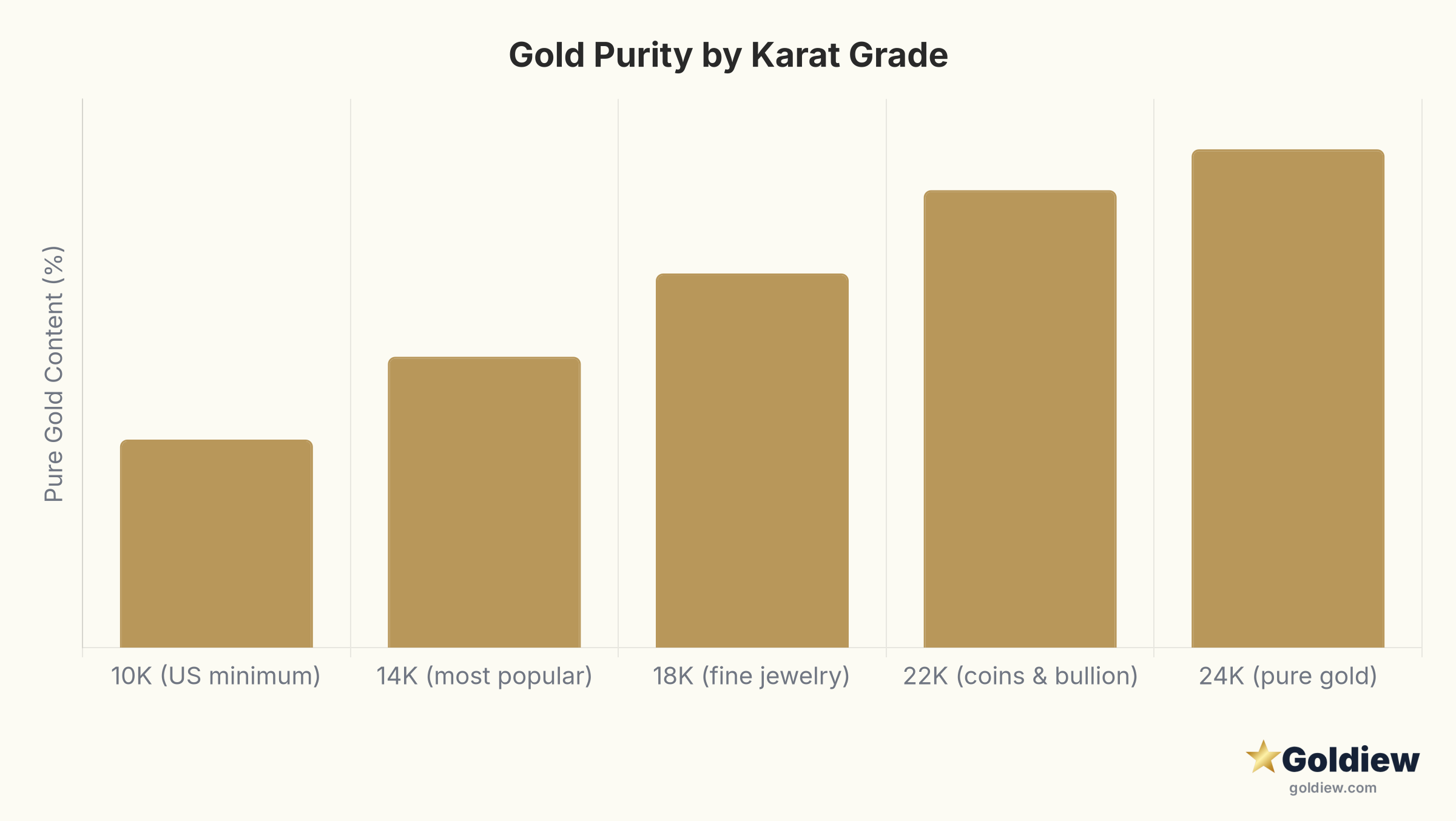
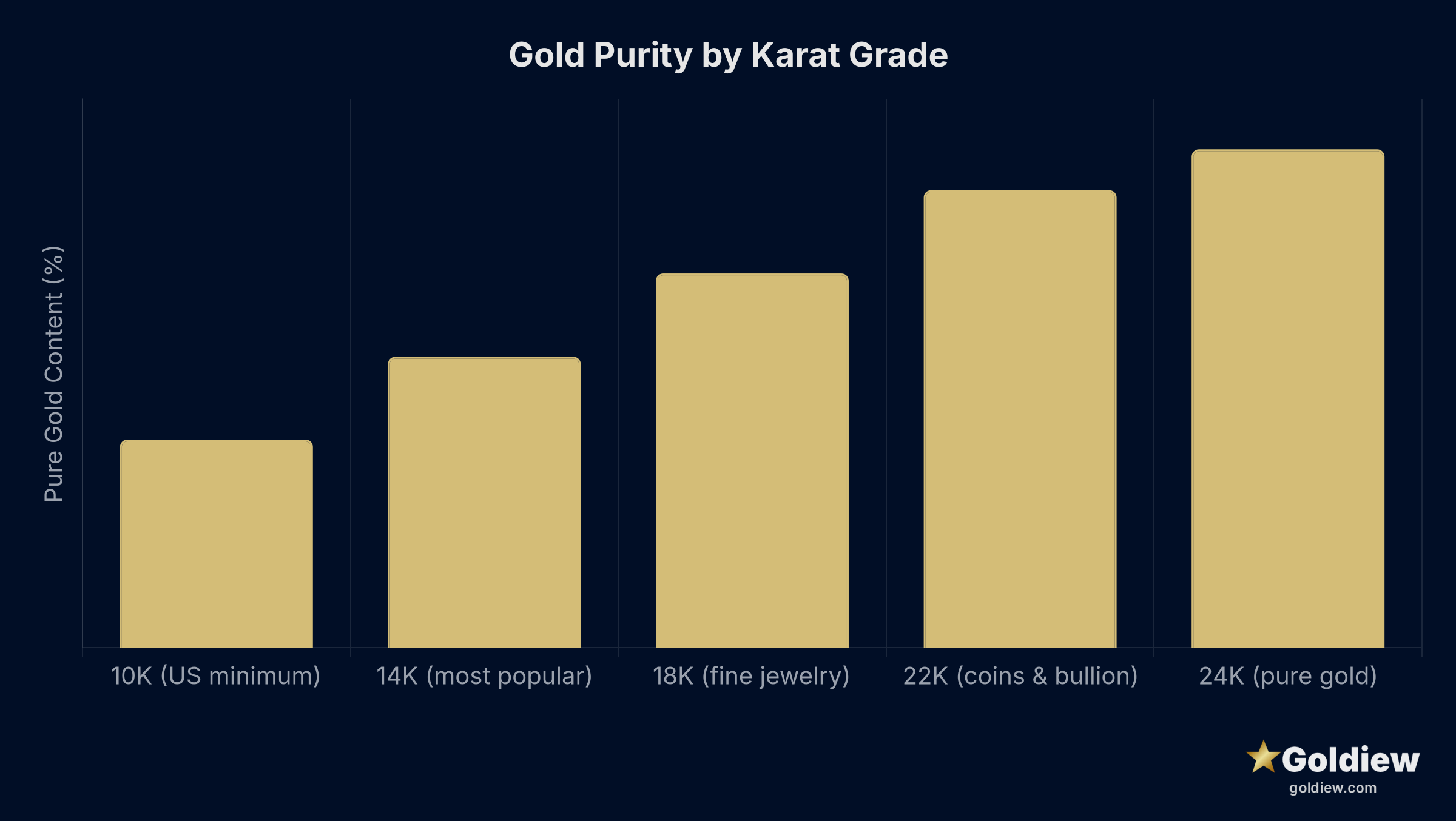
The chart below shows how purity jumps between the five most common karat grades sold in the US market. Note how the gap between 10K and 14K is larger than the gap between 18K and 22K, even though both represent a four-karat step.
The US legal minimum: 10K
The Federal Trade Commission’s Jewelry Guides (16 CFR Part 23) establish that an item can only be described as “gold” or labeled with a karat mark if it contains at least 10 karats fine gold. This rule applies to items manufactured or sold in the United States. Items below 10K (such as 9K, which is common in the UK and Australia) cannot legally be sold as gold in the US market, though they may be sold as gold-colored metal or by their alloy composition.
The FTC also requires that any karat marking be accurate within a tolerance of plus or minus 0.5 karat. A stamp reading “14K” must represent between 13.5K and 14.5K gold content (56.25% to 60.4%).
Millesimal fineness and European hallmarks
If you find a three-digit number stamped on a piece of jewelry with no “K” next to it, that is the millesimal fineness: the gold content expressed as parts per thousand rather than parts per 24. The conversions are straightforward.
European and Asian pieces often carry the millesimal stamp instead of (or alongside) the karat mark. The UK uses 9K, 18K, and 22K most commonly; the fineness mark on British pieces is typically accompanied by an assay office symbol (a lion passant for gold in England, a thistle for Scotland, etc.) indicating independent third-party testing. Italian jewelry commonly shows 750 for 18K. Indian wedding gold is often 22K, marked as 916. What each assay office symbol means alongside a karat mark is covered step by step in the jewelry hallmarks identification guide.
When you see a stamp like “750” on a ring from Italy or “916” on a bracelet from India, you can treat those equivalently to 18K and 22K American-stamped pieces in terms of gold content. The method of verification is still the same: a stamp is a claim, not a guarantee.
Karat vs. carat: why the spelling matters
In the United States, “karat” (abbreviated K or KT) refers exclusively to gold purity. “Carat” (abbreviated ct or cts) is a unit of weight used for gemstones. One carat equals exactly 200 milligrams (0.2 grams), as defined by the International Organization of Legal Metrology.
A ring described as “a 14K gold ring with a 0.75 ct diamond” contains 14-karat gold (58.3% purity) set with a diamond weighing 150 milligrams. The two numbers measure completely different things. British English uses “carat” for both meanings, which is the source of much confusion when reading descriptions of jewelry from the UK or Australia. In those contexts, you usually need the surrounding text (or the unit: carats-of-gold vs. carats-of-gemstone) to determine which meaning applies.
For anyone buying, selling, or inheriting jewelry in the US, the safe rule is simple: K or KT next to a number refers to gold purity, always.
Why pure gold is almost never used in jewelry
Pure 24K gold is genuinely beautiful but almost unusable for everyday jewelry. It rates approximately 2.5 on the Mohs hardness scale, placing it below a fingernail (rated roughly 2.5) and far below a copper penny (3.0). A 24K gold ring worn daily would develop scratches within weeks, bend out of round, and eventually deform to the point of being unwearable.
Alloying gold with harder metals solves this problem. The tradeoff is reduced gold content (and thus lower melt value per gram) in exchange for practical wearability. Different alloy combinations also produce different colors, which jewelers use intentionally.
The most common alloying metals and their roles:
- Copper adds hardness and imparts a warm reddish tone. Higher copper content produces rose gold.
- Silver adds hardness with minimal color change. Combined with copper in standard yellow gold alloys.
- Zinc used in smaller quantities to improve casting flow and add additional hardness.
- Nickel or palladium bleaches the gold to produce white gold. Nickel is cheaper but causes allergic reactions in roughly 10-15% of people; palladium is hypoallergenic and increasingly standard in quality white gold.
- Platinum used in premium white gold alloys; adds density and exceptional durability.
The alloy recipe is proprietary to each manufacturer, which is why two rings both stamped 14K may look slightly different in color or feel different in hardness. Both meet the karat standard, but the mix of the remaining 41.7% differs between makers.
Gold alloy colors at a glance
The color does not affect the karat grade or the gold content. A 14K rose gold ring and a 14K yellow gold ring both contain 58.3% pure gold; they differ only in what metals make up the other 41.7%.
Calculating the melt value of your gold
Melt value is the worth of the pure gold content in a piece, based solely on the current spot price of gold. It does not include craftsmanship, gemstone value, collector premium, or any markup above raw metal value. Cash buyers at pawn shops and gold dealers typically offer 70-90% of melt value. Refiners may offer closer to 95-98% for large quantities of scrap gold.
The formula requires three inputs: spot price per troy ounce, the item’s weight in grams, and the karat grade.
Melt Value = Spot Price ($/troy oz) x Weight (grams) x 0.0321507 x (Karat / 24)The constant 0.0321507 converts grams to troy ounces (there are 31.1035 grams per troy ounce).
Worked example (illustrative; spot price and weight are for demonstration only): assume a 14K yellow gold ring weighing 5.2 grams, and an illustrative spot price of $3,200 per troy ounce (verify the current price at a live spot feed before doing your own calculation).
- Convert grams to troy ounces: 5.2 x 0.0321507 = 0.1672 troy oz total weight
- Isolate the pure gold portion: 0.1672 x (14 / 24) = 0.0976 troy oz of pure gold
- Apply the spot price: 0.0976 x $3,200 = $312 melt value (illustrative)
That $312 figure is the theoretical maximum a refiner would pay for the pure gold in that ring before any refining cost. A dealer buying scrap may offer $220-$280 on this example piece. A retail buyback from a jewelry chain might be lower still. Our gold value calculator lets you enter your own weight, karat, and today’s live spot price to get an instant estimate.
For silver items, including silver jewelry or coins, the same logic applies with silver’s spot price. Use our silver value calculator for those calculations.
When stamps lie: testing and verification
A karat stamp is a manufacturer’s self-certification, not an independent assay. The FTC Jewelry Guides require accuracy, but enforcement is limited, particularly for imported goods. Counterfeit stamps, gold-plated base metal passing as 14K, and gold-filled items marked as solid gold all appear in the market regularly. The BBB and the FTC have both documented consumer complaints involving misrepresented karat marks on jewelry purchased online and from informal sellers. Recognizing counterfeit marks requires knowing what legitimate ones look like first; the gold and silver hallmarks and stamps decoder covers both.
The only way to confirm actual gold content is through physical testing:
- Acid test: A drop of nitric acid on a scratch from the piece produces no visible reaction on real gold but turns green on base metal. A stronger acid test (aqua regia) distinguishes 10K from 18K. Inexpensive acid test kits are available at coin and jewelry supply stores and are the most common method used by pawn shops. The test is mildly destructive (leaves a small scratch) but accurate.
- XRF (X-ray fluorescence) analysis: A handheld XRF analyzer can read gold purity non-destructively in seconds. Professional pawn shops and gold dealers increasingly use these devices. Results are accurate to within 0.5-1.0% purity. If you have a valuable or unusual piece, ask the buyer to show you the XRF reading.
- Specific gravity test: Pure gold has a specific gravity of 19.3; pure silver is 10.49. An alloy’s measured specific gravity can narrow down its likely composition. The test requires a scale with a water immersion kit and some arithmetic, but produces no chemical or physical damage to the piece.
- Professional assay: A certified assay lab will chemically analyze a sample of the metal and return a precise purity report. Cost typically ranges from $25-$75 per item. This is the method to use for large lots of estate jewelry, high-value pieces, or any situation where the stamp is suspicious and the dollar amount justifies certainty.
Gold-filled and gold-plated items deserve special attention. Gold-filled items (sometimes stamped “GF”, “1/20 14K GF”, or “14K GF”) have a layer of 14K gold mechanically bonded to a base metal core. Gold-plated items are electrochemically coated with a thin layer of gold, typically less than 0.5 microns thick. Neither is solid gold, though both can carry karat marks referring to the gold layer, not the overall item. Our guide on gold-filled vs. gold-plated vs. solid gold explains how to read these markings in detail.
Selling gold jewelry or inherited pieces?
If you are decoding karat stamps to price a piece for sale, Goldiew’s free gold selling platform connects you with up to 15 verified precious metals buyers who submit sealed competitive offers. You post one request, buyers respond with bids, and you choose whether to accept. No obligation, no pressure, and no cost to you. Browse submitted offers or post your own at the link above before accepting the first price a local buyer quotes.
To see what each purity is worth today, open the per-gram price for 10K, 14K, 18K, 22K and 24K.
Frequently asked questions about gold karats
What does 14K mean on gold jewelry?
A 14K stamp means the item contains 14 parts pure gold out of 24 total parts, which equals 58.3% gold content by weight. The remaining 41.7% is an alloy of other metals, typically a combination of copper, silver, and zinc in yellow gold, or palladium and nickel in white gold. The stamp may also appear as “14KT” or “585” (the millesimal fineness equivalent). It is the most common karat sold for fine jewelry in the United States because it balances reasonable gold content with practical durability.
Is 10K real gold?
Yes. 10K gold is legally real gold in the United States under the Federal Trade Commission’s Jewelry Guides (16 CFR Part 23), which set 10K as the minimum karat that can be described or sold as gold. A 10K piece contains 41.7% pure gold. It is harder and more scratch-resistant than higher-karat gold because of the larger alloy proportion, but it has a noticeably lower melt value per gram and may cause reactions in people with certain metal sensitivities. Some countries, including the UK, recognize a lower 9K minimum, but 9K pieces cannot be marketed as gold in the US.
What is the difference between karat and carat?
In the United States, karat (K or KT) measures gold purity on a scale of 1 to 24. Carat (ct) is a unit of mass used for gemstones; one carat equals exactly 200 milligrams (0.2 grams). A ring described as “14K with a 1.0 ct diamond” has 58.3% gold content and a diamond weighing 0.2 grams. The two units are completely unrelated despite sounding similar. British English uses “carat” for both meanings, which creates confusion when reading jewelry descriptions from the UK or Australia.
What does 750 mean stamped on gold?
A stamp of 750 is the millesimal fineness for 18K gold, indicating the piece contains 750 parts pure gold per 1,000 parts total (75.0% gold content). This stamp is the European and international equivalent of 18K and is especially common on jewelry from Italy, France, and Switzerland, as well as on Swiss watch cases and clasps. Treat a 750-stamped piece the same as an 18K-stamped piece when calculating melt value or assessing purity.
How do I calculate the value of my gold at home?
You need three things: the current gold spot price (available on financial sites or commodity exchanges), the item’s weight in grams (a digital jewelry scale accurate to 0.01 grams costs about $15-$30), and the karat stamp. Multiply the weight in grams by 0.0321507 to get troy ounces, then multiply by (karat / 24) to get the pure gold weight, then multiply by the spot price. The result is the melt value. Our gold value calculator performs this calculation automatically once you enter the three inputs.
Is 18K or 14K better for everyday jewelry?
It depends on priority. 18K gold has higher gold content (75% vs. 58.3%), which gives it a richer color and higher intrinsic value per gram. However, it is softer than 14K and shows wear more quickly with daily use, particularly in prong settings and thin bands. 14K is harder, more durable, and less expensive for a given size piece. Most American jewelers recommend 14K for rings worn daily (especially engagement rings and wedding bands) and 18K for pieces worn occasionally or where color richness matters most. For investment purposes, the melt value difference is directly proportional to the karat difference.
Can gold jewelry be used in a gold IRA retirement account?
No. The Internal Revenue Service sets strict purity requirements for precious metals held in a self-directed IRA. Under IRC Section 408(m)(3), gold must be at least 99.5% pure (equivalent to 23.88K) to qualify, with limited exceptions for certain government-issued coins. Standard jewelry (10K, 14K, 18K, or even 22K) does not meet this threshold and cannot be contributed to or held in a tax-advantaged IRA. Only purpose-made investment-grade bullion coins and bars meeting the IRS fineness standard are eligible.
Why does my gold look the same color regardless of karat?
The color of yellow gold changes subtly but not dramatically across karat grades. 24K gold has the deepest, most saturated yellow tone. 18K yellow gold is noticeably warm and rich. 14K and 10K yellow gold are slightly paler because the higher silver and copper proportion mutes the gold color. The difference is visible when pieces are placed side by side under good lighting, but harder to spot on an individual piece. White gold and rose gold look similar across karat grades because their color is determined primarily by the alloy metals (nickel or palladium for white, copper for rose) rather than the gold fraction.
Sources
- Federal Trade Commission. Guides for the Jewelry, Precious Metals, and Pewter Industries, 16 CFR Part 23. ecfr.gov
- World Gold Council. Gold Jewellery Alloys. gold.org
- Internal Revenue Service. Publication 590-B: Distributions from Individual Retirement Arrangements. irs.gov
- Internal Revenue Code Section 408(m)(3). Collectibles in Individual Retirement Accounts. uscode.house.gov
- International Organization of Legal Metrology. The International Carat (OIML R 37). oiml.org
- Better Business Bureau. Jewelry Scam Alerts. bbb.org