
Quick answer
Bitcoin ETFs are simpler and cheaper at smaller account sizes; physical gold is the only option that lets you take delivery
Since January 2024, spot bitcoin ETFs trade inside any conventional brokerage IRA, no self-directed account required. Physical gold still requires an SDIRA and an IRS-approved depository. The fee math favors bitcoin ETFs below roughly $110,000 in account value and flips toward physical gold above that threshold, where flat custodian and storage fees outperform percentage-based expense ratios. Only physical gold can be taken as an in-kind distribution. That single feature, tangibility on exit, is where most of the structural argument for physical gold lives. Past performance is not a guarantee of future results. This page covers neither asset’s price prospects: only how each works inside a retirement account and what it costs to hold it there.
What changed in January 2024 and why it reshaped this comparison
Before January 2024, getting bitcoin exposure inside a retirement account meant opening a self-directed IRA, finding a custodian willing to hold direct cryptocurrency, and dealing with the operational complexity and cost that comes with that structure. Grayscale’s Bitcoin Trust (GBTC) had been available as a publicly traded product, but it carried a 1.50% annual fee and, before its conversion, did not directly track the spot price with the precision an ETF structure provides.
On January 10, 2024, the U.S. Securities and Exchange Commission approved 11 spot bitcoin exchange-traded products simultaneously. Starting the following day, funds from BlackRock (IBIT), Fidelity (FBTC), Bitwise (BITB), VanEck (HODL), and several others began trading on U.S. exchanges. The structural significance is this: these are registered ETFs under the Investment Company Act of 1940, which means they can be purchased inside any standard brokerage IRA without requiring a self-directed account or a specialized custodian. Anyone with a Fidelity, Schwab, or TD Ameritrade IRA can buy bitcoin ETF shares the same way they buy shares of a stock or a bond fund.
Physical gold has no equivalent shortcut. You can hold gold-backed ETFs (GLD, IAU) in a conventional brokerage IRA, and those are legitimate options for portfolio exposure. But holding actual physical gold bars or coins inside an IRA requires the IRS-mandated self-directed structure: a qualified trustee or custodian that specializes in self-directed accounts, plus physical storage at an IRS-approved depository. The custodian holds legal title; the depository holds the physical metal. Neither the account owner nor their family member can personally store IRA-owned gold at home, a rule reinforced by the Tax Court ruling in Andrew McNulty et al. v. Commissioner (T.C. Memo. 2021-122).
This page focuses on that structural divide: a conventional-brokerage spot bitcoin ETF versus an SDIRA holding physical gold. If you are already considering GLD or IAU as paper gold alternatives inside a standard IRA, note that their expense ratios (GLD: 0.40%; IAU: 0.25% as verified on Yahoo Finance, July 2026) put them in a similar cost category to bitcoin ETFs, without the physical delivery option.
The fee math no one shows you
Cost comparison between these two structures is almost always presented incompletely. Bitcoin ETFs quote expense ratios (a percentage of assets charged annually). Gold IRA fees are typically quoted as a fixed dollar amount per year. Comparing them requires picking an account size and doing the math at that size, which few articles bother to do. Here is what the numbers actually show.
Spot bitcoin ETF expense ratios
| Fund (ticker) | Expense ratio | Annual cost on $100,000 | Bitcoin custodian |
|---|---|---|---|
| Bitwise Bitcoin ETF (BITB) | 0.20% | $200 | Coinbase Custody |
| VanEck Bitcoin ETF (HODL) | 0.20% | $200 | Gemini Custody |
| iShares Bitcoin Trust (IBIT) | 0.25% | $250 | Coinbase Custody |
| Fidelity Wise Origin Bitcoin Fund (FBTC) | 0.25% | $250 | Fidelity Digital Assets |
| Grayscale Bitcoin Trust ETF (GBTC) | 1.50% | $1,500 | Coinbase Custody |
Expense ratios verified via Yahoo Finance, July 2026. Highlighted rows are the two largest by assets under management. Expense ratios are subject to change; verify current rates in each fund’s prospectus before investing. GBTC was converted from a closed-end trust in January 2024 and retains its legacy 1.50% fee structure.
Physical gold IRA: all-in annual cost breakdown
A physical gold IRA typically carries three cost layers:
- One-time setup fee: $50 to $100, charged when you open the self-directed IRA account. Amortized over five years, this adds roughly $10 to $20 per year to your all-in cost.
- Annual custodian fee: $75 to $175 per year for most self-directed IRA custodians that specialize in precious metals. Some custodians charge flat fees regardless of account size; others scale the fee modestly with balance.
- Annual storage fee: $100 to $175 per year for allocated (segregated) storage at an IRS-approved depository. Segregated storage means your specific coins or bars are assigned to your account by serial number or lot, rather than commingled with other clients’ metals. Segregated storage costs more than commingled, but provides cleaner asset identification.
Total all-in annual cost (excluding the amortized setup fee): roughly $175 to $350 per year for most providers, with $250 to $275 as a representative midpoint for a low-to-mid-cost combination. Some custodians bundle custodial and storage fees into a single flat amount; verify the full schedule in writing before opening an account.
Where the two costs cross over
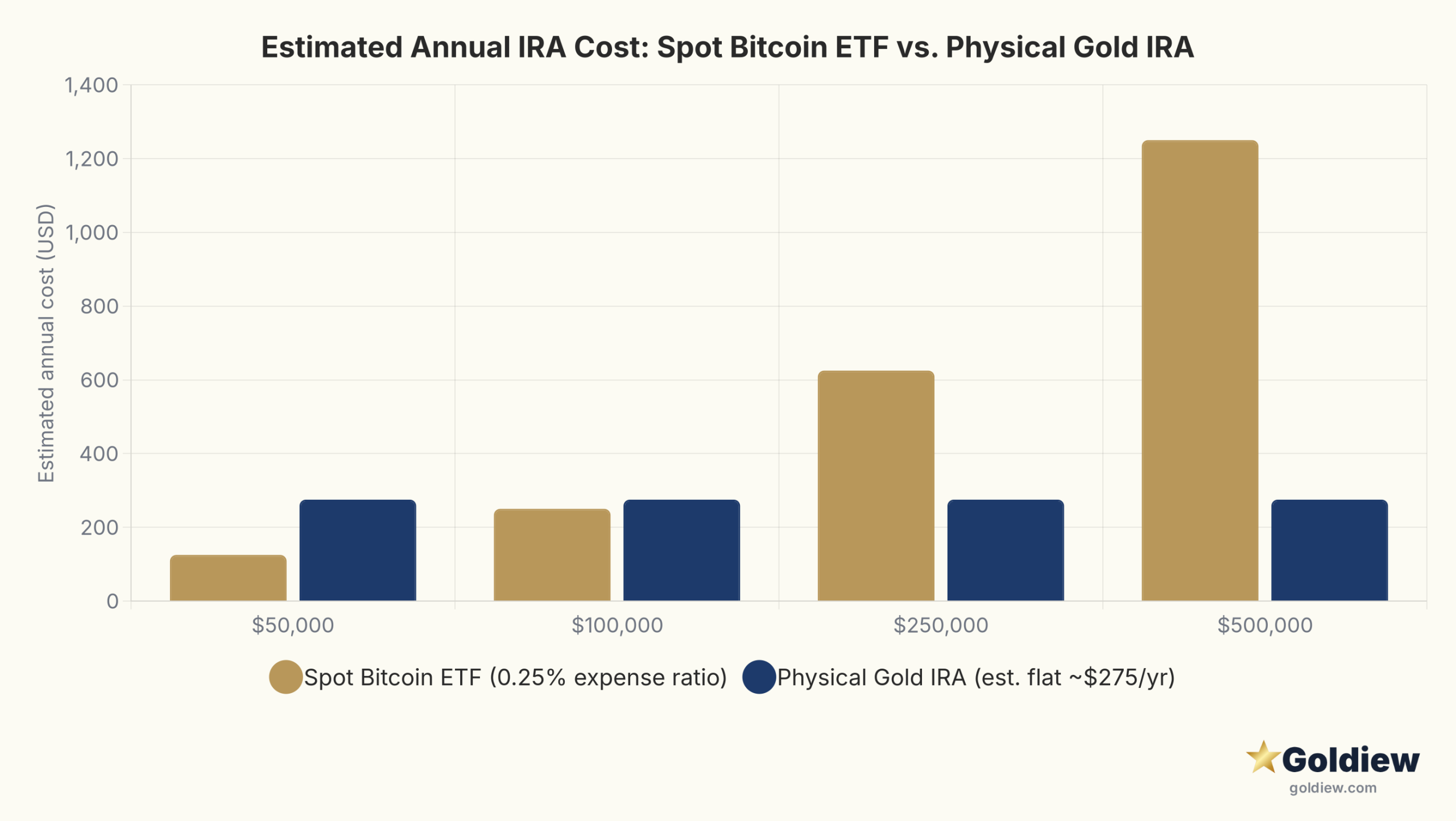
One practical caveat: the cheapest bitcoin ETF by expense ratio (BITB and HODL at 0.20%) pushes the crossover point to roughly $138,000 rather than $110,000. And GBTC at 1.50% flips the equation entirely: on a $50,000 account, GBTC costs $750 per year, nearly three times what a flat-fee gold IRA would cost at the same balance. This is why fund selection inside the bitcoin ETF category matters as much as the asset class comparison itself.
For a deeper breakdown of gold IRA fees across specific custodians, see our gold IRA fees and taxes guide.
Custody models: how each asset is actually held
This is the section most comparison articles skip. Both a spot bitcoin ETF and a physical gold IRA require secure custody of the underlying asset. The mechanisms differ substantially, and those differences have real implications for risk concentration and investor access.
Bitcoin ETF custody
When you buy shares of IBIT, you own a fractional interest in a Delaware statutory trust. The trust holds actual bitcoin, not a derivative or a futures contract. That bitcoin is custodied at Coinbase Custody Trust Company, a New York State-chartered limited purpose trust company regulated by the New York Department of Financial Services (NYDFS). Coinbase Custody uses a combination of multi-party computation (MPC) and air-gapped cold storage to secure the underlying bitcoin. Fidelity’s FBTC uses Fidelity Digital Assets, Fidelity’s own institutional custody subsidiary, as its bitcoin custodian, making it the only major spot ETF where the asset manager and bitcoin custodian are the same corporate family.
Three points matter for retirement investors:
- Custody concentration risk. Coinbase Custody holds the bitcoin for IBIT, BITB, and GBTC, among others. If Coinbase Custody experienced an operational failure, multiple ETFs would be affected simultaneously. FBTC’s in-house structure and HODL’s use of Gemini Custody provide some diversification across custodians, though investors hold shares of a single fund, not a direct claim on specific bitcoin units.
- No personal access to bitcoin. ETF investors cannot withdraw bitcoin, move it to a personal wallet, or take delivery in any form. Distributions are always in cash. For investors whose interest in bitcoin includes self-custody and censorship resistance, an ETF does not satisfy those goals.
- SEC oversight. As registered investment products, spot bitcoin ETFs are subject to ongoing SEC examination and prospectus disclosure requirements. Custodians are independently audited. This regulatory layer provides investor protections that direct bitcoin self-custody does not.
Physical gold IRA custody
Physical gold held in an IRA requires a two-layer custody structure. The self-directed IRA custodian (a bank, trust company, or other IRS-approved entity) holds legal title to the IRA assets. The depository holds the actual physical metal and issues storage receipts that the custodian records on your behalf. The depository must meet IRS standards under IRC Section 408(m)(3); most operate to COMEX or LBMA good delivery standards for vault security and insurance.
Allocated (segregated) storage assigns specific bars or coins to your account by serial number. If the depository ever had to return metal to account holders, you would receive your exact pieces back. Commingled storage pools your metal with other clients’ holdings and returns equivalent metal, not your original pieces. For IRA purposes both are legally permissible, but allocated is generally the more verifiable option for investors who value provable ownership.
The structural difference that sets physical gold IRAs apart: you can request an in-kind distribution at any time. Instead of selling the gold and receiving cash, you can take delivery of the actual gold bars or coins. The distribution is still taxable income in the year received (in a traditional IRA), but you own the physical metal rather than a cash equivalent. No bitcoin ETF offers this. An ETF share is a security; your distribution is cash.
For a complete comparison of IRS-approved depositories and their custodian arrangements, see our IRS-approved gold IRA depository comparison. For the SDIRA custodian landscape, our SDIRA custodian comparison covers every custodian currently accepting precious metals accounts.
Volatility and drawdown: what the historical record shows
Both assets carry meaningful downside risk. They just carry it differently.
Bitcoin’s drawdown profile
Bitcoin has experienced three bear markets with peak-to-trough declines exceeding 75% since 2017. In 2018, it fell from around $19,800 to around $3,200, a decline of approximately 84%. In 2020, it dropped roughly 60% in a week during the March liquidity event. In 2022, it fell from around $68,000 (late 2021 peak) to under $16,000 by November 2022, a decline of approximately 77%. These are measured from closing prices using public market data available from exchanges and financial data providers.
Spot bitcoin ETF holders experience the full daily volatility of bitcoin’s price. A standard measure used in markets is 30-day realized volatility; for bitcoin, this figure has historically ranged from roughly 40% to 120% annualized depending on the period. For comparison, the S&P 500’s annualized volatility typically runs 10% to 25%.
Gold’s drawdown profile
Gold’s largest modern bear market ran from the September 2011 peak of around $1,900 per troy ounce to the December 2015 trough near $1,050, a decline of approximately 45% over four years. The 2008 financial crisis saw gold sell off roughly 30% in the first months of the crisis before recovering. In 2022, when the Federal Reserve raised rates aggressively, gold fell modestly by roughly 3% over the year, substantially less than the equity markets. Gold’s annualized volatility typically runs 10% to 18%, closer to equity market norms but still meaningful for retirement accounts.
What this means for a retirement time horizon
A 10-to-20-year retirement time horizon changes the calculation. Both assets have recovered from their bear markets in historical data, but the sequence matters: a 77% drawdown in the first two years of retirement, combined with Required Minimum Distributions that force selling into a decline, can permanently impair an account’s purchasing power. Sequence-of-returns risk is specific to each investor’s withdrawal schedule and account structure. A financial advisor can help you model the impact.
Neither asset is a “safe” component of a retirement portfolio in the sense of capital preservation on a one-to-three-year horizon. They are held for different reasons by different investors: bitcoin for asymmetric growth potential and hard-cap supply characteristics; gold for its historical behavior as a non-correlated store of value over multi-decade periods. Whether either belongs in a retirement account depends on your specific situation, time horizon, and what the rest of your portfolio looks like. This is financial advice territory; consult a licensed advisor.
Tax treatment inside an IRA: mostly the same rules
The IRA wrapper equalizes most of the tax treatment between these two assets. Both benefit from the same core IRA mechanics.
Traditional IRA
Contributions may be tax-deductible (subject to income limits per IRS Publication 590-A). Growth is tax-deferred: no capital gains taxes are owed annually, regardless of how many times the ETF is bought and sold or how much the gold’s value changes. Withdrawals are taxed as ordinary income in the year received.
Roth IRA
Contributions are made with after-tax dollars. Growth and qualified withdrawals are tax-free. Both a spot bitcoin ETF and physical gold benefit equally from this structure.
Required Minimum Distributions
Both a conventional brokerage IRA holding a bitcoin ETF and a self-directed gold IRA are subject to Required Minimum Distributions beginning at age 73 under the SECURE 2.0 Act (Public Law 117-328, signed into law December 29, 2022). The RMD calculation uses the prior year-end account balance and the IRS Uniform Lifetime Table from Publication 590-B. Failing to take an RMD triggers a 25% excise tax on the shortfall (reduced to 10% if corrected within the correction window).
The in-kind distribution difference
This is where the two accounts diverge most practically. For a gold IRA, you can satisfy an RMD or any distribution by taking physical delivery of the actual gold. The fair market value of the gold on the distribution date counts as the distribution amount and is reported on Form 1099-R as ordinary income for a traditional IRA. You end up with the gold in hand, paying income tax on its value.
A bitcoin ETF cannot be distributed in kind as bitcoin. The ETF is a security. Your distribution is cash proceeds from selling shares. Some investors specifically structure physical gold IRAs for the eventual in-kind distribution option, intending to move the gold into personal storage after retirement while managing the tax consequences. No similar path exists with an ETF.
Contribution limits
For 2026, IRA contributions across all your traditional and Roth IRA accounts combined cannot exceed $7,500 ($8,600 if you are age 50 or older), or your taxable compensation for the year if less, per the IRS contribution limits page. This applies to new contributions only; rollovers from 401k, 403(b), or other employer-sponsored plans into either account type are not subject to annual contribution limits.
Who fits which structure
Bitcoin ETF in a brokerage IRA fits investors who:
- Hold accounts below roughly $110,000 in this allocation, where ETF expense ratios are lower than flat gold IRA fees
- Want exposure to bitcoin’s price without opening a specialized self-directed account
- Prefer the operational simplicity of a standard brokerage (Fidelity, Schwab) where everything is in one place
- Are comfortable with bitcoin’s volatility profile across the investment period
- Do not need or want physical delivery on exit
- Want the liquidity of being able to sell ETF shares at any point during market hours
Physical gold IRA fits investors who:
- Hold accounts of roughly $110,000 or more in this allocation, where flat fees become proportionally cheaper than ETF expense ratios
- Want the option to take physical delivery of the metal as a distribution at any point
- Prefer the custody model of IRS-approved depositories with COMEX/LBMA-standard allocated storage
- Understand and accept the administrative requirements of an SDIRA (annual filings, custodian relationships, depository statements)
- Are willing to pay a one-time setup fee and maintain the account long enough for the flat-fee advantage to compound
Some investors hold both simultaneously, which is structurally straightforward: a conventional brokerage IRA at Fidelity or Schwab for the bitcoin ETF allocation, and a separate self-directed IRA at a precious metals custodian for the physical gold allocation. Annual IRA contribution limits apply across both accounts combined, but existing retirement funds rolled over from employer plans can be split across both without restriction. The administrative complexity is higher with two accounts, but there is no IRS rule preventing it.
For investors who specifically want to compare the self-directed custodian options available for physical gold alongside each other, our broader gold IRA vs. cryptocurrency comparison covers the direct crypto SDIRA route alongside other alternatives.
Common questions
Do I need a special IRA to hold a spot bitcoin ETF?
No. Spot bitcoin ETFs like IBIT and FBTC trade on regulated stock exchanges and can be purchased through any standard brokerage IRA, including those held at Fidelity, Schwab, or TD Ameritrade. No self-directed IRA or specialized custodian is required. This is one of the main practical differences from holding physical gold, which does require an IRS-compliant self-directed IRA and a separate approved depository.
Can I take physical delivery of bitcoin from a bitcoin ETF in my IRA?
No. A spot bitcoin ETF is a publicly traded fund. When you take a distribution, you receive cash (or shares you then sell for cash), not bitcoin. The fund itself holds bitcoin in institutional cold storage, but individual investors do not have a claim to specific bitcoin units. By contrast, a physical gold IRA allows you to request an in-kind distribution of your actual gold coins or bars at any time, though the distribution is treated as taxable income in the year received for a traditional IRA.
What happens to my bitcoin ETF if the ETF sponsor goes out of business?
The bitcoin held by the fund is custodied separately from the sponsor’s corporate assets. For IBIT, the bitcoin is held by Coinbase Custody Trust Company, an independent qualified custodian regulated by the New York Department of Financial Services. ETF trust structures are designed to ring-fence the underlying assets from sponsor insolvency. That said, there is operational concentration risk if multiple ETFs use the same custodian. Review each fund’s prospectus for the specific trust structure and custodian arrangements before investing.
At what account size does a physical gold IRA become cheaper than a bitcoin ETF?
For most custodian and storage fee combinations, a physical gold IRA’s flat annual fees become lower than a 0.25% bitcoin ETF expense ratio at roughly $110,000 in account value. Below that range, the ETF’s proportional fee is lower. Above it, the gold IRA’s flat fee structure is more cost-efficient. At $250,000, a flat-fee gold IRA at $275 per year costs 0.11% annually compared to 0.25% for an ETF. Actual crossover depends on the specific custodian and storage fees you negotiate.
Are bitcoin ETF gains taxed differently than gold IRA gains?
Inside an IRA, neither triggers annual capital gains taxes. Both grow tax-deferred in a traditional IRA, or tax-free in a Roth IRA, under the same IRS rules that apply to any IRA investment. Outside an IRA, the underlying asset’s classification matters: bitcoin is taxed as property per IRS Notice 2014-21, while gold is taxed as a collectible at up to 28% capital gains. Inside the IRA wrapper, those differences are irrelevant. Required Minimum Distributions beginning at age 73 apply to both account types equally. Consult your tax advisor for specifics on your situation.
Can I hold both a bitcoin ETF and a physical gold IRA at the same time?
Yes. There is no IRS rule preventing you from holding a spot bitcoin ETF in a conventional brokerage IRA and simultaneously holding physical gold in a self-directed IRA. Annual contribution limits apply per person across all IRAs combined ($7,500 for 2026, or $8,600 if you are 50 or older, per IRS Publication 590-A). Existing retirement savings rolled over from employer plans are not subject to the annual contribution limits and can fund either account type without restriction.
What is the minimum investment required to open each account type?
Spot bitcoin ETFs have no minimum investment beyond the price of a single share, and some offer fractional shares. Physical gold IRA minimums vary by custodian: typically $5,000 to $25,000, with higher minimums common at providers that include dedicated account support. The minimum is separate from cost-efficiency: the flat-fee structure that benefits larger gold IRA accounts can make smaller accounts proportionally expensive on an annual fee basis.
Does the IRS classify spot bitcoin ETFs as collectibles inside an IRA?
The IRS has not issued explicit guidance classifying spot bitcoin ETF shares as collectibles for IRA purposes. ETF shares are securities, not the physical asset, and the current consensus among tax professionals is that holding a spot bitcoin ETF in an IRA is treated the same as holding any other publicly traded ETF. For physical gold, the collectibles carve-out under IRC Section 408(m)(3) permits IRA ownership when specific IRS fineness thresholds are met and the metal is held by an approved custodian and depository. Consult a tax attorney or CPA for guidance specific to your situation.
Sources
- U.S. Securities and Exchange Commission, Press Release 2024-6, January 10, 2024 (approval of 11 spot bitcoin exchange-traded products). sec.gov
- IRS Publication 590-A, Contributions to Individual Retirement Arrangements (IRAs). irs.gov/publications/p590a
- IRS Publication 590-B, Distributions from Individual Retirement Arrangements (IRAs), including RMD tables and distribution rules. irs.gov/publications/p590b
- Internal Revenue Code Section 408(m)(3), the collectibles carve-out permitting IRS-approved gold and silver in self-directed IRAs. law.cornell.edu
- IRS Notice 2014-21, virtual currency treated as property for federal tax purposes. irs.gov
- SECURE 2.0 Act of 2022 (Public Law 117-328), raising the RMD starting age from 72 to 73. congress.gov
- Andrew McNulty et al. v. Commissioner, T.C. Memo. 2021-122 (Tax Court ruling on home storage of IRA-owned gold as a prohibited transaction). ustaxcourt.gov
- IRS Retirement Topics: IRA Contribution Limits (2026 limits: $7,500 / $8,600 for 50+). irs.gov
- iShares Bitcoin Trust ETF (IBIT) expense ratio: 0.25%. Yahoo Finance fund data, accessed July 2026.
- Fidelity Wise Origin Bitcoin Fund (FBTC) expense ratio: 0.25%. Yahoo Finance fund data, accessed July 2026.
- Bitwise Bitcoin ETF (BITB) expense ratio: 0.20%. Yahoo Finance fund data, accessed July 2026.
- Grayscale Bitcoin Trust ETF (GBTC) expense ratio: 1.50%. Yahoo Finance fund data, accessed July 2026.
- iShares Gold Trust (IAU) expense ratio: 0.25%. Yahoo Finance fund data, accessed July 2026.
- New York Department of Financial Services, Coinbase Custody Trust Company charter and regulatory status.