
A physical gold IRA and a gold ETF held inside a standard IRA both give you exposure to the price of gold within a tax-advantaged account. The difference shows up in fees. This guide computes the total 10-year cost at three account sizes: $25,000, $100,000, and $500,000. The model holds gold price flat so you can see the structural cost drag without layering in return assumptions. The math is honest, including about the sizes where a physical gold IRA does not come out ahead.
How the 10-Year Cost Stacks Up
Under illustrative flat-fee custodian assumptions, a $25,000 physical gold IRA carries roughly 15% in total 10-year cost drag; a $100,000 account about 7.5%; a $500,000 account about 5.4%. A gold ETF (iShares IAU) at 0.25%/yr costs roughly 2.5% at any account size over the same period. The physical gold IRA premium ranges from 3 to 13 percentage points depending on account size. The math does not favor physical IRAs at small balances. At large balances with a flat-fee custodian the gap narrows, but does not close.
Get the worksheet: 22 fee questions to get in writing
Print one page. Take it to every call with a gold IRA provider, and get every answer in writing.
- Year-one fee stack (setup, custodian, storage, transaction, distribution)
- Spread per product on a 1 oz American Gold Eagle
- Promotional terms, and the fee schedule after the promo ends
- Named custodian, named depository, insurance coverage per client
- Buyback spread and days from request to cash in your bank
Free. One email, double opt-in, no follow-up marketing. Educational document only, not tax or investment advice. By submitting, you agree to receive one email with the worksheet. See our privacy policy.
The Five Fee Buckets in a Physical Gold IRA
Every cost a physical gold IRA owner pays falls into one of five categories. Understanding each bucket is necessary before the breakeven math makes sense.
1. Account setup fee
A one-time charge when the account is established. Published custodian fee schedules show a range from roughly $50 to $150. This analysis uses an illustrative figure of $80. Paid once at opening, it does not recur. Noble Gold fees 2026 breaks down every charge from account opening through year five of ownership.
2. Annual custodian administration fee
The self-directed IRA custodian holds your account record, issues IRS Form 5498 annually, processes contributions and distributions, and provides account statements. Custodians charge either a flat dollar fee or a percentage of account value (scaled). Published flat-fee schedules across the major self-directed IRA custodians that accept precious metals IRAs run from roughly $75 to $175 per year. This analysis uses an illustrative flat fee of $100/yr. A scaled alternative of 0.15%/yr is also modeled. Augusta Gold IRA fees vs. competitors puts those published schedules side by side across the major providers.
3. Annual storage fee
IRS rules require that IRA-owned physical gold be held by an approved third-party depository, not in your home. IRS Publication 590-A and IRS Publication 590-B make clear that the account owner cannot take possession of the metal while it remains inside an IRA. Depository fees for segregated storage (your metal stored separately from others) typically run from $100 to $300 per year under flat-fee arrangements, or 0.35% to 1.0% per year under scaled arrangements. This analysis uses an illustrative flat fee of $150/yr and a scaled alternative of 0.50%/yr.
4. Bid-ask spread at purchase
When the custodian dealer fills your purchase order, you pay a premium above the spot price. The exact margin depends on the product (American Gold Eagle coins vs gold bars, for instance) and the dealer. Industry-published price lists for IRS-eligible gold products show premiums over spot that commonly run from 1% to 5% depending on product type and order size. This analysis uses an illustrative 3% purchase premium. This is a one-time cost paid at entry, not an annual recurring fee, but its effect compounds across the full holding period.
5. Liquidation spread at exit
When you eventually sell (either to take a cash distribution or to satisfy a required minimum distribution), the dealer buyback price is below spot. Buyback programs at major gold IRA dealers advertise prices ranging from spot minus 1% to spot minus 3%. This analysis uses an illustrative 2% exit discount. Combined with the 3% entry spread, the round-trip spread under this model is 5%. The Birch Gold fees 2026 breakdown includes their buyback spread and how it changes across holding periods.
Setup: $80 one-time. Annual custodian (flat): $100/yr. Annual storage (flat): $150/yr. Annual custodian (scaled): 0.15%/yr. Annual storage (scaled): 0.50%/yr. Purchase spread: 3% above spot. Exit spread: 2% below spot. Wire transfers: $25 each, two total ($50). Gold spot price: FLAT over 10 years (no appreciation or depreciation assumed, to isolate structural cost). These figures are illustrative assumptions for modeling purposes, not quotes from any specific custodian or dealer. Actual fees vary by provider. Request a published fee schedule from any custodian before opening an account.
What a Gold ETF Costs
A gold ETF held inside a standard traditional or Roth IRA also offers tax-deferred (or tax-free, for Roth) growth with exposure to gold prices. The cost structure is fundamentally different.
The iShares Gold Trust (IAU) charges an annual expense ratio of 0.25% of net asset value, deducted continuously from the fund’s holdings. The SPDR Gold Shares (GLD) charges 0.40%/yr. The SPDR Gold MiniShares (GLDM) charges 0.10%/yr. These figures are publicly disclosed in each fund’s prospectus and on the fund issuer’s website. Most major brokers charge no trading commission on ETF purchases or sales, and the bid-ask spread on a liquid ETF like IAU is typically under 0.02%, which is negligible at any account size in this analysis.
There is no setup fee, no separate custodian fee, and no separate storage fee. The custodian for a standard brokerage IRA (Fidelity, Schwab, Vanguard, and others) charges no separate fee for holding an ETF. The fund’s expense ratio is the total cost of exposure.
Using IAU at 0.25%/yr as the comparison point, a 10-year holding period on a flat gold price produces a cost drag of approximately 2.5% regardless of account size: N × (1 – 0.0025)^10 = N × 0.9753, leaving 0.9753N after 10 years.
10-Year Model: Three Account Sizes
Small account: cost gap is widest here
Mid account: gap narrows with flat fee
Large account: closest to breakeven
The table below computes total 10-year cost drag in dollars and as a percentage of opening balance, for a physical gold IRA under two fee structures and for a gold ETF. All figures assume flat gold spot price. Calculations use the illustrative assumptions defined above.
| Account size | Vehicle | Setup | 10-yr annual fees | Entry spread | Exit spread | Total cost drag | % of opening |
|---|---|---|---|---|---|---|---|
| $25,000 | Physical IRA, flat fee | $80 | $2,500 | $726 | $484 | $3,840 | 15.4% |
| Physical IRA, scaled fee | $80 | $1,625 | $726 | $484 | $2,965 | 11.9% | |
| Gold ETF (IAU 0.25%) | $0 | $617 | $0 | $0 | $617 | 2.5% | |
| $100,000 | Physical IRA, flat fee | $80 | $2,500 | $2,911 | $1,942 | $7,483 | 7.5% |
| Physical IRA, scaled fee | $80 | $6,500 | $2,911 | $1,942 | $11,483 | 11.5% | |
| Gold ETF (IAU 0.25%) | $0 | $2,469 | $0 | $0 | $2,469 | 2.5% | |
| $500,000 | Physical IRA, flat fee | $80 | $2,500 | $14,559 | $9,706 | $26,895 | 5.4% |
| Physical IRA, scaled fee | $80 | $32,500 | $14,559 | $9,706 | $56,895 | 11.4% | |
| Gold ETF (IAU 0.25%) | $0 | $12,344 | $0 | $0 | $12,344 | 2.5% |
Entry spread and exit spread are computed on the amount actually deployed after setup fee. The 3% purchase spread is calculated as: amount deployed / 1.03 gives gold value at spot; the difference is the spread cost. The 2% exit spread is applied to the spot-priced gold value at liquidation. Annual fee totals exclude wire fees ($50 total) for simplicity; adding them changes the result by less than 0.1% of opening balance at any account size in this model.
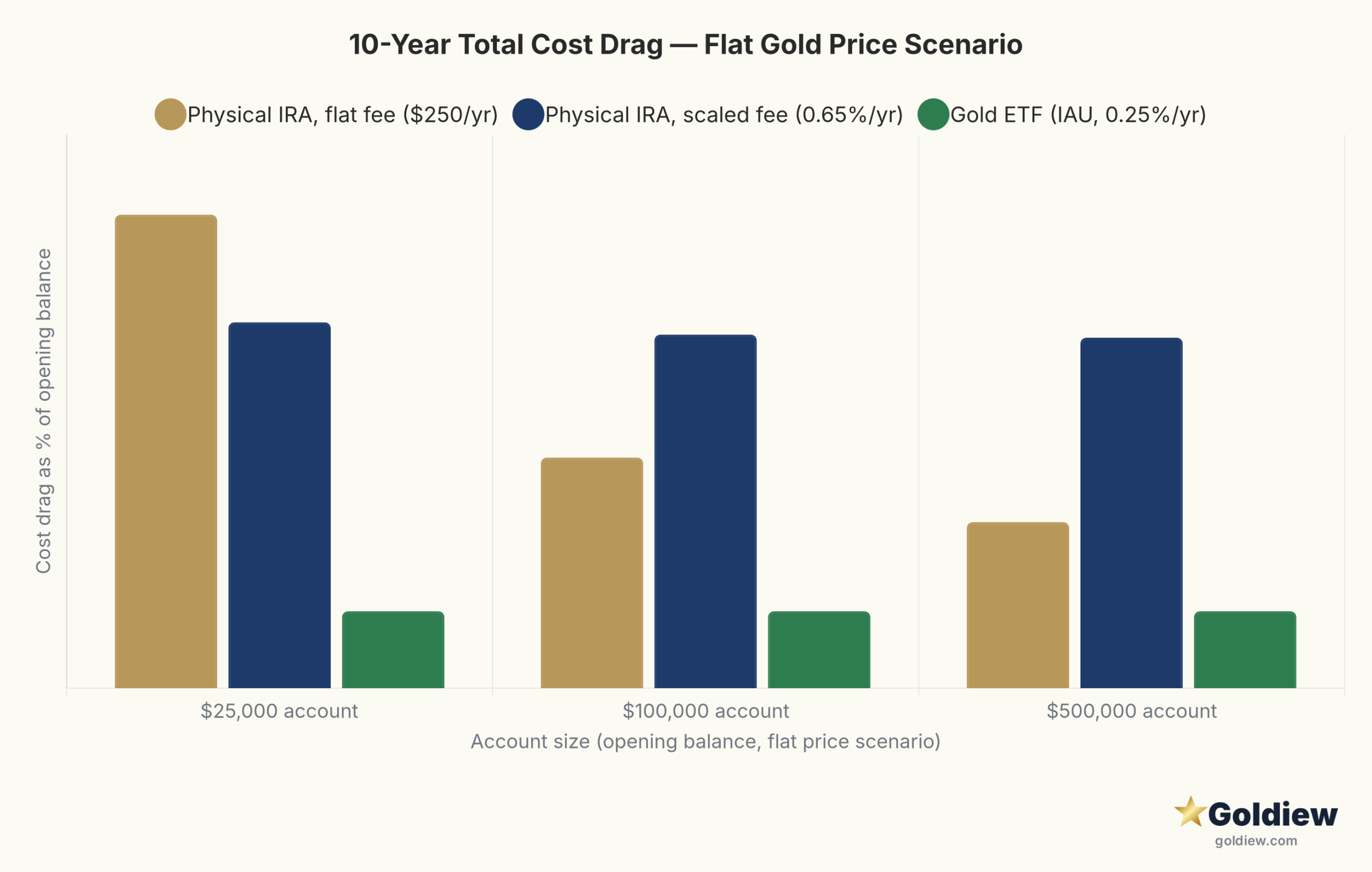

Three patterns emerge clearly from the data. First, the gold ETF cost is scale-neutral: 2.5% whether the account holds $25,000 or $500,000. Second, a flat-fee physical gold IRA gets relatively cheaper as balance grows because the fixed annual charge shrinks as a percentage of a larger account. Third, a scaled-fee physical gold IRA stays expensive regardless of account size because the percentage drag compounds on a larger base the same way it would on a smaller one. The only advantage of a scaled fee structure shows up at very small balances, where the percentage fee in dollar terms is lower than a flat annual charge: the crossover point with a 0.65% total scaled rate ($0.15% + $0.50%) and a $250/yr flat rate is approximately $38,500.
Flat-Fee vs Scaled-Fee: Which Favors You
The flat vs scaled choice is the single most impactful decision after picking a custodian. Read the full flat-fee vs scaled-fee comparison guide for complete breakdowns across more account sizes and fee schedule variants. The short version from this model: once your account exceeds roughly $38,000 to $50,000, a flat-fee custodian almost always results in lower total annual charges. At $100,000, the flat-fee model in this analysis saves $4,000 over 10 years compared to the scaled alternative. At $500,000 the saving is $30,000 over 10 years, a difference that would pay for five or six years of flat-fee charges entirely.
Before committing to a custodian, ask for a written fee schedule that includes: the annual administration fee, the annual storage fee, any fee caps or minimums, the transaction fee for each purchase or sale order, and the wire transfer fee. A custodian that cannot provide a clear written schedule is a red flag regardless of fee structure. FINRA’s investor alert on self-directed IRAs specifically flags fee transparency as a warning sign to watch for.
What the Numbers Do Not Capture
This analysis is intentionally limited to cost drag under a flat-price scenario. Several factors sit outside the model and could weigh in either direction for your situation.
Tax structure is identical
Both a physical gold IRA and a gold ETF held in a standard IRA follow the same IRS retirement account rules. Contributions may be deductible (traditional IRA) or not (Roth IRA); growth is tax-deferred or tax-free respectively; distributions are taxed as ordinary income (traditional) or not at all (Roth). IRS Publication 590-A covers contributions and IRS Publication 590-B covers distributions for both. The tax treatment is not a differentiator between the two vehicles.
Gold price performance is the same driver
Both vehicles track the spot price of gold. A gold ETF like IAU holds allocated gold bullion and publishes daily holdings. A physical gold IRA holds IRS-approved gold products in a third-party depository. The underlying price driver is the same in both cases. There is no systematic reason physical gold held in a vault would appreciate faster than the spot price that the ETF tracks. At liquidation, you receive below spot (the dealer’s buyback price); the ETF trades at or near spot at any time the market is open. Under a flat-price scenario the price driver is neutral, but at liquidation the physical IRA owner pays the exit spread while the ETF holder does not.
Counterparty considerations
A gold ETF is an equity security held in a brokerage account. A physical gold IRA involves the fund, the custodian, and the depository as three separate institutions, each of which presents its own operational and insolvency considerations. How you weigh those risks is a personal decision that only you and a licensed financial advisor can make.
Liquidity
An ETF can be sold on an exchange on any trading day and proceeds are available within the standard settlement window. A physical gold IRA liquidation goes through the dealer buyback process and then the custodian distribution workflow, which typically takes several business days longer. If liquidity matters for your planning horizon, factor it in separately from the cost model here.
Who the Math Does Not Favor
Based on the cost model above, the 10-year cost premium for a physical gold IRA over an ETF alternative is:
- At $25,000: approximately 9 to 13 percentage points over 10 years (depending on fee structure), or roughly $2,350 to $3,230 in additional cost drag
- At $100,000: approximately 5 to 9 percentage points, or $5,010 to $9,010 in additional cost
- At $500,000 with a flat-fee custodian: approximately 3 percentage points, or $14,550 in additional cost
For accounts under $50,000, the structural cost premium of a physical gold IRA is significant relative to account size and is unlikely to be offset by price dynamics alone, since both vehicles track the same underlying asset. If you have a $25,000 IRA and want gold exposure within that account, a gold ETF delivers the same economic exposure with a substantially lower fee burden. See our gold IRA vs gold ETF comparison for a fuller treatment of all the dimensions beyond cost.
For large accounts ($500,000+) with a flat-fee custodian, the gap narrows to a level where the non-cost factors become the relevant decision variables. Whether physical custody is worth a 3-percentage-point premium over 10 years is a personal judgment that a licensed financial advisor can help you work through. The Best Gold IRA for Low Fees comparison ranks providers by total ownership cost across the same three account sizes.
Frequently Asked Questions
What is the total cost of a gold IRA over 10 years?
Under the illustrative flat-fee model in this analysis, a $100,000 physical gold IRA costs roughly $7,500 in total 10-year cost drag under a flat-price scenario, about 7.5% of opening balance. A $25,000 account costs approximately $3,840 under the same model, or 15.4% of opening balance. A $500,000 account with a flat-fee custodian costs approximately $26,900, or 5.4%. A gold ETF at 0.25%/yr costs roughly 2.5% at any account size over the same period. These are illustrative model outputs, not guarantees; actual costs depend on the specific custodian, dealer, and storage provider you choose.
Is a gold ETF cheaper than a physical gold IRA?
On pure structural cost grounds, yes, by a significant margin at small account sizes and a narrower margin at large account sizes with flat-fee custodians. A gold ETF at 0.25%/yr has no setup fee, no separate storage charge, and no significant bid-ask spread. The total cost is scale-neutral at roughly 2.5% over 10 years. A physical gold IRA carries all five fee buckets described in this analysis, and the combined drag is higher at every account size modeled here.
At what account size does a gold IRA start to make sense on cost grounds?
There is no account size at which a physical gold IRA becomes cheaper than an ETF on pure cost grounds under this model. The gap narrows as account size grows and narrows further with a flat-fee custodian, but does not close. At $500,000 with a flat-fee structure the 10-year cost gap is roughly 3 percentage points (about 0.3%/yr annualized). Whether that premium is acceptable for the non-cost attributes of physical custody is a separate judgment. Consult a licensed financial advisor for your specific situation.
What is the difference between a flat-fee and scaled-fee gold IRA custodian?
A flat-fee custodian charges a fixed dollar amount per year regardless of account balance. A scaled-fee custodian charges a percentage of your account value each year. Flat-fee structures favor larger accounts; at any balance above roughly $38,000 to $50,000, a combined flat fee of $250/yr is lower in dollar terms than a 0.65%/yr scaled fee. Read the flat-fee vs scaled-fee comparison guide for full account-size breakdowns.
Does this analysis assume gold prices will rise?
No. The model holds gold spot price flat over the entire 10-year period. The purpose is to isolate structural cost drag without return assumptions. Nobody can accurately predict where prices will go in the future. Past performance is not a guarantee of future results. All investment decisions should be made in consultation with a licensed financial advisor.
Are gold IRA custodian and storage fees tax-deductible?
Fees paid from funds inside an IRA reduce your tax-advantaged balance and are not separately deductible. Fees paid from outside the IRA (i.e., from personal funds) may or may not be deductible in your specific tax situation. Consult your tax advisor. See also our full guide on whether you can deduct gold IRA fees on taxes.
Related Guides
- Gold IRA fees: comprehensive breakdown of every cost category
- Flat-fee vs scaled-fee gold IRA comparison
- Gold IRA vs gold ETF: full comparison beyond fees
- Gold IRA fees and taxes: hub guide
Sources
- IRS Publication 590-A, Contributions to Individual Retirement Arrangements (IRAs). irs.gov/publications/p590a. Accessed July 2026.
- IRS Publication 590-B, Distributions from Individual Retirement Arrangements (IRAs). irs.gov/publications/p590b. Accessed July 2026.
- iShares Gold Trust (IAU) Prospectus, expense ratio 0.25% per annum. ishares.com. Accessed July 2026.
- SPDR Gold Shares (GLD) Prospectus, expense ratio 0.40% per annum. spdrgoldshares.com. Accessed July 2026.
- SPDR Gold MiniShares (GLDM) Prospectus, expense ratio 0.10% per annum. spdrgoldshares.com/gldm. Accessed July 2026.
- FINRA Investor Alert: Self-Directed IRAs and the Risk of Fraud. finra.org. Accessed July 2026.
- SEC Investor Bulletin: Self-Directed IRAs. sec.gov. Accessed July 2026.