
Quick answer
Gold content in dental restorations varies from roughly 40 percent (high-noble crowns) to zero percent (base-metal or ceramic crowns). The only way to know what you have is a fire assay or XRF scan at a refinery. Most walk-in cash-for-gold shops skip that step, which is why their offers tend to fall far below what a refiner will pay after testing.
If you had a crown removed, discovered a relative’s dental work while clearing an estate, or simply want to understand what a handful of old gold teeth is worth before deciding what to do with it, this guide covers the practical reality. You will see why “dental gold” is not a single, predictable thing, how refiners calculate what they will pay, and what the smartest path from extraction to check actually looks like.
Not Every Dental Crown Contains Gold
The term “dental gold” covers a wide range of materials. Before estimating any value, you need to understand the three alloy families your dentist or a dental laboratory may have used.
High-Noble Alloys (the real gold content)
The American Dental Association classifies an alloy as high-noble when it contains at least 60 percent noble metals (gold plus platinum-group metals), with gold making up at least 40 percent of the total weight. Crowns and bridges made from these alloys, common through the 1980s and still used today for posterior (back) teeth requiring strength, carry the most metal value. A full-cast gold crown in a high-noble alloy can be 75 to 80 percent gold, comparable to roughly 18-karat to 20-karat fine gold.
Noble Alloys (partial gold, mixed composition)
Noble alloys must contain at least 25 percent noble metals by weight, but the ADA definition does not require gold specifically. A noble alloy might be primarily palladium, a platinum-group metal that trades separately from gold. Some palladium-heavy alloys contain little to no gold at all. These can still carry meaningful metal value, but you need the actual assay to know how much and of what.
Predominantly Base-Metal Alloys (little to no precious metal)
Base-metal crowns, typically nickel-chromium or cobalt-chromium alloys, contain less than 25 percent noble metals by total weight. Many contain no gold whatsoever. If you have a gray or silver-looking crown that feels lighter than you expect, it may be a base-metal restoration. Refiners may still accept it but the melt value is effectively zero from a gold standpoint.
Modern Restorations: Zirconia and All-Ceramic
Since roughly 2000, zirconia (a white ceramic material) and other all-ceramic systems have displaced metal crowns in many practices, particularly for front teeth. These restorations have no metal component whatsoever. If you are looking at a tooth-colored crown, verify with the original dental records or an XRF scan before assuming any metal content.
| ADA Classification | Noble Metal Minimum | Gold Minimum | Common Gold Range | Refining Value |
|---|---|---|---|---|
| High Noble | 60%+ | 40%+ | 40 to 80% | High |
| Noble | 25%+ | Not required | 0 to 40% | Moderate to High (depends on palladium) |
| Base Metal | Less than 25% | None | 0% | Minimal |
| Ceramic / Zirconia | None | None | 0% | None |
Source for ADA classification criteria: the American Dental Association has published dental alloy standards since 1932. Consult your original dental records or laboratory reports for the exact alloy used in your specific restoration.
Understanding which family your crown belongs to is the single most important step. Without that knowledge, any value estimate is a guess. To learn how gold purity is measured more broadly, see our guide to the gold karat system explained.
How Much Does a Dental Crown Weigh?
Weight determines the absolute ceiling on metal value. A refiner can only pay for the metal that is actually there.
Full-cast metal crowns (the type made entirely from alloy, with no porcelain veneer) typically weigh between 2 and 5 grams depending on the tooth size and the era of manufacture. Molars tend to be larger and heavier than premolars. Crowns fabricated before the 1970s sometimes used slightly thicker alloy walls, so older pieces can weigh toward the top of that range.
Porcelain-fused-to-metal crowns (PFM) combine a thin metal coping, often 0.3 to 0.5 mm thick, with a porcelain layer baked on top. The metal substructure of a PFM crown typically weighs 1.5 to 3 grams. The porcelain itself has no metal value and must be separated or accounted for during refining.
Bridge pontics and connecting spans add weight beyond individual crowns. A three-unit bridge (two crowns plus one false tooth in between) may weigh 8 to 15 grams of alloy in total, depending on construction.
One important note: if there is natural tooth material still attached (the “root” or remaining dentin inside the crown), a refinery will account for that in their process. You do not need to remove it yourself. Refiners process the entire piece and calculate the metal content from the assay result, not the gross weight.
The Illustrative Math: Estimating a Value Range
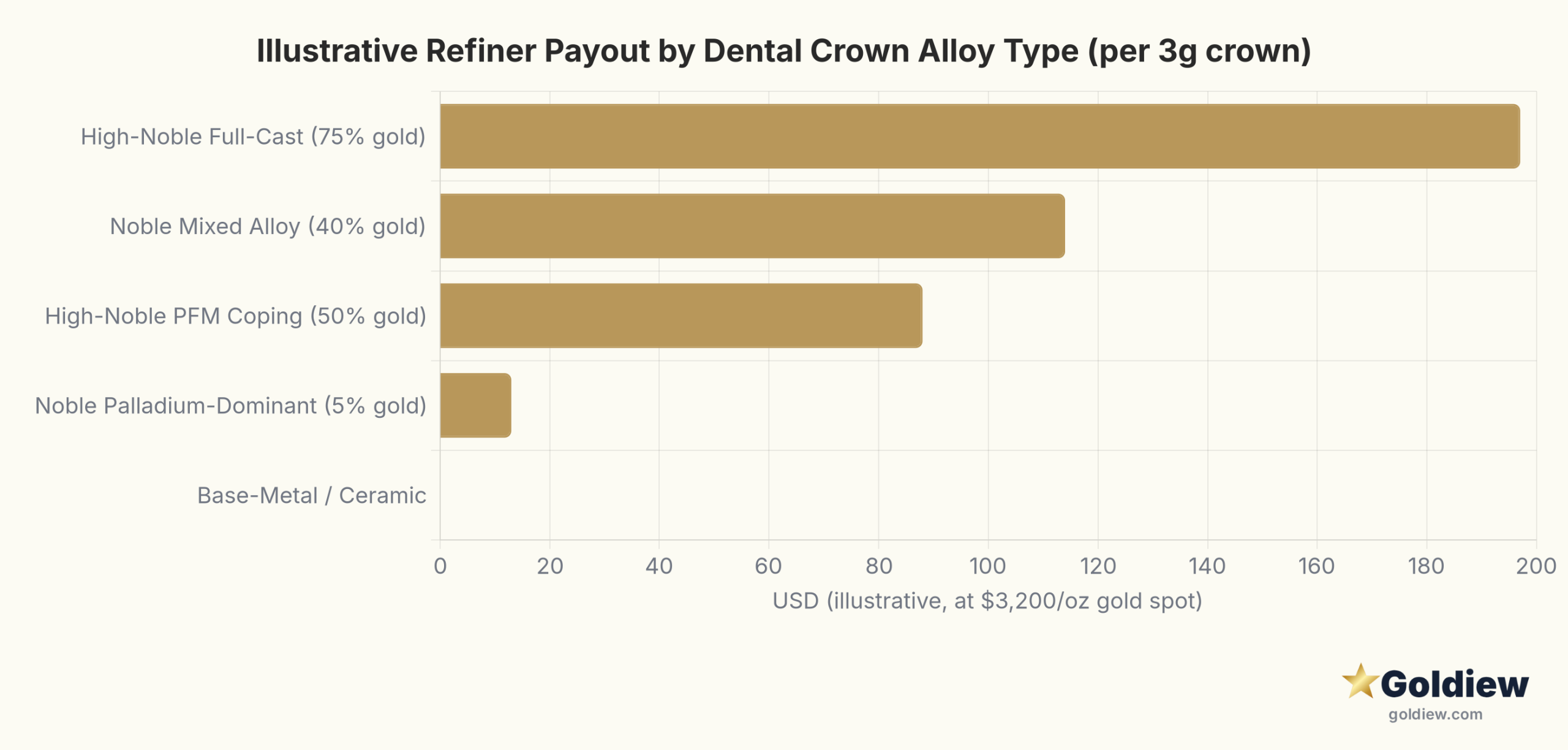
The table below uses an illustrative spot price to show the range of possible refiner payouts. Spot prices change daily. Verify the current gold and palladium spot price at a commodity exchange or financial site before drawing any conclusions from these figures. Current melt value per gram by karat is tracked in the scrap gold price today table, which updates with each spot price move.
These calculations assume an illustrative gold spot price of $3,200 per troy ounce ($102.88 per gram) and an illustrative palladium spot price of $1,100 per troy ounce ($35.37 per gram). Refiner payout is assumed at 85 percent of calculated melt value, which reflects typical processing and refining costs. Actual terms vary by refiner. Past performance is not a guarantee of future results. These figures are illustrative only.
| Crown Type | Est. Crown Weight | Approx. Gold Content | Gold at $3,200/oz | Refiner Payout (est. 85%) |
|---|---|---|---|---|
| High-Noble, full-cast (75% gold) | 3 g | 2.25 g gold | $232 | ~$197 |
| High-Noble PFM coping (50% gold) | 2 g | 1.0 g gold | $103 | ~$88 |
| Noble (40% gold, 10% palladium) | 3 g | 1.2 g gold + 0.3 g Pd | $124 + $11 Pd | ~$114 |
| Noble (palladium-dominant, 5% gold) | 3 g | 0.15 g gold | $15 | ~$13 (plus Pd value) |
| Base-metal or ceramic crown | 3 g | 0 g gold | $0 | $0 |
A three-unit bridge with high-noble alloy could yield $400 to $600 at the same illustrative price. Estate collections with multiple pieces accumulate accordingly. To explore how spot price translates to value in real time, use the Goldiew gold value calculator.
Why Assay Beats the Walk-In Window
The most consequential decision a seller can make is choosing who tests the metal before buying it.
How cash-for-gold shops typically work
Walk-in cash-for-gold counters, pawn shops, and some jewelry stores base their bids on a visual inspection and, at best, an acid scratch test. These tests confirm that some gold is present but cannot determine exact purity or measure palladium content. Buyers offering on the spot must protect themselves against uncertainty, so they discount their offer significantly. A $197 refiner payout on a high-noble crown might translate to a $60 to $100 walk-in offer for the same piece. That gap is the price of convenience and the cost of uncertainty transferred to the seller.
How dental gold refiners work
Dental refineries, and general precious metal refiners that accept dental scrap, use either fire assay (melting a small sample and measuring the resulting metals chemically) or X-ray fluorescence (XRF) scanning, which reads elemental composition from the surface without melting anything. Both methods produce a certified assay report showing exact percentages of gold, palladium, platinum, silver, and base metals. From that report, the refiner calculates a payout based on current spot prices for each metal, minus a processing fee. The result is a significantly higher offer for the same piece because the guesswork is removed.
Volume matters
Some dental refiners have minimum submission weights, commonly 1 to 5 grams. A single crown at 3 grams often meets that threshold. Estates with multiple crowns, bridges, or dental bars will process more efficiently in a single lot. If you have only one small crown, confirm the refiner’s minimum before shipping.
For a deeper look at how professional appraisals compare to actual resale value across precious metals and jewelry, see our guide to appraisal value versus resale value.
Hygiene, Handling, and Getting It There
Dental gold recovered after extraction, from estate jewelry boxes, or after a dental procedure is generally safe to handle, but a few practical considerations apply.
Basic hygiene
Crowns that have been in use will carry organic material and potentially biofilm from years in the mouth. Rinsing with warm water and allowing pieces to air-dry is sufficient before storage or shipping. Refiners process this material as a matter of routine. You do not need to clean or polish the metal before submission. Attempting to polish could dislodge porcelain layers, which is harmless to value but unnecessary.
How to store and ship
Place dental gold pieces in a sealed plastic bag or small envelope inside a padded mailer. Include a written list of what you are sending, your contact information, and a copy of any relevant documentation (original dental lab report, if available). Most dental refiners provide prepaid shipping materials upon request. Always use a tracked, insured shipping method. Declared value for insurance should reflect your best estimate of melt value based on weight and expected alloy content. For high-value lots, consider requiring a signature on delivery.
Getting more than one offer
Refiner terms vary in payout percentage, assay fees, and processing timelines. Submitting to two or three refiners before committing, or getting a quoted payout from each, is the practical way to maximize what you receive. Some refiners will quote based on a photo and weight estimate before you ship; others require the physical piece. Confirm the refiner’s process before sending anything.
Get Up to 15 Sealed Offers on /sell-gold/
If you have dental gold, old crowns, or other gold scrap to sell, Goldiew’s free seller request service connects you with up to 15 verified buyers who submit sealed competitive offers. You compare the offers before committing. There is no obligation and no fee. You can also browse active listings and buyer profiles on the Goldiew marketplace to evaluate buyers before you send anything.
Estate Scenarios: Working Through Multiple Pieces
Clearing a relative’s estate sometimes turns up a small collection of dental gold: pieces removed during their lifetime and saved, or dental bridges and crowns that need to be handled after death. Several practical points apply in this situation.
First, there is no requirement to do anything quickly. Dental gold does not deteriorate. You can take time to get proper assay offers rather than accepting the first offer made during a stressful period.
Second, the dental records from the deceased’s dentist may be available and can tell you the alloy type of any restorations. ADA alloy classification and sometimes the specific product name used may appear in dental lab invoices or patient charts. This information gives you a baseline before any refiner quotes you a price.
Third, if the estate includes a significant volume of dental metal (several bridges, multiple crowns, or a full denture framework), consider submitting everything as a single lot to a dental refiner rather than splitting it among walk-in shops. The assay cost is the same whether you submit one crown or fifteen, so a larger lot improves your cost efficiency.
For context on how insurance-replacement appraisals versus melt-floor values differ across precious metals, see the appraisal value versus resale value guide, which applies the same framework to jewelry and coins that your estate executor may encounter alongside dental gold.
Frequently Asked Questions About Dental Gold Value
Is dental gold the same purity as jewelry gold?
Not necessarily. Dental alloys are engineered for hardness, biocompatibility, and castability, not for the standardized karat purity of jewelry gold. A high-noble crown with 75 percent gold is roughly comparable to 18-karat gold (75 percent pure), but the remaining 25 percent may include platinum, palladium, silver, copper, or zinc rather than the copper-heavy mixes typical of jewelry. The practical effect on resale is that dental gold typically refines to a slightly different gold content than jewelry with the same nominal karat, and a refiner will treat it accordingly after assay.
Do I need to remove porcelain or tooth material before selling?
No. Dental refiners are set up to process mixed-material pieces. The porcelain fused to a PFM crown, or any remaining natural tooth attached to an extracted crown, will be separated and accounted for during the refining process. The assay and payout are calculated on the metal content of the finished product, not on the gross weight of everything you send. Do not attempt to remove porcelain yourself; it risks cracking the metal underneath and provides no benefit.
Can I tell what kind of alloy I have just by looking at it?
Visual inspection is unreliable. Color gives a rough clue: full yellow-gold crowns are more likely to be high-noble, silver or gray crowns are more likely to be base-metal or palladium-dominant. But color can be misleading. Some high-palladium alloys are silver-colored yet have significant noble metal value. The only reliable method is XRF scanning or fire assay. If you want a rough indication before sending anything, ask the original dentist’s office for a copy of the dental lab report, which should list the alloy family used.
What is XRF and how accurate is it?
X-ray fluorescence (XRF) is a non-destructive scanning method that exposes the piece to X-rays and measures the energy emitted by each element. The result is an elemental breakdown by percentage, typically accurate to within 0.1 to 0.5 percent for the major metals. XRF does not require melting the piece, so it is fast and leaves the crown intact. Many dental refiners use XRF as a first step and fire assay as a confirmatory method for large or high-value lots. Fire assay involves melting a small sample and is considered the gold standard for accuracy.
How long does the refining process take?
Most dental refiners complete the assay and issue a settlement check or wire within five to ten business days of receiving your submission. Some offer expedited processing for a fee. Inquire about the timeline and payment method before choosing a refiner, especially if you have a deadline such as an estate closing date.
Is there tax reporting on proceeds from selling dental gold?
The proceeds from selling personal property, including dental restorations, may be considered taxable income or subject to capital gains rules depending on your situation. The IRS treats precious metals as collectibles in some contexts. Consult your tax advisor for your specific situation before filing. This guide is informational and does not constitute tax or financial advice.
What happens if I have only one small crown?
One crown typically meets most dental refiners’ minimum submission threshold, often stated at 1 to 5 grams. Confirm the specific minimum with the refiner before shipping. For a single crown in the $50 to $200 melt value range, a reputable dental refiner will still process it and the assay-based payout should exceed a walk-in cash offer. If your piece falls below a refiner’s minimum, you may need to accumulate additional pieces or find a refiner with no minimum requirement.
Sources
- American Dental Association. Dental Alloy Classifications. ADA Council on Scientific Affairs. www.ada.org
- International Organization for Standardization. ISO 22674:2016 Dentistry: Metallic materials for fixed and removable restorations and appliances. Geneva: ISO.
- Craig, R.G. and Powers, J.M. Restorative Dental Materials. 11th ed. Mosby, 2002. (Crown alloy weight ranges and composition data.)
- Goldiew Gold Karat System Explained (internal reference).
- Goldiew Appraisal Value vs. Resale Value (internal reference).
- Goldiew Gold Value Calculator (interactive tool for current spot prices).