
Quick answer
Insurance appraisals are written to reflect what a retailer would charge to replace your piece new today. That figure anchors to retail markup, not to what resale buyers will offer. For most gold and diamond jewelry, realistic offers from estate buyers run 20 to 50 percent of an insurance appraisal. Metal-only buyers pay the melt floor, which can be 5 to 15 percent. Knowing each number prevents two costly mistakes: accepting a lowball and walking away from a fair offer.
Three values for the same piece of jewelry
Every piece of gold or silver jewelry carries at least three distinct market values at any given moment. They exist simultaneously and serve different purposes. Confusing them is the reason most sellers feel cheated when a buyer’s offer falls short of the appraisal certificate they are holding.
| Value type | What it measures | Who uses it | Typical range vs. insurance appraisal |
|---|---|---|---|
| Retail replacement value | Cost to replace the piece new at a comparable retail jeweler today | Insurance companies, estate attorneys, probate courts | This IS the appraisal figure (100%) |
| Fair market value (FMV) | Price a willing buyer pays a willing seller, neither under compulsion | Estate sales, private transactions, auction houses, IRS valuations | 20% to 50% of replacement value for most pieces |
| Liquidation or melt value | Intrinsic metal content only, at spot price minus refiner’s discount | Pawn shops, scrap gold buyers, metal refiners | 5% to 20% of replacement value |
The IRS defines fair market value as “the price at which the property would change hands between a willing buyer and a willing seller, neither being under any compulsion to buy or to sell and both having reasonable knowledge of relevant facts.” That definition comes from IRS Publication 561, Determining the Value of Donated Property, and it applies equally to private jewelry sales: both parties are voluntary, and price reflects real market conditions, not what the piece cost to manufacture or what a retailer would charge new.
Why insurance appraisals run above resale
An insurance appraisal is not wrong or padded out of carelessness. It answers one specific question: what would it cost the insurer to replace this piece with something equivalent, bought new, from a comparable retailer? That is the correct answer for insurance coverage. It is the wrong number for selling. Three structural factors create the gap.
Retail markup on new jewelry is substantial
When you buy fine jewelry from a chain or independent jeweler, the retail price covers the jeweler’s overhead, labor, design costs, and profit margin. The markup from raw materials to final retail price can range from 100 to 300 percent or more, depending on the piece and the retailer. An appraiser writing a retail replacement certificate must document what insurance would have to spend at retail. That figure is structurally higher than what a used piece commands on the secondary market, because buyers know they can also buy new and will not pay new-retail prices for a worn item.
Insurance pricing creates a market preference for higher appraisals
Jewelry insurance premiums are typically set at one to two percent of the appraised value per year. A ring appraised at $8,000 costs about $80 to $160 annually to insure. The same ring appraised at $5,000 costs $50 to $100. Policyholders who want thorough coverage naturally prefer appraisals that fully capture replacement costs. Appraisers serving that market understand the expectation and write to it. This is a market-mechanics outcome, not professional misconduct: the appraiser is doing exactly what the insurance context calls for.
Diamonds carry a steep secondary-market discount
Diamonds are graded on the 4Cs (cut, color, clarity, carat weight) by the Gemological Institute of America and other labs, but the resale market for diamonds is thin relative to new retail. Estate buyers, auction houses, and private purchasers all discount significantly below new retail values because they must hold the stone until a buyer appears, and they compete against every other diamond available on the resale market. A 1-carat round diamond sold new for $5,000 can trade in the secondary market for $1,200 to $2,500 depending on current demand, the quality grade, and who is bidding.
Melt value: the floor beneath any offer
Melt value is the amount a metal refiner would pay for the raw gold or silver content in your piece, minus the cost of separating and refining that metal. For a 14-karat gold ring, only 58.3 percent of the total weight is pure gold. The rest is alloy metals including silver, copper, and zinc. If the ring weighs 5 grams, approximately 2.9 grams is pure gold.
At a spot gold price near $3,300 per troy ounce (one troy ounce equals 31.1 grams), that 2.9 grams of pure gold is worth about $308 at spot. But no buyer pays full spot. Scrap buyers and pawn shops typically pay 70 to 85 percent of spot to cover refining costs, overhead, and margin. That puts the melt offer for this 5-gram, 14K ring in the range of $215 to $262, regardless of any number on an appraisal certificate.
Melt value is a floor, not a ceiling. A piece with no collectible or design premium will trade near its melt floor. A piece with designer provenance, strong secondary-market demand, or significant stone content will trade above it. Knowing the melt floor gives you a hard walk-away number: any offer below melt means the buyer is underpaying even for the raw metal, before accounting for the piece’s craftsmanship or stones.
You can calculate the melt floor for your own pieces using our gold value calculator or silver value calculator, both updated with current spot prices.
Illustrative worked example: a 1-carat diamond engagement ring
The figures below are illustrative and computed for reference only. Actual market values vary based on stone quality, cut grade, condition, brand, and current demand. Do not rely on these figures for any specific transaction. Consult a licensed appraiser or credentialed professional for valuations that carry legal or financial weight.
| Value type | Illustrative figure | Basis for the estimate |
|---|---|---|
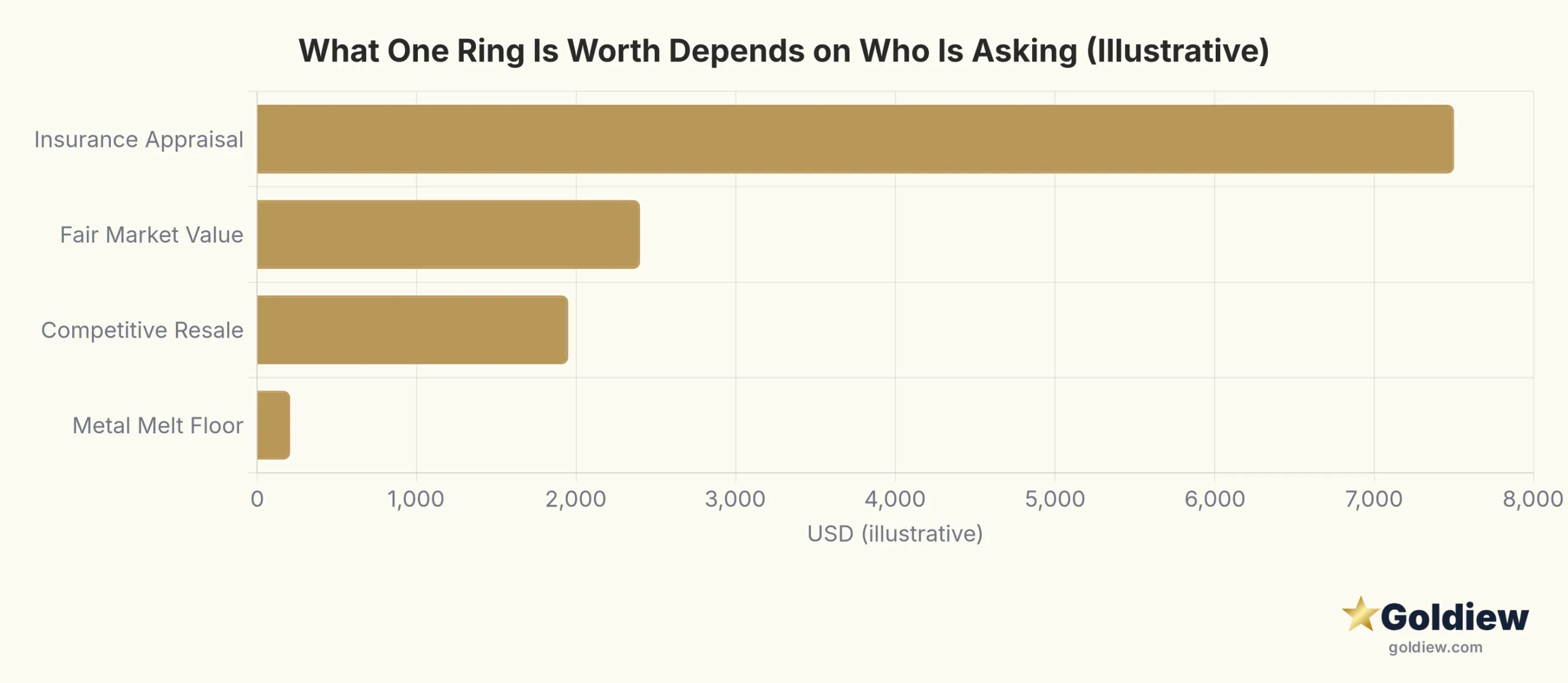
| Insurance appraisal (retail replacement) | $7,500 | New equivalent ring, mid-range retailer, current pricing, 1-ct round, SI2, I color, 14K white gold band |
| Fair market value (estate buyer or auction) | $1,800 to $3,000 | Secondary-market comps for 1-ct round SI2 I color; buyer margin factored in |
| Metal melt value (14K band, 4 grams) | $185 to $230 | Gold spot ~$3,300/oz, 14K = 58.3% pure, 70-85% of spot paid by scrap buyers |
| Competitive resale with multiple bidding buyers | $1,400 to $2,500 | Multiple sealed bids, stone value drives most of the offer, metal is incidental |
The spread between the $7,500 appraisal and a $1,400 to $2,500 realistic offer is not a sign of buyer fraud. It reflects the structural difference between replacing a piece at retail and selling a used piece into a thin secondary market. A seller who goes in expecting $7,500 will turn down every fair offer. A seller who understands the gap can evaluate bids against real market anchors and choose the best one available.

What number should a seller anchor on
The right anchor depends on the piece and your goal.
Start with the melt floor as your walk-away number
Calculate the pure metal content using spot prices and a realistic payout percentage (70 to 80 percent of spot for most buyers). Any offer above that floor has something beyond raw metal built into it. Use the melt floor as the absolute minimum: if a buyer cannot clear your melt value, the offer does not make economic sense for you.
Research recent sold prices, not listed prices
If your piece has significant stone or design value, look at recent sold prices for comparable items, not asking prices. Sold prices on platforms like eBay (completed listings) and estate jewelry auction results reveal what actual buyers paid, not what sellers hoped to receive. A listing at $3,000 tells you nothing about market reality. A sale at $2,100 tells you what the market supported on a specific day.
Adjust for brand and provenance
A small number of designer brands (Cartier, Tiffany, Van Cleef, Bvlgari) hold secondary-market value better than generic fine jewelry. Original packaging, receipts, and authentication certificates can meaningfully raise offers for these pieces. For non-branded jewelry, provenance rarely affects the price a buyer will pay.
How to get the most competitive offer
Once you know your melt floor and have a realistic fair market range in mind, the practical goal is generating competition among buyers. A single offer from a single buyer has no market pressure behind it. Multiple independent offers from verified buyers create real competition.
Request at least three independent written offers
Oral quotes are not useful for comparison. Ask each potential buyer for a written offer valid for 48 to 72 hours, specifying the weight they measured, the karat they tested, and the spot price they applied. Any buyer who will not explain their arithmetic is a buyer worth declining. Any buyer who clears your melt floor and can document their reasoning deserves serious consideration. A dedicated questions to ask a gold buyer checklist covers exactly which answers to require before accepting any offer.
Separate the stone evaluation from the metal evaluation when relevant
Some buyers specialize in gemstones and pay competitively for quality diamonds while offering only melt value for the metal setting. Others focus on scrap and price everything by weight. If your piece has both a quality stone and a substantial gold component, getting evaluations from stone-focused buyers separately from metal-focused buyers can reveal whether a bundled offer is undervaluing one component of the piece.
Know what red flags look like
FINRA’s investor resources on precious metals transactions highlight common pressure tactics used by less reputable buyers: creating urgency, refusing to show their calculation, and presenting a single take-it-or-leave-it price. None of those behaviors characterize reputable estate buyers or competitive bidding platforms. If a buyer insists you decide on the spot, treat that as a signal to seek other offers. For a detailed breakdown of undervaluation tactics, see our guide on how to spot a lowball gold offer.
Category notes: engagement rings, sterling, and dental gold
Three categories come up most often when sellers compare an appraisal to an offer and feel the gap most sharply.
Engagement rings. Sentimental value has no effect on resale price. An engagement ring sold on the secondary market competes against every other engagement ring available. Buyers know it was purchased new at retail and priced accordingly. For a full walkthrough of this specific sale, see our selling an engagement ring guide.
Sterling silver flatware. Many families inherit sterling sets with high appraisals that reflect silver content plus a retail craftsmanship premium. Resale for flatware is driven primarily by weight and silver purity. Pattern and age matter far less than most sellers expect. The full breakdown is in our guide to selling sterling silver flatware.
Dental gold. Dental restorations contain alloys in the 10K to 18K range mixed with base metals. Sellers often compare offers to what the dental work originally cost, which has no relationship to metal content or current spot prices. Our dental gold value guide covers how to calculate what your pieces are actually worth on the melt market.
Get sealed bids from verified buyers
Submit one free request on Goldiew’s sell gold page and receive sealed bids from up to 15 verified precious metals buyers. No commitment to sell, no listing fee. You can compare every bid against your melt floor and walk away from any offer that does not clear it. You can also browse active listings on the Goldiew marketplace to understand current demand for pieces like yours before deciding.
Frequently asked questions
Is an insurance appraisal the same as a fair market value appraisal?
No. Insurance appraisals state retail replacement value: the cost to buy an equivalent piece new from a comparable retail jeweler. Fair market value appraisals state what a willing buyer would pay a willing seller, neither under pressure. The IRS defines fair market value in Publication 561 and uses it for charitable donation deductions and estate valuations. The two figures serve different purposes and typically differ by 40 to 70 percent for most jewelry. If you need an FMV figure for an estate filing, tax return, or documented private sale, request a fair market value appraisal specifically from a credentialed appraiser, not an insurance replacement certificate.
Can I negotiate a higher offer by showing my insurance appraisal?
Rarely, and usually not by a meaningful amount. Buyers who make cash offers on used jewelry understand the difference between retail replacement value and resale value. Presenting an insurance appraisal does not change their calculation; it documents what a retailer would charge new, which has no bearing on what they can resell your piece for. The factor that raises offers is competition. Multiple buyers bidding simultaneously creates far more price pressure than documentation alone.
When is an appraisal figure closest to what a seller can actually receive?
Insurance appraisal values come closest to achievable resale prices in a narrow set of circumstances: recently purchased designer pieces (Cartier, Tiffany, Bvlgari) in excellent condition with original packaging and receipts; rare antique items with verifiable provenance and current collector demand; and loose certified diamonds in highly sought grades where secondary-market liquidity is strong. For most mass-market fine jewelry, modern diamond engagement rings, and karat gold pieces without brand recognition, the resale price will be materially below the insurance appraisal figure.
Should I pay for a new appraisal before selling?
A new retail replacement appraisal will not help you sell for more. A fair market value appraisal from a credentialed appraiser can be useful if you are selling a high-value piece privately and want documentation to support your asking price, or if you suspect a buyer is significantly underpaying relative to fair market conditions. For pieces where the metal content is worth under $500 to $1,000, the cost of an FMV appraisal typically runs $50 to $150 and may not be justified economically. For pieces with significant stones or potential collector value, the investment can clarify whether you are in the right negotiating range. Consult your tax advisor or a licensed financial professional before making decisions that may carry tax implications.
What is the typical percentage gap between appraisal and a realistic offer?
For most karat gold and diamond jewelry sold on the secondary market, realistic offers from reputable buyers run 20 to 50 percent of a current insurance appraisal. Metal-only or pawn shop offers often run 10 to 20 percent. The gap is largest for pieces where design premium, brand, and diamond value drive the retail price, and smallest for pieces where gold or silver weight dominates, such as heavy gold chains or sterling flatware sets. Past performance in any jewelry category is not a guarantee of results in your specific situation.
Does the age of an appraisal affect what I can get?
Yes, in two directions. Gold and silver spot prices change daily, so the melt floor on your piece today may be higher or lower than when your appraisal was written, depending on market conditions at each point. An appraisal written at peak retail pricing may also overstate today’s replacement cost if that jewelry category has softened since. For selling purposes, today’s spot price for the metal and today’s sold comps for comparable pieces matter far more than the date on the appraisal certificate.
Sources
- IRS Publication 561: Determining the Value of Donated Property (fair market value definition used throughout this guide)
- Gemological Institute of America: Diamond Quality Factors (4Cs grading standards referenced in the worked example)
- FINRA: Precious Metals Fraud (buyer verification and pressure tactic guidance)
- American Society of Appraisers: Uniform Standards of Professional Appraisal Practice (USPAP), definitions of appraisal types including replacement value and fair market value