
If your gold IRA is approaching the required minimum distribution threshold, the rules are not identical to those for a stock-based retirement account. Physical metal sitting in an IRS-approved depository does not pay dividends, cannot be sold in fractional shares, and its value fluctuates with spot prices that have nothing to do with your withdrawal schedule. This guide covers the IRS rules specific to gold IRAs under SECURE Act 2.0, including Section 107’s age changes, the in-kind distribution option, the updated penalty structure for missed distributions, and the tax treatment of what you take out.
Quick Answer
SECURE Act 2.0 (Section 107) raised the RMD starting age to 73 for those born between 1951 and 1959, and to 75 for those born in 1960 or later. Your gold IRA uses the same formula as any traditional IRA: divide your December 31 account balance by the IRS Uniform Lifetime Table factor for your age. You can satisfy the RMD by liquidating metal for cash or by taking an in-kind distribution (receiving the physical gold itself), with the fair market value on the distribution date taxable as ordinary income. Missing a deadline triggers a 25% excise tax, reduced to 10% if corrected within the IRS correction window (generally two years).
This guide is educational. Consult your tax advisor for guidance specific to your situation.
SECURE Act 2.0 Section 107 sets RMDs to begin at 73 for owners born between 1951 and 1959 and at 75 for those born in 1960 or later. A gold IRA uses the same formula as any traditional IRA: divide the December 31 balance by the IRS Uniform Lifetime Table factor. You can satisfy the distribution by liquidating metal for cash or by taking the physical gold in kind, with fair market value taxed as ordinary income. A missed deadline triggers a 25 percent excise tax, reduced to 10 percent if corrected within two years.
What Are Required Minimum Distributions?
The IRS requires holders of traditional IRAs and most employer-sponsored retirement plans to begin withdrawing money each year once they reach a defined age. These withdrawals are Required Minimum Distributions, or RMDs.
The rule exists because traditional IRA contributions and earnings grow tax-deferred. You did not pay income tax on the money going in, and the growth in the account has not been taxed either. RMDs are the mechanism the IRS uses to ensure that deferred tax eventually gets collected during the account holder’s lifetime, rather than passed entirely to heirs as a tax-free windfall.
A gold IRA is a self-directed IRA that holds physical precious metals instead of stocks and bonds. From the IRS’s perspective, it is still a traditional IRA. The type of asset held inside does not change the distribution requirement. Whether your IRA holds Apple shares, Treasury bonds, or American Eagle gold coins in an IRS-approved depository, the RMD schedule and calculation method are identical.
One important exception: Roth IRAs, including Roth gold IRAs funded with after-tax dollars, are not subject to RMDs during the account owner’s lifetime. The RMD requirement applies only to traditional (pre-tax) accounts. That distinction carries real planning implications, discussed in the FAQ section below.
Source: IRS Publication 590-B, “Distributions from Individual Retirement Arrangements”
SECURE Act 2.0 Age Rules: Who Starts at 73 vs. 75
The Setting Every Community Up for Retirement Enhancement (SECURE) Act 2.0, signed December 29, 2022 as part of the Consolidated Appropriations Act, 2023, changed the RMD starting age under Section 107. The change happened in two steps, phased in by birth year.
| Birth year | RMD starting age | First RMD deadline |
|---|---|---|
| Before 1951 | 72 (prior law, already in effect) | Already receiving RMDs |
| 1951 through 1959 | 73 | April 1 of the year after turning 73 |
| 1960 or later | 75 | April 1 of the year after turning 75 |
The first-year grace period (and its tax trap)
In the first year you become subject to RMDs, you can delay that initial distribution until April 1 of the following year. The trade-off: if you defer, you end up taking two distributions in the same calendar year. One by April 1, a second by December 31. Two distributions in the same year can push you into a higher tax bracket and affect Medicare premium calculations (IRMAA surcharges).
For most gold IRA holders, taking the first distribution in the actual year you reach the RMD age, rather than using the April 1 grace period, avoids the bunching problem. This is a situation where your tax advisor’s input on your specific income picture matters before you make the decision.
SECURE Act 1.0 transition (for those who turned 72 before 2023)
If you turned 72 before January 1, 2023, you were already required to start RMDs under the SECURE Act 1.0 rules. SECURE Act 2.0 did not retroactively change your schedule. You continue taking RMDs as required. The new age thresholds apply only to people who had not yet reached their RMD start age as of 2023.
How to Calculate Your Gold IRA RMD Each Year
The formula is straightforward. The complication specific to gold IRAs is how the account balance is determined, since the value fluctuates with spot metal prices every day.
The formula
RMD = Account balance as of December 31 of the prior year ÷ Distribution period
The distribution period is the life expectancy factor from the IRS Uniform Lifetime Table. The table was updated by IRS final regulations (TD 9930) effective January 1, 2022, reflecting longer life expectancies than the prior version. The new factors produce smaller RMDs for the same account balance compared to the old table.
Step 1: Determine your December 31 account balance
Your gold IRA custodian files IRS Form 5498 each year reporting the fair market value (FMV) of your account. The FMV is calculated as of December 31 of the prior year. For metal holdings, FMV is calculated using the spot price at market close on December 31, multiplied by the number of troy ounces held.
Example: if you hold 12 troy ounces of gold and the spot price was $2,350 on December 31, your IRA balance for RMD purposes is $28,200. Your custodian handles this calculation and reports it to the IRS. You receive a copy on Form 5498.
Step 2: Find your life expectancy factor
Look up your age in the IRS Uniform Lifetime Table for the year in which you are taking the distribution. Common factors:
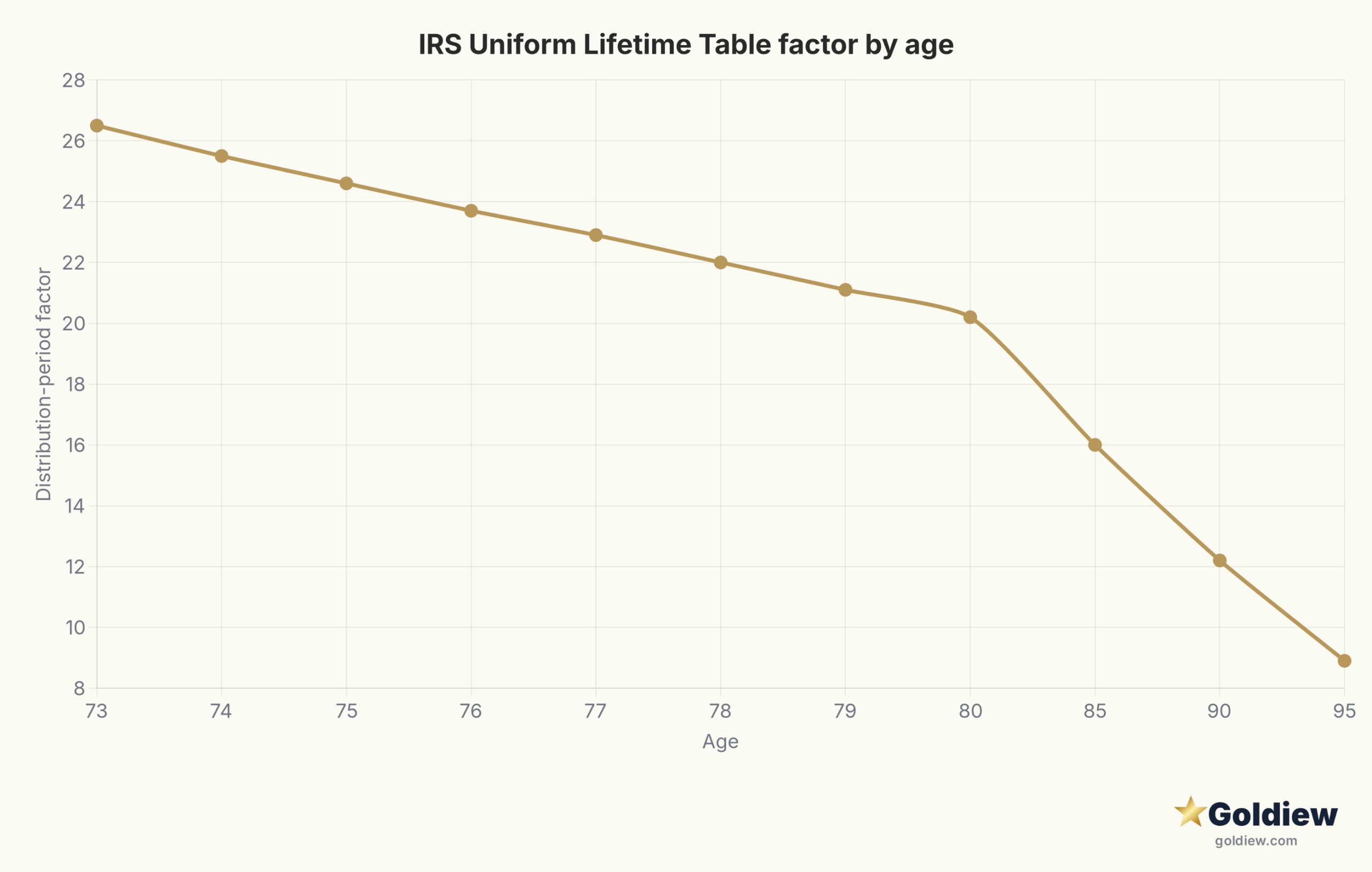

| Age | Distribution period (life expectancy factor) |
|---|---|
| 73 | 26.5 |
| 74 | 25.5 |
| 75 | 24.6 |
| 76 | 23.7 |
| 77 | 22.9 |
| 78 | 22.0 |
| 79 | 21.1 |
| 80 | 20.2 |
| 85 | 16.0 |
| 90 | 12.2 |
| 95 | 8.9 |
Step 3: Calculate
Divide your December 31 balance by the factor for your age. Two worked examples:
| Age | Dec 31 balance | Uniform Lifetime factor | Required distribution |
|---|---|---|---|
| 73 | $150,000 | 26.5 | $5,660 |
| 73 | $300,000 | 26.5 | $11,321 |
| 75 | $300,000 | 24.6 | $12,195 |
| 80 | $200,000 | 20.2 | $9,901 |
Aggregating across multiple IRAs
If you hold more than one IRA, including both a gold IRA and a traditional brokerage IRA, the RMD is calculated separately for each account. But you can take the total combined RMD from any single account or any combination of accounts. You are not required to take a proportional withdrawal from each one.
This matters practically: if your gold IRA holds metal and your brokerage IRA holds cash or easily liquidated assets, you could satisfy the entire annual RMD from the brokerage account, leaving the gold untouched. This flexibility is specific to IRAs. 401(k) plans require separate distributions from each plan. The RMD aggregation rule explains how to structure distributions across multiple IRAs so your gold holdings stay untouched.
Spouse beneficiary exception
If your spouse is more than 10 years younger and is the sole beneficiary of your IRA, a different table (the Joint Life and Last Survivor Expectancy Table) applies instead of the Uniform Lifetime Table. This produces a smaller RMD. See IRS Publication 590-B for the full calculation under this rule.
In-Kind Distribution: Taking the Physical Metal Instead of Cash
This is the element of gold IRA RMDs that most confuses account holders, and it is genuinely different from any stock or bond IRA. In a standard brokerage IRA, satisfying an RMD means selling shares and withdrawing cash. In a gold IRA, you have two options.
Option 1: Liquidate and distribute cash
The custodian sells metal at the current spot price, and the cash proceeds fund your distribution. The metal leaves your IRA; you receive cash. This is the default approach most custodians process, and the simplest from a tax and logistics standpoint.
Option 2: In-kind distribution (take the metal itself)
You receive the physical gold, silver, or other IRS-approved precious metal as the distribution. The metal is transferred out of the IRS-approved depository and shipped to you (or picked up at the depository if permitted). You now own the metal outright, outside any IRA wrapper.
The IRS treats in-kind distributions identically to cash distributions for tax purposes. The fair market value (FMV) of the metal on the date it is distributed is the taxable amount, reported as ordinary income for that tax year. You do not pay tax on future appreciation of the metal you now hold personally; that becomes a capital gains question when you eventually sell it. But the FMV at the time of distribution is taxable income regardless of what you paid for it inside the IRA.
Example: your gold IRA distributes 4 troy ounces of gold on a day when spot gold is $2,500/oz. You have $10,000 of ordinary income to report for that year. If the metal later appreciates to $3,000/oz and you sell it, the $500/oz gain would be subject to collectibles capital gains rates (up to 28%) on the personal-ownership portion.
Why some account holders prefer in-kind
In-kind distribution appeals to holders who want to maintain physical ownership of their metal rather than sell it back. The metal moves from the IRS-approved depository into your personal possession without requiring a sale at current spot. You still pay income tax on the transfer value, but you retain the asset for whatever purpose you choose, storage at home, a private vault, or eventual sale on your own timeline.
Logistics and limitations
In-kind distributions require active coordination with your custodian and the depository. Not every custodian handles this smoothly. Costs include shipping, insurance for transit, and the physical logistics of receiving bullion bars or coins. Most IRS-approved depositories (Delaware Depository, Brink’s, Texas Precious Metals, and others) do ship to account holders, but lead times and minimum handling fees vary.
Confirm the process, cost, and timeline with your custodian before your distribution year. If you hold coins that qualify as collectibles under IRS rules (proof coins, numismatic coins), the tax and valuation treatment can be more complex than standard bullion. A tax advisor familiar with precious metals IRAs can clarify the treatment for your specific holdings.
Home storage is not IRS-approved for IRA metal
Metal held inside your IRA must stay in an IRS-approved depository. Storing IRA-owned gold at home or in a personal safe is treated as a distribution and a prohibited transaction, triggering taxes and penalties on the full account value. Once metal is distributed to you (whether in-kind or as cash), you can store it anywhere. The distinction is whether it is still inside the IRA or not.
Tax Treatment of Gold IRA Distributions
The tax treatment of distributions from a traditional gold IRA follows the same rules as any other traditional IRA. There is no special rate for gold IRA withdrawals.
| Account type | Distribution tax treatment |
|---|---|
| Traditional gold IRA | Ordinary income at your marginal tax rate for the year |
| Roth gold IRA (qualified distribution) | Tax-free (no income tax on distributions after 5-year holding period and age 59½) |
| Gold held directly outside an IRA | Collectibles capital gains rate (maximum 28% federal, per IRS guidance) |
The key point: the appreciation inside a traditional gold IRA is not treated as a capital gain when distributed. All distributions (your original contributions plus all growth) come out as ordinary income. If you contributed $50,000 over the years and the account grew to $300,000, the full $300,000 distributed will be taxed as ordinary income as it comes out, at whatever marginal rate applies to your total income in those years.
State income tax
Most states follow federal treatment for IRA distributions. Several states offer partial or full exclusions on retirement income. States with notable IRA income exclusions include Mississippi (full exclusion on retirement income), Pennsylvania (state does not tax qualified IRA distributions), and others that offer age-based deductions. State tax rules change periodically. Consult your tax advisor for the treatment in your state.
Medicare premium surcharges (IRMAA)
Large RMDs can push your modified adjusted gross income (MAGI) above the thresholds that trigger Medicare Part B and Part D surcharges (Income-Related Monthly Adjustment Amount, or IRMAA). For 2024, the standard Part B premium jumps at MAGI above $103,000 (single) or $206,000 (married filing jointly). If your RMDs are substantial, coordinating their timing and size with your Medicare premium situation is worth reviewing with a financial advisor.
Past performance is not a guarantee of future results. Consult your tax advisor and a licensed financial advisor for guidance specific to your situation before making any distribution decisions.
The Penalty for Missing an RMD (and How to Fix It)
Before SECURE Act 2.0, failing to take a required minimum distribution triggered a 50% excise tax on the shortfall. That was among the harshest penalties in the tax code. SECURE Act 2.0 cut it significantly.
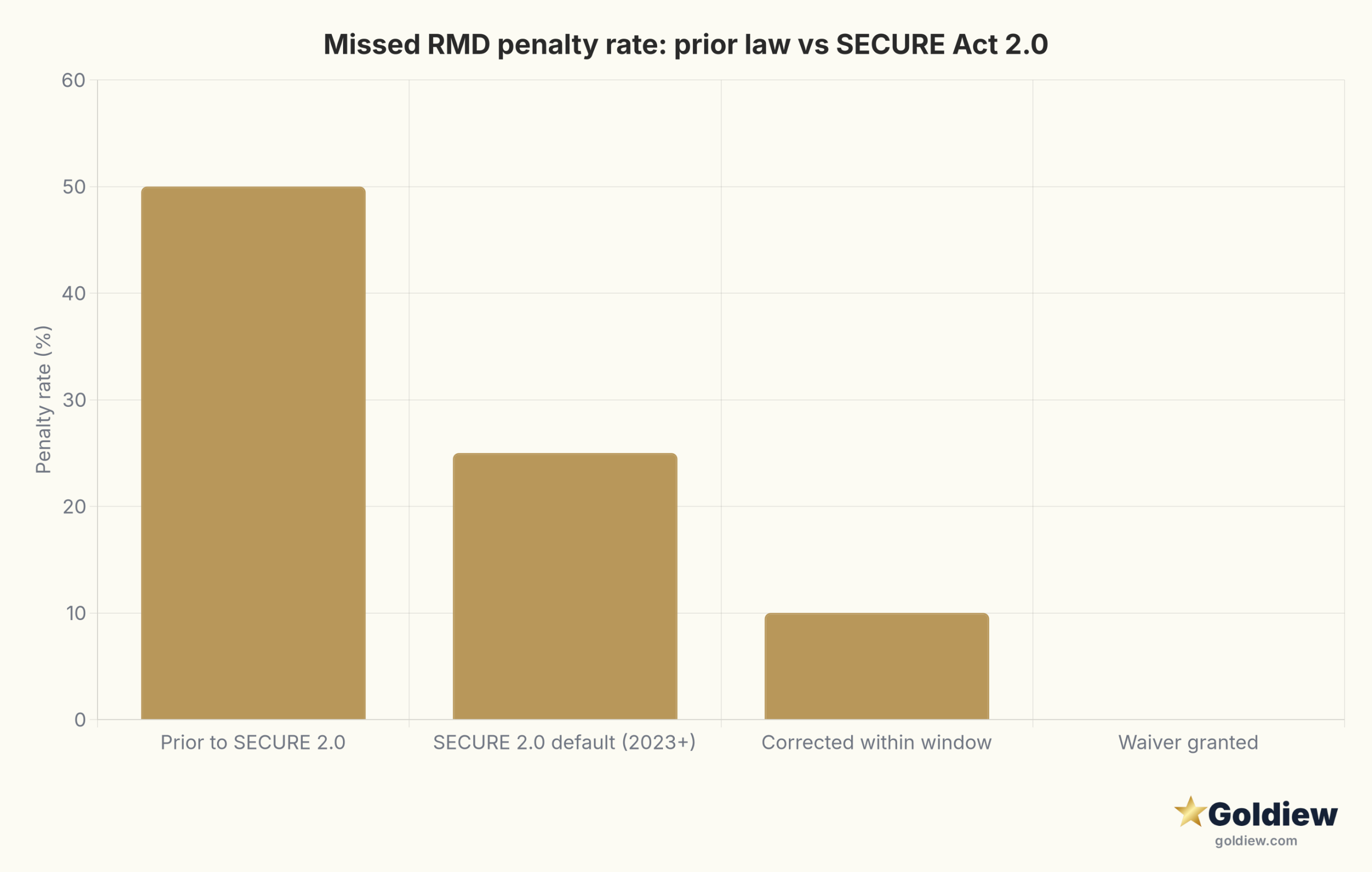
| Situation | Excise tax rate |
|---|---|
| RMD missed (prior to SECURE Act 2.0) | 50% of the missed amount |
| RMD missed (SECURE Act 2.0, effective 2023) | 25% of the missed amount |
| Missed RMD corrected within the correction window | 10% of the missed amount |
| Penalty waived by IRS (reasonable cause + correction steps taken) | 0% |
The correction window
The IRS defines the correction window as the end of the second calendar year following the year in which the RMD was due. If you were required to take an RMD for 2024 and did not, the correction window runs through December 31, 2026. Take the missed distribution by then, file IRS Form 5329 to report the shortfall and calculate the excise tax, and pay only the 10% rate.
Requesting a waiver
The IRS can waive the penalty entirely if you can show the failure was due to reasonable error and you are taking steps to remedy it. You request the waiver by attaching a written explanation to Form 5329 and entering zero for the excise tax due. The IRS reviews the explanation and either accepts or denies it. Waivers are not guaranteed, but the IRS has historically been reasonable for first-time failures with no pattern of non-compliance. Work with a tax professional when filing a waiver request.
Why gold IRA holders miss RMDs more often than average
A few factors are specific to metal accounts. First, the custodian must value the account at the prior year’s December 31 spot price to calculate the RMD. Some custodians are slower with this reporting than major brokerage firms. Second, there is no automatic distribution setup at most gold IRA custodians the way there is at major brokerages (where you can set up a recurring annual withdrawal). Third, account holders who are managing the RMD across multiple IRAs and choosing to satisfy it from a liquid account sometimes forget to actually execute the transaction before December 31.
The practical fix: set a calendar reminder in late October of each distribution year, contact your custodian to confirm the RMD amount calculated from the prior year’s Form 5498, and execute either a liquidation or an in-kind distribution with enough time before year-end for the paperwork to clear.
How Gold IRA Companies Coordinate RMDs
All three of Goldiew’s partner companies provide support for RMD administration, though each structures it differently. Choosing a company that handles RMD coordination smoothly reduces the risk of missed deadlines and administrative friction.
Augusta Precious Metals (founded 2012, rated Money Magazine’s Best Overall Gold IRA Company 2022 through 2026, BBB A+ rating with zero complaints) uses a salaried, non-commissioned educator model for client communications. Their salaried staff do not earn transaction commissions, which means guidance on RMD timing is not influenced by an incentive to encourage you to keep metal in the account or to liquidate more than necessary. Augusta’s Education-First Process includes one-on-one sessions with a specialist where RMD planning can be discussed in the context of your overall retirement picture.
Birch Gold Group (founded 2011, trusted by 40,000+ Americans, BBB A+ rating) assigns each client a dedicated Gold Specialist and has a separate in-house IRA Department specifically focused on account administration paperwork. Their IRA Department structure is built for processing the custodian coordination that in-kind and cash distributions require.
Noble Gold Investments (marketing references industry experience going back to 2003; 16,000+ investors, $2.5 billion safeguarded) operates its own Texas-based depository. For Noble clients, in-kind distribution logistics involve fewer third parties, which can simplify the coordination between the IRA custodian and the storage facility.
None of these companies provides tax advice. They coordinate the mechanics of the distribution. The tax strategy, including whether to take RMDs in cash or in-kind, how to sequence distributions across multiple IRAs, and how to handle IRMAA implications, is the territory of your CPA or tax advisor.
Goldiew internal user reviews (independently moderated): Augusta 4.71/5.0 across 7 reviews (Safety Index: Excellent Reputation), Noble 4.67/5.0 across 9 reviews (Safety Index: Excellent Reputation), Birch 4.43/5.0 across 7 reviews (Safety Index: Good Standing).
Augusta Precious Metals
Get Augusta’s free Gold IRA guide + company checklistBirch Gold Group
Get Birch’s free Info KitNoble Gold Investments
Get Noble’s free Gold & Silver guideFor deeper reviews of each company on Goldiew: Augusta Precious Metals review, Birch Gold Group review, Noble Gold Investments review.
Frequently Asked Questions
Do gold IRAs have required minimum distributions?
Yes. A traditional gold IRA is an IRS-recognized self-directed IRA under IRC Section 408. The same RMD rules that govern traditional stock IRAs apply in full to gold IRAs. The asset type held inside the account does not change the distribution schedule or the calculation method. Source: IRS Publication 590-B.
At what age do RMDs start for a gold IRA under the current rules?
Under SECURE Act 2.0 (Section 107, signed December 29, 2022): age 73 if you were born between 1951 and 1959, and age 75 if you were born in 1960 or later. Anyone who was already taking RMDs before these changes remain on their existing schedule. There is no retroactive change for current RMD recipients.
Can I take my gold IRA RMD as physical metal instead of cash?
Yes. This is called an in-kind distribution. Your custodian transfers the metal out of the IRS-approved depository to you directly. The fair market value of the metal on the distribution date is reported as ordinary income for that tax year, exactly as if you had received cash. Whether in-kind is practical depends on your custodian and depository. Confirm the process and any associated shipping and handling costs before your distribution year.
How do I calculate my gold IRA RMD for a given year?
Divide your account balance as of December 31 of the prior year by the IRS Uniform Lifetime Table factor for your age. At 73, the factor is 26.5; at 75 it is 24.6. Example: a $200,000 balance at age 73 produces an RMD of $200,000 ÷ 26.5 = $7,547. Your custodian reports your December 31 balance on IRS Form 5498 each year, which gives you the starting number. Consult your tax advisor for your specific situation, especially if you hold multiple IRAs or have a spouse beneficiary more than 10 years younger.
What happens if I miss my gold IRA RMD deadline?
A 25% excise tax applies to the amount you should have distributed but did not (SECURE Act 2.0 reduced this from the prior 50%). If you take the missed distribution within the IRS correction window (generally the end of the second calendar year after the missed RMD year), the rate drops to 10%. File IRS Form 5329 to report the shortfall. The IRS can waive the penalty entirely for reasonable cause if you are actively correcting the error.
Can I satisfy my gold IRA RMD by withdrawing from a different IRA instead?
Yes. IRA RMDs can be aggregated and taken from any single IRA or any combination of IRAs. You are required to calculate the RMD for each account separately, but the actual withdrawal can come from whichever IRA is most convenient. This means you can take your entire annual RMD from a cash or stock IRA and leave your gold IRA untouched for the year. This flexibility applies to IRAs only; 401(k) and 403(b) accounts require distributions from each plan separately.
Is a gold IRA RMD taxed differently than a regular IRA RMD?
No. Both are taxed as ordinary income at your marginal federal rate for the year of distribution. The gold held inside a traditional IRA does not receive special capital gains treatment when distributed. The collectibles capital gains rate (up to 28%) applies to gold sold outside an IRA, not to IRA distributions. If you hold metal in both an IRA and personally, the tax treatment differs between the two buckets.
Does a Roth gold IRA require RMDs?
No. Roth IRAs, including Roth gold IRAs funded with after-tax dollars, are not subject to RMDs during the account owner’s lifetime. Qualified distributions from a Roth IRA (after the 5-year holding period and age 59½) are also tax-free. Some account holders convert a traditional gold IRA to a Roth gold IRA before reaching RMD age to eliminate future RMD obligations. Roth conversions trigger income tax in the year of conversion on the converted amount. Consult your tax advisor before pursuing this strategy.
What types of gold are eligible to be held in a gold IRA?
The IRS specifies that precious metals held in an IRA must meet minimum fineness standards. For gold: a minimum fineness of .995 (99.5% pure). Eligible products include American Gold Eagle coins (an exception to the purity rule; Eagles are .9167 fine but explicitly approved by statute), American Gold Buffalo coins, Canadian Gold Maple Leaf coins, Austrian Philharmonic coins, and gold bars from approved refiners meeting the .995 standard. Collectible coins, numismatic coins, and items that do not meet IRS fineness requirements are not eligible. Source: IRS Publication 590-A, IRC Section 408(m).
Do inherited gold IRAs have different RMD rules?
Yes, significantly. Inherited IRA rules were substantially changed by the SECURE Act of 2019 and modified further by SECURE Act 2.0. Non-spouse beneficiaries generally must deplete an inherited IRA within 10 years of the original owner’s death. Spouse beneficiaries have several options, including treating the inherited IRA as their own. Rules vary based on whether the original owner had already started RMDs, the beneficiary’s relationship to the deceased, and other factors. Inherited gold IRA distributions involve the same in-kind vs. cash options, but the mandatory 10-year depletion rule creates different planning pressure. Work with a tax advisor before making any distribution decisions on an inherited account. Source: IRS Publication 590-B, Section on Inherited IRAs.
Sources consulted for this guide. Rates, tables, and regulations are reviewed and updated when IRS guidance changes.
- IRS Publication 590-B: Distributions from Individual Retirement Arrangements
- IRS Publication 590-A: Contributions to Individual Retirement Arrangements
- SECURE Act 2.0 (Consolidated Appropriations Act, 2023) Section 107
- IRS Final Regulations TD 9930: Updated Uniform Lifetime Table
- IRS Form 5329: Additional Taxes on Qualified Plans
- IRS Form 5498: IRA Contribution Information
- FINRA Investor Insights: Precious Metals
- SEC Investor.gov: Retirement Investing
- BBB: Augusta Precious Metals
- BBB: Birch Gold Group
This guide is provided for educational purposes only. Goldiew Research & Editorial is not a financial advisor, tax advisor, or registered investment advisor. Nothing in this guide constitutes investment advice or tax advice. Consult a licensed tax professional and a licensed financial advisor before making decisions about required minimum distributions, Roth conversions, or precious metals IRA investments. Past performance is not a guarantee of future results.