
Quick answer
Palladium and platinum solve different problems for automakers, and their prices reflect it.
Both belong to the platinum-group metals (PGMs), but platinum catalyzes diesel exhaust and palladium handles gasoline exhaust. Palladium’s price surged past platinum in late 2018 and peaked near $3,440 per troy ounce in early 2022, driven by tightening emissions standards and supply fears tied to Russia. Since then, automaker substitution and the rise of electric vehicles have pulled palladium well off its peak. For physical buyers, both are thin, volatile markets with wider dealer spreads and lower liquidity than gold or silver. Live spot quotes for both metals are updated daily on the platinum price today reference page.
Most investors know gold and silver. Far fewer understand the two metals that sit inside nearly every car on American roads. Platinum and palladium share a periodic-table neighborhood, look almost identical to the naked eye, and both come out of the ground in only a handful of countries. Yet they have spent the last decade moving in opposite directions, with consequences that continue to reshape the physical precious metals market.
Two metals from the same family
Platinum and palladium belong to a cluster of six elements called the platinum-group metals (PGMs), along with rhodium, iridium, osmium, and ruthenium. All six are silver-white, highly resistant to corrosion, and excellent catalysts. Two properties immediately separate platinum and palladium from the others: they are the most widely traded and the most commercially useful.
Platinum was identified in 1748 by Spanish naval officer Antonio de Ulloa from samples collected in South America. Palladium was isolated in 1803 by British chemist William Hyde Wollaston, who named it after the asteroid Pallas. Both occur naturally in the same ore deposits, so they share a common geological origin and are often mined together.
The physical differences are more striking than the chemical ones. Platinum is one of the densest metals on Earth, at approximately 21.45 grams per cubic centimeter, heavier than gold (19.3 g/cm³) and nearly twice as heavy as silver. A one-ounce platinum coin feels noticeably heavier than a gold coin the same size. Palladium, by contrast, weighs roughly 12.0 grams per cubic centimeter, closer to silver in density. That weight difference is one of the clearest ways to distinguish the two metals by touch.
Both metals are catalytically active, meaning they accelerate chemical reactions without being consumed in the process. That property made them indispensable to the automotive industry starting in the 1970s, when catalytic converters became mandatory equipment on American cars under the Clean Air Act.
The autocatalyst split: diesel vs. gasoline
A catalytic converter converts harmful exhaust gases, primarily carbon monoxide, hydrocarbons, and nitrogen oxides, into less harmful carbon dioxide, water, and nitrogen. The converter uses a honeycomb ceramic substrate coated with a thin layer of PGMs to trigger this reaction. The choice of which PGM to use depends heavily on one factor: engine type.
Diesel engines run at lower exhaust temperatures than gasoline engines. The catalytic chemistry required at those lower temperatures favors platinum. Diesel oxidation catalysts, lean NOx traps, and selective catalytic reduction systems used in modern diesel vehicles all rely heavily on platinum, often in combination with palladium. European passenger car fleets historically skewed toward diesel, which made Europe the largest source of platinum demand from the automotive sector for decades.
Gasoline engines run hotter. The three-way catalysts standard in gasoline cars work most efficiently with palladium as the primary active metal, sometimes supplemented with small amounts of rhodium and platinum. North America and Asia, where gasoline engines dominate, became the largest sources of palladium demand from autocatalysts.
The 2015 diesel emissions scandal, in which a major European automaker was found to have manipulated emissions test results, permanently altered the demand picture. European consumers and regulators turned sharply against diesel passenger cars. New registrations collapsed in several markets within two years. That shift removed a significant pillar of platinum demand from autos at exactly the moment palladium demand from gasoline catalysts was growing, driven by stricter emissions standards in China, India, and the United States.
Platinum does have one potential future demand driver that palladium lacks: hydrogen fuel cells. Proton exchange membrane (PEM) fuel cells, used in hydrogen-powered vehicles and industrial electrolyzers for green hydrogen production, require platinum as a catalyst. The World Platinum Investment Council has consistently highlighted this as a longer-term demand offset for declining diesel vehicle production. Palladium has no comparable emerging application at meaningful scale.
Where each metal comes from
Platinum and palladium are mined in only a small number of locations worldwide, which makes their supply chains unusually vulnerable to disruptions in specific regions.
Platinum production is concentrated in South Africa’s Bushveld Igneous Complex, a geological formation that accounts for roughly 71 percent of global platinum mine supply, according to the United States Geological Survey. Russia contributes approximately 13 percent, Zimbabwe around 8 percent, and the remainder comes from other smaller producers including Canada and the United States. South Africa’s dominance means that labor disputes, power shortages, and infrastructure problems in the Bushveld region can move platinum prices meaningfully within days.
Palladium supply is more evenly split, but between two different countries that present very different geopolitical risk profiles. Russia accounts for approximately 40 percent of global palladium mine production, primarily from the Norilsk Nickel operations in Siberia. South Africa produces around 39 percent, with Canada contributing roughly 9 percent. Because palladium is largely a byproduct of nickel mining in Russia, its output is also influenced by nickel market dynamics unrelated to precious metals demand.
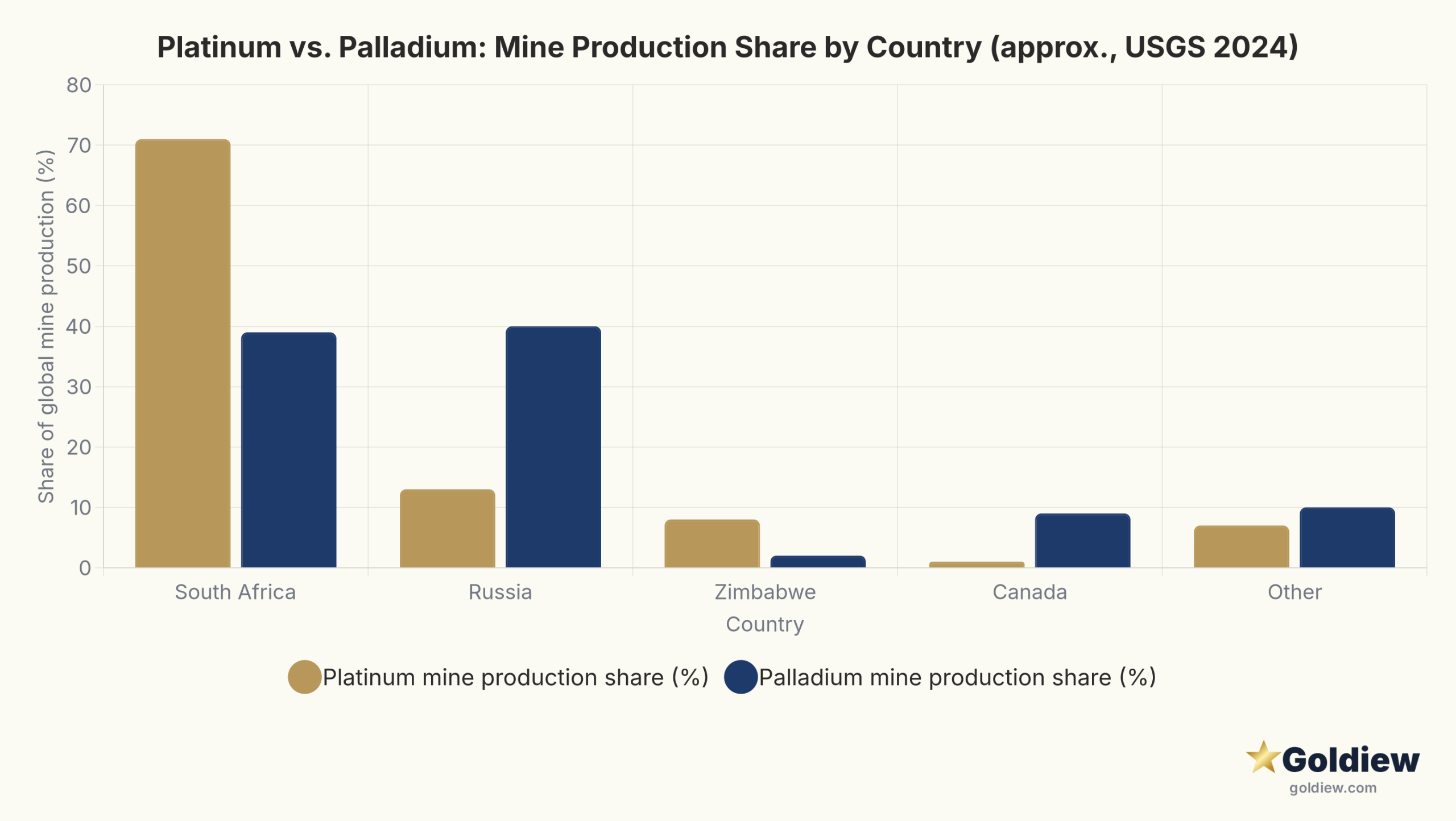
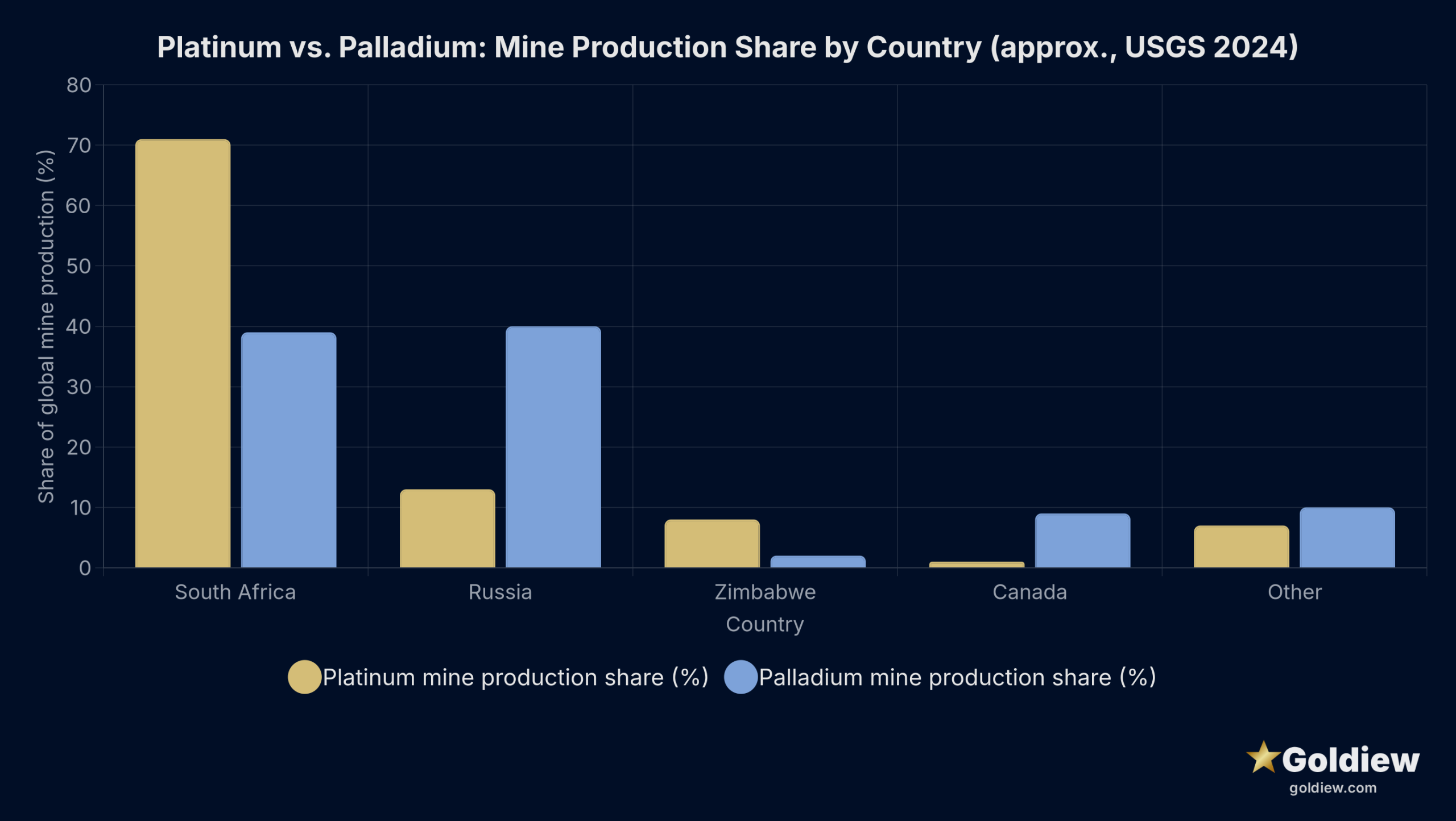
The geographic divergence matters for price risk. A disruption to South African mining (common due to recurring electricity shortages from the national grid) hits platinum much harder than palladium, because South Africa’s share of platinum supply is roughly twice its share of palladium. A Russian supply disruption, by contrast, is more consequential for palladium. That distinction became tangible in February 2022, when geopolitical concerns about Russian commodity exports helped push palladium past $3,000 per troy ounce within days.
How palladium leapt above platinum and fell back
For most of the twentieth century, platinum traded at a meaningful premium to palladium. The conventional wisdom held that platinum was the rarer, more prestigious metal. That assumption held through 2017.
In the second half of 2018, palladium crossed above platinum for the first time since the early 2000s. Several forces aligned to produce that reversal. Emissions rules in China (the China 6 standard) and India (Bharat Stage 6), both implemented with tight deadlines, required substantially higher palladium loadings per catalytic converter. At the same time, auto sales in the United States and China remained strong, maintaining high gasoline vehicle production. Supply, largely a byproduct of nickel mining and therefore not easily scaled up quickly, could not keep pace. Inventories held by auto manufacturers had been drawn down over the preceding decade.
The gap widened through 2019 and 2020. By late 2020, palladium traded above $2,000 per troy ounce while platinum remained below $900. The price divergence created an unusual incentive: automakers began working with chemical engineers to reformulate catalyst washcoats that could use platinum as a partial substitute for palladium in gasoline converters, reducing exposure to palladium’s price spike.
The peak came in early 2022. In the weeks following Russia’s invasion of Ukraine in February, concerns about potential sanctions on Russian commodity exports pushed palladium to an all-time high of approximately $3,440 per troy ounce in March 2022, according to CME Group historical settlement data. That level held for only a brief period. By the second quarter of 2022, prices were retreating sharply as the feared Russian export halt did not materialize and automaker substitution programs began reducing palladium demand per vehicle.
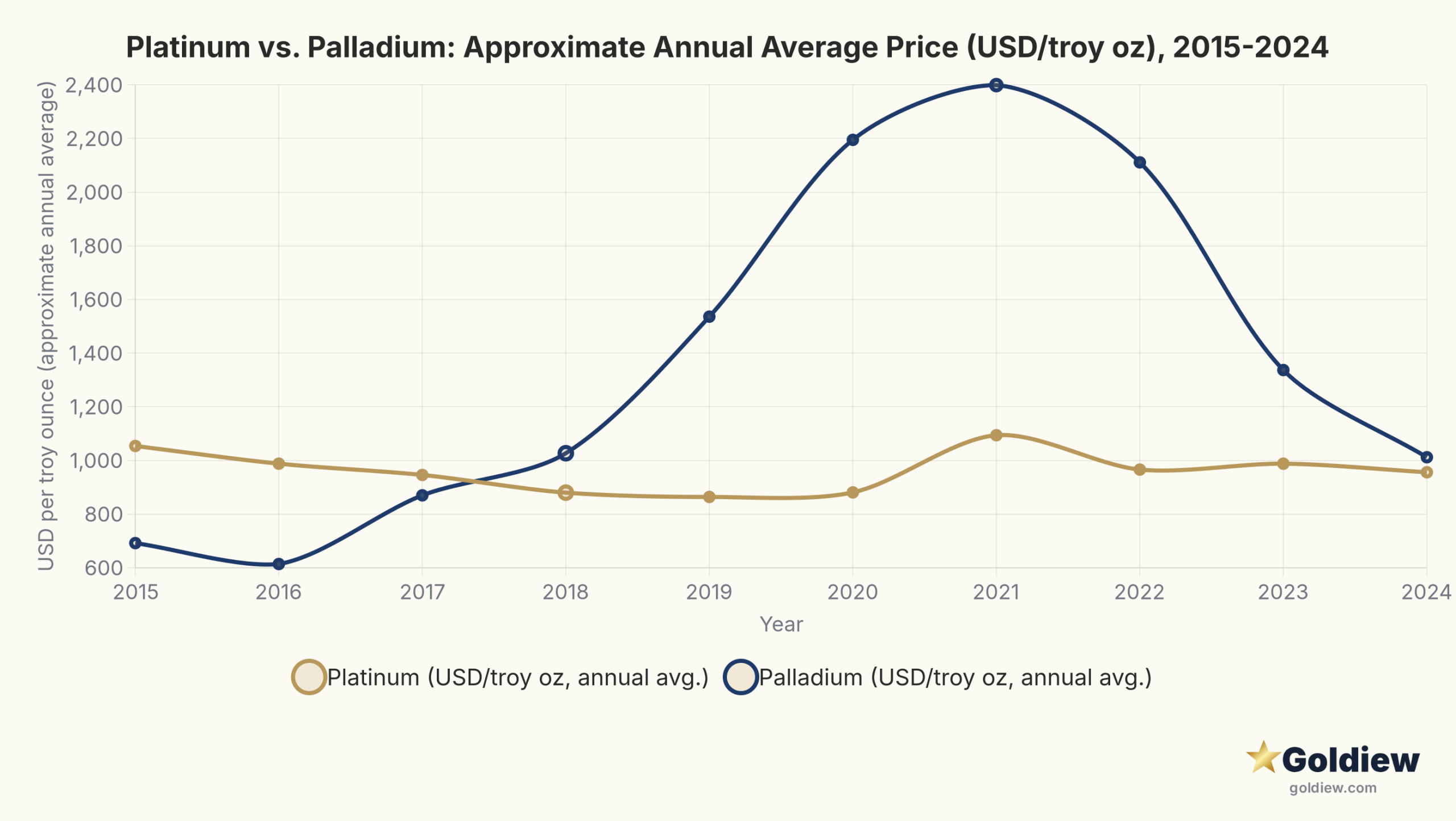
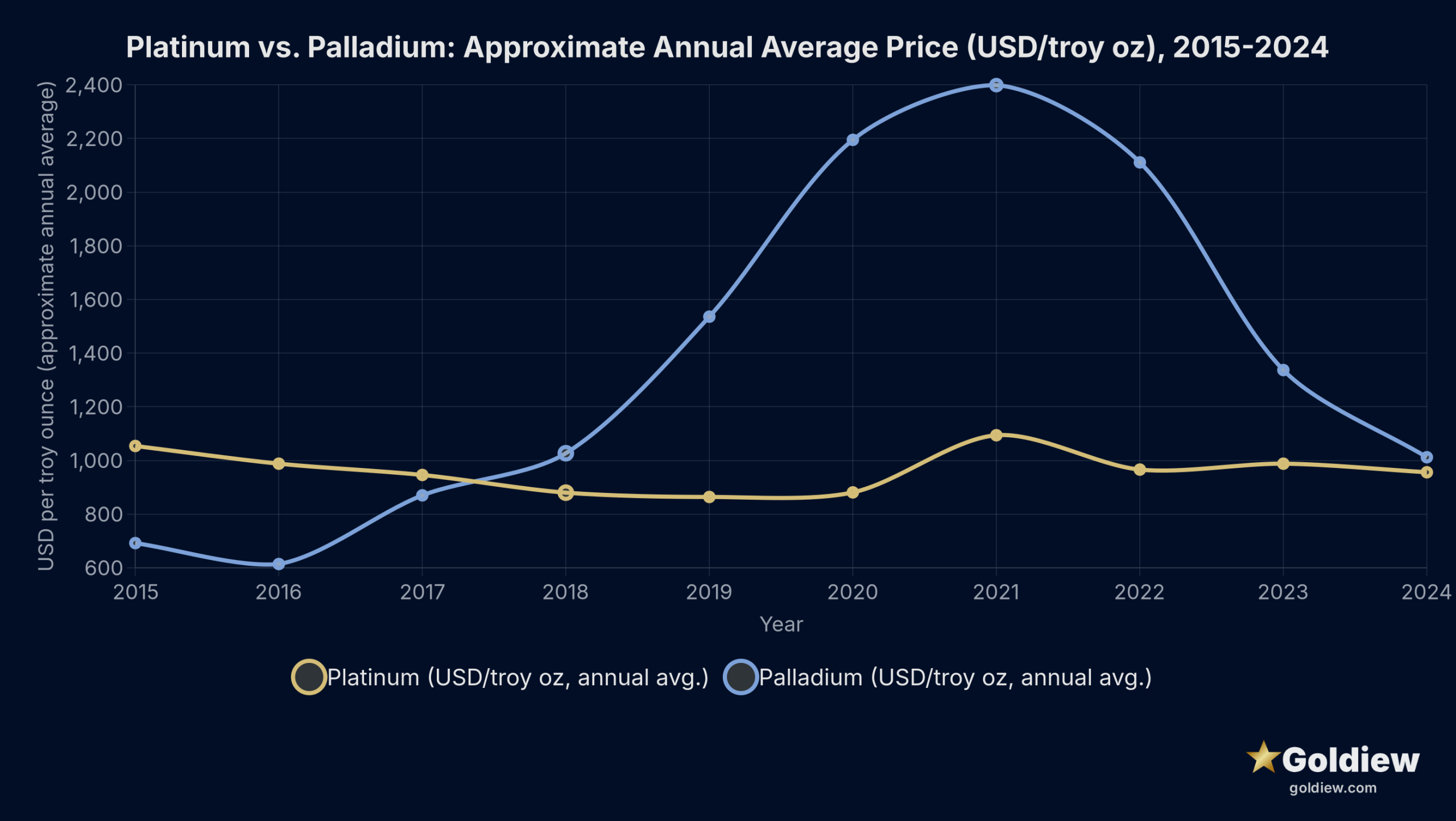
Through 2023 and into 2024, palladium continued declining toward price parity with platinum. Investors holding palladium purchased at peak prices experienced significant paper losses. The metal that had briefly looked like a one-way story of automotive demand growth became a case study in how industrial demand cycles can reverse faster than supply chains adapt. For a deeper look at the full palladium bull and bust cycle, see our detailed history at Palladium Bubble and Crash History.
Substitution, thrifting, and what EVs mean for both metals
The decline in palladium prices after 2022 reflects two structural changes that are likely to persist: thrifting and substitution.
Thrifting means using less of a metal per unit of output. When palladium prices exceeded $2,000 per troy ounce, automakers had strong economic incentives to minimize the palladium content in each converter while still meeting emissions standards. Catalyst engineers accomplished this through more precise deposition methods and improved washcoat chemistry. Each car manufactured from roughly 2021 onward requires less palladium than it would have at 2019 loadings.
Substitution goes a step further. Research showed that platinum could replace a portion of palladium in gasoline three-way catalysts without meaningfully compromising emissions performance. Automakers have disclosed that some share of palladium in their gasoline converter formulations has been replaced with platinum. The exact percentage varies by manufacturer and engine family, but this shift represents direct demand destruction for palladium paired with incremental demand growth for platinum.
The longer-term question is what battery electric vehicles (BEVs) do to both metals. A BEV has no internal combustion engine and therefore no exhaust system and no need for a catalytic converter at all. As BEV market share grows, demand for autocatalytic PGMs from new vehicle production declines proportionally. The International Energy Agency projects continued BEV growth in most major markets through the remainder of this decade and into the 2030s.
The impact falls unevenly on the two metals. Palladium, with roughly 80 to 85 percent of its primary demand coming from gasoline autocatalysts according to Johnson Matthey’s PGM Market Report data, faces the more direct exposure. Platinum has partial offsets: diesel vehicles will remain in service for decades as the installed base turns over slowly, and PEM fuel cell applications may provide incremental demand. Neither metal is immune to the EV transition, but platinum’s demand profile is more diversified.
For broader context on why platinum already trades below gold despite its rarity, see our guide at Platinum Price History: Why It Fell Below Gold.
Buying platinum or palladium as a physical asset
Understanding the market history is one thing. Deciding whether to hold either metal physically involves a different set of questions about products, premiums, and liquidity. Acquiring either metal step by step is covered in the how to buy platinum and palladium guide.
Platinum has a far broader product ecosystem than palladium. The United States Mint has produced the American Platinum Eagle (one troy ounce, .9995 fine) since 1997. The Royal Canadian Mint produces the Platinum Maple Leaf. Major refiners including PAMP Suisse and Valcambi offer platinum bars in various sizes from one gram to 100 troy ounces. Because platinum products have been available for decades and from multiple mints, the secondary market is better developed, though still narrower than for gold or silver. The Platinum Eagle vs. Maple Leaf comparison breaks down mintage limits, premium history, and resale liquidity coin by coin.
Palladium physical products are significantly more limited. The United States Mint introduced the American Palladium Eagle (.9995 fine, one troy ounce) in 2017, but production has been sporadic and limited by legislative constraints. The Royal Canadian Mint’s Palladium Maple Leaf has also had intermittent availability. Bar products from major refiners exist but are less consistently available through retail dealers. The thinner palladium market means that bid-ask spreads, the difference between what a dealer will pay and what they will charge, tend to be wider for palladium than for platinum.
The weight difference discussed earlier has practical implications. A one-ounce platinum coin is noticeably heavier than gold, which some collectors find appealing as a tactile proof of density. A one-ounce palladium coin is somewhat lighter than gold. Both metals have a bright silver-white appearance that makes them visually similar to silver and to each other. Distinguishing platinum from palladium by eye alone is essentially impossible without assay marks or density testing, unlike distinguishing gold (yellow color) or copper (red). For a guide on visually identifying PGMs and white metals, see White Gold vs. Platinum: Identification Guide.
Both platinum and palladium are eligible for self-directed IRAs under IRC Section 408(m)(3), provided the metal meets the minimum fineness requirement (generally .9950 for platinum and .9995 for palladium coins and bars from approved refiners). For details on platinum IRA eligibility, see our guide on Platinum Coins for a Precious Metals IRA, and for palladium IRA rules, see Palladium Maple Leaf IRA Guide.
One consistent theme for both metals: they are thin markets. Thin market means that the number of active buyers and sellers at any given moment is small compared to gold or silver. Wide spreads are normal. A coin dealer who routinely handles American Gold Eagles may not stock platinum or palladium at all. Selling quickly at a fair price requires either finding a specialist dealer or accepting a larger discount to spot than you would for gold or silver. This is not a hidden defect of the metals; it is a feature of any market where industrial demand, not monetary demand, drives the price. Buyers planning to hold either metal in an IRA can cross-check eligibility in the IRS-approved gold IRA coins table.
Key differences at a glance
| Factor | Platinum | Palladium |
|---|---|---|
| Primary auto use | Diesel catalysts | Gasoline catalysts |
| Largest supplier | South Africa (~71%) | Russia and South Africa (~79% combined) |
| Density | 21.45 g/cm³ (denser than gold) | 12.02 g/cm³ (lighter than silver) |
| Coin products (US) | American Platinum Eagle (since 1997) | American Palladium Eagle (since 2017, sporadic) |
| Physical liquidity | Moderate; specialist dealers required | Low; fewer dealers carry inventory |
| IRA eligible? | Yes, if .9950+ fine (IRC §408(m)(3)) | Yes, if .9995+ fine (IRC §408(m)(3)) |
| EV demand risk | Partial; hydrogen fuel cells may offset | High; ~80-85% demand from gasoline catalysts |
| Price vs. gold (approx. 2024) | Below gold | Well below gold |
Inherited platinum or palladium? Goldiew can help.
If you received platinum or palladium items through an estate and want to understand their value or connect with verified buyers, post a free request on Goldiew’s Sell Gold marketplace. Up to 15 verified buyers submit sealed offers at no cost to you. If you are in the market to buy PGM coins or bars, the gold dealer and coin dealer directories list verified local specialists in your area who carry PGM inventory.
Frequently asked questions
Why did palladium become more expensive than platinum?
The short answer is that demand for palladium from gasoline catalysts grew faster than supply could respond. China and India adopted stricter emissions standards in the late 2010s that required higher palladium loadings per vehicle. At the same time, European diesel vehicle sales collapsed after the 2015 emissions scandal, removing demand for platinum from the auto sector without a compensating increase. Palladium supply, largely a byproduct of Russian nickel mining, cannot be quickly scaled up in response to price signals. The mismatch between accelerating demand and constrained supply pushed palladium from roughly $600 per troy ounce in 2016 to more than $2,000 by 2020 and a record near $3,440 in March 2022.
Will electric vehicles make palladium worthless?
Probably not worthless, but the long-term demand outlook for palladium is weaker than for platinum. Battery electric vehicles need no catalytic converter, so each BEV displaces roughly three to seven grams of palladium demand compared with an equivalent gasoline vehicle. As BEV market share grows, the total palladium required for new vehicle production declines. Palladium demand from the installed base of existing gasoline vehicles (for replacement converters) provides some cushion for years to come, and palladium is also used in electronics manufacturing. However, platinum has a potentially significant offsetting demand driver in hydrogen fuel cells and green hydrogen production that palladium does not. Neither trajectory is certain, and both metals face the same fundamental uncertainty around the pace of the EV transition.
Can I hold platinum or palladium in a self-directed IRA?
Yes, under certain conditions. Internal Revenue Code Section 408(m)(3) permits self-directed IRAs to hold platinum and palladium if the metal meets the minimum fineness requirement and is held by an approved IRS custodian in an approved depository. Platinum must generally be at least .9950 fine; palladium must generally be at least .9995 fine. The American Platinum Eagle and American Palladium Eagle meet these standards. Not all custodians handle PGMs, and because the secondary market is thinner than for gold or silver, liquidating a PGM IRA position may take longer and result in a larger spread than you would expect for gold. Consult a qualified IRA custodian and a tax advisor before adding either metal to a retirement account.
Which metal carries higher premiums over spot price?
Palladium typically carries higher percentage premiums over spot than platinum, because its physical market is thinner. The American Palladium Eagle has at times sold for 15 to 25 percent above spot in retail markets, particularly when new mintages were delayed or limited. Platinum premiums on Eagles and Maple Leafs are usually in the 5 to 12 percent range over spot, varying with market conditions. Both are substantially higher premiums than you would pay for a comparable gold or silver coin. Bar products from major refiners generally carry lower premiums than coins for both metals, but require verification of authenticity through an approved refiner’s assay card or certificate.
Is palladium actually rarer than platinum?
In terms of annual mine production, platinum and palladium are produced in roughly similar volumes, each around 5 to 6 million troy ounces per year globally, according to USGS data. Palladium produced slightly more than platinum in recent years when Russian output was counted. In the Earth’s crust, platinum and palladium occur at very low concentrations, but platinum is generally considered slightly more abundant than palladium by measured crustal concentration estimates. In practical market terms, “rarity” is less important to price than the relationship between annual supply and annual industrial demand. Palladium’s price spike above platinum reflected demand outpacing supply, not absolute rarity.
Where can I buy platinum or palladium coins in the United States?
The most reliable sources are established coin dealers and precious metals dealers who specialize in PGMs. Not every local coin shop carries platinum or palladium inventory, because the market is smaller and the capital required to maintain inventory is higher per ounce than for silver. Reputable online dealers (with a physical address and established BBB history) often have more consistent platinum Eagle stock than local retailers. The United States Mint periodically makes American Platinum Eagles and American Palladium Eagles available directly to the public, though allocation can be limited. The coin dealer directory and gold dealer directory on Goldiew list verified local dealers by state and city; many carry PGM products or can source them on request.
Sources
- U.S. Geological Survey (USGS). Mineral Commodity Summaries 2024: Platinum-Group Metals. pubs.usgs.gov (accessed July 2026).
- World Platinum Investment Council (WPIC). Platinum Quarterly and Annual Reports. platinuminvestment.com.
- Johnson Matthey. PGM Market Report. matthey.com.
- CME Group. Historical NYMEX platinum and palladium settlement data. cmegroup.com.
- London Bullion Market Association (LBMA). Platinum and Palladium Price Statistics. lbma.org.uk.
- Internal Revenue Service. Internal Revenue Code Section 408(m)(3): IRA Investments in Coins and Bullion. irs.gov.
- International Energy Agency (IEA). Global EV Outlook 2024. iea.org.
- U.S. Environmental Protection Agency. Catalytic Converters and Emissions Control Overview. epa.gov.