
A Gold IRA owner past age 90 faces an accelerated distribution rhythm. The IRS Uniform Lifetime Table assigns a life expectancy factor of 12.2 at age 90, dropping each year afterward, which means a larger share of the account is required to be distributed annually. The decisions in this period are procedural rather than strategic: confirm the RMD amount with the custodian, choose between cash and in-kind for each year’s distribution, review the beneficiary designation on file, and check what late-life support the custodian provides. None of this is tax or financial advice. Consult your tax advisor for your specific situation.
Past age 90, the Gold IRA owner takes a larger required minimum distribution each year because the IRS Uniform Lifetime Table life expectancy factor drops year over year (12.2 at age 90, 11.5 at age 91, and so on). Each annual RMD can be satisfied in cash or in-kind, depending on the owner’s preference for the depository buyback spread versus insured shipping and personal storage. Beneficiary designations on the IRA itself control inheritance regardless of any will or trust, so a periodic review on the custodian’s beneficiary form is the single most important estate task in this period. Custodians offer late-life support that varies by firm: trusted contact designation, durable power of attorney recognition, simplified distribution workflows, and direct deposit. The custodian is the first place to request the current support menu in writing. None of this is tax or financial advice. Consult your tax advisor.
Why the Distribution Rhythm Accelerates Past Age 90
The annual required minimum distribution for a Traditional IRA is calculated by dividing the prior December 31 account balance by the IRS Uniform Lifetime Table life expectancy factor for the account owner’s age in the distribution year. The factor is reproduced in IRS Publication 590-B. The Uniform Lifetime Table starts at a factor of 27.4 at age 72 and drops year over year. By age 90, the factor is 12.2.
The smaller the factor, the larger the percentage of the prior year-end balance that is required to be distributed for the year. At age 90, the implied percentage is 1 divided by 12.2, or roughly 8 percent of the prior year-end balance. At age 91, the factor is 11.5, raising the implied percentage. At age 95, the factor is 8.9, raising the implied percentage further. Past age 100, the factor declines toward 6.4 and continues lower.
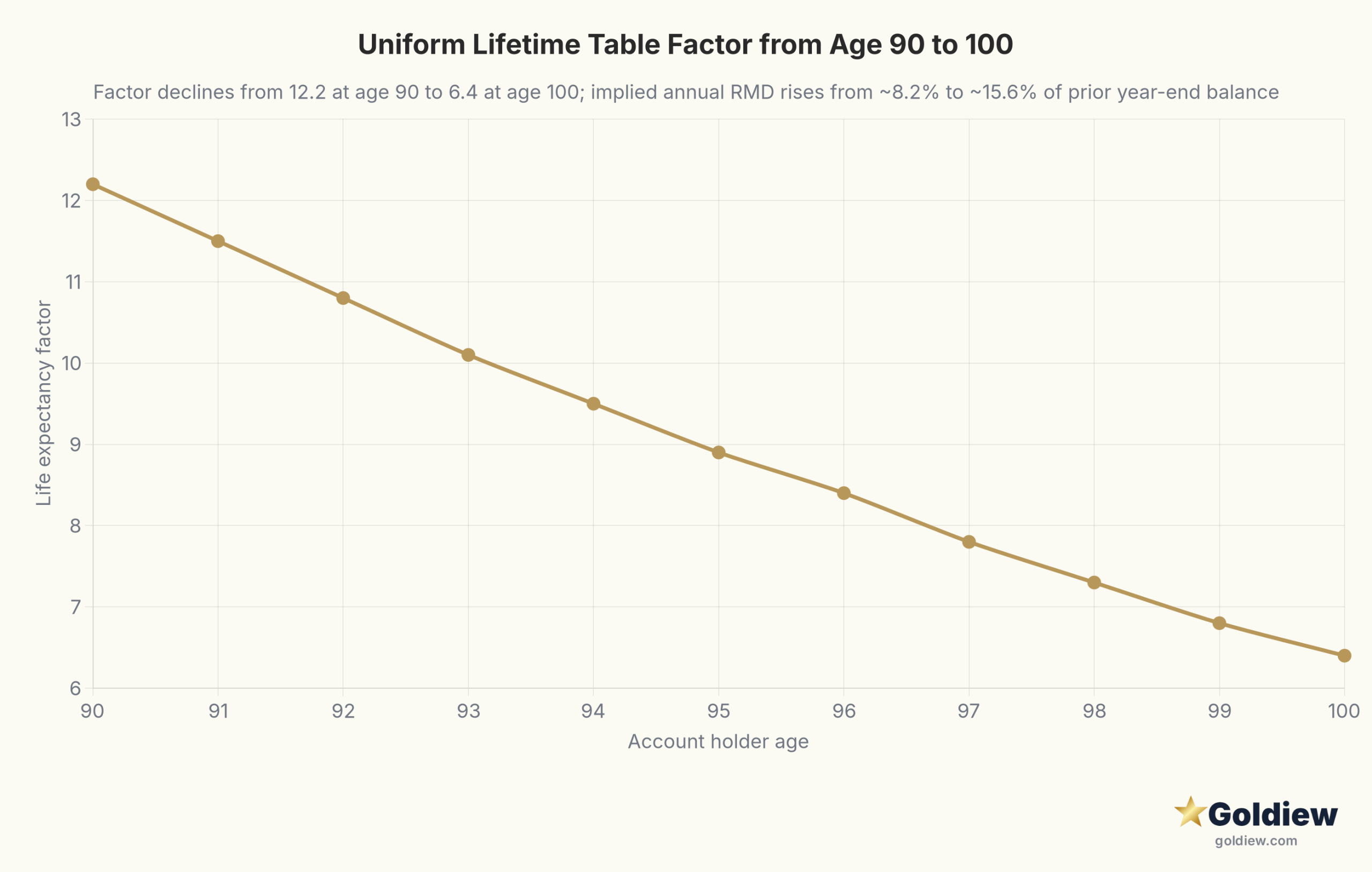
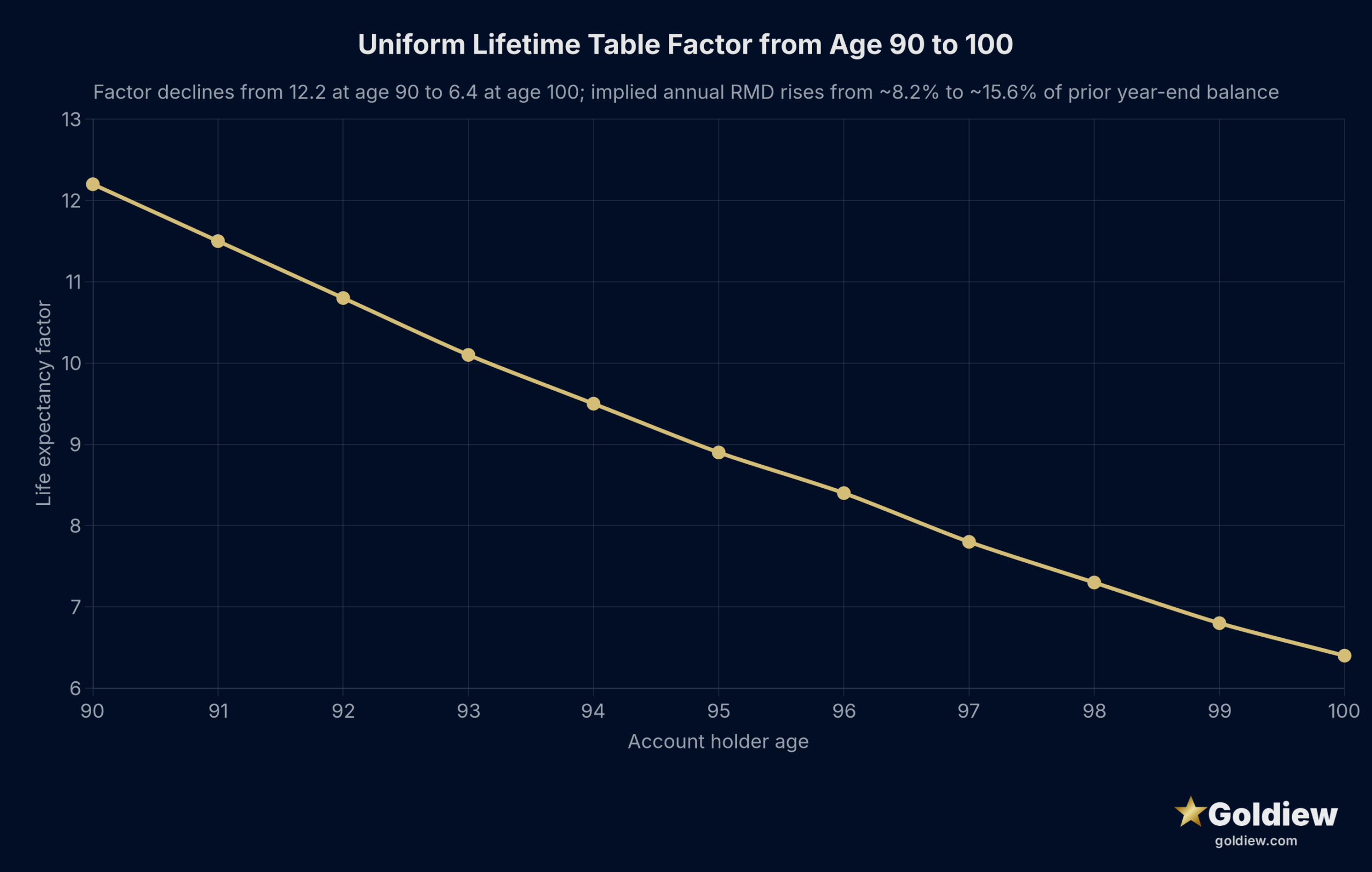
| Age in distribution year | Uniform Lifetime Table factor | Implied annual RMD percentage of prior year-end balance |
|---|---|---|
| 90 | 12.2 | About 8.2 percent |
| 91 | 11.5 | About 8.7 percent |
| 92 | 10.8 | About 9.3 percent |
| 93 | 10.1 | About 9.9 percent |
| 94 | 9.5 | About 10.5 percent |
| 95 | 8.9 | About 11.2 percent |
| 96 | 8.4 | About 11.9 percent |
| 97 | 7.8 | About 12.8 percent |
| 98 | 7.3 | About 13.7 percent |
| 99 | 6.8 | About 14.7 percent |
| 100 | 6.4 | About 15.6 percent |
Two practical points follow from the table. First, the wind-down of a Gold IRA is a mechanical process driven by the IRS table, not a discretionary planning choice. Second, a Roth Gold IRA owner is not subject to RMDs during the owner’s lifetime, so the Roth wind-down is driven instead by the owner’s personal cash needs and by the eventual beneficiary’s post-death distribution rules. The Traditional and Roth paths diverge after age 73 and again at death.
Step-by-Step: The Annual RMD Workflow Past Age 90
The annual RMD workflow is the same each year. The custodian sends the year’s RMD calculation to the account owner, the owner elects how the distribution will be satisfied (cash from a sale of metal, in-kind release of the metal, or a combination), the depository or the custodian executes the chosen path, and the custodian files IRS Form 1099-R for the gross distribution amount by January 31 of the following year. The preparation required when RMDs first begin at 73 is covered in the Approaching Age 73 guide for Gold IRA holders.
- Receive the custodian’s annual RMD notice. The custodian’s notice lists the prior December 31 account balance, the Uniform Lifetime Table factor for the age the owner will be in the distribution year, the calculated RMD amount, and the deadline (December 31 of the distribution year for most years, with the first RMD year having an April 1 deadline option that does not apply past age 90).
- Choose cash or in-kind for the year. A cash RMD instructs the custodian to sell enough metal at the depository to generate the calculated RMD amount and to pay the proceeds out in cash. An in-kind RMD instructs the custodian to release specific coins or bars to the account owner; the fair market value of the released metal on the distribution date must be at least the calculated RMD amount. The two paths can be combined in the same year.
- Submit the custodian’s distribution request form. The form lists the IRA account number, the requested distribution amount, the cash-versus-in-kind election, the federal income tax withholding election (default 10 percent unless changed), any state tax withholding election, the delivery address (in-kind) or the cash payment instructions (cash), and the notarized signature of the account owner or the authorized representative under a recognized power of attorney.
- Custodian executes the chosen distribution path. For a cash RMD, the depository sells the requested inventory at the day’s spot price minus the buyback spread and remits the cash to the custodian, who pays it to the owner by check or ACH. For an in-kind RMD, the depository packages and releases the inventory to an insured carrier for shipment to the address on the account file.
- Custodian withholds and remits federal income tax in cash. Federal income tax withholding is paid in cash from the IRA, not from the metal. The IRA must have cash to cover the withholding amount; if not, the owner elects no withholding and pays through estimated payments or with the federal return. State tax withholding follows state rules where applicable.
- Custodian files IRS Form 1099-R. The custodian files Form 1099-R with the IRS by January 31 of the following year and sends a copy to the account owner. Box 1 reports the gross distribution. Box 2a reports the taxable amount. Box 4 reports any federal income tax withheld. Box 7 reports the distribution code (typically code 7 for a normal distribution at age 59 and a half or older).
- Owner reports the distribution on the federal return. A Traditional IRA distribution flows to Form 1040 line 4a (gross) and 4b (taxable). A Roth IRA distribution flows to the same lines under the Roth distribution rules. State income tax follows state rules. Consult your tax advisor for your specific situation.
The In-Kind Option for Late-Life Owners
The in-kind distribution path is often a natural fit for an account owner past age 90. The owner is no longer accumulating retirement assets, the wind-down is happening one year at a time, and physical possession of the metal allows for direct gifting, private sale, or pass-through to the eventual beneficiary outside the IRA structure. The in-kind path also avoids the depository buyback spread, which can be material on small annual distributions.
The in-kind path adds two responsibilities that the owner or the authorized representative should plan for in advance:
- Insured shipping logistics. The depository ships the metal under an insured carrier (Brink’s, Loomis, or another armored or specialty courier). The shipment requires an adult signature at the address on the account file. The delivery address must usually match the residential address the custodian has on the account; a P.O. box or a non-account address is normally not accepted.
- Personal storage and insurance after delivery. The carrier’s in-transit insurance ends at the moment of signature. Personal storage after that point requires its own insurance arrangement. Homeowner’s insurance commonly carries a low precious metals sub-limit. A scheduled personal property rider or a dedicated bullion policy is the standard alternative. Confirm coverage with the personal insurance broker before the shipment arrives.
The complete step-by-step in-kind distribution process (custodian request, FMV recording, insured shipping, tax reporting on Form 1099-R) is covered in the Goldiew guide on in-kind Gold IRA distributions. The same procedural sequence applies to an annual RMD satisfied in-kind.
Beneficiary Designation Review: The Most Important Estate Task
The beneficiary designation on file with the custodian controls who inherits the Gold IRA. This designation is independent of any will or trust. A will or trust does not override the beneficiary form on the IRA itself. A periodic review of the beneficiary designation past age 90 is the single most important estate task on the account, because the IRA itself flows directly to the named beneficiary regardless of estate documents. When a minor child appears on the form, the minor child IRA beneficiary rules add SECURE Act layers most families overlook.
The review covers the following fields on the custodian’s current beneficiary designation form:
| Beneficiary form field | What to verify |
|---|---|
| Primary beneficiary or beneficiaries | Legal name, date of birth, Social Security number, current contact information, and the allocation percentage for each primary beneficiary (the total across all primary beneficiaries must equal 100) |
| Contingent beneficiary or beneficiaries | Backup beneficiaries who inherit if no primary beneficiary survives; same identifying details as primary beneficiaries |
| Per stirpes or per capita designation | How an allocation passes if a beneficiary predeceases the owner: per stirpes flows to the deceased beneficiary’s descendants, per capita reallocates among surviving beneficiaries |
| Spousal consent (where applicable) | Some custodians require spousal consent on a non-spouse beneficiary designation in community property states |
| Trust as beneficiary documentation | If a trust is named, the custodian’s trust documentation requirements (copy of the trust, certification of trustee, see-through trust status) must be on file |
| Signature and date | The form is signed by the account owner, dated, and (typically) notarized; an outdated form may not reflect the owner’s current intent |
An estate attorney is the right professional to review how the beneficiary designation interacts with the rest of the estate plan, including the will, any revocable trust, any irrevocable trust, and any state-level inheritance rules. Goldiew is not an estate attorney and does not provide legal advice. The review is also a useful trigger to confirm that the executor or trustee named in the broader estate plan knows that the IRA flows by beneficiary designation, not through probate.
How the IRA Flows at Death Past Age 90
If the account owner dies past age 90, the IRA passes to the beneficiary or beneficiaries on the most recent beneficiary designation form on file. The inheritance treatment depends on the beneficiary type:
- Surviving spouse. The spouse may treat the IRA as their own (rolling it into a spousal IRA) or as an inherited IRA. The choice affects future RMD calculations and the spouse’s own distribution rights.
- Eligible designated beneficiary. A minor child of the owner (until reaching majority), a disabled or chronically ill beneficiary, or an individual not more than 10 years younger than the owner may take distributions over a life expectancy schedule under the SECURE Act of 2019 rules.
- Other designated beneficiary. A non-spouse beneficiary who is not an eligible designated beneficiary is generally subject to the 10-year rule: the inherited IRA must be fully distributed by December 31 of the tenth year after the year of death.
- Non-designated beneficiary. An estate, a non-qualifying trust, or a charity follows different post-death distribution rules, generally based on whether the owner had reached the required beginning date for RMDs.
Each beneficiary type carries its own annual reporting and tax treatment. Consult your tax advisor and an estate attorney for the inheritance path that fits the specific situation.
Custodian Late-Life Support: What to Ask the Custodian to Confirm in Writing
Self-directed IRA custodians vary in the late-life support they offer on the account. The account owner or an authorized representative can request the custodian’s current support menu in writing. The common services to ask about are listed below.
| Late-life custodian service | What it covers | What to confirm in writing |
|---|---|---|
| Trusted contact designation | A non-authorized person the custodian can contact if it is unable to reach the account owner or if it suspects financial exploitation | The trusted contact does not have authority to direct the account; the custodian’s role is information only |
| Durable power of attorney recognition | Recognition of an authorized representative under a state-law durable power of attorney instrument | The custodian’s specific durable POA form requirements, any notarization or witness requirements, and the scope of authority granted |
| Beneficiary designation review and update | Assistance updating the beneficiary form, contingent beneficiary, allocation percentages, and trust-as-beneficiary documentation | The current form version, the custodian’s intake process, and whether spousal consent is required for any change |
| Annual RMD calculation and reminders | The custodian’s annual notice with the RMD amount, deadline, and request form | The notice is automatically sent; the custodian does not automatically take the distribution unless the account is on a recurring distribution schedule |
| Direct deposit of cash distributions | Cash RMD proceeds paid by ACH to a designated bank account | The custodian’s ACH enrollment form, the bank account on file, and any timing delays between distribution date and cash availability |
| In-kind distribution support | The custodian’s distribution request workflow for in-kind releases, including depository instruction, FMV recording, and insured shipping arrangement | The custodian’s published procedure for in-kind distributions, the carrier used, the insurance cap, and any handling fee |
| Recurring distribution schedule | Automatic monthly, quarterly, or annual distributions on a published calendar | The schedule, the amount per distribution, the cash-versus-in-kind election, and the cancellation procedure |
| Account closure procedure | The custodian’s process for a full account closure, including final RMD calculation, full liquidation or in-kind release, and final tax reporting | The published closure procedure, any minimum balance trigger, and the timing for the final Form 1099-R |
Custodian services and the documentation required vary by firm. The information above is a request checklist for the account owner or the authorized representative. The custodian is the authoritative source for the specific services available on the specific account.
Read the Augusta Precious Metals review Augusta serves clients with 50,000 dollars or more in eligible retirement assets. The link above goes to our review page first. The review is independent of any distribution decision the account owner may later make. Consult your tax advisor for your specific situation.Common Mistakes During a Wind-Down Past Age 90
The mistakes below are the ones IRA custodians and tax advisors see most often when reviewing late-life Gold IRA accounts after the fact. Each is procedural and avoidable with a slower setup and a written file at every step.
- Missing the December 31 RMD deadline. The annual RMD must be distributed by December 31 of the distribution year (except for the first RMD year, which has an April 1 deadline option that does not apply past age 90). A missed RMD triggers an excise tax of 25 percent of the shortfall under SECURE Act 2.0, reducible to 10 percent with timely correction reported on IRS Form 5329.
- Calculating the RMD from the wrong year-end balance. The RMD denominator is the prior December 31 account balance, not the current balance. For an in-kind portfolio, the balance is the FMV of the metal on the prior December 31, as recorded by the custodian. The custodian’s annual notice is the authoritative source.
- Leaving the beneficiary designation outdated. The beneficiary form on file controls the inheritance, regardless of any will or trust. An outdated form may direct the IRA to a deceased beneficiary, a former spouse, or an unintended recipient. The fix is to file an updated beneficiary designation with the custodian.
- Confusing the will or trust with the beneficiary form. The IRA does not flow through probate when a valid beneficiary designation is on file. A will or trust does not override the beneficiary form on the IRA itself.
- Skipping the federal withholding decision on each annual RMD. The default 10 percent federal withholding applies unless the account owner files a different election. The IRA must have cash to pay any withholding amount. An in-kind RMD with elected withholding still requires cash inside the IRA to pay the withholding.
- Forgetting that an in-kind RMD becomes personal property at delivery. Once the metal is delivered, it is personal property. Personal storage requires its own insurance arrangement. The carrier’s in-transit insurance ends at signature.
- Closing the account in a single tax year without checking the tax bracket impact. A full closure in one year pushes the entire remaining balance into one year of gross income for a Traditional IRA. The tax bracket implication should be reviewed with a tax advisor before electing a single-year closure.
- Acting on power of attorney without first registering the POA with the custodian. The custodian’s recognition of a durable power of attorney requires the custodian’s own documentation procedure. Acting on a POA that the custodian has not registered will generally not be honored.
When a Cash RMD Fits, and When an In-Kind RMD Fits
- The owner needs the cash for living expenses or scheduled spending
- The custodian’s buyback spread at the depository is competitive with the cost of insured shipping
- The owner does not want to take personal storage responsibility for additional metal
- The annual RMD amount is small enough that shipping logistics outweigh the spread saved
- The owner prefers a single ACH deposit on a published schedule
- The owner wants to keep the same coins or bars outside the IRA for gifting, private sale, or pass-through to heirs
- The depository buyback spread on the relevant coin variants is wide
- The owner already has a personal storage and insurance arrangement in place
- The annual RMD amount is large enough to absorb the insured shipping and handling fees
- The owner is preparing the account for a planned closure within a small number of years
The cash-versus-in-kind decision is made on the custodian’s distribution request form for each annual RMD. The two paths can be combined in the same year. The decision is procedural rather than a tax planning choice (the IRS-reported amount on Form 1099-R is the same whether the distribution moves as cash or as metal).
Who This Guide Is Not Written For
This guide covers the procedural wind-down of a Gold IRA past age 90. It is not written for the situations below, which are addressed in other Goldiew guides.
- Account owners under age 73. Required minimum distributions have not begun. The relevant guides are the upstream account-setup guides and the eligibility guides.
- Account owners under age 59 and a half. Distributions are subject to the 10 percent additional tax under IRC section 72(t) unless an exception applies. The substantially equal periodic payments framework is one of the IRC 72(t) exceptions.
- Beneficiaries of an inherited IRA. The post-death distribution rules differ from the owner’s lifetime RMD rules. The beneficiary’s distribution path depends on the beneficiary type and the year of the owner’s death.
- Account owners with a Roth Gold IRA only. A Roth IRA owner is not subject to lifetime RMDs. The wind-down for a Roth account is driven by personal cash needs and by the eventual beneficiary’s post-death distribution rules.
- Account owners considering a full single-year closure. The tax bracket impact of pushing the full remaining balance into one tax year should be reviewed with a tax advisor before electing a single-year closure.
Related Goldiew Guides
The wind-down past age 90 connects to several adjacent Gold IRA mechanics. The companion guides below help fill in the surrounding procedural context without crossing into individualized tax or financial advice.
- How to take an in-kind Gold IRA distribution step-by-step: the full procedural sequence for an in-kind release, applicable to any in-kind RMD past age 90.
- In-kind RMD with gold: rules, FMV, tax treatment: the RMD-specific in-kind path under SECURE Act 2.0.
- How to set up a 72(t) SEPP early withdrawal: the IRC 72(t) exception path for owners under age 59 and a half (not applicable past age 90, included for cross-reference).
- Home storage Gold IRA warning: McNulty v. Commissioner: why personal storage of an active IRA is not the same as personal storage after a distribution.
- First 30 days with a Gold IRA: the upstream custodian and depository decisions that shape every downstream distribution.
- Best Gold IRA companies: methodology-driven comparison of self-directed precious metals IRA providers.
FAQ
Is a Gold IRA owner past age 90 still subject to required minimum distributions?
Yes. A Traditional Gold IRA owner remains subject to required minimum distributions for every year past the RMD start age, with no upper age cap. The RMD start age is 73 for owners born from 1951 to 1959 and 75 for owners born in 1960 or later under SECURE Act 2.0. The annual RMD is calculated by dividing the prior December 31 account balance by the IRS Uniform Lifetime Table life expectancy factor for the owner’s age in the distribution year. Roth IRA owners are not subject to RMDs during the owner’s lifetime. Consult your tax advisor for your specific situation.
What is the Uniform Lifetime Table life expectancy factor at age 90?
The IRS Uniform Lifetime Table life expectancy factor at age 90 is 12.2 under the table reproduced in IRS Publication 590-B. The factor decreases each year (11.5 at age 91, 10.8 at age 92, 10.1 at age 93, 9.5 at age 94, 8.9 at age 95, and so on). A smaller factor means a larger percentage of the account is required to be distributed each year. The exact percentage of the account required is 1 divided by the life expectancy factor (8.2 percent of the prior year-end balance at age 90, rising over time). Consult your tax advisor for the calculation that applies to your specific account.
Can a Gold IRA RMD past age 90 be taken in-kind instead of in cash?
Yes. A required minimum distribution may be satisfied with an in-kind distribution of coins or bars as long as the fair market value of the metal on the distribution date is at least the calculated RMD amount. The custodian releases the inventory at the depository, the FMV is recorded for IRS Form 1099-R, and the metal is shipped insured to the address on file. The in-kind path avoids the depository buyback spread but adds insured shipping logistics and personal storage responsibility. The full step-by-step in-kind process is covered in the Goldiew guide on in-kind Gold IRA distributions. Consult your tax advisor.
What happens to a Gold IRA when the owner dies past age 90?
The IRA passes to the beneficiary or beneficiaries listed on the IRA’s most recent beneficiary designation form on file with the custodian, regardless of what a will or trust says. A surviving spouse beneficiary may treat the IRA as their own or as an inherited IRA. A non-spouse designated beneficiary who inherits in 2020 or later is generally subject to the 10-year rule under the SECURE Act of 2019: the inherited IRA must be fully distributed by December 31 of the tenth year after the year of death. Eligible designated beneficiaries (minor child of the owner, disabled or chronically ill beneficiary, individual not more than 10 years younger than the owner) follow different rules. Consult your tax advisor and estate attorney for the inheritance treatment that applies to the specific situation.
What is the penalty for missing a required minimum distribution from a Gold IRA?
Under SECURE Act 2.0, the excise tax on a missed RMD was reduced from 50 percent to 25 percent of the shortfall. The 25 percent is further reduced to 10 percent if the shortfall is corrected within a defined correction window and IRS Form 5329 is filed reporting the correction. The IRS may also waive the excise tax for reasonable cause when the account owner files Form 5329 with an explanation. The penalty applies to the difference between the calculated RMD and the amount actually distributed for the year. Consult your tax advisor for the correction procedure that applies.
Should beneficiary designations be reviewed past age 90?
Beneficiary designations on the IRA are independent of any will or trust and override estate documents on the IRA itself. A periodic review confirms that the primary beneficiary, contingent beneficiary, allocation percentages, and personal details (legal name, date of birth, Social Security number, contact information) are current and match the account owner’s intent. A review is particularly useful after any major life event (death of a spouse, change in family circumstances) and at the start of any new year when retirement assets are being inventoried. The review is done with the custodian on the custodian’s beneficiary designation form. Consult an estate attorney and your tax advisor for the structure that fits the specific situation.
What custodian services help a Gold IRA owner past age 90?
Common late-life custodian services include trusted contact designation on the account file, durable power of attorney recognition for an authorized representative, beneficiary designation review and update support, simplified distribution request workflows for annual RMDs, and direct deposit of cash distributions. The exact services and the documentation required vary by custodian. The account owner or an authorized representative can request the custodian’s late-life support menu in writing. Account changes typically require the account owner’s notarized signature and customer identification verification under the custodian’s standard procedures.
Can a Gold IRA be closed entirely past age 90?
Yes. A full account closure is processed by submitting a distribution request to the custodian for the entire remaining balance, in cash or in-kind. The custodian liquidates or releases the inventory, settles any pending fees, files IRS Form 1099-R for the full distribution amount, and closes the account on the custodian’s records. The full distribution amount is included in the account owner’s gross income for the year (Traditional IRA) or follows Roth distribution rules. A full closure in a single year accelerates the income tax liability for the entire account balance into that one year. Consult your tax advisor before electing a full closure in a single tax year.
Sources and Methodology
This guide is based on the following authoritative sources. This is not tax or investment advice. Consult your tax and financial professional for your specific situation.
- IRS Publication 590-B, Distributions from Individual Retirement Arrangements (IRAs), including the Uniform Lifetime Table and the Single Life Table: irs.gov/publications/p590b
- IRS Form 1099-R, Distributions From Pensions, Annuities, Retirement or Profit-Sharing Plans, IRAs, Insurance Contracts, etc.: irs.gov/forms-pubs/about-form-1099-r
- IRS Form 5329, Additional Taxes on Qualified Plans (Including IRAs) and Other Tax-Favored Accounts: irs.gov/forms-pubs/about-form-5329
- SECURE Act 2.0 of 2022, RMD age changes and reduced missed-RMD excise tax: irs.gov/retirement-plans/secure-2-0-act-changes
- SECURE Act of 2019, post-death 10-year rule for non-spouse designated beneficiaries: congress.gov/bill/116th-congress/house-bill/1865
- Internal Revenue Code section 401(a)(9), required minimum distribution rules: law.cornell.edu/uscode/text/26/401
- Internal Revenue Code section 408(m), collectibles exception and precious metals fineness rules for IRAs: law.cornell.edu/uscode/text/26/408#m
- IRS withholding rules for periodic and non-periodic IRA payments (IRS Publication 505): irs.gov/publications/p505
- FINRA investor alerts on senior investors, durable power of attorney, and trusted contact designations: finra.org/investors/insights
- SEC Office of Investor Education and Advocacy, retirement account guidance: investor.gov
- Augusta Precious Metals public website: augustapreciousmetals.com
Goldiew’s editorial methodology cross-references statutory text, IRS publications, custodian and depository disclosures, and partner company public materials. We are not financial or tax advisors. Past performance is not a guarantee of future results.