
A 72(t) SEPP is a series of substantially equal periodic payments from an IRA that waives the 10 percent early withdrawal penalty before age 59 and a half. The series must use one of three IRS-approved calculation methods, must continue without modification for the longer of 5 years or until age 59 and a half, and locks you into the chosen payment schedule for the entire period.
Section 72(t)(2)(A)(iv) of the Internal Revenue Code lets an IRA owner avoid the 10 percent early withdrawal penalty by taking a fixed schedule of payments calculated under one of three IRS methods. The penalty waiver only holds if the series is maintained without modification for the longer of 5 full years or until age 59 and a half. Stopping early, taking an extra dollar out, or contributing to the source IRA mid-series triggers retroactive penalties plus interest on every payment taken. The income tax on each payment is unchanged. Consult your tax advisor before you elect a SEPP.
What a 72(t) SEPP Actually Is
A SEPP is an exception, not a tax break. The 10 percent additional tax on early distributions is the federal penalty that normally applies to IRA money taken before age 59 and a half. A properly elected and maintained SEPP series removes that 10 percent penalty on the included distributions, but every dollar paid still flows to your tax return as ordinary income from a traditional IRA.
The legal authority sits at Internal Revenue Code section 72(t)(2)(A)(iv). The current operational rules are in IRS Notice 2022-6, which replaced the long-standing Rev Rul 2002-62 framework and updated the interest rate ceiling. The IRS also covers the SEPP exception in IRS Topic 558.
The SEPP applies to a specific account. If you elect the SEPP from one traditional IRA, only that IRA is the source. Other IRAs in your name are not included in the calculation and are not bound by the modification rule. This is why account splitting before the SEPP is a routine planning step.
Who Should Even Consider a SEPP
The 72(t) SEPP is a narrow tool. It serves a specific situation: an IRA owner who needs steady income from the IRA before age 59 and a half, has no qualifying penalty exception available, and can lock in a multi-year payment plan without flexibility.
- Early retiree age 50 to 58 with a known income gap until age 59 and a half
- Stable cash flow expectation for the full SEPP term
- IRA balance large enough that the calculated payment covers the planned use
- No need to add money to the source IRA during the term
- Comfort with documentation: signed election letter, custodian forms, annual review
- One-time cash need (a hardship withdrawal or a different exception may fit better)
- Income need that is uncertain or seasonal
- Plan to keep contributing to the source IRA during the SEPP term
- Account balance too small for the math to produce a useful payment
- Eligible for another 72(t) exception such as disability, qualified medical expenses, or the Rule of 55 on a 401(k) (different statute)
A SEPP is also not a fix for a 401(k) before separation from service. The 401(k) plan must permit the in-service rollover that moves the money into an IRA first. Read the in-service 401(k) rollover at age 55 guide for the rollover side of that question.
The 3 IRS-Approved SEPP Methods
Notice 2022-6 carries forward the same three calculation methods first set by Rev Rul 2002-62. Each method produces a different payment amount on the same starting balance. The method you choose is locked for the SEPP term, except for the one-time switch described later.
The annual payment equals the account balance divided by a life expectancy factor from an IRS table (single, joint, or uniform lifetime as elected). The balance is revalued each year, so the payment changes each year. This method usually produces the smallest first-year payment of the three.
The annual payment is calculated once by amortizing the account balance over the chosen life expectancy at the chosen interest rate. The payment stays the same every year for the SEPP term. This method usually produces a larger payment than the RMD method.
The annual payment is the account balance divided by an annuity factor derived from the chosen mortality table and interest rate. The payment is fixed for the SEPP term and is generally close to the amortization method result. The mortality table used must be Appendix B in Notice 2022-6.
For both fixed methods, the interest rate may be any rate not more than the greater of 5 percent or 120 percent of the federal mid-term applicable federal rate for either of the 2 months ending before the first distribution. The 5 percent floor was the key change Notice 2022-6 introduced.
The RMD method is the simplest to implement because each year’s payment is just the new balance divided by the new factor. The fixed methods front-load complexity: the calculation is locked at the start and the IRA owner is responsible for taking exactly that amount each year for the full term.
Calculation Example on a $400,000 IRA at Age 55
The numbers below illustrate the difference between the three methods on a hypothetical $400,000 traditional IRA balance, single life expectancy, no joint beneficiary calculation. This is an illustration of the math, not a recommendation. Consult your tax advisor or a licensed financial professional before relying on any calculated SEPP figure.
| Method | Starting balance | Interest rate assumed | Year-1 payment (illustrative) | Payment behavior |
|---|---|---|---|---|
| RMD method | $400,000 | n/a (no interest rate input) | About $13,300 | Recalculated each year on new balance |
| Fixed amortization | $400,000 | 5 percent | About $25,800 | Fixed for the SEPP term |
| Fixed annuitization | $400,000 | 5 percent | About $25,700 | Fixed for the SEPP term |
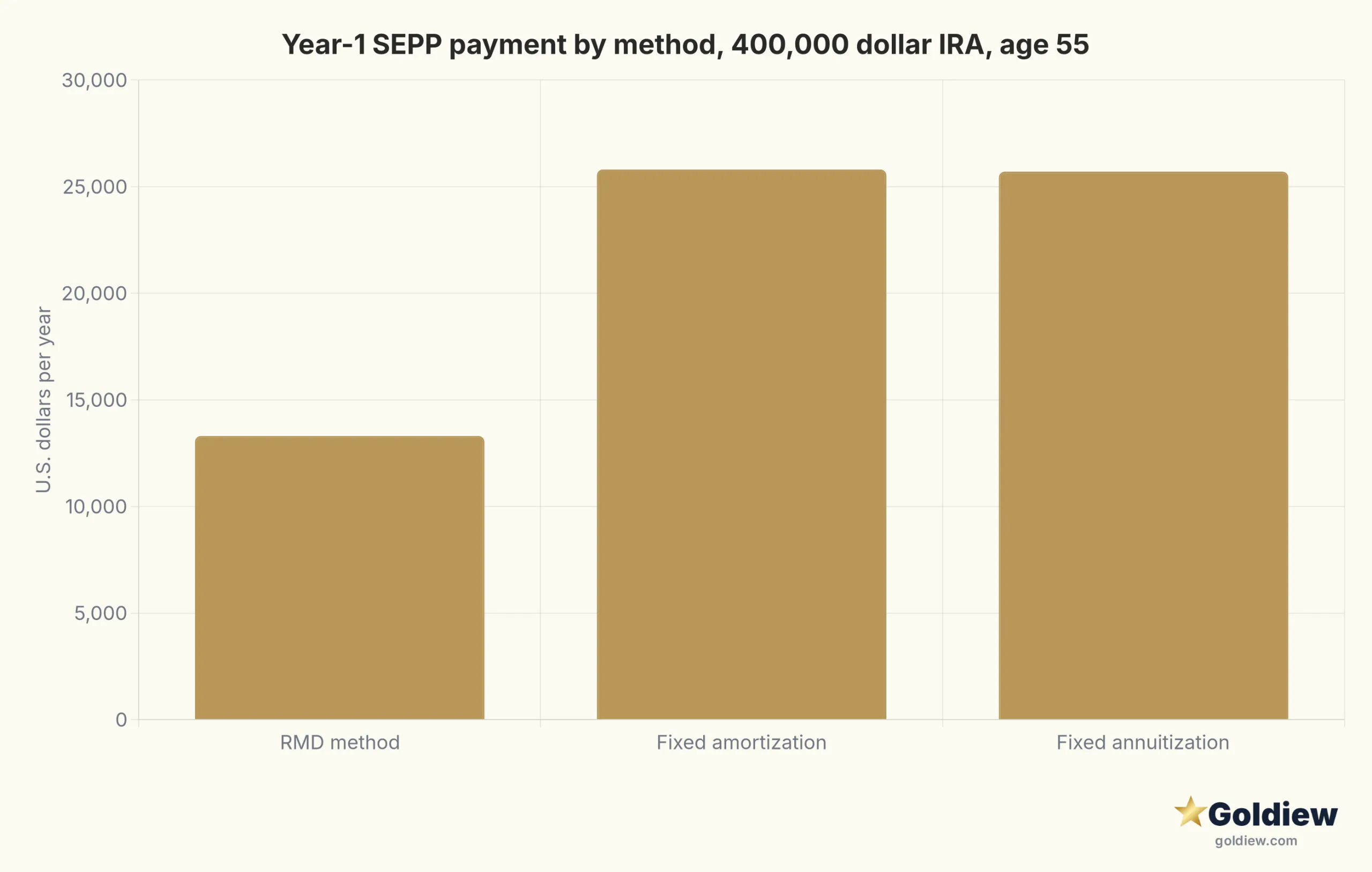

The figures use the single life expectancy table for an age 55 owner, factor 31.6 for the RMD method, and a 5 percent rate for the fixed methods. Actual factors and rates change with each calculation cycle. Always rerun the math at the time of the election with current IRS tables and the current applicable federal rate.
The example shows the structural trade-off. The fixed methods produce a higher payment but lock the number. The RMD method produces a lower starting payment that rises or falls each year with the balance. A SEPP set on a $400,000 IRA at age 55 must continue for the longer of 5 years or until age 59 and a half. For age 55, that is 5 years (the 5-year rule is the binding constraint). For age 58, the binding constraint is age 59 and a half. Running the same balance through all three methods side by side is straightforward with a 72(t) SEPP calculator built to current IRS tables.
How to Set Up a 72(t) SEPP: Step-by-Step
The setup sequence below mirrors how a CPA or financial advisor implements a SEPP in practice. Each step is documentable. The election should leave a clear paper trail at both the IRA custodian and in your personal records.
- Confirm the SEPP is the right tool. Compare the SEPP to other section 72(t) exceptions you may qualify for: disability, qualified higher education expenses, qualified first-time homebuyer expenses up to the statutory limit, qualified medical expenses above the deductibility threshold, and the Rule of 55 for a 401(k) of an employer you separated from. The IRS list is at Retirement Topics Exceptions to Tax on Early Distributions.
- Decide whether to split the IRA. A SEPP applies only to the source IRA. Splitting the IRA before electing the SEPP isolates the SEPP balance and leaves the other IRA fully flexible. The split is a trustee-to-trustee transfer and is not taxable. The split must be complete before the first SEPP distribution.
- Lock the starting balance. Notice 2022-6 says the account balance used in the calculation may be determined in any reasonable manner based on the facts and circumstances. The most defensible approach is the balance on the last business day of the month immediately before the first distribution. Document the date and the balance in writing.
- Select the calculation method. Compare the year-1 payment under each of the three methods on the actual balance. If the SEPP needs to produce a target annual cash amount, the fixed methods are usually the way to reach that amount. If the goal is the smallest required payment, the RMD method is usually the lowest.
- Select the interest rate (fixed methods only). Pull the federal mid-term applicable federal rate for each of the 2 months before the first distribution from the IRS AFR page. Multiply by 1.2. Compare the result to 5 percent. Use any rate up to the greater of the two. Document the rate used and the calendar months pulled.
- Select the life expectancy or annuity table. Notice 2022-6 lists the single life table, the uniform lifetime table, and the joint life and last survivor table for the RMD and amortization methods, plus an Appendix B mortality table for the annuitization method. Document the table used and the factor.
- Run the calculation and document each input. Save the worksheet showing balance, table, factor, interest rate, and result. Keep the worksheet for the full SEPP term plus the standard tax record retention period of at least 7 years.
- Set up the custodian payment schedule. The custodian needs a written SEPP election letter listing the calculated annual amount, the payment frequency (annual, semiannual, quarterly, monthly), and the method. Request a confirmation in writing from the custodian. Some custodians use IRS distribution code 2 (early distribution, exception applies) on Form 1099-R when notified of a SEPP in advance.
- Confirm the IRS code on Form 1099-R. If the custodian uses code 1 (early distribution, no known exception), you file IRS Form 5329 with your return to claim the section 72(t)(2)(A)(iv) exception. Keep the worksheet with the return.
- Calendar the annual review. For the RMD method, recalculate the next-year payment on the new balance and life expectancy factor each year. For the fixed methods, take exactly the same amount every year. Mark the calendar in advance of the year-end deadline.
- Monitor the no-modification rule. Do not take any extra distribution, do not roll a non-SEPP IRA into the SEPP IRA, do not stop early, and do not contribute to the source IRA during the SEPP term. Each of those is a modification under Notice 2022-6.
- Plan the end of the SEPP term. The term ends on the later of the 5-year anniversary of the first distribution or age 59 and a half. After the end date, the SEPP rules no longer apply and the source IRA returns to normal IRA rules.
The Modification Trap
The modification rule is what makes the SEPP a serious commitment. A modification before the end of the SEPP term is treated as if every distribution from the start had been subject to the 10 percent early withdrawal penalty, plus interest from the year each was taken. The penalty is owed on a single tax return, the return for the year of the modification.
The list of actions that count as a modification under Notice 2022-6 includes the following. The list is not exhaustive. Any change to the structure of the SEPP is risky.
- Taking any payment outside the SEPP schedule. Even a small extra distribution from the source IRA breaks the series.
- Stopping the payments early. The series must run through the full term.
- Contributing to the source IRA. New contributions to the SEPP IRA invalidate the series.
- Rolling another IRA into the source IRA. An incoming rollover changes the SEPP balance and counts as a modification.
- Rolling money out of the source IRA. A non-SEPP outbound rollover changes the balance and counts as a modification.
- Switching the SEPP method outside the permitted one-time switch. Going from RMD method to a fixed method, or switching twice, breaks the series.
The one permitted change is a single switch from the fixed amortization method or the fixed annuitization method to the required minimum distribution method. The switch is final and one-directional. Notice 2022-6 confirms this is not treated as a modification. The opposite switch, from RMD to a fixed method, is not allowed.
Custodian Setup Inside a Self-Directed Gold IRA
A self-directed IRA holding IRS-approved precious metals is a regular IRA for purposes of section 72(t). Internal Revenue Code section 408(m) sets the bullion fineness rules, and section 408 governs the IRA itself. A SEPP elected from a self-directed metals IRA must still meet the calculation, documentation, and no-modification rules.
The custodian mechanics introduce a few practical issues that do not exist on a brokerage IRA.
- Liquidity timing. Metal sales are not instant. The custodian works with a buyback partner or arranges a private market sale. Build several weeks of lead time before each SEPP payment date.
- In-kind distribution option. Some custodians can distribute metals in-kind at fair market value. The fair market value on the distribution date is the taxable amount. Document the price source.
- Reporting on Form 1099-R. The custodian reports the gross distribution and the distribution code. Confirm in writing before the first payment that the custodian will use code 2 if notified of the SEPP in advance, or that you will file Form 5329 if the custodian uses code 1.
- Account split before the SEPP. If the metals IRA holds multiple coin types and you want to isolate a portion for the SEPP, request a trustee-to-trustee transfer to a new self-directed IRA before the first SEPP distribution.
- Cash position planning. Holding a small cash sleeve inside the SEPP IRA reduces the need to sell metals at exactly the SEPP payment date.
The IRS does not maintain a list of approved gold IRA companies for purposes of section 72(t). Any IRA custodian that supports IRC section 408(m) metals can host the SEPP. The choice of custodian is about fee structure, buyback liquidity, and operational reliability, not SEPP eligibility.
Get Augusta’s free Gold IRA guide Education-First Process: Learn, Talk, Decide. Free, no obligation.Tax Reporting and Documentation
The IRS audits SEPP elections regularly because the modification penalty is large and the calculation is technical. Documentation is the single most important defense if the election is questioned later. Every input should be traceable to a published IRS table, an IRS-published AFR, and a written election letter.
- Form 1099-R from the custodian. The form reports the gross distribution. Box 7 contains the distribution code: 2 if the custodian recognizes the SEPP, 1 if not. The custodian copy goes to you and the IRS.
- Form 5329 with your federal return. If the custodian uses code 1, file Form 5329 to claim the section 72(t)(2)(A)(iv) exception on the distribution. Use exception code 02 on the form.
- SEPP election worksheet. Keep a signed worksheet showing the date of the first distribution, the starting balance, the interest rate, the table used, the factor, the calculated annual payment, and the chosen frequency. Sign and date the document.
- Annual review memo. For the RMD method, document each year’s recalculation. For the fixed methods, document that you took exactly the SEPP amount and nothing more.
- Custodian acknowledgment. Keep a written confirmation from the custodian that the schedule is the SEPP and that distributions on the schedule are coded accordingly.
Each payment is ordinary income on the federal return for the year received. State income tax follows state rules and varies. Consult a tax professional familiar with the state of residence for the SEPP term, because state conformity to federal SEPP treatment is not uniform.
Common SEPP Mistakes
The errors below show up in IRS audits and in the published cases on section 72(t). Most are avoidable with a careful pre-election worksheet and a documented annual review.
- Taking an extra distribution. A withdrawal of any amount outside the SEPP schedule from the source IRA breaks the series and triggers retroactive 10 percent penalties plus interest.
- Stopping a year early. Skipping the final SEPP year, or stopping before age 59 and a half if the 5-year clock has run, breaks the series.
- Rolling money into the source IRA. Inbound rollovers to the SEPP IRA are modifications. Direct any new IRA money to a separate IRA.
- Contributing to the source IRA. Annual contributions to the source IRA mid-SEPP break the series. Use a separate IRA for contributions.
- Using a non-IRS table. Only the IRS tables in Notice 2022-6 (or in earlier Rev Rul 2002-62 for older SEPPs) are valid. Custom or commercial tables are not.
- Using an out-of-date AFR. The interest rate must come from the federal mid-term AFR for one of the 2 months ending before the first distribution. Using an older or newer month invalidates the rate.
- Switching methods without documentation. The one-time switch from a fixed method to the RMD method is allowed but must be documented in a signed switch memo dated the year of the switch.
- Confusing 72(t) and the Rule of 55. The Rule of 55 waives the 10 percent penalty on distributions from a 401(k) of an employer you separated from in or after the year you turn 55. It is a separate exception. It does not apply to IRAs.
Who This Path Is Not For
The SEPP is a structured commitment with a steep penalty for mistakes. It does not fit every saver who wants pre-59-and-a-half access to retirement money. A few situations are usually better served by other tools.
- One-time large cash need. A SEPP forces multi-year payments. A different 72(t) exception, a Rule of 55 distribution from a 401(k), or a different funding source may serve a single cash need more cleanly.
- Income need that is variable. A fixed annual payment from a SEPP cannot be adjusted without triggering a modification. A non-SEPP IRA leaves flexibility.
- Plan to contribute to the source IRA during the term. Contributions to the SEPP IRA are modifications. Either change the plan or use a separate IRA.
- Small IRA balance. The math may produce a payment too small to matter.
- Uncertainty about the SEPP rules. A SEPP that is set up incorrectly is worse than no SEPP. If the documentation cannot be built and maintained for the full term, choose a different exception.
Related Goldiew Guides
The SEPP sits at the intersection of IRA rules, early retirement planning, and self-directed account mechanics. The companion guides below help fill in the surrounding context without crossing into tax or financial advice.
- 401(k) in-service rollover at age 55: how to move 401(k) money into an IRA while still employed.
- Can I contribute to a Gold IRA after RMD age?: contribution rules in coexistence with required minimum distributions.
- Can I deduct Gold IRA fees on taxes?: the post-TCJA rules on retirement account fees and itemized deductions.
- First 30 days with a Gold IRA: custodian onboarding, depository setup, and document flow.
- Best Gold IRA companies: methodology-driven comparison of self-directed precious metals IRA providers.
FAQ
What is a 72(t) SEPP early withdrawal?
A 72(t) SEPP is a series of substantially equal periodic payments from an IRA or, in limited cases, a qualified retirement plan, calculated under one of three IRS-approved methods. The series, once started, waives the 10 percent early withdrawal penalty on the included account but must continue for the longer of 5 full years or until you reach age 59 and a half. The exception is documented at Internal Revenue Code section 72(t)(2)(A)(iv) and explained in IRS Notice 2022-6.
What are the three IRS-approved SEPP calculation methods?
The three methods set by Rev Rul 2002-62 and updated by IRS Notice 2022-6 are the required minimum distribution method, the fixed amortization method, and the fixed annuitization method. The RMD method recalculates the payment each year using the account balance and a life expectancy factor. The amortization and annuitization methods produce a fixed annual payment for the entire SEPP series.
How long does a 72(t) SEPP have to last?
The series must continue without modification for the longer of 5 full years measured from the date of the first distribution or until the IRA owner reaches age 59 and a half. A modification before that point, such as taking an extra distribution, stopping the series, or contributing to the account, is treated as if the 10 percent early withdrawal penalty had applied to every distribution from the start, plus interest.
What interest rate can I use to calculate a SEPP under Notice 2022-6?
Under IRS Notice 2022-6, the interest rate used for the fixed amortization and fixed annuitization methods may be any rate not more than the greater of 5 percent or 120 percent of the federal mid-term applicable federal rate published by the IRS for either of the 2 months immediately before the first distribution. The applicable federal rates are published monthly by the IRS.
Can I switch SEPP methods after starting?
Yes, once. IRS guidance allows a one-time change from the fixed amortization method or the fixed annuitization method to the required minimum distribution method. The switch is not treated as a modification and does not retroactively apply the 10 percent penalty. The switch is one-way: from a fixed method to the RMD method, never back.
Can I run a 72(t) SEPP from a self-directed Gold IRA?
Yes, in principle. A self-directed IRA holding IRS-approved precious metals is still an IRA under Internal Revenue Code section 408 and is eligible for the 72(t) exception. The practical challenge is liquidity: the custodian must be able to sell metals or distribute in-kind on the schedule required by the SEPP. Confirm the sale and distribution process with the custodian before electing a SEPP.
Does a 72(t) SEPP avoid income tax on the distributions?
No. The 72(t) exception waives the 10 percent additional tax on early distributions. Each SEPP payment from a traditional IRA remains taxable as ordinary income in the year received. The IRA custodian reports the distributions on Form 1099-R and you report them on your federal return. Consult your tax advisor for your specific situation.
Can I split my IRA before starting a SEPP?
Yes. A common planning step is to split the IRA into two accounts before electing a SEPP. The SEPP applies only to the source IRA used for the calculation. The non-SEPP IRA stays untouched and is available for separate planning. The split must be a trustee-to-trustee transfer completed before the first SEPP distribution.
Sources and Methodology
This guide is based on the following authoritative sources. This is not tax or investment advice. Consult your tax and financial professional for your specific situation.
- Internal Revenue Code section 72(t), exceptions to the 10 percent additional tax on early distributions: law.cornell.edu/uscode/text/26/72#t
- IRS Notice 2022-6, Updated Life Expectancy and Distribution Period Tables for Section 72(t) Payments: irs.gov/pub/irs-drop/n-22-06.pdf
- Revenue Ruling 2002-62 (superseded by Notice 2022-6 for new SEPPs but cited for historical context): irs.gov/pub/irs-drop/rr-02-62.pdf
- IRS Topic 558, Additional Tax on Early Distributions from Retirement Plans: irs.gov/taxtopics/tc558
- IRS Retirement Topics, Exceptions to Tax on Early Distributions: irs.gov/retirement-topics-exceptions-to-tax-on-early-distributions
- IRS Publication 590-B, Distributions from Individual Retirement Arrangements: irs.gov/publications/p590b
- Internal Revenue Code section 408(m), collectibles exception and precious metals fineness: law.cornell.edu/uscode/text/26/408#m
- IRS Form 5329, Additional Taxes on Qualified Plans (Including IRAs): irs.gov/forms-pubs/about-form-5329
- IRS Applicable Federal Rates index page: irs.gov/applicable-federal-rates
- Augusta Precious Metals public website: augustapreciousmetals.com
Goldiew’s editorial methodology cross-references statutory text, IRS publications, and partner company public materials. We are not financial or tax advisors. Past performance is not a guarantee of future results.