
A Gold IRA inherited by a Pennsylvania resident is subject to Pennsylvania inheritance tax at a rate that depends on the relationship between the decedent and the beneficiary. The four rates run from 0% for a surviving spouse to 15% for a non-relative. The IRA wrapper, the age of the decedent at death, and the beneficiary designation on file with the custodian decide whether the tax applies and at what rate. This guide explains the rules, the rates, and the planning options for a Pennsylvania Gold IRA holder and the beneficiaries.
Consult your tax advisor for your specific situation. Goldiew is not a financial advisor and is not a tax advisor. The content on this page describes Pennsylvania inheritance tax rules at a general level for educational purposes. State tax statutes, Department of Revenue letter rulings, and court interpretations evolve. Engage a licensed Pennsylvania tax professional or estate attorney before acting on any item discussed here. Past performance is not a guarantee of future results.
Quick Answer
Pennsylvania inheritance tax on a Gold IRA runs 0% (spouse), 4.5% (lineal descendants and ascendants), 12% (siblings), or 15% (other heirs). The tax applies when the decedent had reached age 59 and a half at death, per longstanding Pennsylvania Department of Revenue guidance under 72 P.S. section 9111(r). The taxable value is the date-of-death fair market value reported on Form REV-1500, Schedule G. Form REV-1500 is due nine months from the date of death, with a 5% discount available for payment within three months.
Pennsylvania Inheritance Tax: The Basics
Pennsylvania is one of six states that imposes an inheritance tax, levied on the recipient of the inherited property. The tax is set out in the Pennsylvania Inheritance and Estate Tax Act, codified at 72 P.S. sections 9101 through 9196. Pennsylvania has no separate state estate tax; the inheritance tax is the only state-level transfer tax on property passing at death. The Pennsylvania Department of Revenue administers the tax through its Inheritance Tax Bureau.
The tax applies to property of a decedent who was a Pennsylvania resident at death, regardless of where the property is located. The tax also reaches real property and tangible personal property located in Pennsylvania even when the decedent lived in another state. A self-directed Gold IRA held by a Pennsylvania resident is treated as intangible personal property of the decedent and is included in the Pennsylvania taxable estate.
Pennsylvania Form REV-1500 is the inheritance tax return. The return is due within nine months of the date of death. A 5% discount on tax paid is available when payment is made within three months of the date of death, per 72 P.S. section 9136. The discount is meaningful for high-balance estates that include a Gold IRA, because the discounted payment can be substantially lower than the full tax.
Schedule G of REV-1500 is the schedule for transfers of intangible personal property, which is where an inherited IRA is reported. The custodian provides the date-of-death account statement. The beneficiary designation on file with the custodian controls who receives the IRA outside of the probate estate, but the value is still reported on Schedule G for Pennsylvania inheritance tax purposes.
Rates by Relationship to the Decedent
Pennsylvania inheritance tax rates are set by 72 P.S. section 9116 and are based on the relationship between the decedent and the beneficiary, not on the dollar amount transferred. The rate that applies to a Gold IRA inherited from a Pennsylvania resident depends entirely on who receives it.
| Beneficiary | Rate | Statutory basis |
|---|---|---|
| Surviving spouse | 0% | 72 P.S. § 9116(a)(1) |
| Parent inheriting from a child age 21 or younger | 0% | 72 P.S. § 9116(a)(1) |
| Lineal descendants and ascendants (children, grandchildren, parents) | 4.5% | 72 P.S. § 9116(a)(1.1) |
| Siblings (whole, half, or adopted) | 12% | 72 P.S. § 9116(a)(1.2) |
| All other heirs (nieces, nephews, cousins, friends, unrelated individuals) | 15% | 72 P.S. § 9116(a)(2) |
| Charitable organizations qualifying under federal Section 501(c)(3) | 0% | 72 P.S. § 9111(c) |


Pennsylvania does not stack the rate. The same 4.5% applies to a 100,000 USD Gold IRA and a 1,000,000 USD Gold IRA when the beneficiary is a child. The state has no progressive bracket; the relationship alone fixes the rate. This is different from federal estate tax, which applies a unified rate schedule. Federal estate tax is a separate exposure and applies only to estates above the current federal exemption, which is well above most Pennsylvania Gold IRA balances at the time of writing.
IRA vs Taxable Account: How the Pennsylvania Treatment Differs
A taxable brokerage account passes to a Pennsylvania beneficiary at fair market value on the date of death and is reported on REV-1500 Schedule B. The full date-of-death value is subject to inheritance tax at the applicable relationship rate. The beneficiary then takes the stepped-up basis under federal Internal Revenue Code section 1014 for future capital gains purposes.
A Gold IRA is treated differently in two ways. The IRA does not receive a stepped-up basis under federal law because IRAs hold pre-tax dollars in a traditional account; the beneficiary inherits the same tax character. The beneficiary pays ordinary federal income tax on future distributions under IRS Publication 590-B. A Roth IRA, by contrast, allows tax-free qualified distributions to the beneficiary, subject to the SECURE Act 10-year rule for most non-spouse beneficiaries.
For Pennsylvania inheritance tax, the key difference is the age 59 and a half rule. Under Pennsylvania Department of Revenue guidance summarized in 61 Pa. Code section 93.131 and in published letter rulings, a retirement account becomes taxable for inheritance tax when the decedent could have withdrawn the funds without the federal 10% early withdrawal penalty. A decedent who had reached age 59 and a half at death holds a taxable IRA for Pennsylvania purposes. A decedent who died before age 59 and a half, and was not disabled at death, holds an IRA exempt from Pennsylvania inheritance tax under 72 P.S. section 9111(r). This is a meaningful distinction at the planning stage.
The federal income tax treatment on the inherited Gold IRA continues regardless of the Pennsylvania result. A Pennsylvania child beneficiary of a 500,000 USD Gold IRA from a parent age 65 at death faces 4.5% Pennsylvania inheritance tax on the date-of-death value, plus federal income tax on each distribution taken under the SECURE Act 10-year payout window. The state and federal exposures are stacked, not exchanged.
Gold IRA Specific Treatment
The asset class inside the IRA does not change the inheritance tax treatment. Pennsylvania does not apply a special rule because the IRA holds physical gold, silver, platinum, or palladium rather than stocks or bonds. The IRS-approved bullion held by the custodian is reported at its date-of-death fair market value, the same as any other IRA asset.
The custodian and the depository are the source of the date-of-death valuation. For a self-directed Gold IRA with bullion at a depository such as Delaware Depository or International Depository Services, the depository issues an inventory statement listing each coin or bar with its weight, fineness, and quantity. The custodian applies the spot value at close of business on the date of death, plus any premium for IRS-approved coins where the secondary market trades at a premium to spot. The result is the fair market value reported on REV-1500 Schedule G.
One operational detail matters for Pennsylvania Gold IRA beneficiaries: the custodian, not the depository, files the federal Form 1099-R when the beneficiary takes a distribution. The depository ships the metal on the custodian’s instruction. The Pennsylvania inheritance tax is settled on the date-of-death value before any distribution is taken. A delay in shipping the metal to the beneficiary does not delay the Pennsylvania filing deadline.
Planning Strategies to Minimize Pennsylvania Tax
Several planning structures reduce the Pennsylvania inheritance tax exposure on a Gold IRA. Each strategy carries trade-offs and requires advisor input. The objective is to align the beneficiary designation, the timing, and the account type with the household’s overall estate plan.
The spousal exemption is the largest single lever. A Gold IRA passing to the surviving spouse is taxed at 0% in Pennsylvania, regardless of value. The spouse can later designate children or other beneficiaries, who would face the applicable rate at the surviving spouse’s death. Many married Pennsylvania residents structure the Gold IRA beneficiary as the spouse primary, children as contingent, to defer the inheritance tax exposure for one generation.
Lineal descendant beneficiaries receive the 4.5% rate. Naming children or grandchildren directly produces a lower rate than naming a non-relative or an unrelated friend. A Pennsylvania resident with no spouse and no children sometimes considers a charitable beneficiary for part of the IRA to capture the 0% charitable rate on that portion, leaving the rest to family.
Pennsylvania includes in the taxable estate any transfer made within one year of death that exceeds 3,000 USD per recipient, per 72 P.S. section 9107(c)(3). A retiree planning to gift cash to family from non-IRA sources should make those gifts well outside the one-year window. Gifts made earlier are excluded from the Pennsylvania inheritance tax base and reduce the future REV-1500 exposure.
A Roth IRA conversion years before death is a structure discussed by estate planners. The conversion pays federal income tax now, in exchange for tax-free Roth distributions to the beneficiary later. For Pennsylvania inheritance tax, the Roth IRA itself is still subject to inheritance tax on the date-of-death value at the relationship rate. The benefit is the elimination of the future federal income tax on the inherited Roth distributions for the beneficiary. We are not financial advisors. Consult a licensed advisor before making retirement decisions.
Three Beneficiary Case Patterns
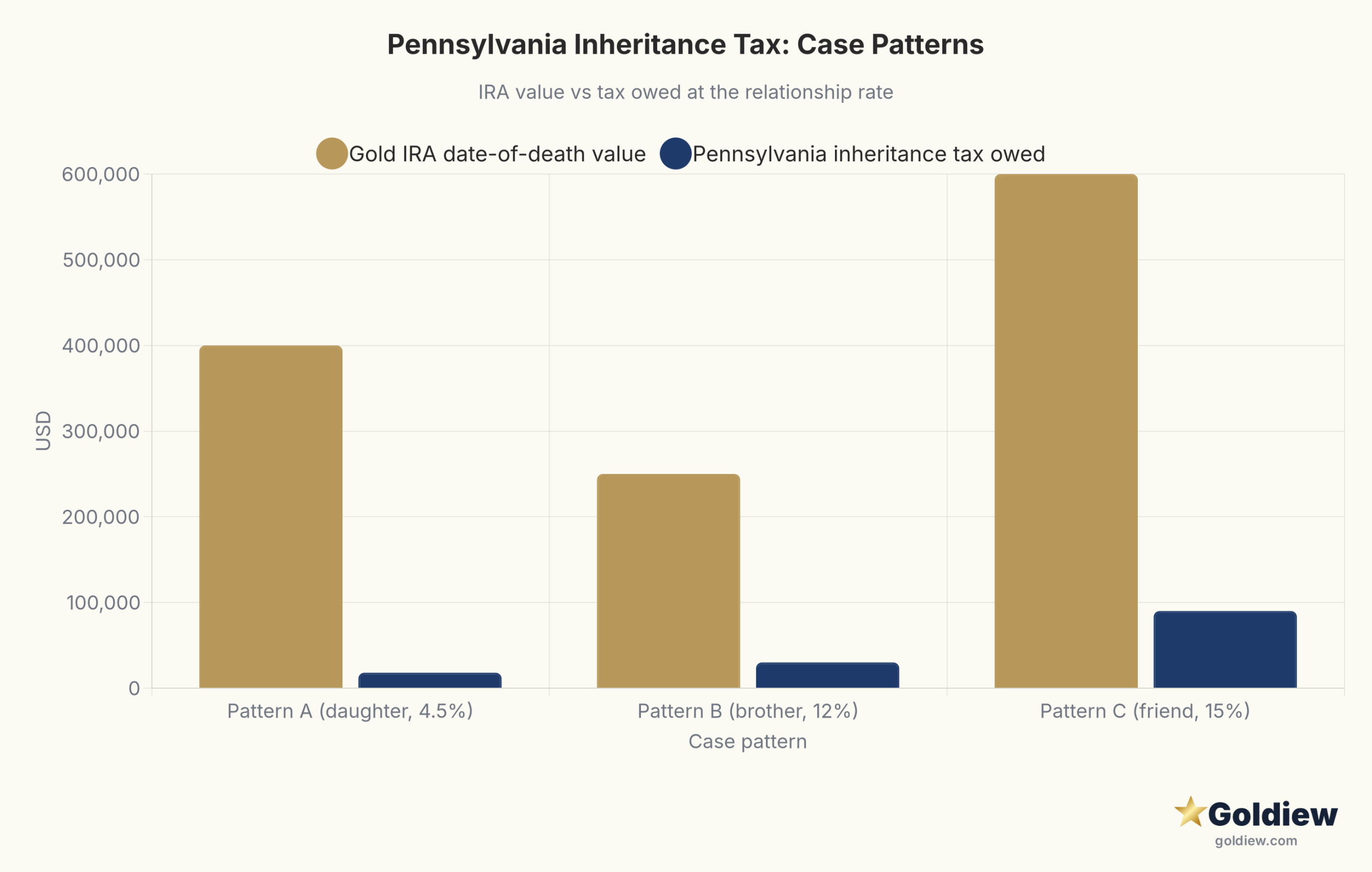
The following three patterns are illustrative of common Pennsylvania Gold IRA inheritance situations and do not represent any specific taxpayer. Each pattern shows how the rules above apply in practice.
Gold IRA of 400,000 USD, decedent age 72, sole beneficiary is the adult daughter
A retired Pennsylvania resident dies at age 72 with a self-directed Gold IRA valued at 400,000 USD at the depository on the date of death. The beneficiary designation names the decedent’s adult daughter. The 4.5% lineal descendant rate applies under 72 P.S. section 9116(a)(1.1). The Pennsylvania inheritance tax owed on the IRA is 18,000 USD. The executor files REV-1500 within nine months, paying within three months to claim the 5% discount, which reduces the cash payment by 900 USD. The daughter takes distributions under the SECURE Act 10-year rule and pays federal ordinary income tax on each distribution separately.
Gold IRA of 250,000 USD, decedent age 68, sole beneficiary is the decedent’s brother
An unmarried Pennsylvania resident dies at age 68 with no children, leaving a Gold IRA worth 250,000 USD to the decedent’s brother. The 12% sibling rate applies under 72 P.S. section 9116(a)(1.2). The Pennsylvania inheritance tax owed on the IRA is 30,000 USD. The brother evaluates whether to take a lump-sum distribution to fund the inheritance tax cash payment, accepting the federal ordinary income tax on the distribution, or to fund the tax from other personal assets to preserve the IRA’s tax-deferred growth for the 10-year payout window. The structure of the cash flow is a decision for the beneficiary with advisor input.
Gold IRA of 600,000 USD, decedent age 80, sole beneficiary is a longtime friend
A Pennsylvania resident dies at age 80 with no living spouse, children, or siblings, and a Gold IRA of 600,000 USD passing by beneficiary designation to a longtime friend. The 15% rate applies to other heirs under 72 P.S. section 9116(a)(2). The Pennsylvania inheritance tax owed on the IRA is 90,000 USD. This is the maximum Pennsylvania inheritance tax exposure for an IRA. Some Pennsylvania residents in this situation structure part of the IRA to a charitable beneficiary at 0% under 72 P.S. section 9111(c) and the balance to the individual, lowering the blended Pennsylvania tax. Federal income tax still applies separately for the individual beneficiary’s distributions.

Working with the Gold IRA Custodian on a Pennsylvania Inheritance
Self-directed Gold IRA custodians issue the date-of-death account statement that supports REV-1500 Schedule G. The executor or beneficiary requests this statement once a certified copy of the death certificate has been delivered. The depository provides the inventory listing of each bar or coin so the custodian can apply spot value plus premium where applicable.
For readers comparing Gold IRA providers as part of estate planning, the Augusta Precious Metals review on Goldiew covers the public methodology behind Augusta’s service model, the bullion catalog, and the depository options. Augusta does not provide tax advice. The value of working with an established Gold IRA provider is operational support across the beneficiary designation process and the post-death account servicing.
Related Goldiew Guides
Two companion guides cover adjacent questions that often arise in Pennsylvania Gold IRA estate planning.
- Gold value calculator: estimate the fair market value of physical gold by weight, purity, and current spot price. Useful for executors building the REV-1500 Schedule G valuation and for beneficiaries reviewing the depository inventory before requesting an in-kind distribution.
- Is your gold real?: practical authentication checks for physical gold. Relevant for beneficiaries who receive an in-kind distribution from the depository and want to verify each item against the Gold IRA inventory before storing it outside the depository.
Frequently Asked Questions
What are the Pennsylvania inheritance tax rates for a Gold IRA?
Pennsylvania applies four inheritance tax rates set by 72 P.S. section 9116: 0% to a surviving spouse and to a parent inheriting from a child under age 21, 4.5% to lineal descendants and ascendants (children, grandchildren, parents), 12% to siblings, and 15% to other heirs such as nieces, nephews, cousins, and unrelated individuals. A Gold IRA inherited by a Pennsylvania beneficiary is taxed at the rate that corresponds to the relationship between the decedent and the beneficiary. Consult your tax advisor for your specific situation.
Is a Gold IRA subject to Pennsylvania inheritance tax?
Yes, when the decedent had attained age 59 and a half at the time of death. Under longstanding Pennsylvania Department of Revenue guidance, retirement accounts including traditional IRAs, Roth IRAs, and self-directed Gold IRAs become taxable for inheritance tax purposes when the decedent could have withdrawn without the federal 10% early withdrawal penalty. An IRA of a decedent who died before age 59 and a half and who was not disabled is generally exempt under 72 P.S. section 9111(r). Consult your tax advisor for your specific situation.
How is a Gold IRA valued for Pennsylvania inheritance tax?
The taxable value is the fair market value of the Gold IRA on the date of death, reported on Pennsylvania Form REV-1500 Schedule G. For physical gold held inside a self-directed IRA, the depository or custodian provides a date-of-death statement reflecting the metal’s spot value plus any premium. Federal income tax basis is separate from the inheritance tax valuation. Past performance is not a guarantee of future results. Consult your tax advisor for your specific situation.
Does a surviving spouse pay PA inheritance tax on an inherited Gold IRA?
No. Pennsylvania exempts transfers to a surviving spouse from inheritance tax at a 0% rate per 72 P.S. section 9116(a)(1). A Gold IRA inherited by the surviving spouse is not subject to Pennsylvania inheritance tax. Federal income tax on subsequent distributions from the inherited IRA still applies under IRS Publication 590-B rules. Consult your tax advisor for your specific situation.
When is the PA inheritance tax return due for a Gold IRA?
Pennsylvania Form REV-1500 is due nine months from the date of death. A 5% discount applies to inheritance tax paid within three months of the date of death. Pennsylvania has no state estate tax, only this inheritance tax administered by the Pennsylvania Department of Revenue. Filing the discount payment requires a value estimate for the Gold IRA, which the custodian can provide on request. Consult your tax advisor for your specific situation.
How are siblings taxed on an inherited Gold IRA in Pennsylvania?
Siblings of the decedent are taxed at 12% on inherited assets including a Gold IRA, per 72 P.S. section 9116. A sibling is defined as a person who has at least one parent in common with the decedent (whole-blood, half-blood, or adopted siblings all qualify). The 12% rate applies to the fair market value of the Gold IRA on the date of death, less any allowable funeral expenses and administration costs allocated to that asset. Consult your tax advisor for your specific situation.
Can a Gold IRA owner reduce PA inheritance tax through gifting?
Pennsylvania includes in the taxable estate any transfer made within one year of death that exceeds 3,000 USD per recipient, per 72 P.S. section 9107(c)(3). A retiree planning to reduce the future inheritance tax base must gift outside that one-year window and from non-IRA assets, since IRA distributions still trigger federal income tax. A Roth IRA conversion years before death is one strategy discussed by estate planners. We are not financial advisors. Consult a licensed advisor before making retirement decisions.
What documents does a Gold IRA beneficiary need for PA inheritance tax?
Required documents include the date-of-death account statement from the Gold IRA custodian, the depository inventory of the physical metal, the decedent’s death certificate, the beneficiary designation form on file with the custodian, Form REV-1500 with Schedule G completed for the Gold IRA, and Form 5498 for the year of death. Federal Form 1099-R is issued in the year of any subsequent distribution to the beneficiary. Consult your tax advisor for your specific situation.
Sources and Methodology
This guide is based on the following authoritative sources. This is not tax or investment advice. Consult your tax and financial professional for your specific situation. Past performance is not a guarantee of future results.
- Pennsylvania Inheritance and Estate Tax Act, 72 P.S. sections 9101-9196: legis.state.pa.us
- Pennsylvania Department of Revenue Inheritance Tax overview: revenue.pa.gov/InheritanceTax
- Pennsylvania Form REV-1500, Inheritance Tax Return Resident Decedent: revenue.pa.gov/rev-1500.pdf
- Pennsylvania REV-1500 Instructions: revenue.pa.gov/Inheritance Forms
- 61 Pa. Code section 93.131, transfers of intangible personal property: pacodeandbulletin.gov
- IRS Publication 590-B, Distributions from Individual Retirement Arrangements: irs.gov/publications/p590b
- IRS Form 1099-R, Distributions from Pensions, Annuities, Retirement or Profit-Sharing Plans: irs.gov/about-form-1099-r
- IRS Form 5498, IRA contribution and fair market value reporting: irs.gov/about-form-5498
- SECURE Act of 2019, Public Law 116-94, 10-year payout rule for inherited IRAs: congress.gov SECURE Act
- FINRA Investor Insight, Self-Directed IRAs and the Risk of Fraud: finra.org/self-directed-iras
- SEC investor.gov, Self-Directed IRAs and the Risk of Fraud: investor.gov/self-directed-iras
- Augusta Precious Metals public website, bullion catalog and account servicing materials (verify current terms): augustapreciousmetals.com
Goldiew editorial methodology cross-references statutory text, Pennsylvania Department of Revenue guidance, IRS publications, and partner public materials. Pennsylvania inheritance tax interpretation evolves with administrative rulings and case law; this guide directs the reader to current guidance and a qualified tax advisor. We are not financial or tax advisors. Past performance is not a guarantee of future results.