
Ohio public employees retiring under OPERS often ask whether any part of the system can move into a gold IRA. The Traditional Pension Plan pays a monthly lifetime allowance and is not itself rollover-eligible, but five specific OPERS distribution paths are: a refund of contributions, the full Member-Directed Plan balance at separation, the defined contribution portion of the Combined Plan, the Partial Lump Sum Option Payment elected at service retirement, and certain death and survivor lump sums. Ohio Deferred Compensation, a separate 457(b) plan available to OPERS members, follows its own rollover process. This guide describes each operational path, the federal withholding mechanics, and how a self-directed IRA holding IRS-eligible physical metals receives the funds.
How OPERS pays retirees: three plan options under one system
The Ohio Public Employees Retirement System administers retirement benefits for state and local government employees in Ohio under three distinct plan options selected at enrollment: the Traditional Pension Plan, the Member-Directed Plan, and the Combined Plan (OPERS Retirement Plans). The plan a member chose governs how contributions accumulate, how the retirement benefit is calculated, and which distributions are rollover-eligible at separation or retirement.
The Traditional Pension Plan is a defined benefit plan. The allowance amount is calculated from years of service credit, a benefit factor tied to age at retirement, and final average salary under the formula in the member classification. The retiree receives a regular monthly payment for life. The defined benefit structure does not produce an account balance that can be transferred to an IRA at standard retirement, with one important exception described below for the PLOP election.
The Member-Directed Plan is a defined contribution plan. Member and employer contributions are invested in funds selected by the participant. The retirement benefit is the account balance at retirement. The full vested balance is rollover-eligible at separation or retirement, including to a traditional IRA or to a self-directed IRA holding IRS-eligible physical metals under IRC Section 408(m)(3).
The Combined Plan is a hybrid. Part of the contributions fund a smaller defined benefit and part fund a defined contribution account. The defined benefit portion pays a monthly allowance at retirement; the defined contribution portion is treated like a Member-Directed Plan account and is rollover-eligible at separation. Consult your tax advisor for your specific situation.
The five OPERS distributions that are rollover-eligible
Five OPERS distribution paths can move to an IRA, including a self-directed IRA holding IRS-eligible metals. Each path has its own eligibility window and its own administrative process at OPERS.
- Available only before retirement
- Member contributions plus accumulated interest, lump sum
- Employer contributions stay with OPERS in most categories
- Forfeits pension benefit unless prior service credit is later restored
- Direct rollover to IRA preserves tax deferral
- Traditional Pension Plan retirees only
- Elected at service retirement, one-time lump sum
- Permanent reduction in monthly allowance is the offset
- Rollover-eligible portion moves by direct rollover
- RMD-calculated portion is excluded from rollover
- Full vested account balance at separation or retirement
- Defined contribution account, member-directed investments
- Direct rollover to traditional IRA, including self-directed metals IRA
- Vesting schedule applies to the employer contribution portion
- Roth designated subaccounts may roll to a Roth IRA
- Defined contribution side only; defined benefit side pays as annuity
- Account balance rollover-eligible at separation
- Direct rollover process matches the Member-Directed Plan
- The defined benefit allowance is not rollover-eligible
- Two separate decisions at retirement, one per side
- Some OPERS death benefits pay as a lump sum to a survivor
- Eligibility depends on the deceased member status and election
- Lump sum portions may be rollover-eligible to a beneficiary IRA
- Spouse beneficiaries have different options than non-spouse beneficiaries
- Coordinate with the OPERS Survivor Benefits team
The monthly pension allowance under the Traditional Pension Plan is not on this list because it pays as a lifetime annuity rather than as an eligible rollover distribution. Ohio Deferred Compensation is a separate path through a different administrative entity and is described in its own section below. The decision about which path applies depends on the OPERS plan option, the member career status, age, and goals at the time of distribution.
Refund of contributions: pre-retirement only
An OPERS member who separates from OPERS-covered employment before retiring can request a refund of accumulated contributions and interest (OPERS Refund of Your Account). The refund is paid as a full lump sum of the member account. Ohio statute does not allow a partial refund. The full balance pays out or stays in the fund. There is no middle option.
The decision is significant. Taking the refund forfeits future OPERS retirement and survivor benefits tied to the service credit funded by those contributions. Employer contributions remain in the OPERS fund in most member categories and are not refunded. If the member later returns to OPERS-covered employment, prior service credit may be restored through redeposit, subject to additional rules and interest. The refund is irrevocable once processed. Consult a licensed advisor before making retirement decisions.
The federal tax treatment is also material. OPERS is required to withhold 20 percent federal income tax on a refund payment distributed directly to the member, even when the member states the intent to roll the funds over later (IRS rollovers reference). A direct rollover to an IRA, including a self-directed IRA holding IRS-eligible precious metals, avoids the mandatory 20 percent withholding because the funds move trustee to trustee and never reach the member personally. The rollover preserves the tax-deferred status under IRS Publication 590-A.
The 60-day rollover window applies to indirect rollovers, but the direct rollover process is the cleaner path because it avoids the withholding entirely. The receiving custodian deposits the funds and the rollover is reported on Form 1099-R. Once processed, the rollover removes the funds from OPERS and they are governed thereafter by the IRA rules.
If the member is under age 59 1/2 and does not roll over the funds, an additional 10 percent federal tax may apply on top of regular income tax on the distribution (IRS Topic 558). The direct rollover to an IRA preserves the tax-deferred status and avoids the early distribution penalty on the rolled portion. The Required Minimum Distribution rules also interact with the refund in narrow cases: if the member is past the applicable RMD age, the RMD-calculated portion must be taken as a direct payment and only the non-RMD portion is rollover-eligible. Consult your tax advisor for your specific situation.
Partial Lump Sum Option Payment at service retirement
The Partial Lump Sum Option Payment, PLOP, is an election available to a retiree under the OPERS Traditional Pension Plan at the time of service retirement (OPERS Payment Options). The retiree elects to receive part of the actuarial value of the lifetime allowance as a one-time payment at retirement. In exchange, the monthly allowance is permanently reduced by an actuarially calculated amount for life. The reduction is the offset for receiving cash up front instead of as future monthly payments.
The PLOP amount is constrained by OPERS rules and limits in place at the time of retirement. The election cannot be reversed once retirement is effective. A member considering a PLOP review the OPERS PLOP estimate, which compares the unmodified allowance to the reduced allowance under each PLOP amount. The estimate is the operational tool for evaluating the trade between the one-time payment and the lifetime monthly reduction. Consult a licensed advisor before electing.
The PLOP payment is reported on Form 1099-R. The rollover-eligible portion can move by direct rollover to a traditional IRA, including a self-directed IRA holding IRS-eligible metals. The Required Minimum Distribution exclusion applies: if the retiree is past the applicable RMD age, the RMD-calculated portion of the PLOP cannot be rolled over and must be taken as a direct payment. The non-RMD portion is rollover-eligible.
The 20 percent mandatory federal withholding applies to a PLOP payment delivered directly to the retiree. A direct rollover sent from OPERS to the receiving IRA custodian avoids the withholding because the funds never reach the retiree personally. The receiving custodian deposits the funds and the PLOP rollover is reported on Form 1099-R with code G. The reduced monthly allowance begins the same month service retirement begins and continues for life. Consult your tax advisor for your specific situation.
Member-Directed Plan and Combined Plan account rollovers
The OPERS Member-Directed Plan is a defined contribution plan in which the member directs the investment of member and employer contributions in OPERS-offered investment options. At separation or retirement, the participant can leave the balance in the plan, take a distribution, or roll the balance to another qualified retirement vehicle. A rollover to a traditional IRA, including a self-directed IRA holding IRS-eligible metals, follows the standard direct rollover process. The plan administrator processes the rollover paperwork and sends the funds to the receiving custodian.
The vesting schedule applies to the employer contribution portion of the Member-Directed Plan account. Member contributions vest immediately. Employer contributions vest over time per the OPERS schedule, and only the vested portion of the employer contributions can move to an IRA on separation. Unvested employer contributions are forfeited per OPERS rules. The Roth designated subaccount, if any, rolls to a Roth IRA rather than a traditional IRA.
The OPERS Combined Plan splits contributions between a smaller defined benefit and a defined contribution account. At retirement the defined benefit side pays a smaller monthly allowance for life. The defined contribution side functions like a Member-Directed Plan account: rollover-eligible at separation or retirement, subject to the vesting schedule on employer contributions, with the same direct rollover process to a qualified IRA. A Combined Plan retiree often faces two distinct decisions at retirement, one for each side. CalPERS members face a parallel hybrid question; the CalPERS to Gold IRA Rollover covers which distributions are eligible.
Required minimum distribution rules apply to the account-based portion of the Member-Directed Plan and the defined contribution side of the Combined Plan starting at the applicable SECURE Act 2.0 age (IRS RMD page). The RMD must be distributed first in any RMD year, then the remaining balance may be rolled over. Rolling over an RMD by mistake creates an excess contribution in the receiving IRA, subject to additional excise taxes until corrected (IRS Publication 590-B).
Ohio Deferred Compensation 457(b) rollover process
Ohio Deferred Compensation, known as Ohio DC, is a voluntary governmental 457(b) plan administered by the Ohio Public Employees Deferred Compensation Board, separate from OPERS (Ohio Deferred Compensation). Public employees in Ohio whose employers participate in the program can defer salary on a pre-tax or Roth basis up to the annual IRS limits. The Ohio DC account balance at any time is the sum of contributions, investment earnings, and any plan fees and distributions.
At separation from a participating Ohio public employer, the Ohio DC participant can leave the balance in the plan, take a distribution, or roll the balance to another qualified retirement vehicle. A rollover to a traditional IRA, including a self-directed IRA holding IRS-eligible metals, follows the standard direct rollover process. The pre-tax balance rolls to a traditional IRA. The Roth designated subaccount rolls to a Roth IRA. The plan administrator processes the rollover paperwork and sends the funds to the receiving custodian.
Governmental 457(b) plans, including Ohio DC, are not subject to the 10 percent early withdrawal tax that applies to 401(k) and 403(b) early distributions (IRS Section 457(b) reference). A participant who separates before age 59 1/2 and takes a direct cash distribution from Ohio DC generally avoids the 10 percent additional tax that other employer plans impose. Rolling the balance to a traditional IRA changes this: the IRA early withdrawal rules then apply to subsequent IRA distributions before age 59 1/2.
The still-working exception that delays RMDs for governmental 457(b) plans applies plan by plan: a participant who continues working for the same Ohio DC-participating employer past the applicable RMD age may delay Ohio DC RMDs until separation. The exception does not apply to an Ohio DC balance from a former employer. The exception also does not apply to IRAs. Consult your tax advisor for your specific situation.
Funding a self-directed gold IRA from an OPERS source
A self-directed IRA holding IRS-eligible physical precious metals receives the rollover from OPERS or Ohio DC through the same trustee-to-trustee process used for any other employer plan rollover. The receiving custodian is a qualified self-directed IRA custodian, not OPERS. The custodian accepts the rollover check or wire, credits the funds to the new IRA, and the participant then directs the purchase of eligible metals through a precious metals dealer. The metals are stored at an IRS-approved depository in the name of the custodian. Texas TRS members use the same trustee-to-trustee process; the TRS Texas rollover to IRA details what that plan makes eligible.
Eligible metals under IRC Section 408(m)(3) must meet purity standards: 99.5 percent fine for gold, with a statutory carve-out for American Gold Eagles, 99.9 percent for silver, and 99.95 percent for platinum and palladium. Collectible coins outside these standards are not eligible. The participant does not take physical possession until a qualifying distribution event. An in-kind distribution can ship the actual metal to the participant at that point, or the metal can be sold inside the IRA and the cash distributed.
The operational sequence for an OPERS rollover into a gold IRA generally runs as follows. First, open the self-directed IRA with a chosen custodian. Second, submit the rollover request to OPERS, or to Ohio DC if the source is the 457(b) plan, using the form for the path involved. Third, OPERS or Ohio DC issues the rollover check made payable to the new custodian for the benefit of the participant. Fourth, the participant delivers the check to the custodian. Fifth, the custodian credits the funds and the metals purchase is executed at the custodian instruction. A gold value calculator helps reconcile the dollar amount of the rollover with the spot value and premium of the eligible products being purchased.
If the rollover follows a refund, a PLOP, or an account distribution and the member is past the applicable RMD age, the RMD-calculated portion cannot be rolled over and must be taken as a direct payment. The non-RMD portion is rollover-eligible. The same rule applies to an Ohio DC rollover after the RMD year begins: the RMD must be distributed first from Ohio DC, then the remaining balance may be rolled over. Rolling over an RMD by mistake creates an excess contribution in the receiving IRA, subject to additional excise taxes until corrected.
Physical authentication of bullion received in an in-kind distribution is a separate concern. The custodian and the depository deliver the metal as documented in their records, but the recipient is responsible for verifying weight, purity marks, and packaging integrity on receipt. Reference materials on how to verify physical gold describe the home tests and the limits of each. The in-kind distribution is then a taxable event reported on Form 1099-R, with the fair market value of the metal as the distribution amount. Consult your tax advisor for your specific situation.
Three scenarios for Ohio public employees
The scenarios below illustrate the rules with hypothetical fact patterns common among OPERS members. The scenarios are illustrative. They do not recommend a specific election or rollover decision. Tax outcomes depend on filing status, state of residence, other income, and timing. Consult your tax advisor and a licensed advisor before electing.
Scenario A: County employee, age 57, leaving OPERS-covered employment under the Traditional Pension Plan with 9 years of service credit
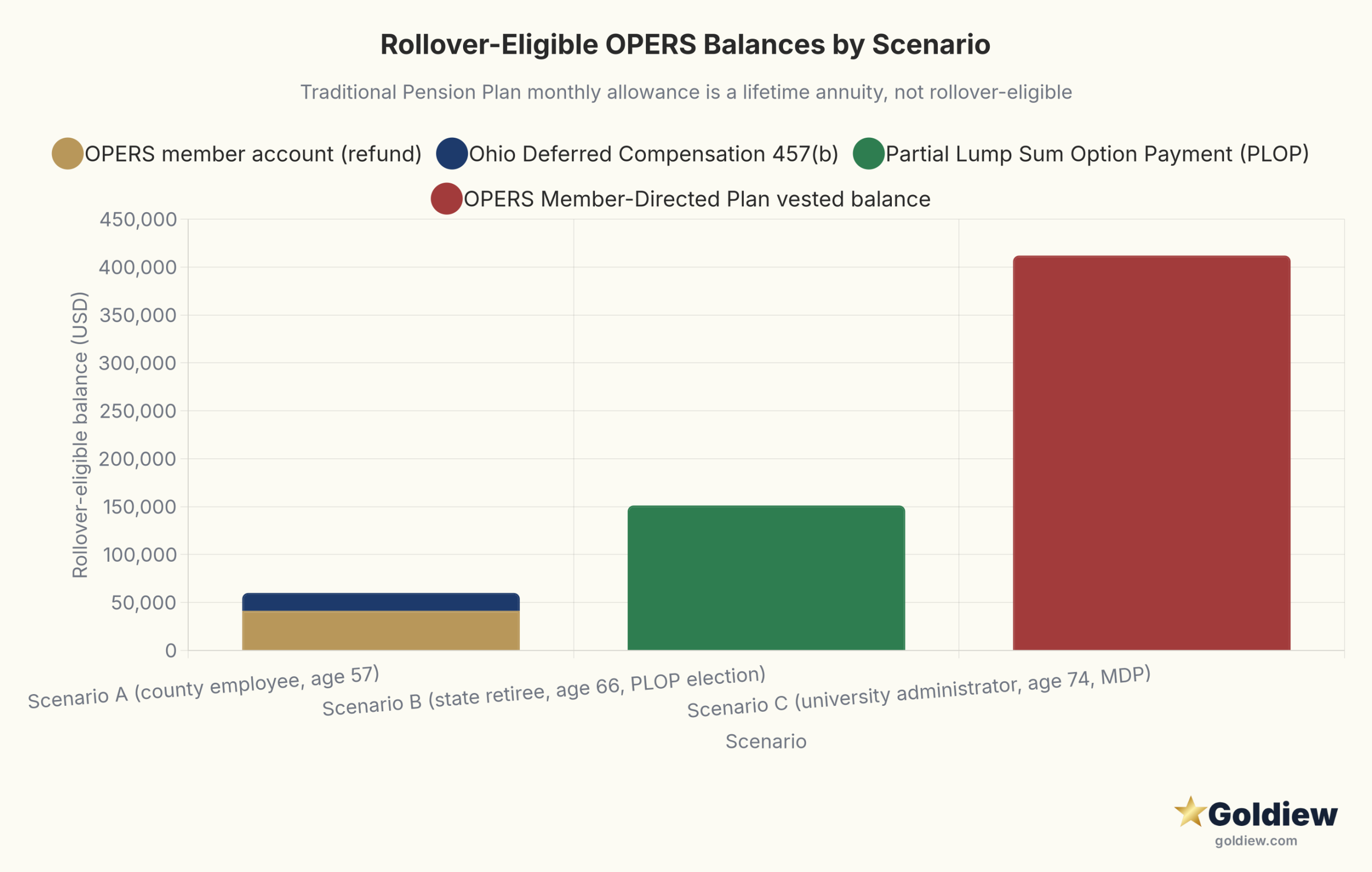
Anonymized profile based on a county employee who moves to a non-OPERS private-sector employer before reaching age 60 retirement eligibility. OPERS Traditional Pension Plan member account balance: 41,200 dollars. Ohio DC account balance: 18,700 dollars. The employee is under age 59 1/2.
Path 1 applies for the OPERS member contributions: a refund of contributions is available. Taking the refund as a direct payment triggers the 20 percent mandatory federal withholding and may trigger an additional 10 percent federal tax because the employee is under 59 1/2. A direct rollover to a traditional IRA, including a self-directed IRA holding IRS-eligible metals, preserves the tax-deferred status and avoids the early distribution penalty on the rolled portion. The refund forfeits the future OPERS pension benefit tied to that service credit unless prior service credit is later restored through redeposit.
For the Ohio DC balance, the participant can roll the balance to the same IRA in a separate direct rollover transaction. Ohio DC, as a governmental 457(b), would not have been subject to the 10 percent early withdrawal tax even as a cash distribution, but rolling to an IRA changes the early withdrawal rules going forward to the IRA rules.
Scenario B: Retired state employee, age 66, receiving an OPERS Traditional Pension Plan allowance and electing PLOP at service retirement
Anonymized profile based on a fully retired state employee under the Traditional Pension Plan. Unmodified service retirement allowance estimate: 4,200 dollars per month. The retiree elects a Partial Lump Sum Option Payment at service retirement equal to 36 months of the unmodified allowance, with an actuarially calculated permanent reduction in the monthly allowance for life.
The PLOP payment is reported on Form 1099-R. Because the retiree is past 59 1/2 and under the applicable RMD age, the entire PLOP payment is rollover-eligible. A direct rollover to a self-directed IRA holding IRS-eligible metals avoids the 20 percent mandatory federal withholding. The reduced monthly allowance begins the same month retirement begins and continues for life.
The retiree tax position drives the election. A cash PLOP is ordinary income in the year received and may push the retiree into a higher federal marginal bracket. A direct rollover defers the federal tax until the IRA pays out distributions in future years. The IRA required minimum distribution rules will apply when the retiree reaches the applicable RMD age under the SECURE Act 2.0. Consult your tax advisor for your specific situation. Maine public employees face the same tax trade-off; the MainePERS rollover covers which distributions their plan makes eligible.
Scenario C: Public university administrator, age 74, still working past the applicable RMD age, Member-Directed Plan participant
Anonymized profile based on a senior public university administrator who continued working past the SECURE Act 2.0 RMD age of 73. OPERS Member-Directed Plan vested account balance: 412,000 dollars. The administrator is not a 5 percent owner and continues full-time employment. No Ohio DC balance.
The Member-Directed Plan is treated under the federal RMD rules applicable to a defined contribution plan within a governmental retirement system. RMD treatment of the Member-Directed Plan during continued OPERS-covered employment is plan-specific; the administrator confirms the RMD schedule with the OPERS plan administrator and a tax advisor before separation.
Once the administrator separates, any RMD due for that year must be taken as a direct payment from the Member-Directed Plan account before the remaining balance is rolled over to a self-directed IRA holding IRS-eligible metals. The 20 percent mandatory federal withholding is avoided on the rollover-eligible portion by sending the funds trustee to trustee. The IRA RMD schedule then applies in subsequent years.
Sources and methodology
This guide describes the OPERS distribution rules and federal tax treatment under the Internal Revenue Code and current IRS guidance. It does not give allocation, investment, tax, or retirement advice. Each factual claim links to a primary institutional source. Individual circumstances and Ohio state tax rules may modify the federal rules described here.
- OPERS Retirement Plans: overview of the three OPERS plan options and the benefit structure under each.
- OPERS Refund of Your Account: refund eligibility, tax treatment, mandatory federal withholding, and rollover treatment.
- OPERS Payment Options at Retirement: PLOP election and lifetime allowance options.
- Ohio Deferred Compensation: Ohio DC 457(b) plan overview and rollover process.
- IRS Publication 590-A: Contributions to Individual Retirement Arrangements (IRAs).
- IRS Publication 590-B: Distributions from Individual Retirement Arrangements (IRAs).
- IRS Required Minimum Distributions reference page.
- IRS Section 457(b) deferred compensation plans reference.
- IRS Rollovers of Retirement Plan and IRA Distributions reference page.
- IRS Topic 558: Additional tax on early distributions from retirement plans.
- 26 U.S. Code Section 408 (Cornell Law), individual retirement accounts, including the precious metals carve-out at subsection (m)(3).