
Quick answer
A 2006 U.S. Treasury rule (31 CFR Part 82) bans melting, treating, or exporting pennies and nickels because their metal content exceeds their face value. Pre-1965 dimes, quarters, and half dollars made of 90% silver can be melted legally, as can gold coins, since the temporary silver-melt ban of 1967 was lifted by 1969 and gold ownership restrictions were repealed in 1974. Violations of the penny and nickel rule carry fines up to $10,000 and up to five years in prison.
Is It Legal to Melt US Coins? Pennies, Nickels, Silver, and Gold Answered
Whether you have a drawer full of pennies or a bag of pre-1965 silver dimes, the answer to “can I legally melt these?” depends entirely on the denomination. Federal law draws a sharp line between base-metal circulating coins and silver or gold coins, and that line determines what refiners can and cannot process legally.
Coin Melting Legality at a Glance
| Coin | Metal Content | Legal to Melt? | Authority |
|---|---|---|---|
| Penny (post-1982, zinc core) | 97.5% zinc, 2.5% copper | No | 31 CFR Part 82 |
| Penny (1909-1982, copper core) | 95% copper | No | 31 CFR Part 82 |
| Nickel (modern) | 75% copper, 25% nickel | No | 31 CFR Part 82 |
| Dime, post-1965 (clad) | 91.67% copper, 8.33% nickel | Yes | No current restriction |
| Quarter, post-1965 (clad) | 91.67% copper, 8.33% nickel | Yes | No current restriction |
| Pre-1965 dime, quarter, half (90% silver) | 90% silver, 10% copper | Yes | Silver melt ban lifted 1969 |
| Kennedy half dollar, 1965-1969 (40% silver) | 40% silver, clad | Yes | No current restriction |
| War nickel, 1942-1945 (35% silver) | 35% silver, 56% copper, 9% manganese | Legally uncertain; see note below | 31 CFR Part 82 may apply |
| US gold coins (Eagles, Buffalos, pre-1933) | 91.67% or 99.9% gold | Yes | No restriction since 1975 |
The war nickel entry carries a note because these 5-cent coins were struck as nickels and fall technically within the denomination covered by 31 CFR Part 82. The silver content complicates the economic calculus, but the legal text covers all 5-cent coins regardless of composition. Anyone holding war nickels for their silver content should consult a numismatist or attorney before melting.
Why Pennies and Nickels Are Protected: The Economics of the Ban
The ban on melting pennies and nickels exists because those coins cost the government more to produce than they are worth at face value. When the metal inside a coin is worth more than the coin itself, anyone with smelting equipment can profit by destroying circulating currency, draining coins from everyday transactions and forcing taxpayers to fund replacement production.
The U.S. Mint reports to Congress each year on production costs by denomination. In recent annual reports, the Mint has disclosed that it costs more than one cent to produce a penny and more than five cents to produce a nickel, once minting, distribution, and materials are factored in. The nickel’s 75-percent copper composition made its melt value especially vulnerable to copper price swings during the mid-2000s commodity run.
The Treasury Department responded by issuing a final rule on December 14, 2006, effective the same day, codified as 31 CFR Part 82. The rulemaking authority derives from 31 U.S.C. 5111(d), which gives the Secretary of the Treasury power to limit or prohibit the export, melting, or treatment of coins when the Secretary determines it is necessary to protect the coinage of the United States.
The Penny and Nickel Prohibition: What 31 CFR Part 82 Actually Says
Under 31 CFR § 82.1, no person may export, melt, or treat any 5-cent coin or any one-cent coin of the United States except as authorized by the Secretary of the Treasury. The term “treat” covers any process intended to alter the coins in preparation for melting, including shredding, dissolving, or chemically processing.
The rule applies to every penny and nickel in circulation, without regard to date, condition, or composition variant. A 1943 steel penny struck during the wartime copper shortage, a valuable 1909-S Lincoln cent, and a current-year cent fresh from a bank roll are all equally covered by § 82.1. The denomination controls, not the age or value.
Export Limits Under § 82.2
Section 82.2 provides a limited exception for travelers and small-scale commercial activity. Under those provisions, individuals may export up to $5 face value in pennies and nickels combined for personal purposes. That limit rises to $25 when the purpose is clearly numismatic, recreational, or for personal amusement. Commercial exporters may ship up to $100 face value in a single shipment without triggering the prohibition. Quantities above those thresholds require Treasury authorization, and unauthorized export is treated the same as unauthorized melting under the penalty provisions.
Penalties for Violation
Under 31 CFR § 82.4, a person who melts, treats, or exports pennies or nickels in violation of § 82.1 is subject to the penalties established in 31 U.S.C. 5111(d): a fine of not more than $10,000 and/or imprisonment of not more than five years. Under § 82.4(b), additional penalties under 18 U.S.C. 1001 (false statements to the federal government) may apply where a violation involves misrepresentation to authorities.
Enforcement has focused primarily on commercial-scale melting operations rather than isolated individual acts. No widespread federal prosecution for a private individual melting a handful of cents has been publicly reported. The regulation nonetheless carries real federal criminal exposure, and the penalties scale with the quantity involved. A refiner or scrap dealer processing penny rolls is in a materially different position than someone fusing a few coins in a backyard experiment.
Pre-1965 Silver Coins: Fully Legal to Melt
The legal picture for 90 percent silver coins is the opposite of the penny and nickel situation. Pre-1965 Roosevelt dimes, Washington quarters, Franklin and Kennedy half dollars (1964 and earlier), and Morgan and Peace dollars are entirely legal to melt today. Refiners process them routinely, and buying or selling them by the ounce of silver content is a normal commercial activity.
The History: How the Silver Melt Ban Came and Went
This was not always the case. After the Coinage Act of 1965 removed silver from dimes and quarters and reduced the Kennedy half to 40 percent silver, pre-1965 coins began disappearing from circulation almost immediately. The economic dynamic at work is Gresham’s Law: people hoard money with higher intrinsic value and spend money with lower intrinsic value. Silver-rich coins were being pulled from commerce and stored, creating a coin shortage.
Congress responded in 1967 by temporarily banning the melting and export of US silver coins, to slow the drain on the existing silver coin supply. The restriction was a holding measure, not a permanent policy. By 1969, the Treasury Department had determined that the immediate coin-supply emergency had passed and lifted the melting prohibition on pre-1965 silver coinage.
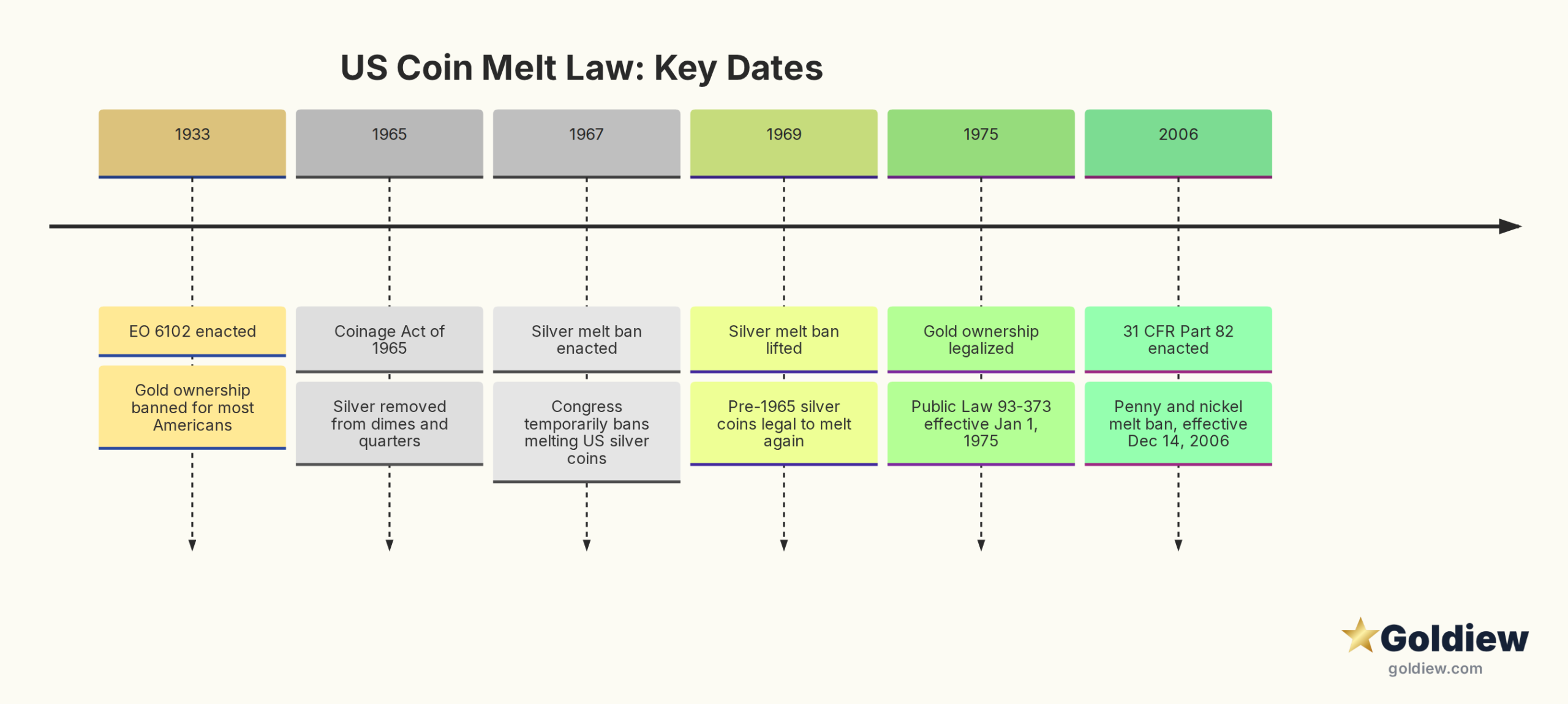

Since 1969, melting 90 percent silver US coins has been entirely legal. Today, the term “junk silver” describes pre-1965 dimes, quarters, halves, and dollars priced purely for their silver weight, with no numismatic premium. A bag of 715 ounces of silver worth of pre-1965 quarters (the standard “junk silver bag” containing $1,000 face value) is a commodity traded openly between dealers, refiners, investors, and collectors. Selling it, melting it, or shipping it to a refiner is all lawful.
40 Percent Silver Kennedy Halves (1965-1969)
Kennedy halves from 1965 through 1969 use a different composition: 40 percent silver in a clad sandwich construction. No current federal regulation prohibits melting them. Their silver content is lower per coin than the pre-1965 halves, but they are commonly traded as silver by weight alongside the earlier coins. The calculation is different (each coin contains approximately 0.1479 troy ounces of silver) but the legal status is the same: legal to melt.
Gold Coins: Legal to Own and Melt Since 1975
Americans were barred from owning gold in meaningful quantities for four decades. Executive Order 6102, signed in 1933, required most citizens to surrender gold above a small personal-use threshold to the Federal Reserve at a fixed price. The Gold Reserve Act of 1934 reinforced those restrictions and made private gold hoarding a federal offense. Coin collectors could retain gold coins of recognized numismatic value, but the general population had no legal pathway to hold gold bullion or non-numismatic gold coins.
That changed with Public Law 93-373, signed in December 1974 and effective January 1, 1975, which repealed the restrictions on private gold ownership. From that date forward, US citizens have been free to buy, sell, store, and melt gold coins and bars without restriction under federal gold-ownership law. American Gold Eagle coins, Gold Buffalo coins, and pre-1933 historic US gold pieces can all be legally melted today.
The economic question of whether melting is wise is separate from whether it is legal. A high-grade pre-1933 Saint-Gaudens double eagle may be worth several times its gold content as a numismatic collectible. A common modern Gold Eagle bought recently at a small premium over spot would lose that premium at a refiner. But neither melting decision involves a legal violation.
Post-1965 Clad Dimes and Quarters: No Restriction, No Economic Incentive
Modern dimes and quarters minted since 1965 are copper-nickel clad with no silver content. The metals in those coins are worth less than their face value, which means there is no arbitrage opportunity in melting them. The regulation at 31 CFR Part 82 does not mention dimes or quarters, and no separate Treasury rule restricts them today.
In practical terms, a coin dealer or refiner has no interest in processing post-1965 clad dimes and quarters for metal value. The economics do not support it. The absence of a legal ban on these coins is a reflection of that economic reality: when the melt value falls below face value, the incentive to melt disappears and regulation becomes unnecessary.
Check Numismatic Value Before You Melt Anything
Melting a coin permanently destroys any collector premium it might carry. A typical bag of junk silver is made up of heavily circulated, low-value coins, but the same bag can contain key-date issues, mintmark varieties, or error coins worth substantially more than their silver content. Dealers, pawn shops, and online buyers each pay differently, and where to sell silver breaks down what each channel typically offers per ounce.
The practice recommended by serious numismatists is straightforward: examine any lot before melting, or have it examined by a professional. A coin show dealer will often do a quick assessment at no charge. For any coin that might have collector interest, a grading service like PCGS or NGC can assign an accurate grade and flag scarce varieties. The time invested before melting can return many times its cost if a valuable piece is in the lot.
For a practical guide to identifying and sourcing junk silver, see our overview of coin roll hunting. If you want to understand spot-based melt value before selling or melting, our precious metals melt value guide walks through the calculation. And before you consider cleaning any coin to improve its appearance, read our explanation of why cleaning a coin destroys its numismatic value.
Do You Run a Coin Shop or Pawn Business?
Coin dealers and pawn shops routinely field questions from customers wanting to know whether their coins can be melted and what they are worth in silver or gold content. A free Goldiew business profile puts your shop in front of local buyers and sellers searching by city for a coin dealer or gold buyer near them. Listing takes a few minutes and costs nothing. Claim your Goldiew business profile or register a new listing to connect with customers in your area.
Frequently Asked Questions
Is it illegal to melt pennies in the United States?
Yes. Under 31 CFR § 82.1, enacted by the U.S. Treasury in December 2006, melting, treating, or exporting one-cent coins is prohibited. The penalty under 31 CFR § 82.4, referencing 31 U.S.C. 5111(d), is a fine of not more than $10,000 and/or imprisonment of not more than five years.
Can I melt pre-1965 silver dimes and quarters?
Yes. Pre-1965 dimes, quarters, and half dollars made of 90 percent silver are legal to melt. A temporary federal ban on silver coin melting, in effect during the late 1960s, was lifted by 1969. Refiners process these coins routinely, and buying or selling them by their silver weight is lawful.
What is the penalty for melting pennies?
Under 31 CFR § 82.4 and 31 U.S.C. 5111(d), melting pennies in violation of 31 CFR § 82.1 carries a fine of not more than $10,000 and/or imprisonment of not more than five years. Additional penalties under 18 U.S.C. 1001 may apply where misrepresentation to federal authorities is involved.
Are war nickels (1942-1945) covered by the nickel melting ban?
War nickels were struck as 5-cent coins and 31 CFR Part 82 covers 5-cent coins without distinguishing composition. The silver content of war nickels creates economic interest beyond that of modern nickels, but the denomination-based language of the regulation may encompass them. Anyone holding war nickels for their silver content should seek legal guidance before melting rather than assuming they fall outside the prohibition.
Is it legal to melt a Gold Eagle or Buffalo coin?
Yes. Private gold ownership and the right to melt gold coins has been legal in the United States since January 1, 1975, following Public Law 93-373. American Gold Eagles, Gold Buffalos, and pre-1933 historic US gold coins can all be legally melted. Whether doing so is economically sensible depends on whether the specific coin carries a numismatic premium above its gold content.
Can I legally carry pennies and nickels out of the country?
A limited amount. Under 31 CFR § 82.2, you may export up to $5 face value of pennies and nickels for personal purposes, or up to $25 when the purpose is clearly numismatic or recreational. Commercial shipments of up to $100 face value in a single shipment are also exempt. Beyond those thresholds, export is prohibited by the same rule that bans melting.
Why are post-1965 clad quarters and dimes not banned from melting?
Because the economics do not require a ban. Post-1965 quarters and dimes are copper-nickel clad with no silver, and their metal content is worth less than face value. The penny and nickel prohibition exists precisely because those coins cost more to produce than they are worth. When a coin’s metal value is below its face value, there is no melting incentive and no need for regulation.
Where can I sell pre-1965 silver coins rather than melting them?
Coin dealers, pawn shops, precious metals buyers, and online silver dealers all buy 90 percent silver coins at or near the silver spot price, minus a margin for refining or resale. Before selling, knowing the current silver spot price and the specific silver content of your coins helps you evaluate offers. Our precious metals melt value guide walks through the weight and purity calculation.
Does the coin melting ban apply to foreign coins in the United States?
No. 31 CFR Part 82 applies only to US one-cent and 5-cent coins. Foreign coins, including silver or gold coins from other countries, are not covered by this regulation. Melting a Canadian silver maple or a Mexican Libertad in the United States is not prohibited under this federal rule, though other regulations may apply depending on the specific circumstances.
I found old coins in an estate. Can I melt them for their silver value?
If the coins are pre-1965 US dimes, quarters, or half dollars, or Kennedy halves from 1965 to 1969, melting them is legal. Before melting any estate coins, though, a professional evaluation is worth the small cost. Estate lots sometimes contain key-date coins or scarce varieties worth substantially more than their melt value. For more on identifying valuable silver coins before making decisions, see our junk silver guide.
Sources
- 31 CFR Part 82, “Prohibition on the Exportation, Melting, or Treatment of 5-Cent and One-Cent Coins” (2006): Cornell Law School Legal Information Institute
- 31 U.S.C. § 5111: Manufacture of coins (enabling authority for the melting prohibition)
- U.S. Mint Annual Reports to Congress: production cost per denomination. usmint.gov
- Coinage Act of 1965, Public Law 89-81: removal of silver from dimes and quarters, reduction of Kennedy half dollar silver content
- Public Law 93-373 (December 1974): legalization of private gold ownership for US citizens, effective January 1, 1975
- Executive Order 6102 (April 5, 1933): Gold Surrender Order (historical reference for gold ownership restrictions)
- 18 U.S.C. § 1001: false statements to federal agencies (referenced in 31 CFR § 82.4(b) for additional penalties)