
The LBMA Gold Price (still called the “London Fix” in most market conversations) is the global benchmark price for unallocated gold. It is set twice daily through an electronic auction run by ICE Benchmark Administration (IBA). Every gold transaction that references a fixed price traces back to this number: mining royalty agreements, gold ETF valuations, central bank reserve calculations, and, for US retirement investors, the reference price used when a self-directed gold IRA custodian executes a trade.
The LBMA Gold Price is the global benchmark for unallocated gold, set twice daily through an electronic auction administered by ICE Benchmark Administration (IBA). It replaced the older London Gold Fix on March 20, 2015, following the 2013 manipulation investigation. Fifteen direct participants submit buy and sell orders each round until imbalance falls within tolerance. The AM and PM benchmarks anchor mining royalties, ETF valuations, central bank reserves, and gold IRA trade pricing.
LBMA Gold Price: Quick Reference
| Official names | LBMA Gold Price (AM) and LBMA Gold Price (PM) |
| Previous name | London Gold Fix (1919 to March 20, 2015) |
| Administrator | ICE Benchmark Administration (IBA) |
| AM auction | 10:30 AM London time (5:30 AM Eastern) |
| PM auction | 3:00 PM London time (10:00 AM Eastern) |
| Method | Electronic auction on ICE Trading Platform |
| Round length | 30 seconds per round |
| Balance threshold | 10,000 troy oz (gold) |
| Direct participants | 15 institutions (as of May 2026) |
| Published currencies | USD (primary); GBP and EUR via real-time FX |
Sources: ICE Benchmark Administration (accessed May 2026); LBMA.org.uk (accessed May 2026).
A Century of Gold Pricing: Origins of the London Fix
The London Gold Fix began on September 12, 1919. Five bullion houses gathered in the offices of N M Rothschild & Sons in the City of London and agreed on a single price for gold. The mechanism was simple. A chairman quoted a starting price, each participant indicated whether they wanted to buy or sell, and the price adjusted until supply and demand balanced. When balanced, the price was “fixed” for that session.
The five original participants: N M Rothschild & Sons, Mocatta & Goldsmid, Samuel Montagu & Co., Pixley & Abell, and Sharps & Wilkins. These names changed over 90 years as London’s gold market consolidated through mergers and acquisitions, but the two-daily-fix structure stayed essentially unchanged.
By the 2000s, the five “fixers” were Deutsche Bank, HSBC, Barclays, Bank of Nova Scotia (Scotiabank), and Société Générale. The brief telephone conference twice a day still set the global benchmark for billions of dollars in mining contracts, physical delivery agreements, and jewelry pricing across dozens of countries.
The telephone fix operated without external oversight. Participants self-administered the process. Conversations were private. Participants could, in theory, communicate price information to their own trading desks while the fix call was still in progress. From 2013 onward, regulators investigated exactly those practices.
The 2013 Investigation and the March 2015 Reform
In 2013, the UK Financial Conduct Authority (FCA) began reviewing benchmark practices across foreign exchange and precious metals markets. In 2014, Deutsche Bank withdrew from the London Gold Fix and attempted to sell its seat. The remaining fixers and the LBMA concluded that the existing model could not withstand modern financial regulation standards.
On March 20, 2015, the LBMA Gold Price replaced the London Gold Fix. The core changes were structural:
- Independent administration: ICE Benchmark Administration took over from the self-administered bank group
- Electronic platform: the private telephone conference became a fully auditable digital auction on the ICE Trading Platform
- Expanded access: the participant list opened to a broader set of qualified institutions beyond the original five banks
- Regulatory alignment: the benchmark was structured to comply with IOSCO Principles for Financial Benchmarks, the international governance standard
The LBMA retained intellectual property rights over the benchmark name and definition. IBA became the operator. This split addressed the core conflict of the old model: the banks that participated in the fix were also the banks administering it.
The equivalent silver benchmark, the LBMA Silver Price, had already launched in August 2014 under the same framework. The LBMA Gold Price followed in March 2015, completing the reform of both precious metals benchmarks.
How the Electronic Auction Works: Round by Round
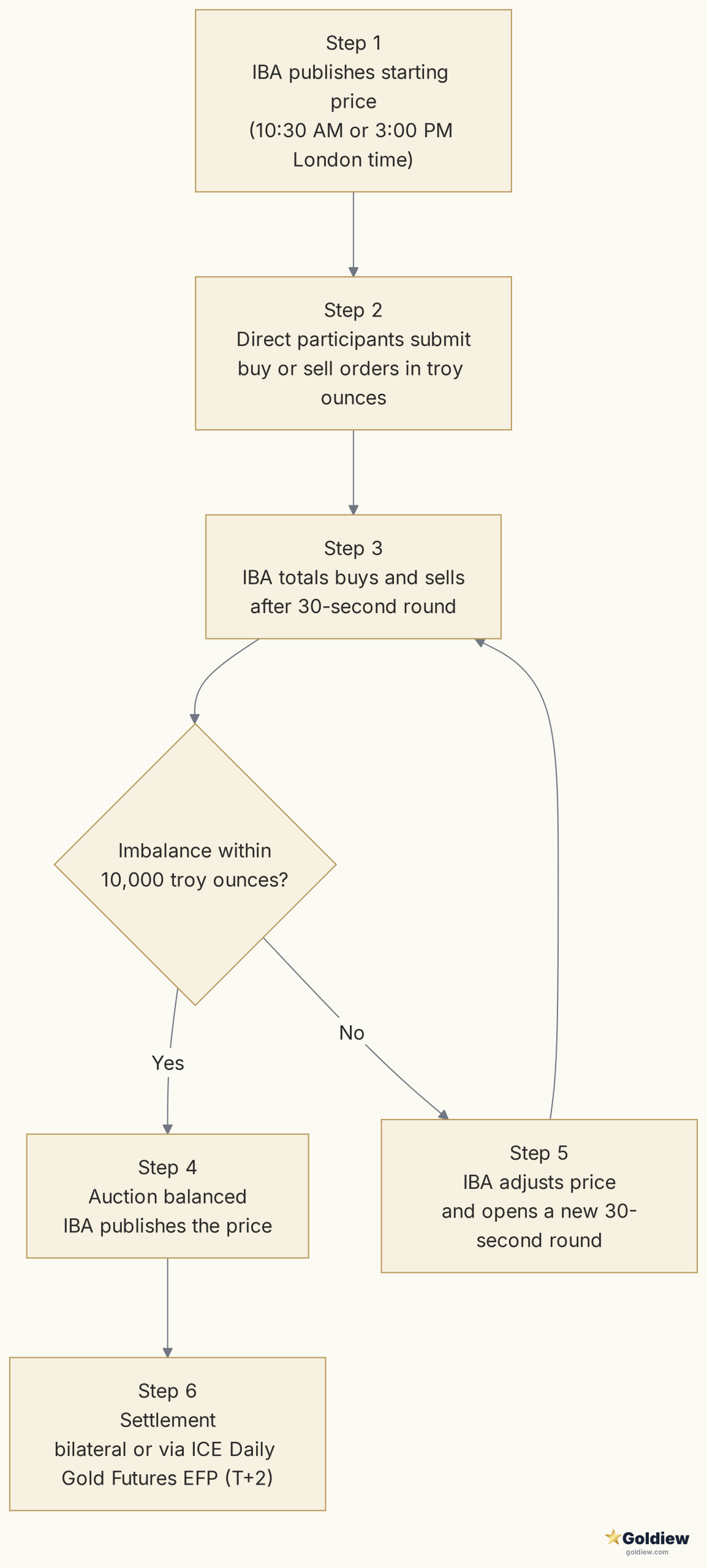
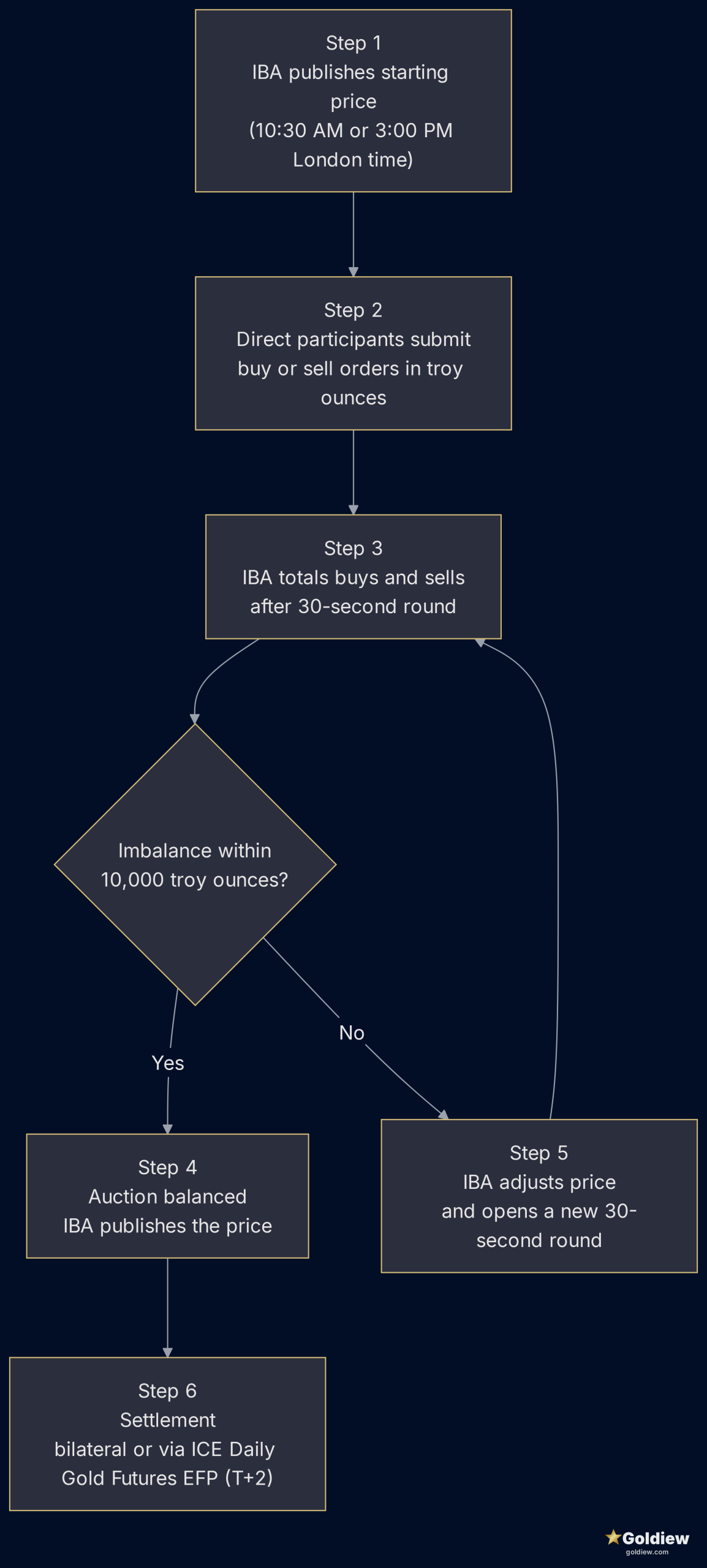
Each LBMA Gold Price auction follows a defined process on the ICE Trading Platform. Here is what happens.
Step 1: IBA Publishes a Starting Price
At the scheduled time (10:30 AM or 3:00 PM London time), IBA’s algorithm generates a starting price. The algorithm incorporates current market conditions and recent spot market activity. This price is visible to all 15 direct participants simultaneously on the ICE platform.
Step 2: Participants Submit Orders
Each direct participant submits buy or sell orders at the published price, specifying volume in troy ounces. Orders can be entered, modified, or withdrawn at any point during the 30-second round. Participants may also be routing orders on behalf of indirect participants or institutional clients.
Step 3: IBA Calculates the Imbalance
At the end of each 30-second round, IBA’s system totals all buy orders and all sell orders. If the difference between total buy volume and total sell volume is within 10,000 troy ounces, the auction is balanced. IBA publishes that price as the LBMA Gold Price for that session.
Step 4: Price Adjusts If Unbalanced
If the imbalance exceeds 10,000 oz, IBA adjusts the price and opens a new 30-second round. Excess buy orders push the price up; excess sell orders push it down. The size of each adjustment is determined algorithmically, taking into account the magnitude of the imbalance and current market conditions. The process repeats until balance is achieved.
Step 5: Settlement
Direct participants choose bilateral or centrally cleared settlement for matched volumes. Any unmatched volume converts to ICE Daily Gold Futures contracts via an exchange-for-physical (EFP) trade, settling spot on a T+2 basis (two business days after the trade date). IBA then publishes the final price in USD, GBP, and EUR using real-time FX conversion rates.
Because the entire process is digital and timestamped, every order, modification, and price adjustment is captured in an auditable record. Regulators can reconstruct any auction in complete detail. This transparency was unavailable in the old telephone-conference format.
The Twice-Daily Schedule: AM Fix vs PM Fix
Both fixings serve different segments of the global gold market. The choice of 10:30 AM and 3:00 PM London time was not arbitrary.
| Benchmark | London time | US Eastern | Market context |
|---|---|---|---|
| LBMA Gold Price (AM) | 10:30 AM | 5:30 AM EDT | Asian close, European open |
| LBMA Gold Price (PM) | 3:00 PM | 10:00 AM EDT | London + New York overlap |
| LBMA Silver Price | 12:00 PM | 7:00 AM EDT | European midday |
The PM fix carries the most weight. At 3:00 PM London time, the New York market is just opening. This overlap of the two largest precious metals trading centers produces the day’s most liquid window, making the PM fix the benchmark of choice for most large institutional contracts, gold ETF net asset value calculations, and long-term physical delivery agreements.
The AM fix serves markets that close before New York opens. Asian central banks, Middle East physical dealers, and some mining royalty contracts specify the AM fix as their reference point.
On UK public holidays when London’s market is closed, the LBMA Gold Price is not published. Contracts referencing the fix typically include a fallback provision specifying which alternative calculation applies on non-publication days.
ICE Benchmark Administration: What the Independent Administrator Does
IBA is a subsidiary of Intercontinental Exchange (ICE), the company that also operates the New York Stock Exchange, ICE Futures U.S., and several other major financial markets globally. Within ICE, IBA focuses exclusively on benchmark administration.
IBA also administers the SONIA overnight rate (the benchmark used in sterling-denominated interest rate derivatives), various ICE interest rate benchmarks that replaced LIBOR, and the LBMA precious metals prices. The LBMA Gold Price is one of the most widely referenced commodity benchmarks IBA operates.
For the gold benchmark specifically, IBA’s responsibilities fall into four areas:
- Auction platform operation: IBA runs the ICE Trading Platform that hosts each session, publishes starting prices, processes orders, calculates imbalances, and determines when balance is achieved.
- Price publication: after each session, IBA distributes the final price in USD, GBP, and EUR to licensed data subscribers. The price is also made available via the LBMA website with a delay.
- Governance and oversight: IBA’s Precious Metals Oversight Committee reviews the methodology, considers any proposed rule changes, and monitors the benchmark for potential vulnerabilities. Members of the Oversight Committee represent both gold and silver markets.
- Regulatory compliance: IBA operates the benchmark under IOSCO Principles for Financial Benchmarks. The FCA supervises IBA’s benchmark operations as a regulated benchmark administrator in the UK.
Any commercial use of the LBMA Gold Price, including using it in financial product pricing, valuation, or contracts, requires a usage licence from IBA. Miners, ETF providers, custodians, and banks that reference the benchmark in their products are all licensed users.
Who Participates: The 15 Direct Institutions
As of May 2026, 15 institutions are direct participants in the LBMA Gold Price auction. Direct participants submit orders for their own accounts and can route additional volume on behalf of clients. Requirements for direct participation include active LBMA membership, demonstrated precious metals expertise, settlement infrastructure, and the ability to clear ICE futures contracts.


| Institution | Type |
|---|---|
| Bank of China Limited | Commercial bank |
| Citibank, N.A. | Commercial bank |
| Goldman Sachs | Investment bank |
| HSBC Bank USA NA | Commercial bank |
| Jane Street | Electronic market maker |
| JPMorgan Chase Bank, N.A. | Commercial bank |
| Koch Supply & Trading | Commodities trading |
| Marex | Commodities broker |
| Morgan Stanley | Investment bank |
| Standard Chartered Bank | Commercial bank |
| StoneX | Financial services / commodities |
| Toronto-Dominion Bank | Commercial bank |
| Virtu Financial | Electronic market maker |
| Coins ‘N Things | Precious metals dealer |
| Plus one additional participant (verify current full list at lbma.org.uk) | |
Source: LBMA.org.uk, verified May 2026. Participant lists change periodically. Verify the current list on the LBMA website before citing in any formal context.
Alongside the 15 direct participants, indirect participants access the auction through a direct participant acting as their broker. IBA data indicates approximately 5 indirect participants currently take part.
How Participation Changed After 2015
The old London Gold Fix had exactly five seats, held by five specific banks. The shift to an electronic, independently administered platform removed that structural cap. Today’s participant list spans traditional commercial banks, investment banks, electronic market makers, a commodities broker, and Coins ‘N Things, a specialist precious metals dealer. That range of institution types would have been impossible under the original 1919 telephone-conference structure.
All participants must adhere to the LBMA Code of Conduct and meet IBA’s standards requirements. The Precious Metals Oversight Committee reviews participant eligibility and can recommend changes to the participant list.
LBMA Gold Price vs Spot Price: The Practical Difference
These two terms describe different things. The confusion between them surfaces repeatedly when investors review gold IRA statements or compare dealer quotes.
The Spot Price
The spot price is a continuous, real-time price derived from over-the-counter trading activity in London and other global markets. It updates throughout each trading day and, in practice, through most of the 24-hour global cycle. When a financial website shows a live gold price chart, that is the spot price. It reflects the price at which large institutional players are currently willing to buy or sell standard-size gold contracts.
The LBMA Gold Price (Fix)
The LBMA Gold Price is a discrete benchmark set at two specific moments per day through a formal auction. It is not the average of that day’s spot trading range. The auction starts from the spot market price at the time of the auction, and the final fix typically falls very close to the prevailing spot price at that moment, but the two are not identical. The fix is a single, agreed-upon number that market participants have actively committed to transact at. Our guide on how the gold spot price is determined breaks down each input behind that continuous OTC rate.
| Feature | Spot Price | LBMA Gold Price |
|---|---|---|
| Update frequency | Continuous | Twice daily |
| Process | OTC market trading (bilateral) | Formal electronic auction |
| Administrator | None (market-driven consensus) | ICE Benchmark Administration (IBA) |
| Governance | Market convention | IOSCO Principles, FCA supervision |
| Primary uses | Live trading, retail dealer pricing | Contract settlement, ETF NAV, gold IRA transactions, mining royalties |
Most physical gold contracts and gold ETFs use one of the two LBMA fixings as their reference price. Retail dealers (coin shops, bullion dealers, gold IRA companies) typically price physical purchases at a premium above the spot price, not above the LBMA fix directly, though the two are closely correlated.
What the LBMA Gold Price Means for Gold IRA Investors
For someone holding physical gold in an IRS-approved self-directed IRA, the LBMA Gold Price is the upstream reference point for every transaction in their account. Our gold price today reference shows the current spot rate per ounce, gram, and kilo updated in real time.
When a gold IRA custodian purchases gold on a client’s behalf, the transaction price is typically referenced against the LBMA Gold Price (usually the PM fix) on the trade date. The dealer then adds a premium above that fix. That premium covers manufacturing costs for the coin or bar, insurance, transport, the custodian’s relationship with the dealer, and the dealer’s margin. Standard premiums for IRS-approved gold bullion coins range from roughly 3% to 10% above the fix price, depending on the product, dealer, and market conditions.
Understanding this matters for comparing gold IRA companies. Two companies pricing the same IRS-approved American Gold Eagle on the same day, referencing the same PM LBMA fix, can quote significantly different all-in prices if their premiums differ. The LBMA fix itself is the same number for everyone. The premium is where the variation is. Beyond premiums, the gold bid-ask spread determines what dealers pay when you eventually sell, a cost that varies by company.
Reputable gold IRA providers disclose their pricing structure before you complete a transaction. Consult your tax advisor for guidance on the specific tax implications of IRA transactions in your situation.
For detailed information on how specific gold IRA companies price their transactions and handle account setup, see our Augusta Precious Metals review (Goldiew’s highest-rated provider as of 2026) and our overview of the best gold IRA companies. For the specific rules governing what metals are IRS-approved for self-directed IRAs, IRS Publication 590-A and Publication 590-B are the authoritative sources.
EVALUATING A GOLD IRA?
Augusta Precious Metals publishes its pricing approach and works with qualified self-directed IRA custodians. Goldiew rates Augusta as the top gold IRA provider based on verified user reviews and our independent methodology.
Get Augusta’s free Gold IRA guideYour cost is the same either way. Consult a licensed financial advisor before making retirement account decisions.
Frequently Asked Questions
What is the LBMA Gold Price?
The LBMA Gold Price is the global benchmark for unallocated gold delivered in London. Administered by ICE Benchmark Administration, it is set twice daily through an electronic auction at 10:30 AM and 3:00 PM London time. It replaced the London Gold Fix on March 20, 2015.
Why is the LBMA Gold Price set twice a day?
Two fixings cover different global trading windows. The 10:30 AM auction (AM fix) captures the Asian close and European open. The 3:00 PM auction (PM fix) overlaps the London afternoon with the New York open. Most large institutional contracts and gold ETF NAV calculations reference the PM fix. Asian and Middle East physical markets often use the AM fix.
How is the LBMA Gold Price different from the spot price?
The spot price is a continuous, real-time OTC price that updates throughout the trading day. The LBMA Gold Price is a specific benchmark set at two fixed points daily through a formal auction. They track closely, but the fix is a single committed transaction price, while the spot price is a continuously changing market quotation. ETFs and long-term contracts use the fix; live trading and retail dealer quotes use spot.
When did the London Gold Fix become the LBMA Gold Price?
The change happened on March 20, 2015. ICE Benchmark Administration replaced the old self-administered bank group as the independent administrator. The telephone conference became an electronic auction. The FCA and the LBMA’s recognition that self-administration by a small group of banks did not meet modern benchmark governance standards drove the transition.
Who administers the LBMA Gold Price?
ICE Benchmark Administration (IBA), a subsidiary of Intercontinental Exchange (NYSE: ICE), is the independent regulated administrator. IBA’s Precious Metals Oversight Committee governs methodology. The benchmark operates under IOSCO Principles for Financial Benchmarks. The LBMA retains IP rights while IBA runs the auction.
Does the LBMA Gold Price affect gold IRA pricing?
Yes. When a gold IRA custodian executes a physical gold purchase or sale, the transaction price is typically referenced against the LBMA Gold Price on the trade date, plus a dealer premium. That premium varies by company and product. Investors should request a clear premium disclosure from any gold IRA provider before committing to an account. Consult your tax advisor for the specific tax implications of IRA transactions in your situation.
How long does each LBMA Gold Price auction take?
No fixed duration. Each round is 30 seconds. The auction continues until buy and sell orders are within 10,000 troy ounces of each other. Under normal conditions, the auction concludes in a small number of rounds. In highly volatile markets, more rounds are required before balance is achieved.
Who are the direct participants in the LBMA Gold Price auction?
As of May 2026, 15 institutions are direct participants, including Bank of China, Citibank N.A., Goldman Sachs, HSBC Bank USA NA, JPMorgan Chase Bank N.A., Morgan Stanley, Standard Chartered Bank, Jane Street, Koch Supply & Trading, Marex, StoneX, Toronto-Dominion Bank, Virtu Financial, and Coins ‘N Things. Verify the current complete list at lbma.org.uk.
What is the 10,000 troy ounce threshold in the LBMA Gold Price auction?
It is the maximum allowable imbalance between total buy and sell orders for the auction to conclude. If buy orders exceed sell orders by 10,000 oz or less (or vice versa), IBA publishes the price and the auction ends. If the imbalance is larger, IBA adjusts the price and opens a new 30-second round. The threshold ensures the benchmark reflects genuine market equilibrium, not a price at which only one side of the market is willing to transact.
Sources and References
- ICE Benchmark Administration (IBA): LBMA Gold and Silver Price overview. ice.com/iba/lbma-gold-price (accessed May 2026).
- London Bullion Market Association (LBMA): Precious Metal Prices page. lbma.org.uk/prices-and-data/precious-metal-prices (accessed May 2026).
- International Organization of Securities Commissions (IOSCO): Principles for Financial Benchmarks (July 2013). iosco.org/library/pubdocs/pdf/IOSCOPD415.pdf
- US Internal Revenue Service: Publication 590-A, Contributions to Individual Retirement Arrangements. irs.gov/publications/p590a
- US Internal Revenue Service: Publication 590-B, Distributions from Individual Retirement Arrangements. irs.gov/publications/p590b
Data freshness: Facts, fees, BBB ratings, regulations, and company policies referenced in this guide were verified at the time of publication. These change; verify directly with the provider, IRS.gov, or regulatory agency before any purchase or filing decision.