
Quick answer
Gold and the Swiss franc protect against different failure modes. Only gold fits in an IRA.
The Swiss franc has been fiat money since May 2000 and is actively managed by a central bank that surprised markets with a 30% single-day revaluation in 2015. Physical francs cannot be held in a standard IRA. Gold carries an explicit IRS statutory exemption for self-directed IRAs. CHF-tracking ETFs are IRA-eligible as securities, but gains outside a retirement account may be taxed as ordinary income. Consult a tax advisor for your specific situation.
Both assets have spent decades earning the label “safe haven.” One earned it by being a physical commodity with no issuer. The other earned it by backing a credible monetary system. Understanding the difference tells you which belongs in a retirement account, and which requires a different vehicle entirely.
Two Assets, Two Different Definitions of “Safe”
Gold is a commodity. It exists independent of any government, bank, or payment system. You cannot print more of it by adjusting a spreadsheet. The total above-ground supply grows by roughly 1-2% per year through mining, and that rate is constrained by the physical limits of ore bodies, energy, and equipment. No committee vote changes that.
The Swiss franc is a currency. The Swiss National Bank issues it, manages its supply, and actively intervenes in foreign exchange markets to influence its value. The SNB is widely regarded as one of the world’s most disciplined central banks, with a strong track record of low inflation and fiscal caution. That track record is worth something. But a franc is ultimately a claim on the quality of Swiss monetary policy, not on anything that exists independently of human decisions.
Both can preserve purchasing power over long periods. They do it differently, for different reasons, and they fail in different ways.
Gold
- No issuer, no central bank
- Supply constrained by physical mining
- IRS statutory carve-out for SDIRAs
- Requires storage; no interest income
- Price set by global market, 24 hours a day
- Not redeemable for anything by law
Swiss Franc (CHF)
- Issued and managed by the SNB
- Supply controlled by monetary policy
- No IRS exemption for physical IRA holding
- Earns interest; liquid in Swiss banking system
- Price influenced by SNB intervention
- Legal tender in Switzerland
Switzerland’s Gold Link: What It Was and When It Ended
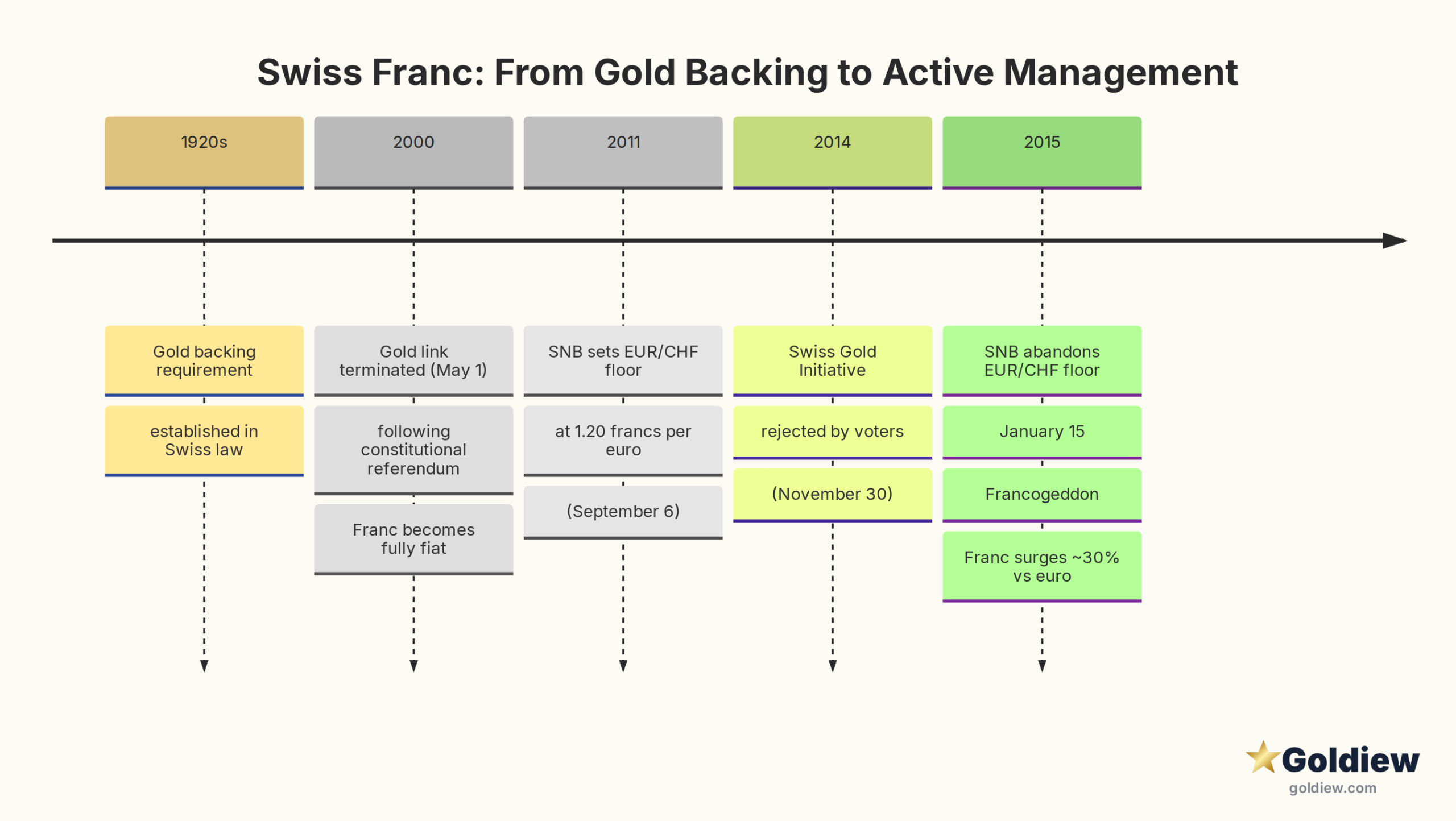
The Swiss franc’s gold-backed reputation lasted most of the twentieth century. Under Swiss law dating from the 1920s, the SNB was required to hold gold reserves covering a fixed proportion of banknotes in circulation. That requirement made the franc unusual among major currencies: while most countries abandoned formal gold convertibility after World War II or by the 1970s, Switzerland kept a version of the link longer than nearly anyone.
Swiss voters ended the arrangement on May 1, 2000, following a constitutional referendum. The vote removed the legal requirement for gold reserves from the new Swiss Federal Constitution. The SNB was freed to manage the currency without a commodity anchor, and it became fiat money in the same sense as the dollar, euro, or yen.
In the years that followed, the SNB sold significant portions of its gold holdings. The bank used the proceeds in part to fund social programs, a political decision that attracted controversy but was legally permitted once the constitutional gold link was broken.
In November 2014, Swiss voters had the chance to reverse course. A referendum called the “Swiss Gold Initiative” proposed restoring a 20% gold coverage requirement for the franc. Voters rejected it by a wide margin.
Key date: May 1, 2000. Switzerland’s gold link, which dated from the 1920s, was terminated following a constitutional referendum, making the franc fiat money. Source: Wikipedia (Swiss franc), verified July 2026.
The SNB still holds gold today. It remains one of the larger central bank gold holders relative to GDP. But that gold is held as a reserve asset, not as a constitutional requirement. The SNB can and does make decisions about its gold holdings based on policy considerations, not a legal mandate.
January 15, 2015: The Day “Safe Haven” Met Active Management
On September 6, 2011, the SNB set a minimum exchange rate of 1.20 Swiss francs per euro. The decision was made to protect Swiss exporters during the eurozone debt crisis, when a surging franc was making Swiss goods expensive on world markets. The SNB committed to defending the floor by buying euros in unlimited quantities.
Markets believed it. For more than three years, the EUR/CHF rate held near 1.20. Currency traders treated the floor as durable. Funds, brokers, and businesses structured positions around it.
On January 15, 2015, the SNB abandoned the floor without advance notice. The franc appreciated by approximately 30% against the euro within minutes. Some of that move was reversed as trading stabilized, but the damage was done. Currency traders and brokers that had held positions near the floor were caught with margin calls. Several retail forex brokers faced insolvency. The episode was described in financial media as “Francogeddon.”
The Swiss franc remained a credible currency. What January 2015 demonstrated is that even the most credible currency is managed by human beings who can change course. No policy announcement, however earnest, binds a central bank permanently. Gold cannot make a surprise announcement.
The SNB has continued to intervene in currency markets since 2015. It holds a large balance sheet of foreign currency reserves, primarily euros and dollars, which it accumulated through past interventions. Managing those reserves is itself a form of active currency policy that affects the franc’s value.
Gold as a Store of Value: The Practical Case
Gold’s claim to long-run value preservation rests on a simple observation: it cannot be created by policy. An ounce of gold required the same general level of human effort, energy, and capital to extract throughout history. That cost floor gives it a baseline purchasing-power anchor that paper instruments cannot replicate.
The World Gold Council publishes historical gold price data going back to 1978 across multiple currencies at gold.org. That data is the most widely cited source for long-run gold performance. It shows periods of significant underperformance as well as strong bull markets. Gold is not a smooth ride.
Gold does not pay dividends or interest. It costs money to store and insure. Physical gold in an IRA incurs custodian fees and depository fees on top of the underlying asset cost. These are real drags on total return that any honest comparison must include. The Augusta vs Schwab gold comparison lines up these cost structures side by side for investors weighing both options.
The case for gold is not that it outperforms stocks or bonds or currencies in any given period. The case is that it preserves real purchasing power across very long time horizons and across scenarios where conventional financial assets might not, including scenarios involving currency debasement, financial system stress, or sovereign debt distress.
Past performance is not a guarantee of future results. Nobody can accurately predict where gold prices will go.
The IRA Question: Which Can You Actually Hold?
For American retirement savers, the question is not just which asset is a better safe haven in theory. The question is which you can actually own inside a tax-advantaged account. The answers are different for gold and the franc. Large platforms like Fidelity draw a hard line here; does Fidelity offer a gold IRA explains what that distinction means in practice.
Physical Swiss Francs in a Standard IRA
Physical foreign currency is effectively barred from standard IRAs. IRC §408(m) prohibits IRAs from holding “collectibles,” and this category is interpreted broadly by the IRS to include physical coins and currency that do not meet specific statutory exceptions. No major IRA custodian accepts direct deposits of foreign cash.
There is no equivalent statutory exemption for foreign currency analogous to the one Congress created for gold, silver, platinum, and palladium. The legal path for holding francs directly in a standard retirement account simply does not exist under current tax law.
CHF Currency ETFs: IRA-Eligible, With a Tax Caveat
Investors who want franc exposure in a retirement account can access it through exchange-traded products. The Invesco CurrencyShares Swiss Franc Trust (ticker: FXF, NYSE Arca) is the primary U.S.-listed vehicle. It is structured as a grantor trust that holds Swiss francs on deposit in a bank account and tracks the franc’s value against the U.S. dollar. Because it is a registered security trading on a U.S. exchange, it is technically IRA-eligible.
The tax caveat applies primarily to taxable brokerage accounts, not retirement accounts. Under IRC §988, gains from foreign currency transactions are generally treated as ordinary income rather than long-term capital gains. For investors holding FXF in a traditional IRA, this distinction is less relevant, since distributions from a traditional IRA are taxed as ordinary income regardless of the underlying asset. Roth IRA qualified distributions are tax-free in either case.
Before investing in any currency ETP, verify the current fund structure, expense ratio, and assets under management with the issuer. Fund details change. Consult your tax advisor for your specific tax situation.
Gold in a Self-Directed IRA
Gold has an explicit statutory carve-out. IRC §408(m)(3) permits self-directed IRAs to hold physical gold, silver, platinum, and palladium bullion and coins that meet IRS purity and specification standards. For gold, the requirement is 99.5% fineness or better, with an exception for American Eagle coins.
A gold IRA requires three things that a standard brokerage IRA does not: a self-directed IRA custodian approved to hold alternative assets, an IRS-approved depository for physical storage, and metals that meet the IRS specification. Home storage of IRA gold is not permitted under current law. At major brokerages like Edward Jones, this structure is unavailable; does Edward Jones offer a gold IRA explains the alternatives.
The setup involves more steps and higher ongoing fees than a standard brokerage account. Those fees (custodian fees, storage fees, and any transaction costs) must be factored into any honest cost analysis. For investors evaluating whether a gold IRA makes sense, our guide to IRS-approved gold coins covers the eligible products in detail.
If you have decided to explore a gold IRA and want to compare major providers, their education-first processes and fee structures, our Augusta Precious Metals review covers one of the leading operators in this space. We are not financial advisors. Consult a licensed advisor before making retirement account decisions.
Side-by-Side Comparison
| Criterion | Gold | Swiss Franc (CHF) |
|---|---|---|
| Gold backing | The asset itself | None since May 2000 |
| Central bank control | None | Active SNB management |
| Physical IRA eligibility | Yes, via SDIRA (IRC §408(m)(3)) | No (collectibles prohibition) |
| ETF/fund IRA eligibility | Yes (GLD, IAU, and others) | Yes (FXF and similar) |
| ETF taxable account tax treatment | Long-term capital gains possible | IRC §988 may apply (ordinary income risk) |
| Single-day policy-driven move | Not applicable (no issuer) | +~30% on Jan 15, 2015 (SNB floor removal) |
| Interest/dividend income | None | Yes, on franc deposits |
| Storage requirement in IRA | IRS-approved depository required | Standard brokerage (for ETF only) |
| Primary risk factor | Price volatility; storage and custodian costs | SNB policy decisions; USD/CHF correlation |
| Supply constraint | Physical mining rate (~1-2% per year) | SNB monetary policy |
Matching Each Asset to the Risk It Hedges
Gold and the Swiss franc do not hedge the same thing. Treating them as interchangeable safe havens misses the point.
Gold may suit you if…
You want exposure to an asset with no issuer and no policy risk, you are eligible for a self-directed IRA, your rollover or contribution amount meets your custodian’s minimum, and you are comfortable with storage fees and a multi-year holding horizon. Gold is not a short-term vehicle.
CHF exposure may suit you if…
You want tactical currency exposure in a taxable brokerage or IRA without setting up a self-directed account, you understand that the SNB actively manages the franc, and you want a liquid, exchange-traded vehicle that can be bought and sold like a stock. Verify tax treatment with a tax professional.
Neither may suit you if…
You are looking for income-producing assets, you have a short time horizon (under 5 years), you need guaranteed purchasing power, or you are under-diversified in traditional equities and bonds first. Neither gold nor a currency ETF replaces a core diversified portfolio. Consult a licensed financial advisor before making allocation decisions.
One honest framing: gold is a bet that no central bank can manage it. The franc is a bet that the SNB will continue to manage it well. Both bets have worked for long periods. January 2015 showed what happens when the second bet meets an unexpected policy shift.
Frequently Asked Questions
Can I hold Swiss francs directly in an IRA?
No, not in a practical sense. IRC §408(m) prohibits IRAs from holding “collectibles,” and physical foreign currency falls within the scope of this restriction for most IRA custodians. There is no statutory exemption for foreign cash in IRAs analogous to the one that exists for gold, silver, platinum, and palladium. If you want franc exposure in a retirement account, you need an exchange-traded fund or similar security that tracks the franc’s value.
Can I hold a CHF currency ETF (like FXF) in my IRA?
Yes. Exchange-traded funds that track the Swiss franc trade on U.S. stock exchanges and are eligible to be held in standard IRAs. The Invesco CurrencyShares Swiss Franc Trust (FXF, NYSE Arca) is the primary U.S.-listed option. Because it is a registered security, it can be held in a traditional IRA, Roth IRA, or standard brokerage account. Verify current fund details, including expense ratio and structure, directly with the issuer before investing.
What is the tax treatment of CHF currency ETFs in a taxable brokerage account?
Gains from foreign currency positions are generally treated as ordinary income under IRC §988, not as long-term capital gains. This means that in a taxable brokerage account, profits from a CHF ETF might be taxed at your ordinary income rate rather than the lower long-term capital gains rate. Inside a traditional IRA, this distinction largely disappears since IRA distributions are taxed as ordinary income regardless. Inside a Roth IRA, qualified distributions are tax-free. Consult your tax advisor for your specific situation.
What makes gold IRA-eligible when foreign currency is not?
Congress created an explicit statutory carve-out in IRC §408(m)(3) for physical gold, silver, platinum, and palladium that meets IRS purity standards. This exemption allows a self-directed IRA to hold physical precious metals at an IRS-approved depository. No equivalent exemption exists for foreign currency. The distinction is a matter of congressional intent in drafting the tax code, not logic. Gold got a carve-out; foreign cash did not.
When did Switzerland remove the gold standard from its currency?
Switzerland’s gold link, which dated from the 1920s, was terminated on May 1, 2000, following a constitutional referendum. The vote removed the legal requirement for gold reserves from the new Swiss Federal Constitution, making the franc fiat money. In November 2014, Swiss voters rejected a referendum called the Swiss Gold Initiative, which would have restored a 20% gold coverage requirement. The initiative failed by a wide margin.
What exactly happened on January 15, 2015, with the Swiss franc?
The Swiss National Bank (SNB) had set a minimum exchange rate of 1.20 Swiss francs per euro on September 6, 2011, to protect Swiss exporters during the eurozone debt crisis. On January 15, 2015, the SNB abandoned this floor without advance notice. The franc immediately appreciated by approximately 30% against the euro, though some of the move reversed as trading stabilized. The episode caused major losses for currency traders who had positioned near the floor. It became known in markets as “Francogeddon” and demonstrated that even the most credible central banks can make surprise policy shifts.
Does the SNB still hold gold?
Yes. The Swiss National Bank still holds gold as part of its reserve assets. Since the gold backing requirement was removed in 2000, those gold holdings are managed as a discretionary reserve rather than a constitutional obligation. The SNB publishes its balance sheet and reserve composition regularly on its official website at snb.ch. For current reserve figures, consult the SNB’s published data directly.
Is the Swiss franc still considered one of the world’s safest currencies?
The franc carries a long-standing reputation for stability, and that reputation is grounded in Switzerland’s low inflation history, fiscal discipline, and political neutrality. What January 2015 showed is that “safe” in the currency sense means something different from “stable.” The franc is safe relative to most currencies. It is not immune to active central bank management or to large moves driven by policy decisions. Gold’s “safety” case rests on having no issuer at all, which is a fundamentally different characteristic.
What is the minimum to open a gold IRA?
Minimums vary by provider. Industry-reported minimums for major gold IRA companies range from around $10,000 to $50,000 or more, depending on the operator. Augusta Precious Metals, for example, has an industry-reported minimum around $50,000 for rollover accounts. Birch Gold Group is industry-reported around $10,000. These figures are not always published on company websites; verify current minimums directly with any provider you contact. We are not financial advisors. Consult a licensed advisor before opening a gold IRA.
Which asset has performed better over the long run: gold or the Swiss franc against the dollar?
Both have outpaced the U.S. dollar over multi-decade periods, but the comparison depends heavily on the starting and ending dates chosen. Gold has had longer bull markets and sharper drawdowns. The franc has appreciated steadily against the dollar since the Bretton Woods system ended in the early 1970s, but with significant periods of weakness. The World Gold Council publishes historical gold price data at gold.org, and the SNB publishes historical exchange rate data at snb.ch. Comparing those datasets against a common baseline is more informative than any summary answer. Past performance is not a guarantee of future results.
Sources
- Wikipedia: Swiss franc (gold link termination May 2000, Francogeddon January 2015, Swiss Gold Initiative)
- Swiss National Bank (SNB) official site (reserve data, balance sheet, historical exchange rates)
- IRS: Individual Retirement Arrangements (IRAs) (IRA investment rules)
- Internal Revenue Code §408(m) (collectibles prohibition in IRAs)
- Internal Revenue Code §408(m)(3) (gold, silver, platinum, palladium statutory exemption)
- Internal Revenue Code §988 (foreign currency transaction income treatment)
- World Gold Council: Historical Gold Prices (long-run gold price data by currency)
- IRS Publication 590-B: Distributions from Individual Retirement Arrangements
- FINRA: Precious Metals Fraud Investor Alert (red flags for gold IRA investors)