Editorial transparency. Goldiew may earn a commission when you use a link on this page to connect with a partner company, at no extra cost to you. That commission never influences our research, ratings, or recommendations. We feature only companies we have researched and consider credible, and because we are not the company itself, we do not set its prices or terms. The information here is educational, not financial or legal advice.
North Carolina applies a single flat income tax rate to all individual income, including IRA distributions. For tax year 2024, that rate is 4.50 percent, and it is scheduled to decline further in 2025 and 2026 under Session Law 2021-180. The flat structure is simpler than the graduated-plus-county stacking common in neighboring states, but North Carolina has one tax factor that does not exist anywhere else in the country: the Bailey settlement exemption. Certain NC state, local, and federal government retirees who were vested before August 12, 1989 receive their retirement benefits free of NC income tax for life. The trap specific to gold IRA planning is that rolling Bailey-exempt pension or retirement funds into a new self-directed IRA permanently forfeits that exemption on the rolled funds. This guide covers that factor in detail, the NC tax picture for gold IRAs more broadly, the top three providers Goldiew tracks for North Carolina residents, and the storage geography that applies when all IRS-approved depositories sit hundreds of miles away.
Consult your tax advisor for your specific situation before acting on any information in this guide, especially regarding the Bailey settlement exemption. Consult a licensed financial advisor before making retirement decisions. We are not financial or tax advisors.
Quick answer for North Carolina residents
For North Carolina residents with $50,000 or more in eligible rollover funds, Augusta Precious Metals ranks first in this guide for its education-first onboarding, salaried (non-commissioned) account representatives, and BBB A+ rating with zero complaints accredited since 2014. Birch Gold Group ranks second with an industry-reported minimum around $10,000 and a publicly listed depository network that includes the Delaware Depository in Wilmington, the closest IRS-approved storage facility to the Research Triangle and Charlotte metro. Noble Gold Investments ranks third with a company-owned Texas depository and an industry-reported minimum around $20,000. All three are unsuitable for anyone with Bailey-exempt retirement income who has not first confirmed with a tax advisor that the rollover would not forfeit the exemption.
Six North Carolina-specific factors affect how a self-directed gold IRA fits into a Tar Heel State resident’s retirement plan, and they are the reason this guide exists as a separate page from the national best-of.
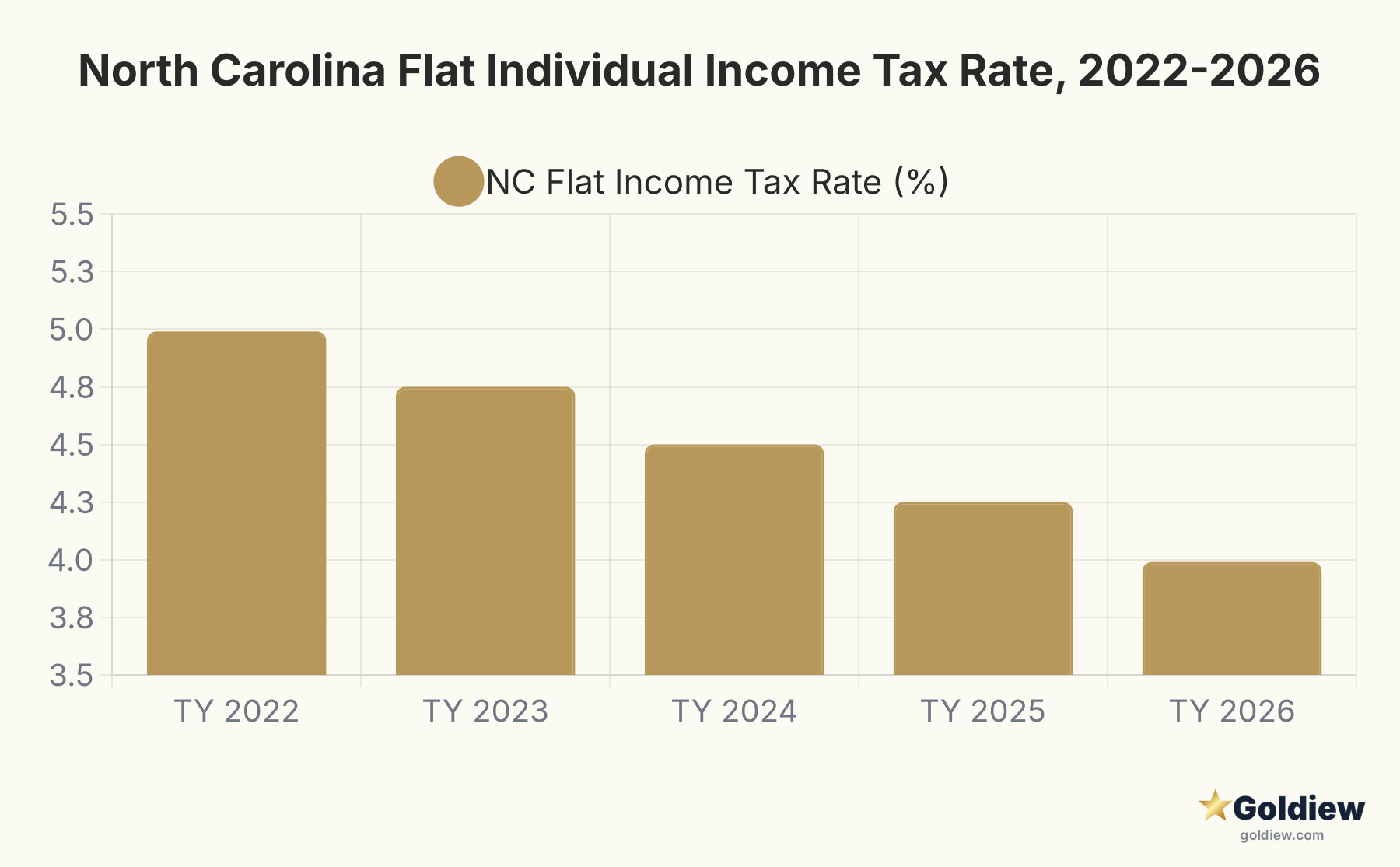
First, North Carolina taxes all individual income, including IRA distributions, at a single flat rate. For tax year 2024, that rate is 4.50 percent. There is no county or municipal surcharge stacked on top, unlike some neighboring states. The rate is scheduled to continue declining to 4.25 percent in 2025 and 3.99 percent in 2026 under Session Law 2021-180. Verify the current-year rate at ncdor.gov before running any projection on gold IRA distributions.
Second, North Carolina does not tax Social Security benefits. Regardless of income level, Social Security retirement, disability, and survivor benefits are excluded from NC individual income tax. This is meaningful for retirees who draw both Social Security and IRA distributions, because the NC tax exposure is limited to the IRA or pension portion.
Third, North Carolina has enacted a full income tax exemption for military retirement pay. Qualifying retired members of the armed forces and their survivors can exclude military retirement income from NC taxable income. The eligibility rules and specific thresholds have been expanded by the NC General Assembly in recent years; verify the current-year terms with NCDOR or a tax advisor before relying on this exclusion.
Fourth, and the most distinctive factor in this guide: North Carolina has a court-ordered tax exemption known as the Bailey settlement that permanently exempts certain government retirement benefits from NC income tax. This exemption applies to NC state employees, NC local government employees, and federal civilian employees who were vested (had at least five years of creditable service) in their specific retirement system before August 12, 1989. The mechanics of this exemption, and the specific risk it creates for gold IRA planning, are covered in full detail in the Bailey section below.
Fifth, North Carolina repealed its state estate tax effective January 1, 2013 (Session Law 2013-316). There is no NC estate tax today and no NC inheritance tax. This simplifies estate planning for retirees compared to states that impose both taxes. Gold IRA accounts pass to named beneficiaries by beneficiary designation outside probate, subject to federal estate tax rules but not any NC state-level estate transfer tax.
Sixth, North Carolina provides statutory creditor protection for IRA assets under NC General Statutes Section 1C-1601(a)(9), which exempts IRA funds from the claims of creditors in North Carolina. The exemption applies to IRAs held by North Carolina residents. Consult a North Carolina attorney for the specific scope of protection in any particular situation, since the protection is not unlimited and is subject to court interpretation.
North Carolina pre-retiree and retiree population, briefly
North Carolina has one of the fastest-growing populations among US states, with significant concentrations of pre-retirees and retirees in the Research Triangle Park corridor (Raleigh, Durham, Chapel Hill, Cary, Apex, Wake Forest, Morrisville, Carrboro, Hillsborough), the Charlotte metro (Charlotte, Huntersville, Cornelius, Davidson, Concord, Gastonia, Mooresville, Matthews), the Triad (Greensboro, Winston-Salem, High Point, Burlington, Kernersville, Asheboro), the military-heavy Fayetteville area surrounding Fort Liberty (formerly Fort Bragg), the Crystal Coast and Outer Banks retirement corridor (Carteret County, Dare County, Onslow County near Camp Lejeune), the western mountain communities (Asheville, Henderson County, Buncombe County, Hendersonville, Brevard), and the Cape Fear region (Wilmington, Brunswick County, New Hanover County). Major employers whose retirees carry mature 401(k), 403(b), pension, and IRA balances include the US Army at Fort Liberty (largest Army installation in the US by population), the Marine Corps at Camp Lejeune and Marine Corps Air Station Cherry Point, the Air Force at Seymour Johnson AFB (Goldsboro) and Pope Army Airfield (Fayetteville), IBM (RTP), Cisco Systems (RTP), Lenovo North America (RTP), SAS Institute (Cary), Red Hat (Raleigh), NetApp (RTP), Biogen (RTP), the National Institute of Environmental Health Sciences (a part of NIH, Research Triangle Park), the EPA Office of Research and Development (RTP), Bank of America (Charlotte HQ), Duke Energy (Charlotte HQ), Lowe’s Companies (Mooresville HQ), Honeywell International (Charlotte HQ), Truist Financial (Charlotte and Winston-Salem), Nucor (Charlotte area), Atrium Health (Charlotte), Novant Health (Winston-Salem), Duke University and Duke University Health System (Durham), the University of North Carolina system (Chapel Hill, Raleigh, Greensboro, Charlotte, Wilmington, and other campuses), NC State University (Raleigh), WakeMed Health (Raleigh), Wake Forest University and Baptist Medical Center (Winston-Salem), the North Carolina state government workforce (Raleigh, concentrated among TSERS and LGERS members), the local government workforce across all 100 NC counties (LGERS members), and the broader federal civilian workforce at the EPA, NIEHS, USDA, and other federal agencies with Triangle-area operations.
The 2026 verdict for North Carolina residents
Three companies meet our editorial floor for North Carolina residents. Each fits a different profile. No IRS-approved depository is close to North Carolina in the way the Delaware Depository is close to Maryland or New Jersey, so storage distance is a factor for all three choices. Read the Bailey section below before making any rollover decision if your retirement income comes from a NC state, NC local, or federal government source.
Best overall
#1
Augusta Precious Metals
Best for NC residents rolling $50,000 or more from private-sector plans.
Education-first gold IRA provider for NC rollovers of $50,000 or more.
Founded2012
HQBeverly Hills, CA
BBBA+ since 2014
Goldiew rating4.71 / 5
Why Augusta fits North Carolina residents with larger rollovers
Augusta has been recognized by Money Magazine as Best Overall Gold IRA Company every year from 2022 through 2026 and by Investopedia as Most Transparent Gold IRA Company across the same period. The BBB profile shows an A+ rating with zero complaints, accredited since 2014. For a Raleigh, Durham, Chapel Hill, Cary, Charlotte, Winston-Salem, Greensboro, or Fayetteville resident weighing a six-figure rollover from a private-sector 401(k), those credentials matter. The company describes its process on its public website as education-first: read the 2026 Gold IRA Guide, speak one-on-one with a salaried (non-commissioned) educator, then decide. The salaried-staff structure means the person on the call earns the same whether you open a $50,000 account or a $500,000 account. For a North Carolina retiree from the Research Triangle Park tech sector or the Charlotte financial corridor, that structural detail is worth attention.
Fit with the NC flat tax on gold IRA distributions
Gold IRA distributions from a traditional (pre-tax) account are taxable as ordinary income at both the federal level and at NC’s flat income tax rate. For tax year 2024, the NC rate is 4.50 percent. Augusta does not publish a full fee schedule on its website. Ask for the complete fee breakdown during the free consultation: setup fee, annual custodian fee, annual storage fee, transaction fees, and the terms of any multi-year fee waiver for qualifying rollover accounts. Request written confirmation so you can include all costs in a total-return projection together with the annual NC flat tax on distributions. Consult your tax advisor for the math specific to your filing status, federal adjusted gross income, and projected distribution timing.
What to ask Augusta before committing
Ask which IRS-approved depository will hold your metals and in which state. Augusta does not state the depository names on its public website, so request written confirmation during the consultation. For NC residents in the Research Triangle or Charlotte metro, the depository location matters because all IRS-approved storage facilities are hundreds of miles from North Carolina. Ask specifically about the Delaware Depository in Wilmington (approximately 400 miles from Raleigh, approximately 430 miles from Charlotte) compared to Texas-based options at over 1,200 miles.
Strengths for NC residents
Money Magazine Best Overall Gold IRA Company 2022 to 2026
BBB A+ rating, zero complaints since 2014 accreditation
Multi-year fee waiver available for qualifying rollover accounts
Free 2026 Gold IRA Guide and one-on-one consultation
4,000+ five-star ratings across Trustpilot, Google, and Consumer Affairs
Tradeoffs to know
Industry-reported minimum around $50,000 closes out smaller rollovers
No North Carolina office (Beverly Hills, CA HQ; Pacific Time, three hours behind NC)
Fee schedule not posted on website; details given by phone during consultation
Custodian and depository names not stated publicly on site
Best fit
NC residents with $50,000 or more in eligible private-sector 401(k), 403(b), or IRA funds, including IBM, Cisco, Lenovo, SAS Institute, Red Hat, NetApp, Bank of America, Duke Energy, Lowe’s, Honeywell, and Atrium Health retirees with mature balances who value a structured education process. Also suitable for federal civilian employees rolling funds that are NOT Bailey-exempt, after confirming exemption status with a tax advisor.
Not the right fit
Investors with under $50,000 to start, those who want to skip the consultation process, and anyone who has not yet confirmed with a tax advisor whether their specific retirement income qualifies for the Bailey settlement exemption.
Lower entry point and publicly listed Delaware Depository option, closest IRS storage to most of NC.
Founded2011
HQIowa
Customers40,000+
Goldiew rating4.43 / 5
Why Birch ranks second for North Carolina
Birch Gold Group has been serving customers since 2011 and reports over 40,000 Americans served. The company holds a BBB A+ rating and an AAA rating from the Business Consumer Alliance. The industry-reported minimum is around $10,000, which opens the door for NC pre-retirees who want to begin a gold IRA position before they reach the Augusta threshold, including the broader workforce at RTP tech companies, UNC Health, WakeMed, Duke Health, the state university system, and the military community around Fort Liberty and Camp Lejeune who are rolling private-sector employer match funds rather than pension funds. Confirm the current minimum directly with Birch before opening an account.
Depository options that matter for NC residents
Birch publicly lists multiple depository partners including the Delaware Depository in Wilmington, Brink’s Global Services, the Texas Bullion Depository, the Texas Precious Metals Depository, and International Depository Services. For North Carolina residents, the Delaware Depository in Wilmington is the closest IRS-approved storage option among the major facilities. From Raleigh to Wilmington, DE by interstate is approximately 400 miles. From Charlotte it is approximately 425 miles. From Fayetteville it is approximately 450 miles. From Asheville in the western mountains it is approximately 580 miles. Texas-based depositories sit more than 1,200 miles from most NC cities. Birch’s publicly stated network gives NC residents the option of the closest East Coast facility, which is a genuine geographic advantage over the Texas-only storage path.
Strengths for NC residents
Industry-reported minimum around $10,000 (lower entry than Augusta or Noble)
BBB A+ and AAA Business Consumer Alliance rating
40,000+ customers served since 2011
Delaware Depository in Wilmington (~400 miles from Raleigh) publicly listed in depository network
Multiple depository options including East Coast and Texas
Tradeoffs to know
Custodian not stated publicly on website
No publicly posted fee waiver promotion comparable to Augusta’s
Iowa Central Time office (one hour behind NC Eastern Time)
Fewer industry awards than Augusta in the period reviewed
Best fit
NC residents starting at $10,000 to $50,000, pre-retirees in the RTP tech corridor and Charlotte financial sector building an early gold IRA position, and households who want the Delaware Depository as their storage location rather than a Texas facility that is 1,200+ miles from North Carolina.
Not the right fit
Higher-net-worth retirees who specifically want Augusta’s structured education process, and anyone rolling Bailey-exempt government retirement funds without first confirming the tax implications with a qualified NC tax advisor.
* Noble’s marketing references industry experience going back to 2003. Noble Gold Investments as a corporate entity is more recent. Corporate founding year independently unverified.
Why Noble ranks third for North Carolina
Noble Gold reports helping over 16,000 investors safeguard more than $2.5 billion in wealth through gold and silver IRAs. The company operates its own Texas-based depository, giving Noble customers a clearly defined single-vendor storage path. Noble’s marketing references industry experience going back to 2003, and the company is headquartered in Encino, California.
For North Carolina residents, the Texas depository is the geographic disadvantage. The drive from Raleigh to Leander, Texas (location of the Texas Precious Metals Depository) is over 1,400 miles. From Charlotte it is over 1,200 miles. From Fayetteville or Wilmington, NC the distance is similar. Noble’s Texas-only storage path is the longest physical distance from any NC city among the three companies in this guide. NC residents who place weight on storage proximity should weigh this against the single-vendor simplicity Noble offers.
Strengths for NC residents
Company-owned Texas depository (single-vendor storage, clear chain of custody)
16,000+ investors and $2.5 billion safeguarded per Noble’s public website
Home delivery option for non-IRA precious metals purchases
Industry-reported minimum around $20,000 (between Augusta and Birch)
Tradeoffs to know
Texas depository is the furthest option from NC (1,200 to 1,400+ miles by road)
Encino, CA headquarters (Pacific Time, three hours behind NC)
Smaller published review sample on Goldiew (9 verified reviews)
BBB A+ rating widely reported; independently verify at BBB.org before relying on it
Corporate founding year independently unverified; Noble’s marketing references 2003
Best fit
NC residents who specifically want a single-vendor Texas depository path and are comfortable with the 1,200 to 1,400-plus mile storage distance from North Carolina.
Not the right fit
NC residents who want the shortest possible distance to their storage facility. Birch’s Delaware Depository option is approximately 400 miles closer to Raleigh than Noble’s Texas path.
Side-by-side comparison for North Carolina residents
Criterion
Augusta (#1)
Birch (#2)
Noble (#3)
Founded
2012
2011
Since 2003 (marketing); corporate entity more recent
Industry-reported minimum
~$50,000
~$10,000
~$20,000
BBB rating
A+ (zero complaints, since 2014)
A+ (AAA Business Consumer Alliance)
A+ (industry-reported; verify at BBB.org)
Goldiew rating
4.71 / 5 (7 verified reviews)
4.43 / 5 (7 verified reviews)
4.67 / 5 (9 verified reviews)
Closest depository to Raleigh, NC
Not stated publicly; ask during consultation
Delaware Depository, Wilmington (~400 mi)
Texas Precious Metals Depository (~1,400 mi)
Fee waiver promotion
Multi-year fee waiver for qualifying accounts
None advertised
None advertised
Sales compensation
Salaried, non-commissioned educators
One-on-one specialist + in-house IRA dept.
Gold and silver specialist call
Money Magazine award (2022-2026)
Best Overall Gold IRA Company
Not listed
Not listed
All figures for minimums are industry-reported and unverified on the companies’ public websites. Confirm directly with the company before opening an account. Depository distances from Raleigh are approximate and by road.
North Carolina flat income tax and IRA distributions
North Carolina taxes all individual income, including IRA distributions, at a single flat rate with no county or city surcharge stacked on top. This is a meaningful structural difference from states that impose a graduated rate plus a county-level surcharge. A North Carolina resident drawing IRA distributions faces a single state rate and can plan accordingly.
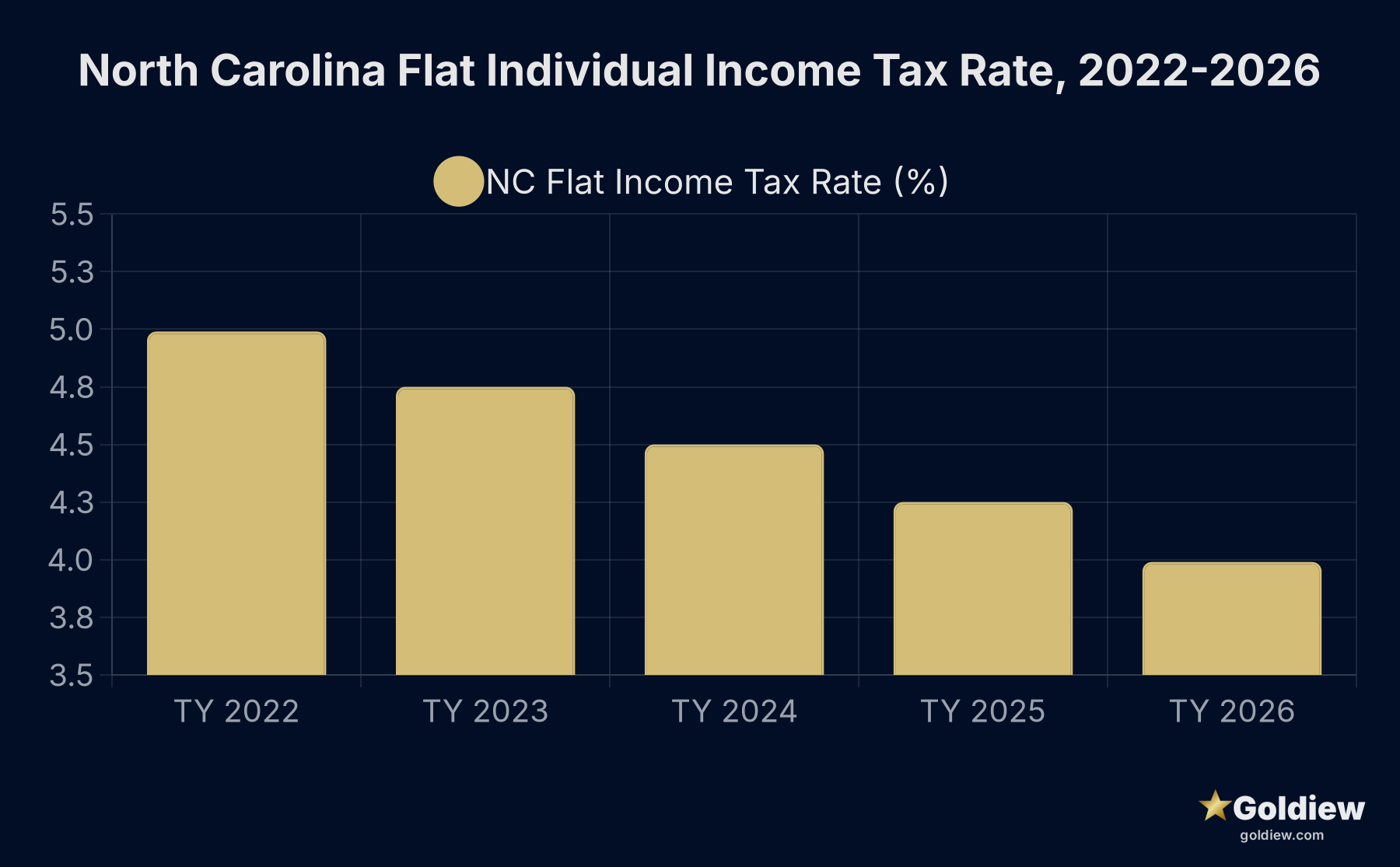
The rate has been on a legislatively mandated declining path since Session Law 2021-180 (House Bill 334, signed November 18, 2021). For tax year 2022, the rate was 4.99 percent. It dropped to 4.75 percent for 2023, then 4.50 percent for 2024. Under the same law, it is scheduled to decline to 4.25 percent in 2025 and 3.99 percent in 2026. Subsequent legislation may alter the schedule further; verify the current-year rate at ncdor.gov before using any figure in a distribution projection.
North Carolina individual income tax rate schedule. Source: NC Session Law 2021-180 (HB 334, signed November 18, 2021). Verify the current-year rate at ncdor.gov before projecting distributions.
Federal ordinary income tax applies separately to the full taxable distribution from a traditional gold IRA (pre-tax contributions and growth). The NC flat rate applies only to the portion of that distribution that is NC taxable income, which may be reduced by any applicable NC-specific exclusion such as the Bailey settlement exemption (discussed next), the military retirement exclusion, or the Social Security exclusion.
The Bailey settlement exemption: the critical NC-specific factor for government retirees
Read this before rolling any government pension into a gold IRA
If you are a current or former NC state employee, NC local government employee, or federal civilian employee who was vested in your retirement system before August 12, 1989, your pension or retirement benefit payments may be permanently exempt from NC income tax under the Bailey settlement. Rolling those funds into a traditional IRA, including a self-directed gold IRA, may permanently forfeit that exemption for the rolled balance. Consult a qualified NC tax advisor before initiating any rollover if this could apply to you.
The Bailey settlement is the product of multiple consolidated cases decided by the North Carolina Supreme Court, implementing a ruling that the taxation of certain government retirement benefits violated the NC Constitution because those benefits were tax-exempt when the employees entered service. The settlement was codified in North Carolina law and established that qualifying retirees are permanently exempt from NC individual income tax on their retirement benefit payments.
The two criteria for Bailey exemption eligibility are: (1) the retirement benefit must come from a qualifying NC state, NC local government, or federal civilian retirement system; and (2) the recipient must have had at least five years of creditable service in that specific system before August 12, 1989. The NCDOR provides detailed guidance on which retirement systems qualify and how vesting is calculated; see ncdor.gov for current guidance documents, or consult a tax professional familiar with NC law.
The gold IRA trap works as follows. A retiree who qualifies for Bailey draws monthly benefit payments from, for example, the Teachers’ and State Employees’ Retirement System of North Carolina (TSERS). Those payments arrive as retirement benefits from TSERS and are NC-tax-exempt under Bailey. If that same retiree decides to take a lump-sum distribution from TSERS and roll it into a self-directed gold IRA, the gold IRA now holds the funds rather than TSERS. When the retiree later takes distributions from the gold IRA, those distributions are IRA distributions, not TSERS benefit payments. The Bailey exemption applies to the benefit payments from the qualifying retirement system. It does not follow the money once it leaves that system and enters a different account type.
The result: a Bailey-eligible TSERS or LGERS retiree who rolls into a gold IRA converts NC-tax-exempt income into NC-taxable IRA distributions at the current flat rate. For a 20-year gold IRA holding with the current 4.50 percent rate (and rate declines scheduled through 2026), the cumulative NC tax on distributions can represent a significant cost compared to simply keeping the benefit in TSERS and drawing the monthly payment tax-free in perpetuity.
The same logic applies to federal civilian employees under the Civil Service Retirement System (CSRS) and the Federal Employees Retirement System (FERS) who were vested before August 12, 1989. Bailey coverage for federal civilian retirees depends on the same five-year vesting date. FERS did not begin until January 1, 1987, which means a FERS employee who had at least five years of FERS service by August 12, 1989 could be Bailey-covered, but the window was short and most FERS participants are not. CSRS participants who entered federal service early enough are more likely to be Bailey-covered.
Note that Bailey coverage is not universal among government retirees. Most employees who entered service after 1984 are not Bailey-covered because they could not have accumulated five years of service before August 12, 1989. If you started working for a NC state agency, a NC county or city, or the federal government after 1984, Bailey likely does not apply to you, and a gold IRA rollover does not carry the same exemption-forfeiture risk. Still, verify your specific situation with a tax advisor or NCDOR guidance rather than assuming.
North Carolina does not tax Social Security retirement, disability, or survivor benefits. The exemption applies at all income levels and is not phased out for higher earners, unlike the federal partial exemption. For NC retirees drawing both Social Security and a gold IRA distribution in the same year, the NC tax applies only to the IRA distribution (subject to any other applicable exclusion, including Bailey). This is a meaningful simplification compared to states that partially or fully tax Social Security benefits. Verify the current-year treatment at ncdor.gov, as state legislatures can modify exemptions.
Military retirement exemption in North Carolina
North Carolina has significantly expanded its income tax exemption for military retirement pay in recent years. North Carolina law now provides that qualifying retired members of the armed forces, the National Guard, and certain reserve components can exclude military retirement income from NC taxable income. The NC General Assembly has broadened this exemption over multiple legislative sessions; confirm the current eligibility rules and any service-length requirements at ncdor.gov or with a tax advisor before relying on this exclusion in a retirement income projection.
For the large military retiree population around Fort Liberty (formerly Fort Bragg) in Fayetteville, Camp Lejeune and Marine Corps Air Station Cherry Point on the Crystal Coast, Seymour Johnson AFB in Goldsboro, and Pope Army Airfield in Fayetteville, this exemption is meaningful. If your military retirement pay is NC-exempt, a gold IRA funded with rollover dollars from a Thrift Savings Plan (TSP) or other non-pension retirement account would generate NC-taxable distributions rather than NC-exempt military pay. The same advice applies here as with Bailey: confirm with a tax advisor whether a rollover changes your NC tax picture before proceeding.
TSERS, LGERS, and other NC public pension rollovers
The Teachers’ and State Employees’ Retirement System of North Carolina (TSERS) is one of the largest public pension systems in the country, covering teachers, state agency employees, university system employees, and certain other state workers. The Local Governmental Employees’ Retirement System (LGERS) covers county and municipal employees across all 100 NC counties. Both systems are administered by the NC Department of State Treasurer.
TSERS and LGERS do not permit ongoing contribution rollovers from external accounts into the pension system. Contributions accumulate within the system during active employment, and upon retirement the member receives a defined monthly benefit based on years of service and final average salary. In-service lump-sum distributions from TSERS or LGERS before retirement are restricted and generally available only in limited circumstances such as termination of employment (member contributions refund).
For a retiree already drawing monthly TSERS or LGERS benefits who is Bailey-eligible: the monthly pension payment is tax-exempt in NC and cannot be “rolled over” into a gold IRA in the traditional sense, because it is already a post-retirement payment stream, not a lump-sum account balance. The more common scenario is a former TSERS or LGERS member who left NC state or local employment before full retirement, has a balance of member contributions in the system, requests a refund of those contributions, and then wants to roll that refund into a gold IRA. That rollover is where the Bailey issue arises.
Separately, many NC state and university employees participate in the NC 401(k) Plan (administered by Prudential on behalf of the NC Department of State Treasurer) or the NC 457(b) Deferred Compensation Plan, which are supplemental defined-contribution plans that sit alongside TSERS and are not subject to the same pension withdrawal rules. Rollover of NC 401(k) Plan or NC 457(b) balances into a self-directed gold IRA does not carry the same Bailey risk, because those accounts are not the qualifying retirement system benefit itself. Confirm this distinction with a tax advisor for your specific situation.
No North Carolina estate tax
North Carolina repealed its state estate tax effective January 1, 2013 under Session Law 2013-316. There is no NC state estate tax today. There is also no NC state inheritance tax. Gold IRA assets pass to named beneficiaries by beneficiary designation outside the probate estate, and at the state level there is no NC transfer tax on those assets at death. Federal estate tax rules apply to total taxable estates above the federal exemption amount (roughly $13.61 million for 2024, indexed annually). Consult an estate planning attorney for beneficiary designation strategy specific to your NC situation, particularly for large gold IRA balances where inherited IRA distribution rules under the SECURE Act and SECURE 2.0 Act are relevant.
IRA creditor protection in North Carolina
North Carolina provides statutory creditor protection for IRA assets under NC General Statutes Section 1C-1601(a)(9). IRA funds held by NC residents are generally exempt from the claims of creditors in NC state court proceedings. The protection applies to traditional IRAs, Roth IRAs, and SEP IRAs. The exemption is subject to court interpretation and has limits; consult a NC attorney for the full scope of protection in any specific situation. Federal bankruptcy proceedings follow federal exemption rules under 11 U.S.C. Section 522, which also provides IRA protection. Gold IRA assets held in a self-directed IRA with a qualified custodian at an IRS-approved depository are generally treated as IRA assets for purposes of the NC creditor protection statute, though this has not been definitively litigated in NC courts for the self-directed precious metals context specifically.
Depository distance from North Carolina
No IRS-approved precious metals depository sits inside North Carolina or immediately adjacent to the state. The practical storage options for NC gold IRA holders, by distance from Raleigh, are the Delaware Depository in Wilmington, DE (approximately 400 miles), Brink’s Global Services (multiple locations; verify the specific assigned location with the provider), International Depository Services (Delaware), the Texas Precious Metals Depository in Leander, TX (approximately 1,400 miles), and the Texas Bullion Depository in Austin, TX (approximately 1,400 miles). From Charlotte, the distances are approximately 25 to 50 miles shorter to Delaware-based facilities and similar to Texas. From Asheville in the western mountains, all facilities are farther.
The practical implication: for most NC residents, all storage options involve a multi-hour or multi-day drive. The difference between Delaware (~400 miles from Raleigh) and Texas (~1,400 miles) is meaningful if you are considering the option of taking an in-kind distribution at retirement by physically collecting your metals from the depository rather than selling them. At 400 miles, an in-kind collection from Delaware is an extended day trip or overnight. At 1,400 miles, it is a significant trip. Birch’s publicly listed depository network includes the Delaware Depository option, which is the geographic factor that places Birch second in this NC-specific guide.
How to choose for North Carolina residents
Choose Augusta if…
You have $50,000 or more from a private-sector 401(k), 403(b), or rollover IRA, you value a structured education-first process with salaried (non-commissioned) staff, and you have confirmed with a tax advisor that a rollover does not affect any NC-specific exemption you currently receive. Augusta’s BBB A+ profile and Money Magazine recognition make it the editorial top choice for qualifying NC rollovers.
You have $10,000 to $50,000 and want to begin a gold IRA position at a lower entry point, or you specifically want the Delaware Depository in Wilmington as your storage location (the closest IRS-approved storage to Raleigh, Durham, Charlotte, and most of NC at approximately 400 miles). Confirm the current minimum and depository availability directly with Birch.
You prefer the simplicity of a single-vendor Texas depository under Noble’s own brand, you have $20,000 or more, and you are comfortable with the 1,200 to 1,400-plus mile storage distance from most NC cities. Noble’s $2.5 billion safeguarded and 16,000-plus investor scale show meaningful operational volume at the mid-range price point.
Before choosing any provider: if you receive or expect to receive retirement income from a NC state retirement system (TSERS, LGERS), the NC National Guard Pension Fund, the Judicial Retirement System, or from a federal civilian pension (CSRS or FERS), and if you may have been vested before August 12, 1989, verify your Bailey settlement eligibility with a North Carolina tax advisor or NCDOR guidance before initiating any rollover. This is not a minor technicality. It is a permanent exemption that a rollover can permanently forfeit. Consulting your tax advisor for your specific situation is mandatory here.
Frequently asked questions
What is the Bailey settlement exemption and does it affect me?
The Bailey settlement exempts certain NC state, NC local government, and federal civilian government retirement benefits from North Carolina income tax. To qualify, you must have had at least five years of creditable service in the specific retirement system before August 12, 1989. If you started working for a qualifying government employer after 1984, you likely do not qualify, because five years of service by the 1989 cutoff requires you to have started by 1984 at the latest. If you started before 1984 and worked for a NC state agency, NC county or city, or the federal government, you may qualify. NCDOR provides guidance on eligible systems at ncdor.gov. Consult a NC tax advisor to confirm your specific status before making any rollover decision.
If I roll my TSERS balance into a gold IRA, do I lose the Bailey tax exemption?
If your TSERS retirement benefit payments are Bailey-exempt and you roll the underlying balance into a self-directed gold IRA, the subsequent distributions from the gold IRA will be taxed as ordinary IRA distributions at NC’s flat income tax rate. The Bailey exemption applies to retirement benefit payments from the qualifying system. Once the funds move into an IRA, they are no longer benefit payments from TSERS. This is the central Bailey trap for gold IRA planning. Consult a qualified NC tax advisor before initiating any TSERS-related rollover, and review the related guide at nc-tsers-to-gold-ira-rollover for more detail on TSERS-specific mechanics.
What is North Carolina’s income tax rate on gold IRA distributions in 2024?
For tax year 2024, the North Carolina flat individual income tax rate is 4.50 percent. This applies to IRA distributions that are NC taxable income. There is no county or city surcharge on top of the state rate. Under Session Law 2021-180, the rate is scheduled to decline to 4.25 percent for tax year 2025 and 3.99 percent for tax year 2026. Federal ordinary income tax applies separately to the full taxable portion of the distribution. Always verify the current-year rate at ncdor.gov before projecting distributions, as the legislature can modify the schedule.
Does North Carolina have an estate tax that would affect my gold IRA at death?
No. North Carolina repealed its state estate tax effective January 1, 2013 under Session Law 2013-316. There is also no NC state inheritance tax. Gold IRA assets pass to named beneficiaries by beneficiary designation at death, outside probate, with no NC state-level estate or inheritance transfer tax. Federal estate tax applies to total taxable estates above the federal exemption amount, which is approximately $13.61 million for 2024. Consult an estate attorney about beneficiary designation strategy and federal Secure Act inherited IRA rules.
Does North Carolina tax Social Security benefits?
No. North Carolina does not tax Social Security retirement, disability, or survivor benefits at any income level. If you draw both Social Security and gold IRA distributions in the same tax year, only the IRA distribution portion (minus any applicable exclusion) is subject to NC income tax. This is more favorable than states that partially or fully tax Social Security benefits. Verify the current-year treatment at ncdor.gov, as state tax law can change by legislative action.
I am a Fort Liberty (Fort Bragg) military retiree. Is my military retirement pay taxable in NC?
North Carolina has significantly expanded its military retirement pay exclusion in recent years, and qualifying military retirees may be able to exclude all military retirement income from NC taxable income. The specific eligibility rules and any service-length requirements are set by NC law, and the legislature has updated them multiple times since 2021. Verify your current eligibility at ncdor.gov or with a tax advisor before relying on the exclusion. If your military retirement pay is NC-exempt and you roll your Thrift Savings Plan (TSP) balance into a gold IRA, the resulting IRA distributions will be taxable at the NC flat rate, not exempt as military retirement pay. Discuss the tax tradeoff with your advisor before proceeding.
Which depository is closest to North Carolina for a gold IRA?
No IRS-approved precious metals depository sits inside or immediately adjacent to North Carolina. The closest major option is the Delaware Depository in Wilmington, Delaware, approximately 400 miles from Raleigh and 425 miles from Charlotte by road. Birch Gold Group publicly lists the Delaware Depository in its network. Texas-based options (Texas Precious Metals Depository, Texas Bullion Depository) are approximately 1,200 to 1,400 miles from most NC cities. Augusta does not state its depository partners on its public website; ask specifically during the free consultation. The assigned depository is confirmed in writing after account opening, so ask before committing.
Are IRA assets protected from creditors in North Carolina?
Yes, with important qualifications. NC General Statutes Section 1C-1601(a)(9) provides a statutory exemption for IRA assets from creditor claims in NC state court proceedings. The exemption covers traditional IRAs, Roth IRAs, and SEP IRAs, and generally extends to self-directed IRAs holding precious metals with a qualified custodian at an IRS-approved depository. The protection has limits and is subject to court interpretation. In federal bankruptcy, 11 U.S.C. Section 522 provides separate IRA protection. Consult a NC attorney for the specific scope in any particular situation, especially if you are considering a gold IRA as part of asset protection planning.
Can I use my NC 401(k) Plan balance (supplemental plan through the state) for a gold IRA rollover without affecting my TSERS benefit?
The NC 401(k) Plan and the NC 457(b) Deferred Compensation Plan are separate defined-contribution plans administered alongside TSERS and LGERS. Rollover of NC 401(k) Plan or NC 457(b) balances into a self-directed gold IRA does not affect your TSERS or LGERS defined benefit, because the defined benefit and the supplemental contribution plan are separate accounts. The Bailey exemption risk applies to the TSERS or LGERS benefit itself, not to money held in the supplemental NC 401(k) or 457(b) plans. Those supplemental plan balances are effectively similar to private-sector 401(k) funds for rollover purposes. Confirm this with a tax advisor for your specific situation, and check current NC 401(k) Plan withdrawal rules with the plan administrator (currently Prudential/Empower) before initiating a rollover.
Sources and methodology
This guide covers three gold IRA providers based on publicly verifiable facts drawn from each company’s official website, the Better Business Bureau, and moderated user reviews on Goldiew. Our methodology is identical for every company we cover, independent of any commercial relationship.
Ratings shown reflect verified user reviews in the Goldiew review database as of the date this guide was last reviewed. Minimums are industry-reported figures consistently cited by third-party financial outlets; confirm directly with each provider.
North Carolina tax figures, the Bailey settlement exemption, estate tax status, military retirement exclusion, and creditor protection are cited from or cross-referenced against official NC sources. Always verify current-year figures with NCDOR before acting. Consult a qualified NC tax advisor for your specific situation.
This guide is reviewed and updated quarterly to reflect changes in IRS rules, partner offers, and company policies. For questions, corrections, or to report inaccuracies, contact our editorial team via the contact page.
Last reviewed: July 16, 2026
editorial team
Goldiew Research & Editorial Independent research on gold, jewelry, and precious metals, from selling and loans to gold IRAs. About our methodology →
Saving favorites is only available to logged-in users. Please log in or sign up to continue.