
Hawaii residents researching a gold IRA face a different state-tax picture than most of the mainland. Hawaii’s top individual income tax rate reaches 11 percent under HRS § 235-51, among the highest in the United States, while HRS § 235-7(a)(3) excludes employer-funded pension income from state tax and leaves employee-contributed IRA distributions taxable. There is no precious metals depository on any Hawaiian island, so every IRA storage option requires mainland custody. This guide covers Hawaii tax brackets, the partial retirement income exemption, General Excise Tax treatment of bullion under HRS Chapter 237, IRA creditor protection under HRS § 651-124, dealer verification through the DCCA Office of Consumer Protection and Securities Enforcement Branch, and a dealer-neutral comparison of three IRS-compliant providers serving Hawaii residents.
Consult your tax advisor for your specific situation. This guide cites Hawaii Revised Statutes and IRS Publication 590-A / 590-B as written. It is not personalized tax advice. Hawaii filers combining ERS/HERS pension income, Social Security, and IRA distributions should review the employer-source versus employee-source allocation with a licensed CPA before initiating any rollover. Consult a licensed financial advisor before making retirement decisions.
Quick Verdict: Gold IRA Picks for Hawaii Residents
Hawaii residents with $50,000 or more in eligible retirement accounts and a preference for one-on-one onboarding tend to fit Augusta Precious Metals’ customer profile. Every provider compared here serves Hawaii from a mainland office, so the practical questions are time zone friction (Hawaii Standard Time is 5 or 6 hours behind Eastern time), shipping insurance for outbound metals movement to mainland depositories, and the documented depository network. Each ranking below reflects Goldiew internal user reviews and verified BBB profile data, not affiliate priority.
Augusta Precious Metals
Birch Gold Group
Noble Gold Investments
- Hawaii Income Tax on IRA Distributions
- The HRS § 235-7 Partial Retirement Income Exemption
- Hawaii General Excise Tax on Precious Metals
- IRA Creditor Protection Under HRS § 651-124
- DCCA Office of Consumer Protection and BBB Verification
- Gold IRA Providers Serving Hawaii
- Augusta vs Birch vs Noble for Hawaii Investors
- Which Provider Fits Your Hawaii Situation
- FAQ
- Sources and Methodology
Hawaii Income Tax on IRA Distributions: The Real Numbers
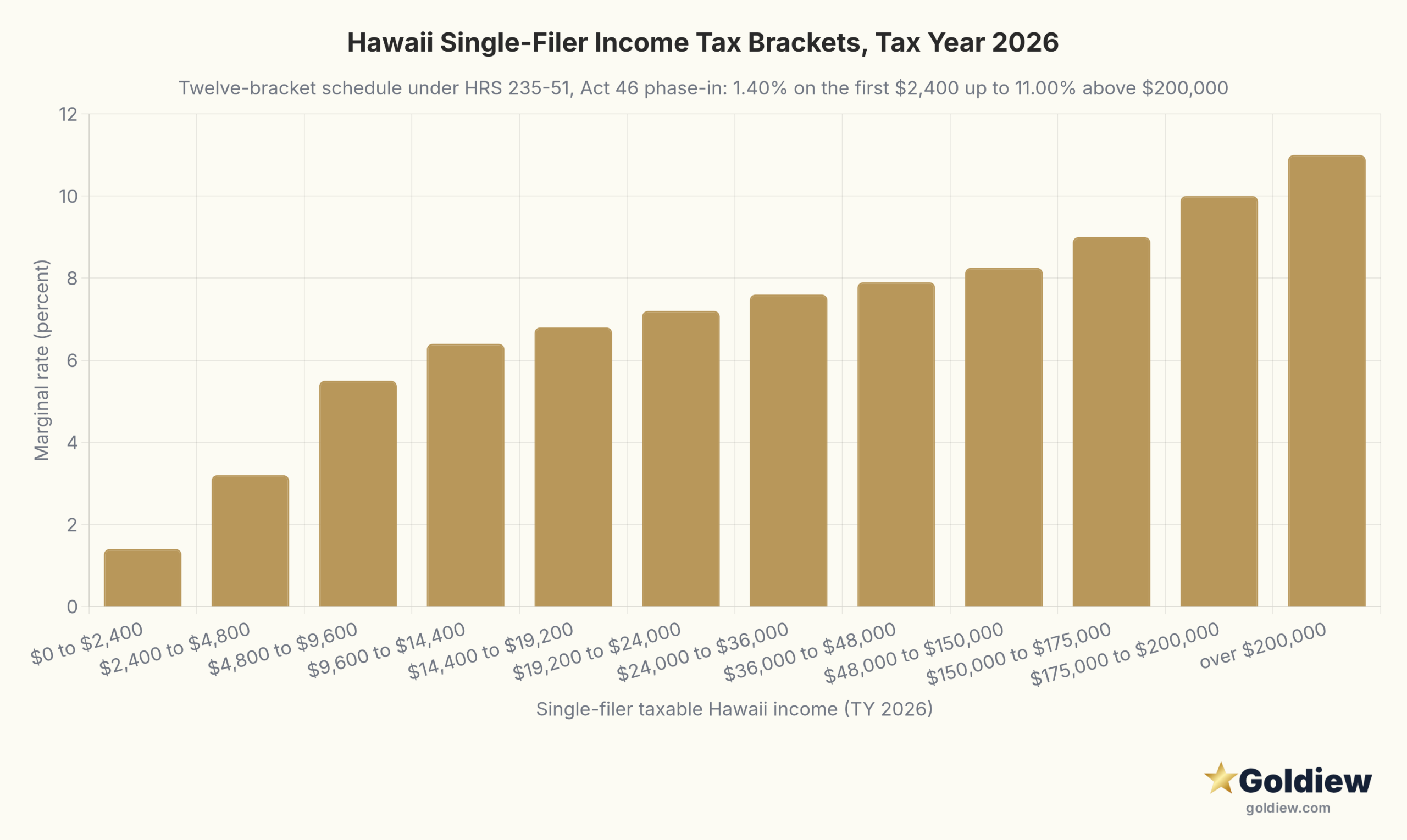
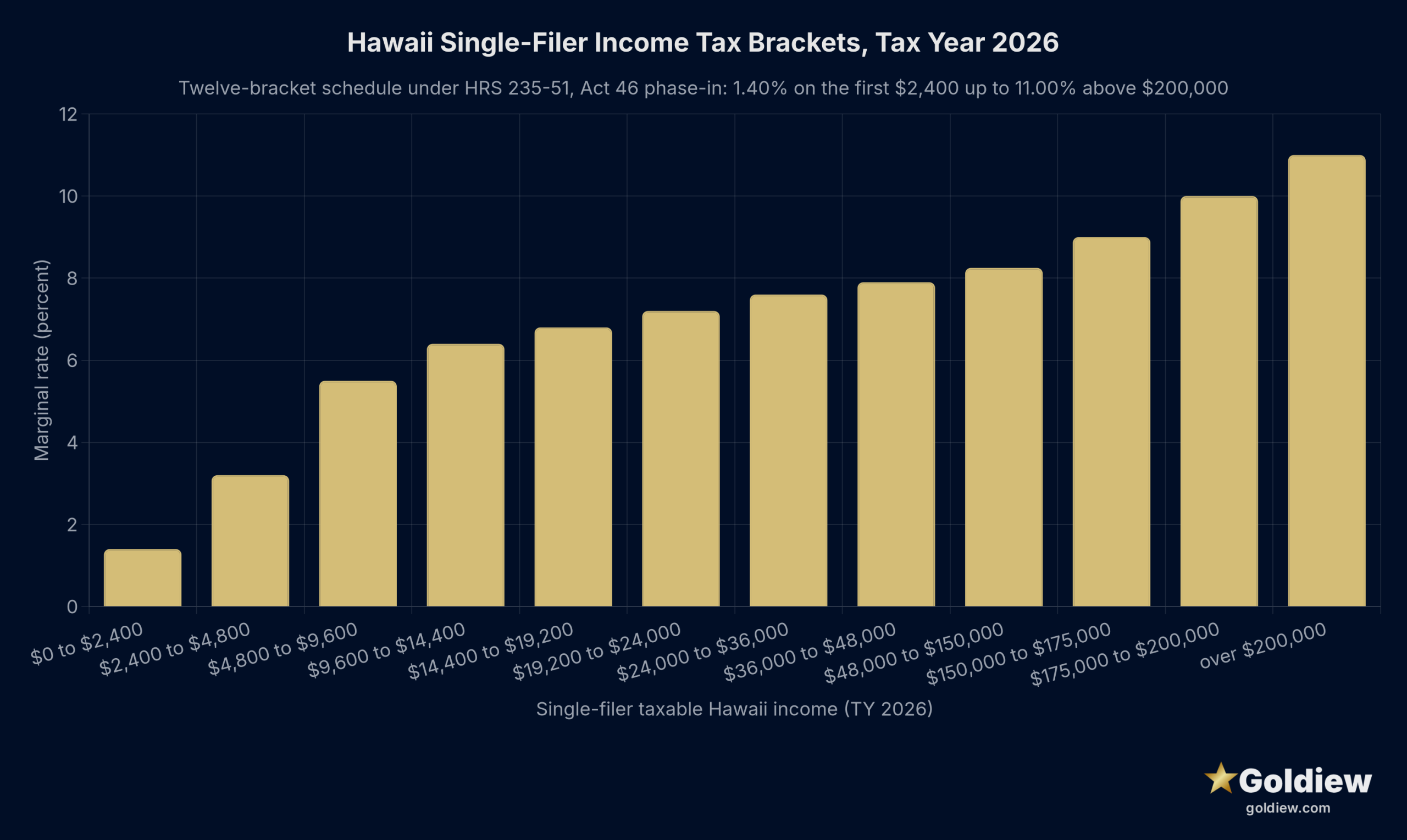
Hawaii taxes most traditional IRA distributions as ordinary state income at progressive rates set in HRS § 235-51. The IRS treats traditional IRA distributions as taxable income reported on Form 1099-R, per IRS Publication 590-B. Hawaii then layers its own 12-bracket schedule on the same income, then subtracts any applicable retirement income exclusion under HRS § 235-7.
Act 46, Session Laws of Hawaii 2024, signed into law by Governor Josh Green, widens the bracket thresholds and raises the standard deduction in phased steps from tax year 2024 through 2031. The 11 percent top rate itself is unchanged, but the income level at which it applies rises over the phase-in window. The brackets below reflect single-filer thresholds for tax year 2026 under the Act 46 phase-in schedule. Married couples filing jointly use approximately doubled thresholds. Verify the current year brackets with the Hawaii Department of Taxation Form N-11 instructions. Idaho operates a flat 5.695 percent rate; the Gold IRA for Idaho Residents covers how that single-bracket structure simplifies IRA distribution planning.
| Single-filer taxable Hawaii income (TY 2026) | Rate |
|---|---|
| $0 to $2,400 | 1.40% |
| $2,400 to $4,800 | 3.20% |
| $4,800 to $9,600 | 5.50% |
| $9,600 to $14,400 | 6.40% |
| $14,400 to $19,200 | 6.80% |
| $19,200 to $24,000 | 7.20% |
| $24,000 to $36,000 | 7.60% |
| $36,000 to $48,000 | 7.90% |
| $48,000 to $150,000 | 8.25% |
| $150,000 to $175,000 | 9.00% |
| $175,000 to $200,000 | 10.00% |
| over $200,000 | 11.00% |
For married couples filing jointly, the thresholds in HRS § 235-51(a) are approximately doubled, so the 11 percent top rate applies to taxable income above roughly $400,000. The Act 46 phase-in widens the lower brackets faster than the upper brackets, which compresses the effective rate for middle-income filers more than for high-income filers. The top marginal rate of 11 percent is among the highest of any US state. Source on the rate ceiling and phase-in: Hawaii Department of Taxation Form N-11 Instructions (2024) and Act 46 (SLH 2024) text.
A taxable IRA distribution flows into federal AGI, then into Hawaii adjusted gross income on Form N-11 (resident) or N-15 (part-year / non-resident). The next section covers how the HRS § 235-7 retirement income exclusion can reduce the Hawaii-taxable portion for distributions traceable to employer contributions.
The HRS § 235-7 Partial Retirement Income Exemption
Hawaii Revised Statutes § 235-7(a)(3) excludes from Hawaii gross income “any compensation received in the form of a pension for past services.” Hawaii Department of Taxation Tax Information Release No. 96-5 clarifies the practical scope: pension and retirement income funded by employer contributions is exempt from Hawaii income tax, while distributions traceable to employee contributions remain taxable as ordinary income.
What qualifies as employer-funded retirement income
Per HRS § 235-7(a)(3) and TIR 96-5, the exemption applies to defined-benefit pension payments (including HERS, ERS, and federal pensions), employer contributions and earnings inside a 401(k) or 403(b), profit-sharing plan distributions traceable to employer contributions, and the employer-funded portion of any rollover IRA. The employee-elected salary deferral portion of a 401(k) is NOT exempt under TIR 96-5, and neither is any portion of a traditional IRA funded by personal contributions.
Why most traditional IRA distributions remain Hawaii-taxable
A standard traditional IRA is built from personal pre-tax contributions made by the individual, not by an employer. Under HRS § 235-7 and TIR 96-5, those distributions do not qualify for the pension exemption. Hawaii taxes the full distribution as ordinary state income at the bracket applicable to total Hawaii AGI. Mississippi exempts all retirement income from state tax; the Gold IRA for Mississippi Residents covers what full exemption means for distribution planning.
The partial exemption matters for rollover IRAs. A rollover IRA that combines (a) employer 401(k) contributions and earnings (exempt) with (b) employee 401(k) deferrals and personal IRA contributions (taxable) requires the filer to separate the two streams. The Hawaii Department of Taxation expects the filer to document the employer-funded portion using plan records or Form 5498 history. Without documentation, Hawaii generally treats the full distribution as taxable. Consult your tax advisor for your specific situation. Arkansas uses a flat $6,000 retirement exclusion rather than source tracing; the Gold IRA for Arkansas Residents covers that approach.
Roth IRAs are different. Qualified Roth IRA distributions are tax-free at the federal level per IRS Publication 590-B, and Hawaii follows the federal treatment. The HRS § 235-7 partial exemption is most relevant for traditional IRA holders whose accounts contain rollover assets from an employer plan.
Practical effect on a Hawaii rollover decision
Consider a 67-year-old Hawaii resident taking a $40,000 distribution in 2026 from a traditional IRA. If the entire $40,000 is traceable to personal IRA contributions, the full amount is Hawaii-taxable at the applicable bracket. If $25,000 of the $40,000 is documented as a rollover from a prior employer’s 401(k) (employer contributions and earnings), only the remaining $15,000 is Hawaii-taxable; the $25,000 employer-source portion is excluded under HRS § 235-7(a)(3).
Moving a 401(k) or traditional IRA into a self-directed gold IRA does not change the Hawaii state tax treatment of later distributions. A self-directed gold IRA holds physical metals at an IRS-approved depository per IRS Publication 590-A. Distributions remain ordinary income at the federal level. At the Hawaii level, the employer-source versus employee-source allocation continues to drive the § 235-7 exemption analysis, with the same documentation burden on the filer. Consult your tax advisor for your specific situation.
Hawaii General Excise Tax on Precious Metals
Hawaii does not have a conventional sales tax. Under HRS Chapter 237 the state imposes a General Excise Tax (GET) on the gross income of nearly all business activity. The base GET rate is 4.00 percent statewide. A 0.50 percent county surcharge applies in the City and County of Honolulu, Hawaii County, and Kauai County, bringing the effective rate to 4.50 percent on those islands. Maui County does not currently impose a county surcharge.
Why GET matters for gold IRA purchases
Most US states exempt investment-grade precious metals from sales tax under bullion exemption statutes. Hawaii does not provide a bullion exemption. A Hawaii-based dealer selling gold for IRA placement passes the GET cost through to the customer as a separate line item or includes it in the quoted price. For out-of-state dealers shipping metals to a Hawaii address for a self-directed IRA, Hawaii Use Tax (HRS Chapter 238) applies at the same combined rate.
For a self-directed IRA, the metals are delivered to the IRS-approved depository on the mainland rather than to the Hawaii resident’s home. The state where the depository is located, not Hawaii, generally determines sales or use tax on the inbound shipment to the depository. Most IRA-popular depository states (Texas, Delaware, Utah) exempt investment-grade bullion. This routing detail is part of why Hawaii residents almost always end up with mainland-based depository storage. Texas levies no state income tax; Best Gold IRA for Texas Residents in 2026 covers how that shapes IRA strategy for residents there.
How GET interacts with personal (non-IRA) purchases
If a Hawaii resident buys gold or silver coins for personal possession (outside an IRA) from a Hawaii-based dealer, GET applies at the 4.00 or 4.50 percent rate depending on county. Buying from an out-of-state dealer with delivery to a Hawaii address triggers Use Tax at the same rate. Personal possession of metals is also outside the IRA wrapper and is not protected by the HRS § 651-124 creditor exemption discussed below. Consult your tax advisor for your specific situation.
IRA Creditor Protection Under HRS § 651-124
Hawaii Revised Statutes § 651-124 provides that the right of an individual to a pension, annuity, retirement, or disability allowance, including amounts held in an individual retirement account, is exempt from attachment or execution. The exemption applies to assets held inside the IRA wrapper, including physical gold or silver held by an IRS-approved depository on behalf of a self-directed IRA. The protection covers both traditional and Roth IRAs.
Common exceptions to the exemption
- Federal tax liens. The Internal Revenue Service can reach IRA assets for unpaid federal taxes regardless of state exemption status.
- Qualified domestic relations orders (QDROs) and child support. Divorce decrees and child support enforcement orders can reach retirement assets.
- Restitution in criminal cases. Some criminal restitution orders override the state exemption.
- Federal bankruptcy interaction. The Bankruptcy Abuse Prevention and Consumer Protection Act sets a federal cap on IRA exemption in bankruptcy (currently above $1.5 million, indexed for inflation), with rollover assets from qualified employer plans generally treated more favorably.
- Fraudulent transfers. Assets moved into an IRA in fraud of an existing creditor are not protected.
Physical metals held outside an IRA (personal possession, home safe, non-IRA brokerage gold) do not receive the § 651-124 exemption. The creditor protection applies to the IRA wrapper, not to the asset class. Hawaii residents holding personal-possession bullion who also have IRA-held bullion should keep clear separation in records and chain of custody. Consult a Hawaii-licensed attorney for situation-specific creditor planning. New York’s CPLR provides similar IRA creditor protection; the Gold IRA for New York Residents covers those statutory limits.
DCCA Office of Consumer Protection and BBB Verification
Hawaii residents researching a gold IRA company have four free verification channels before signing any paperwork. None requires the prospective customer to share personal data with the provider first.
Hawaii DCCA Office of Consumer Protection
The Hawaii Department of Commerce and Consumer Affairs (DCCA) operates the Office of Consumer Protection at cca.hawaii.gov/ocp. The office accepts consumer complaints, investigates deceptive trade practices, and publishes consumer alerts. Filing a complaint creates a paper trail and costs nothing.
Hawaii DCCA Securities Enforcement Branch
The DCCA Securities Enforcement Branch, within the Business Registration Division at cca.hawaii.gov/sec, registers and regulates investment advisers and investigates investment fraud involving Hawaii residents. For self-directed gold IRA providers, registration scope depends on whether the company operates as a precious metals dealer, an investment advisor, or an IRA setup intermediary. The Securities Enforcement Branch page is the first stop for verifying any advisory claim by a provider.
Better Business Bureau profiles
Verify each provider’s BBB profile through bbb.org. Look at the rating, accreditation status, time accredited, complaint volume over the past three years, complaint resolution rate, and any government actions disclosed. Cross-check Trustpilot, Google Reviews, and the SEC’s investor.gov for any registered investment advisor filings.
SEC and FINRA fraud alerts
The Securities and Exchange Commission publishes investor bulletins on investing in gold, and FINRA publishes alerts on precious metals fraud red flags. Both are free, both apply nationwide, and both are useful for spotting high-pressure sales tactics that should disqualify a provider.
Gold IRA Providers Available to Hawaii Residents
The three providers below all serve Hawaii residents and operate under federal IRS Publication 590-A standards for self-directed precious metals IRAs. Each section lists what the company actually offers (verified against the company’s own public marketing), not promotional framing. Time zone friction is real for Hawaii residents: every provider is on Pacific, Mountain, Central, or Eastern time, leaving Hawaii callers with morning-only windows for live conversations.
Augusta Precious Metals
RANK 1 Education-first onboarding, Beverly Hills HQ, Money Magazine award 2022 to 2026What differentiates Augusta for Hawaii investors
Augusta operates an education-first process described on its home page as Learn, Talk, Decide: customers start with a 2026 Gold IRA Guide, then schedule a one-on-one web conference with a salaried, non-commissioned educator, then decide whether to proceed. The salaried-not-commissioned structure is stated directly on augustapreciousmetals.com. For Hawaii residents who prefer a deliberate, education-heavy approach rather than a fast self-serve flow, this fits. The web conference format also removes the time zone disadvantage of a live phone call: Augusta scheduling accommodates a Hawaii morning slot that lands inside California business hours.
Augusta has held a BBB A+ rating with zero complaints (accredited since 2014, per BBB) and reports more than 4,000 five-star ratings across Trustpilot, Google, and Consumer Affairs. Money Magazine has named Augusta Best Overall Gold IRA Company for 2022 through 2026. CEO Isaac Nuriani and Director of Education Devlyn Steele are named on the company’s about page.
Fees and costs
Augusta advertises a multi-year fee waiver for qualifying rollover accounts. The specific terms are reviewed during the free consultation and may vary based on account size. Industry coverage from Money.com and Investopedia reports a minimum investment around $50,000, though this is not stated on Augusta’s home page. Verify current terms with Augusta directly.
Process and depository (Hawaii angle)
Augusta works with a qualified self-directed IRA custodian (per the company’s public statements) and an IRS-approved depository. The specific depository options are shared during the consultation rather than published publicly. There is no Augusta office in Hawaii; all IRA setup is conducted remotely. Hawaii residents should ask during the web conference about insured outbound shipping arrangements for metals that move from a dealer warehouse to the chosen depository, since the inter-island and Hawaii-to-mainland leg adds a layer of in-transit insurance to track.
Pros
- Salaried (non-commissioned) educator model reduces high-pressure sales risk
- BBB A+ rating, zero complaints, accredited since 2014
- 4,000+ five-star aggregate ratings (Trustpilot, Google, Consumer Affairs)
- Multi-year fee waiver structure available on qualifying accounts
- Web-conference format accommodates Hawaii morning scheduling
Cons
- $50,000 industry-reported minimum filters out smaller savers
- Required web conference adds a step compared with self-serve dealers
- Specific depository options not published publicly (shared in consultation)
- No public guidance on Hawaii-specific shipping insurance arrangements
Birch Gold Group
RANK 2 Established 2011, 40,000+ customers, five named partner depositoriesWhat differentiates Birch for Hawaii investors
Birch Gold Group reports more than 40,000 customers since 2011 on birchgold.com. The company is headquartered on the mainland and publicly lists five partner depositories: Delaware Depository (Wilmington), Brink’s Global Services, International Depository Services, Texas Precious Metals Depository, and Texas Bullion Depository. None are in Hawaii, but the five-depository network gives Hawaii residents the widest published menu of mainland storage choices among the three providers in this guide.
Birch has a BBB A+ rating and AAA rating from the Business Consumer Alliance, both verifiable on the company’s about page. Public endorsers include Ron Paul, Stephen K. Bannon, Clay Travis and Buck Sexton, Dan Bongino, Megyn Kelly, Chad Prather, and Lance Wallnau. Hawaii residents who do not value media endorsements can ignore that signal. The BBB rating, customer count, and depository network are the substantive data points.
Fees and costs
Birch does not advertise a fee waiver on its public site. Industry coverage reports a minimum investment around $10,000, lower than Augusta’s $50,000 industry-reported figure. The lower entry point opens Birch to a larger pool of Hawaii savers, including those starting with a partial 401(k) rollover or those with smaller mainland-rollover balances.
Process and depository (Hawaii angle)
The Birch process is a one-on-one Birch Gold Specialist call followed by paperwork handled through an in-house IRA Department. The call originates from the mainland and uses Pacific business hours, which translates to early to mid-morning windows for Hawaii callers (Hawaii Standard Time is 2 or 3 hours behind Pacific). During the call, Hawaii residents can ask which of the five named depositories is closest to existing personal contacts on the mainland for verification visits, or which depository offers the lowest published storage rates.
Pros
- Lower industry-reported minimum (around $10,000) opens access to more Hawaii savers
- Five depository options published (Delaware, Brink’s, IDS, Texas PMD, Texas BD)
- BBB A+ rating, AAA Business Consumer Alliance rating
- 14+ years operating history (since 2011)
Cons
- No public fee waiver structure advertised
- Sales process is commission-incentivized (standard industry model, not salaried like Augusta)
- Media-personality endorsements may not match all Hawaii residents’ filtering criteria
- Pacific-time call windows leave Hawaii callers with a narrower live-call window than mainland customers
Noble Gold Investments
RANK 3 16,000+ customers, Texas-based depository, streamlined applicationWhat differentiates Noble for Hawaii investors
Noble Gold Investments reports more than 16,000 customers and $2.5 billion in metals safeguarded on noblegoldinvestments.com. Noble’s marketing references industry experience going back to 2003, though Noble Gold Investments as a corporate entity is more recent. The company is headquartered in Encino, California, and operates a Texas-based depository. Hawaii residents fine with single-vendor mainland storage will find the Texas option clean; those who want to compare multiple depository pricing or geographies should look at Birch.
The application process is described publicly as four steps: simple application, connection with the trusted custodian, a Gold and Silver specialist call, and metal selection. Noble also publicly offers a non-IRA home delivery option for precious metals, which does not qualify for IRA tax treatment but is available for direct purchase. Hawaii residents should not confuse the home delivery product with the IRA product; they have different tax and creditor outcomes.
Fees and costs
Noble does not advertise a fee waiver. Industry coverage reports a minimum investment around $20,000, between Birch and Augusta. Specific custodian and depository fees are shared during the application call.
Process and depository (Hawaii angle)
Noble operates a Texas-based depository, distinguishing it from Augusta (third-party depositories not publicly listed) and Birch (five-depository network). For Hawaii residents the Texas-only model removes the option of choosing a depository on the West Coast or in Delaware, which can matter for time-zone-aligned customer service calls or for Hawaii residents who already have mainland family on the East Coast for in-person depository visits. The single-vendor structure does simplify the chain of custody for Hawaii residents who weight that over geography. There is no Noble office in Hawaii; all IRA setup is conducted remotely.
Pros
- Single-vendor Texas depository simplifies the chain of custody
- $20,000 industry-reported minimum, mid-range entry point
- Non-IRA home delivery option available for direct purchase (separate from IRA product)
- Streamlined four-step application path
Cons
- Founding year framing requires careful reading (corporate entity is more recent than the 2003 industry-experience reference)
- Single Texas depository removes any West Coast or Delaware storage option for Hawaii residents
- BBB rating widely reported as A+ but not confirmed on every public page
Full Comparison: Augusta vs Birch vs Noble for Hawaii Investors
The table below compares the three providers on the criteria most relevant to a Hawaii resident’s decision. Cells with a light-green highlight indicate the strongest factual position on that row (not a value judgement on the provider as a whole).
| Criterion | Augusta | Birch | Noble |
|---|---|---|---|
| Founded (public) | 2012 | 2011 | Marketing references 2003; corporate entity more recent |
| Customer count | Not stated publicly | 40,000+ | 16,000+ |
| Headquarters | Beverly Hills, CA (secondary in Casper, WY) | Iowa | Encino, CA |
| Minimum investment (industry-reported) | around $50,000 | around $10,000 | around $20,000 |
| BBB rating | A+ (accredited 2014, zero complaints) | A+ | A+ (industry-reported) |
| Depository options published | IRS-approved (specifics shared in consultation) | 5 depositories (Delaware, Brink’s, IDS, Texas PMD, Texas BD) | 1 (Texas-based) |
| Time zone friction for Hawaii callers | Scheduled web conference (mitigates friction) | Pacific-time live call window | Mainland-time live call window |
| Sales staff structure | Salaried, non-commissioned (stated publicly) | Specialist model (industry-standard commission) | Specialist call (industry-standard) |
| Fee waiver advertised | Multi-year waiver on qualifying accounts | None advertised | None advertised |
| Process steps | Learn, Talk, Decide (education-first) | Specialist + IRA Department paperwork | 4-step application |
| Awards (verifiable on site) | Money Magazine Best Overall (2022 to 2026), Investopedia Most Transparent | Endorsements (Ron Paul, Megyn Kelly, others) | None highlighted |
| Goldiew internal rating (verified users) | 4.71 / 5 | 4.43 / 5 | 4.67 / 5 |
| Non-IRA option | Not the primary product | Not advertised | Home delivery (non-IRA) |
No single provider wins every row. Hawaii residents weighing this decision should pick the criteria that match their own situation, then choose the provider that wins on those criteria. For residents specifically asking “which provider lists the most depositories I can pick from on the mainland,” Birch leads with five published partners. The next section walks through who each provider fits best.
Which Provider Fits Your Hawaii Situation?
None of these providers
Hawaii residents starting with under $25,000 are below all three providers’ industry-reported minimums. Continue contributing to your existing 401(k) or IRA, build the balance, and revisit the gold IRA decision once you cross a meaningful threshold. Augusta in particular asks for $50,000 or more for the model to make sense.
Birch Gold Group
Birch publicly lists five partner depositories. Hawaii residents who want to compare Delaware, Texas, and Brink’s options on storage pricing or chain-of-custody policies have the most material to work with at Birch.
Augusta Precious Metals
This is Augusta’s target customer. The salaried-educator model, BBB profile, multi-year fee waiver structure on qualifying accounts, Money Magazine award history, and scheduled web-conference format (which removes the live-call time-zone window problem) align with a Hawaii filer rolling over a substantial 401(k) or IRA.
Noble Gold Investments
Noble’s Texas depository simplifies the chain of custody. Hawaii residents fine with single-vendor storage and a streamlined four-step application will find Noble a clean fit. If you want to choose among multiple depository geographies, Noble is the wrong choice.
A gold IRA may fit your Hawaii profile if
- You have $25,000 or more in eligible retirement accounts
- You are within 10 years of retirement or already retired
- You have decided (independently or with your CPA) to allocate part of retirement holdings to physical precious metals
- You can hold the position for 5 or more years without needing liquidity
- You have documented employer-source versus employee-source contributions inside your existing retirement accounts (relevant for the HRS § 235-7 exemption at distribution)
A gold IRA may not fit your Hawaii profile if
- You have under $25,000 saved
- You may need to liquidate within 1 to 5 years
- You have not maxed out the employer 401(k) match (free money first)
- You have high-interest debt outstanding (pay off first)
- You are uncomfortable with physical asset custody arrangements that require mainland depository storage
Two related Goldiew resources may help before you proceed: Gold Calculator: What Is Your Gold Worth Today? for understanding spot-to-product premium math, and How to Tell If Gold Is Real: 5 Home Tests for verifying physical metals you may already own.
Frequently Asked Questions
Does Hawaii tax IRA distributions in 2026?
Yes, Hawaii taxes traditional IRA distributions traceable to personal contributions as ordinary state income at the HRS § 235-51 bracket schedule (top marginal rate 11 percent). Hawaii excludes from gross income employer-funded retirement income under HRS § 235-7(a)(3) and TIR 96-5. A rollover IRA that combines employer-source and employee-source funds requires the filer to document the split; without documentation, Hawaii treats the full distribution as taxable. Qualified Roth IRA distributions are tax-free at both federal and Hawaii levels. Consult your tax advisor for your specific situation.
What is the Hawaii state income tax rate on a $40,000 IRA withdrawal?
The marginal Hawaii rate depends on your total Hawaii taxable income for the year, with brackets running from 1.40 percent on the first $2,400 (single filer) up to 11.00 percent above $200,000. If part of the $40,000 distribution traces to employer 401(k) contributions and earnings, that portion is excluded under HRS § 235-7(a)(3). Only the employee-source portion (personal IRA contributions or employee 401(k) deferrals rolled into the IRA) remains Hawaii-taxable at the applicable bracket. The federal tax is separate and applies to the full $40,000. Consult your tax advisor.
Are IRAs protected from creditors in Hawaii?
Hawaii Revised Statutes § 651-124 exempts pensions, annuities, retirement allowances, and IRA assets (including Roth IRAs) from attachment or execution. Common exceptions: federal tax liens, qualified domestic relations orders, child support, certain criminal restitution orders, fraudulent transfers, and the federal Bankruptcy Code cap in bankruptcy proceedings. Consult a Hawaii-licensed attorney for situation-specific creditor planning.
Is there a gold IRA depository in Hawaii?
No. There is no IRS-approved precious metals depository on any Hawaiian island. All gold IRA storage available to Hawaii residents uses mainland depositories (Delaware, Texas, Salt Lake City area, and other approved facilities). The IRS rule requires the IRA-held metals to remain in the custody of an IRS-approved trustee or depository until distribution; personal possession before age 59½ or before the rollover completes triggers distribution treatment and potential penalties regardless of where the depository is located.
Does Hawaii charge sales or excise tax on precious metals?
Hawaii imposes General Excise Tax under HRS Chapter 237 rather than a conventional sales tax. The base GET rate is 4.00 percent statewide, with a 0.50 percent county surcharge in Honolulu, Hawaii County, and Kauai County (4.50 percent effective). Hawaii does not have a bullion exemption, so precious metals purchases from a Hawaii-based dealer are subject to GET, and out-of-state purchases delivered to Hawaii addresses are subject to Use Tax at the same rate. Self-directed IRA metals are delivered to the mainland depository, not to the Hawaii resident’s home, so the inbound delivery is subject to the depository state’s rules (most IRA-popular states exempt investment-grade bullion). Consult your tax advisor for your specific situation.
What gold and silver products qualify for an IRA under IRS rules?
Per IRS Publication 590-A, IRA-eligible precious metals must meet specific fineness standards: 0.995 fineness for gold (with the American Gold Eagle exception), 0.999 for silver, 0.9995 for platinum, and 0.9995 for palladium. The metals must be held by an IRS-approved trustee or depository. Personal possession of IRA metals before age 59½ (or before the rollover completes) triggers distribution treatment and potential penalties. Consult your tax advisor for your specific situation.
How do I verify a precious metals provider before signing in Hawaii?
Use four channels: the Hawaii DCCA Office of Consumer Protection at cca.hawaii.gov/ocp for complaints history, the DCCA Securities Enforcement Branch at cca.hawaii.gov/sec for registered investment advisor filings, the BBB profile for rating and complaint volume, and the SEC investor.gov and FINRA fraud alert pages for federal-level red flags. None of these requires sharing your personal data with the provider first.
How does the time zone difference affect a gold IRA rollover from Hawaii?
Hawaii Standard Time is 5 hours behind Eastern, 4 hours behind Central, 3 hours behind Mountain, and 2 hours behind Pacific (Hawaii does not observe daylight saving). Live-call windows for mainland providers typically open at 5 to 7 AM Hawaii time and close by mid-afternoon Hawaii time. Augusta’s scheduled web-conference format generally accommodates a Hawaii morning slot inside California business hours. Birch and Noble use live phone calls, leaving Hawaii callers with a narrower window. Plan the call cadence into the rollover timeline.
Sources and Methodology
- IRS Publication 590-A: Contributions to Individual Retirement Arrangements (IRAs) for federal IRA contribution and rollover rules.
- IRS Publication 590-B: Distributions from Individual Retirement Arrangements (IRAs) for federal IRA distribution rules and tax treatment.
- Hawaii Department of Taxation Form N-11 Instructions (2024) for current resident bracket schedule and standard deduction figures.
- Hawaii Department of Taxation Tax Information Releases (TIR 96-5 on pension exclusion) for the employer-source versus employee-source distinction under HRS § 235-7(a)(3).
- Hawaii Revised Statutes § 235-51 for the individual income tax bracket schedule (top rate 11 percent on single income over $200,000), as amended by Act 46, Session Laws of Hawaii 2024.
- Hawaii Revised Statutes § 235-7(a)(3) for the pension and retirement income exclusion from Hawaii gross income.
- Hawaii Revised Statutes Chapter 237 (General Excise Tax Law) and Chapter 238 (Use Tax Law) for GET and Use Tax treatment of precious metals.
- Hawaii Revised Statutes § 651-124 for IRA creditor exemption framework.
- Hawaii DCCA Office of Consumer Protection for consumer complaint procedures and deceptive trade practice enforcement.
- Hawaii DCCA Securities Enforcement Branch for investment advisor registration verification and securities enforcement actions.
- SEC Investor Bulletin: Investing in Gold for federal investor warnings.
- FINRA: Precious Metals Fraud Alerts for red flags to apply when evaluating any provider.
- Better Business Bureau for company profile verification (ratings, complaint volume, accreditation history).
- Provider public marketing pages verified during the most recent partner verification crawl: augustapreciousmetals.com, birchgold.com, noblegoldinvestments.com.
- Goldiew internal user reviews (manually moderated and verified) for the per-provider rating figures cited in the Quick Verdict and comparison table.
Methodology note. Provider rankings reflect Goldiew internal review aggregates and verifiable BBB profile data. The order does not reflect affiliate commission rates, which differ across the three providers. Provider facts (founding year, customer counts, BBB ratings, fee structures, depository networks) are cross-referenced against each company’s own public website plus the institutional sources above. Where industry coverage (Money.com, Investopedia) cites a figure not on the company’s own site, the figure is labeled “industry-reported.” Hawaii statute citations reflect HRS as amended through Act 46, Session Laws of Hawaii 2024; readers should confirm the latest text via the Hawaii State Legislature site or with a Hawaii-licensed CPA or attorney. This guide is reviewed for factual accuracy each quarter.