
✅ Quick answer
A SEP-IRA or Solo 401(k) lets a 1099 trucker put away up to $72,000 a year tax-advantaged in 2026, far exceeding what a traditional IRA alone allows. Physical gold can sit inside a self-directed IRA once the account is established and funded, but drivers carrying high-interest debt on equipment or without three to six months of operating reserves should complete those priorities before buying any metals.
We are not financial advisors. The information below covers account mechanics and IRS rules. Consult a licensed financial advisor and a tax professional before making decisions about your retirement savings.
The Retirement Gap Most Owner-Operators Never Address
Company drivers with a trucking employer usually have access to a 401(k), sometimes with a match. Lease operators and owner-operators running under their own authority typically have none of that. No plan enrollment, no match, no automatic payroll deduction. Retirement savings become entirely self-directed, in the full sense of the phrase.
That is both a problem and an advantage. The problem is obvious: without structure, busy freight seasons push retirement funding to the back. The advantage is that self-employed truckers can access retirement account types with contribution limits that most W-2 workers never qualify for, and those limits are set as a percentage of net income, which rewards higher-earning years. Owner-operators can compare SEP, SIMPLE, and Solo 401(k) options in the full best gold IRA for self-employed breakdown.
The first task is not choosing an investment. It is choosing which account to open, and in what order to fund it.
Your Funding Ladder: Four Account Types Ranked by Priority
Not every account is right for every situation, and the order in which you fund them matters. The ladder below starts with the most tax-efficient option for a self-employed trucker and works down.
1. SEP-IRA (Simplified Employee Pension)
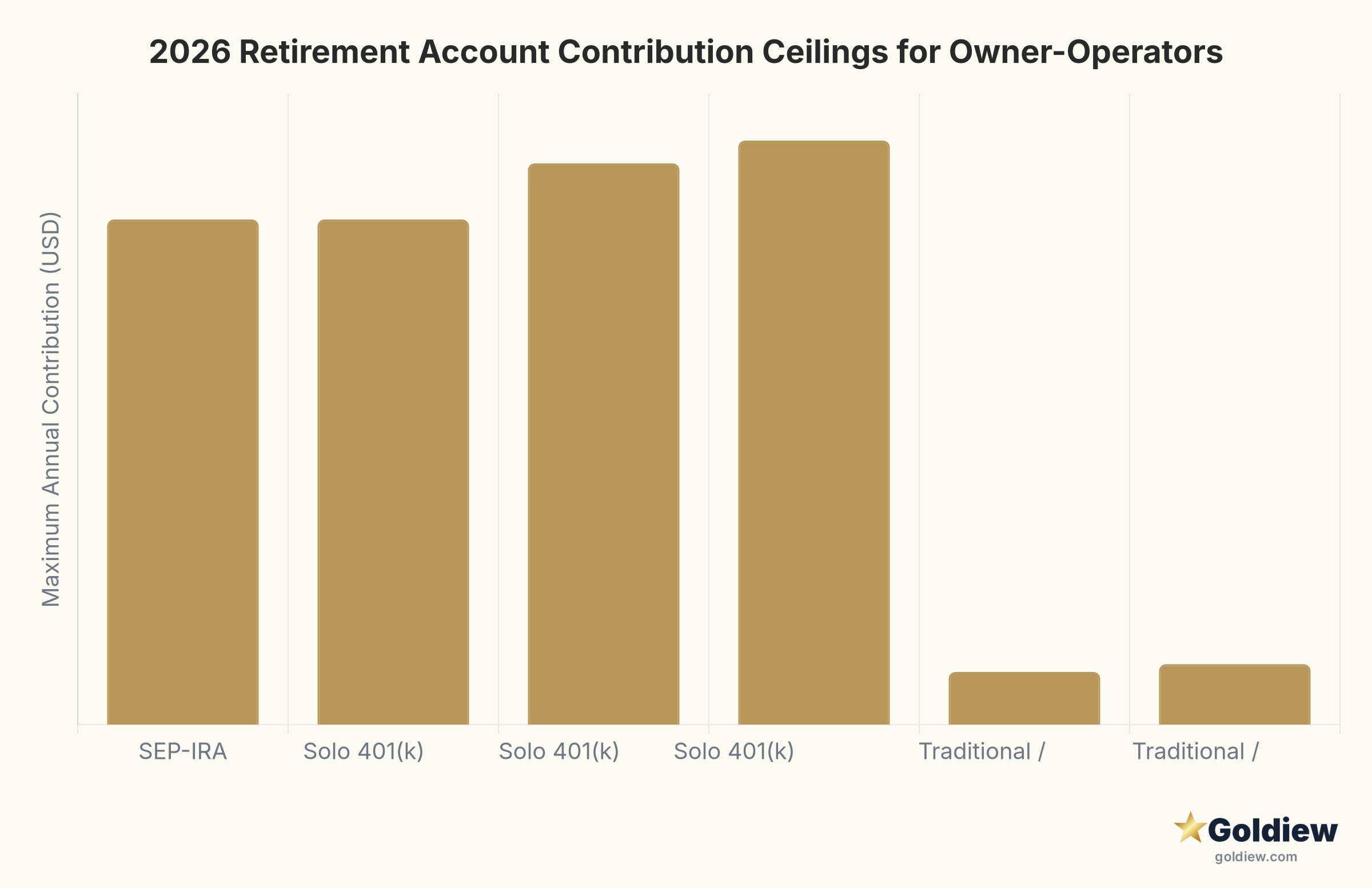
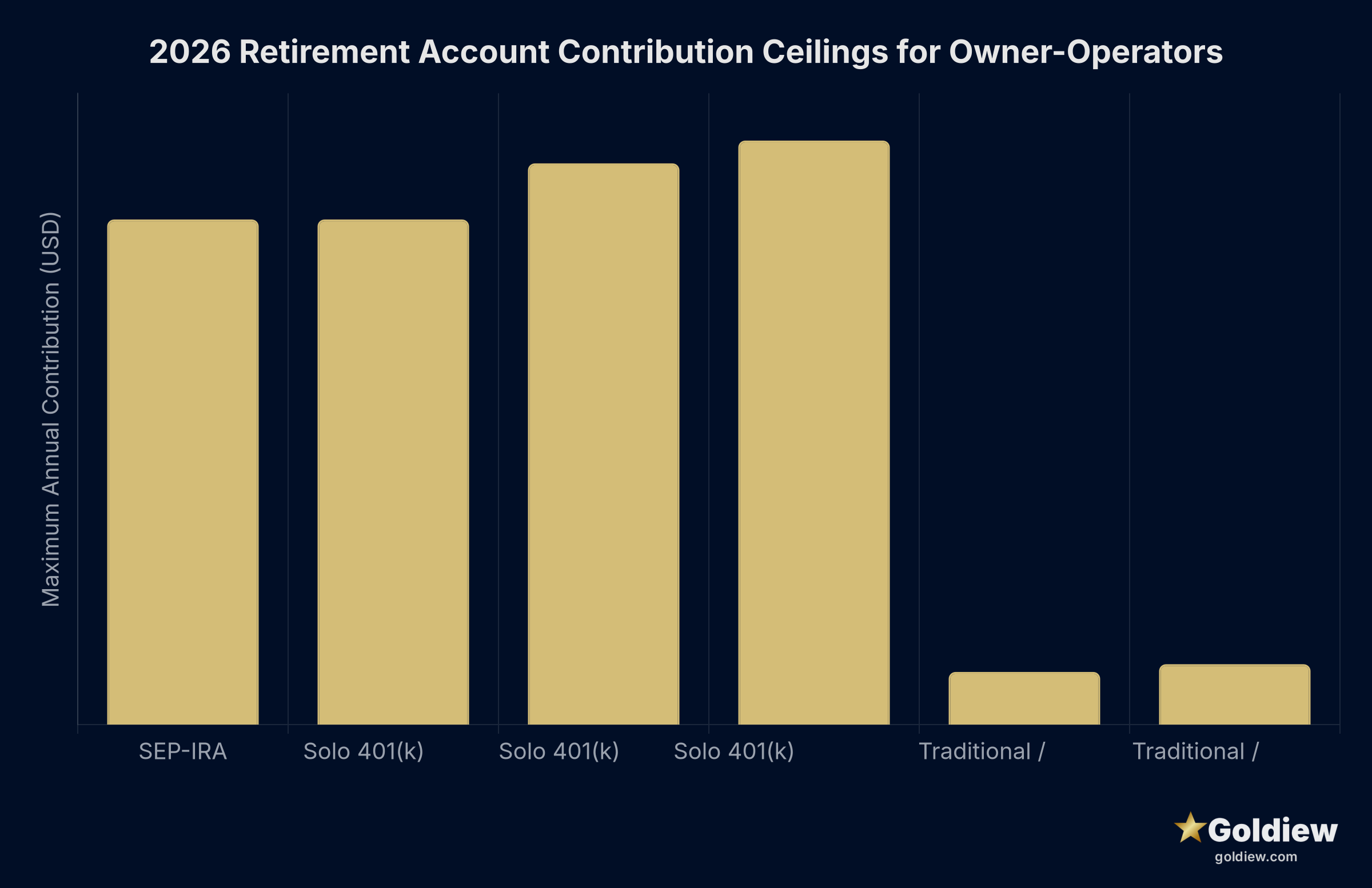
A SEP-IRA is the simplest high-contribution option for a 1099 owner-operator. The IRS allows you to contribute up to 25 percent of net self-employment income, capped at $72,000 for 2026, whichever is lower. You can set one up at most major financial institutions with a single form.
There is no Roth option inside a SEP-IRA. Contributions are always pre-tax, which reduces your taxable income in the year you contribute. Withdrawals in retirement are taxed as ordinary income. There are no catch-up contributions for age 50 or older; the limit is the same regardless of age.
One important limitation: if you have employees other than yourself, you must contribute the same percentage of compensation to their SEP-IRAs as you do to your own. Owner-operators running as a sole proprietorship with no employees avoid this issue entirely.
Consult your tax advisor to confirm how net self-employment income is calculated for your specific situation, since deducting half of the self-employment tax affects the contribution ceiling.
2. Solo 401(k) (Individual 401k)
A Solo 401(k), sometimes called an Individual 401(k), is structured for business owners with no full-time employees other than a spouse. It has two contribution components that together can reach high ceilings.
As an employee of your own business, you can defer up to $24,500 in 2026. On top of that, as the employer, you can contribute up to 25 percent of net self-employment income. The combined employee-plus-employer total cannot exceed $72,000 in 2026 for those under 50. If you are 50 or older, a catch-up provision raises the employee deferral limit by $8,000, bringing the total to $80,000. Under SECURE 2.0, drivers aged 60 through 63 receive an enhanced catch-up that pushes the total ceiling to $83,250 in 2026.
Unlike a SEP-IRA, a Solo 401(k) can have a Roth component if the plan documents allow it. Roth contributions are after-tax, but qualified withdrawals in retirement are tax-free. This flexibility makes the Solo 401(k) especially useful if you expect to be in a higher tax bracket later, or if you want to pass assets to heirs without required minimum distributions during your lifetime. Not all custodians support the Roth option equally; best gold IRA companies for Roth conversions lists those that do.
The Solo 401(k) requires more paperwork than a SEP-IRA and must be opened before December 31 of the year for which you want to make contributions. Once plan assets exceed $250,000, annual IRS Form 5500-EZ filings are required. Consult your tax advisor on the right plan structure for your situation.
3. Traditional or Roth IRA
If your net self-employment income is relatively modest in a given year, or if you want a separate account on top of a SEP or Solo 401(k), a Traditional or Roth IRA is an option. The 2026 contribution limit is $7,500 per person ($8,600 for those 50 and older), sourced from earned income.
Roth IRA contributions are income-limited. In 2026, the ability to contribute phases out at higher modified adjusted gross incomes; consult IRS Publication 590-A or a tax advisor for the current thresholds. Traditional IRA deductibility is also subject to income limits if you or a spouse participates in a workplace retirement plan.
For most owner-operators with meaningful self-employment income, an IRA is a supplement to a SEP or Solo 401(k), not a replacement.
4. Rolling Over an Old Employer Plan
Many owner-operators spent time as company drivers before going independent. If you have a 401(k) balance from a prior employer sitting idle, rolling it over into an IRA or a Solo 401(k) is generally straightforward and preserves the tax-deferred status of the money.
A direct rollover, where the funds move trustee-to-trustee without passing through your hands, avoids the 20 percent withholding requirement that applies to indirect rollovers. If you receive a check made out to you personally, you have 60 days to deposit the full amount (including the withheld 20 percent, which you fund out of pocket and recover when you file your taxes) into a qualifying retirement account. Missing the deadline triggers taxes and potentially the 10 percent early withdrawal penalty if you are under 59 and a half.
Consult your tax advisor and the prior plan administrator before initiating any rollover. Learn more about rollover mechanics at our guide to what a gold IRA is.
The Operating Reserve Rule: Who Should Wait Before Funding Any Retirement Account
This section matters more than any discussion of account types or investment choices. It is the sequence-of-priorities question that most retirement planning content skips, because the writers do not know what it costs to run a truck.
Three situations call for holding off on retirement contributions, at least temporarily:
You carry high-interest debt on your equipment
A truck loan at 8, 10, or 12 percent interest is a guaranteed negative return on whatever principal you are paying down. Funding a retirement account while that debt accrues is mathematically counterproductive unless the retirement contribution produces a very high tax benefit in a high-income year. Work through the numbers with a tax advisor before choosing debt paydown versus retirement funding in any given year. Drivers carrying a 401(k) loan and gold IRA simultaneously face planning layers beyond standard debt paydown math.
You do not have three to six months of operating reserves
Freight income is not linear. Rates drop, loads disappear, fuel surcharges shift, and mechanical problems arrive without notice. A blown injector, a failed turbocharger, or a DOT compliance issue can take a truck off the road for weeks. If those reserves are not in place, a retirement account becomes an emergency fund with a 10 percent penalty attached to every withdrawal.
Before funding a SEP-IRA or Solo 401(k), build a liquid reserve that covers your operating costs: fuel, insurance, truck payments, and living expenses for three to six months. Keep this money in an interest-bearing savings account, not in a retirement account or in metals.
You are a company driver with an unmatched 401(k)
If you are still working as a W-2 employee at a trucking company that offers a 401(k) with an employer match, capture the full match before considering any other retirement vehicle. A 50 percent match on the first six percent of your salary is a 50 percent return on those dollars, which no retirement account type, fund, or asset class can reliably match. If you later move to owner-operator status, revisit your retirement strategy at that point.
What a Self-Directed IRA Actually Is
A standard IRA at a brokerage holds stocks, bonds, mutual funds, and ETFs. A self-directed IRA holds the same plus alternative assets: real estate, private notes, and, under specific IRS rules, physical precious metals.
Two requirements distinguish a self-directed IRA from a standard one.
A qualified custodian is required by law
IRS regulations require that all IRA assets be held by a qualified custodian: a bank, federally insured credit union, savings and loan association, or another entity approved by the IRS under Treasury Regulation 1.408-2(e). You cannot hold your own IRA assets. You cannot store gold you own as an IRA asset in your house, your truck, or a safe you control.
This rule was affirmed in McNulty v. Commissioner, 157 T.C. No. 10 (2021), where the Tax Court found that IRA holders who stored gold coins purchased through their IRA in a home safe had taken a taxable distribution equal to the full value of the coins. The IRS treats possession by the account holder as a distribution.
Custodians for self-directed IRAs typically charge annual administrative fees and storage fees for physical metals. Those fees vary by custodian and account size. Review the full fee schedule before opening an account.
Your truck cannot live in an IRA
IRC Section 4975 prohibits self-dealing and certain transactions between an IRA and a “disqualified person,” which includes you, your spouse, lineal descendants, and entities you control. This means you cannot sell your truck or other business equipment to your IRA, lease it to your IRA, or use IRA assets to buy equipment you then use in your trucking business.
Physical gold held in a gold IRA works differently because the gold is held by the custodian at an approved depository, not used by you personally. The distinction is that the gold sits in a vault and generates no income connected to your labor, which is what distinguishes it from business property under the prohibited transaction rules.
Adding Physical Gold to a Self-Directed IRA
Once a self-directed IRA is open and funded, the IRA can be used to purchase physical precious metals that meet IRS standards under IRC Section 408(m)(3). For gold, the standard is a fineness of at least .995 (99.5 percent pure), with an exception for American Gold Eagle coins, which are .9167 fine but are specifically approved by statute regardless of purity.
Eligible gold products include:
- American Gold Eagle coins (all sizes: 1 oz, 1/2 oz, 1/4 oz, 1/10 oz)
- American Gold Buffalo coins (.9999 fine)
- Canadian Gold Maple Leaf coins (.9999 fine)
- Gold bars and rounds meeting the .995 fineness standard from approved refiners
Products that do not meet these standards, including pre-1933 collectible coins and most foreign gold coins not specifically approved by statute, cannot be held in a gold IRA. Purchasing a non-qualifying product through an IRA is treated as a prohibited transaction and can result in the disqualification of the entire account.
Learn more about funding sources at our guide to SEP-IRA gold and converting a Solo 401(k) to a gold IRA.
Contributions to a gold IRA should track good-income years. When freight rates are favorable and the truck is running well, directing a portion of earnings toward the account makes sense. In a down year, the liquidity needed to keep the business running takes priority.
What to Look for in a Gold IRA Company
A gold IRA involves three parties: the account holder, the custodian, and typically a precious metals dealer that sources the gold. Some companies bundle the dealer and educator roles; others refer you to a separate custodian. Understanding who does what protects you from surprises.
Check any company you consider against these criteria:
- BBB rating and complaint history. The Better Business Bureau maintains accreditation status and complaint records that are publicly searchable. A company with an A+ rating and no unresolved complaints is a basic threshold, not a guarantee. Check BBB.org directly.
- Fee transparency. Annual custodian fees, storage fees (segregated versus commingled), and any setup charges should be disclosed in writing before you open an account. Ask for a full fee schedule covering the first three to five years.
- Salaried versus commissioned sales staff. Some companies compensate sales staff on commissions tied to the size and type of purchase. A salaried, non-commissioned educator model removes that incentive.
- IRS-compliant storage. Gold must be stored at an IRS-approved depository, not shipped to you. Ask which specific depository is used and whether storage is segregated (your metals tracked separately) or commingled.
- Buyback policy. When it comes time to liquidate the position, what is the process? Is there a guaranteed buyback, and at what spread to spot price?
For drivers with eligible retirement assets of around $50,000 or more (industry-reported as a common starting threshold for custodied gold IRA accounts), Augusta Precious Metals is one provider that uses a salaried, non-commissioned educator model and has been recognized by Money Magazine as Best Overall Gold IRA Company from 2022 through 2026. Any account you consider opening warrants direct comparison against multiple providers. Consult your financial advisor before making a decision. The Augusta Precious Metals vs Priority Gold comparison lines up fees, minimums, and education models side by side.
Past performance of gold prices is not a guarantee of future results. Nobody can accurately predict where gold prices will go in the future.
Frequently Asked Questions
Can a 1099 truck driver open a SEP-IRA?
Yes. Any self-employed individual with net earnings from self-employment, including independent owner-operators filing on Schedule C, qualifies to open a SEP-IRA. You establish the account and contribute for any year in which you have net self-employment income, up to the annual ceiling. See IRS Publication 560 for the contribution calculation rules.
What is the difference between a SEP-IRA and a Solo 401(k) for a trucker?
Both allow high contribution ceilings for self-employed individuals. The SEP-IRA is simpler to open and maintain, has no catch-up provision for age 50 or older, and is always pre-tax. The Solo 401(k) involves more paperwork and annual filings once assets exceed $250,000, but allows catch-up contributions for older drivers and can include a Roth component if the plan documents allow it. The right choice depends on your income level, age, and tax situation. Consult a tax advisor.
Can I roll over my old trucking company 401(k) into a gold IRA?
Yes, if you no longer work for the employer that sponsored the 401(k). A direct rollover moves the balance trustee-to-trustee without triggering taxes or penalties. Once the funds land in a self-directed IRA with a qualified custodian, you can use them to purchase IRS-eligible physical gold. Initiate a direct rollover rather than an indirect one to avoid the 60-day rule and the 20 percent withholding that applies when the check is made out to you personally.
Can I put my truck into a self-directed IRA as an asset?
No. IRC Section 4975 prohibits self-dealing between your IRA and yourself as a disqualified person. Because you own and operate the truck in your business, contributing it to or buying it through your IRA would be a prohibited transaction. The penalty for a prohibited transaction is severe: the entire IRA can be treated as distributed, triggering immediate taxes on the full balance plus a potential 10 percent early withdrawal penalty if you are under 59 and a half.
Is there an income limit for contributing to a SEP-IRA or Solo 401(k)?
There is no income ceiling on SEP-IRA or Solo 401(k) contributions. The limit is a percentage of net self-employment income (25 percent for SEP-IRA; combined employee and employer totals for Solo 401(k)), subject to the annual dollar cap set by the IRS. Traditional and Roth IRA contributions, by contrast, are subject to income-based phaseouts for deductibility and eligibility respectively. Consult IRS Publication 560 for the self-employed plan rules and Publication 590-A for IRA rules.
What happens to a gold IRA during a year when freight income is low?
You are not required to contribute in any given year. SEP-IRA and Solo 401(k) contributions are discretionary and can be $0 in a low-income year. A gold IRA with existing holdings simply holds its assets at the depository and continues incurring annual custodian and storage fees regardless of whether you contribute. Planning contributions to track higher-income freight years is a sensible approach, but confirm any strategy with your tax advisor.
Does a gold IRA protect retirement savings from a market downturn?
We are not financial advisors, and no account type or asset can be said to protect savings with certainty. Physical gold held in an IRA carries its own price volatility and does not pay dividends, interest, or rent. Some investors choose to hold a portion of retirement assets in gold as one part of a broader mix, but the appropriate allocation for your situation depends on factors a licensed financial advisor is best positioned to evaluate. Past performance of gold is not a guarantee of future results.
Can a lease operator (not an owner-operator) open a SEP-IRA?
It depends on how your lease arrangement is structured for tax purposes. If you receive 1099 income and file as self-employed, you generally qualify. If you are classified as a W-2 employee of the carrier under the lease agreement, a SEP-IRA based on self-employment income may not apply, though you may have access to a 401(k) through the carrier. Review your classification with a tax professional to confirm which account types you are eligible for.
Sources
- IRS Publication 560, “Retirement Plans for Small Business (SEP, SIMPLE, and Qualified Plans),” updated for 2025 tax year. irs.gov/pub/irs-pdf/p560.pdf
- IRS, Retirement Topics: SEP Contribution Limits (Including Grandfathered SARSEPs), 2026 limits updated. irs.gov
- IRS, Retirement Topics: 401(k) and Profit-Sharing Plan Contribution Limits, 2026 limits. irs.gov
- IRS Publication 590-A, “Contributions to Individual Retirement Arrangements (IRAs),” 2025 edition. irs.gov/pub/irs-pdf/p590a.pdf
- IRC Section 408(m)(3), statutory definition of eligible precious metals for IRA inclusion. uscode.house.gov
- IRC Section 4975, “Tax on Prohibited Transactions.” uscode.house.gov
- McNulty v. Commissioner, 157 T.C. No. 10 (2021). United States Tax Court. Affirming that IRA-owned gold coins stored at home constitute a taxable distribution.
- SECURE 2.0 Act of 2022 (Division T of the Consolidated Appropriations Act, 2023), Section 109, enhanced catch-up contributions for ages 60-63. congress.gov
- IRS, “Rollovers of Retirement Plan and IRA Distributions.” irs.gov