
Single parents carry two retirement planning challenges at once. The first is the same as every worker: build a nest egg before stopping work. The second is unique to a one-income household with dependents: childcare absorbs a meaningful share of monthly cash, and the IRA beneficiary form has to anticipate the possibility of a minor child inheriting the account. This guide walks through how a self-directed gold IRA fits into that picture, where the Saver’s Credit and Head of Household rules apply, and how custodian beneficiary setup works when the named beneficiary is a minor.
A single parent can open a self-directed gold IRA on the same IRS rules as any other worker. The differences sit in three places. First, Head of Household filing status uses its own income brackets for Roth contribution phase-out and Saver’s Credit eligibility. Second, monthly childcare reduces what can be diverted to retirement, which usually rules out a gold IRA below the typical 10,000 to 50,000 dollar custodian minimums until later in the career. Third, naming a minor child as beneficiary requires either a UTMA setup or a trust under the custodian’s beneficiary form, and the SECURE Act and SECURE 2.0 changed the inherited IRA distribution rules. Consult an estate planning attorney before relying on a setup.
Who This Guide Is For
This guide is written for single parents in the United States who are thinking about retirement and curious about how a self-directed gold IRA might fit. The audience covers never-married parents, divorced parents with primary custody, widowed parents, and single adoptive parents. It also reads useful for grandparents raising grandchildren under a kinship arrangement, since the Head of Household filing status often applies in that case too.
The financial picture for a single parent varies widely. A 38-year-old single mother working as a teacher in Ohio with two children at home has different planning windows than a 56-year-old single father whose only child just left for college in California. The general patterns below apply to both. Where age, child status, or filing detail changes the answer, the section flags it.
The Three Things That Make Single-Parent Retirement Different
The Internal Revenue Code does not have a separate IRA chapter for single parents. The same contribution limits, the same rollover rules, and the same self-directed IRA mechanics apply. What changes is the household financial reality around those rules. Three structural facts shape almost every decision.
Dual responsibilities on a single income stream
A two-income household can sometimes designate one paycheck as the household income and the other as the retirement savings paycheck. A single parent does not have that option. Every dollar that funds a 401(k) or an IRA contribution is a dollar that is not buying groceries, paying for after-school care, or covering the higher single-policy health premium. The math is real and the IRS does not adjust limits for it.
The practical effect for retirement saving is later starts, smaller annual contributions during the child-rearing years, and a heavier reliance on catch-up contributions after age 50 when childcare expenses fall off. The age-50 catch-up under IRC section 414(v) lets a worker contribute extra dollars to an employer plan, and IRAs have their own catch-up under IRC section 219. Both become meaningful tools in the post-40 portion of a single parent’s career.
Childcare absorbs the contribution capacity that would otherwise build the IRA
Federal data from the Department of Labor consistently shows childcare as one of the largest household expense categories for working parents. The single-parent version of that statistic is sharper because there is no co-parent at home to share the load. Two partial relief mechanisms exist in the tax code.
The Child and Dependent Care Credit under IRC section 21 offsets a portion of qualifying childcare expenses for a working parent. The credit is non-refundable in most cases, with limited refundability under specific conditions. The IRS covers the rules in Publication 503. The credit reduces taxes owed; it does not directly fund the IRA. Indirectly, it frees cash that can fund the IRA.
The Saver’s Credit under IRC section 25B, also called the Retirement Savings Contributions Credit, is a non-refundable credit for eligible retirement contributions. The credit applies to IRA contributions, 401(k) deferrals, and other qualified deferrals. Head of Household filers qualify if adjusted gross income falls below the threshold the IRS updates each year. Single parents whose income sits in the qualifying band can stack both credits in the same tax year.
Beneficiary setup must anticipate a minor inheriting the account
The third structural fact is the inheritance side of the IRA. A worker who is married usually names a spouse as the primary beneficiary, with the children as contingent beneficiaries. A single parent without a spouse usually names a child directly, or a child via a trust or UTMA arrangement.
The mechanics matter. A minor child cannot legally take direct title to an inherited IRA. Most IRA custodians require either an adult custodian under the relevant state’s Uniform Transfers to Minors Act account, or a trust drafted for the purpose, or both. The SECURE Act of 2019 rewrote the post-death distribution rules for IRAs, and SECURE 2.0 of 2022 refined them further. A minor child of the original owner is an eligible designated beneficiary with a partial stretch. Stepchildren, grandchildren, and adult children of other relationships have different statuses. The estate planning attorney is the person who turns this into a workable setup.
Filing Status Drives Most of the IRA Math
Single parents who claim a qualifying child usually file as Head of Household under IRC section 2(b). Head of Household has its own standard deduction and its own tax brackets, both more favorable than Single but less favorable than Married Filing Jointly. The IRS sets out the requirements in Publication 501.
For IRA planning, Head of Household income thresholds matter in three places. The Roth IRA contribution phase-out under IRC section 408A(c) uses its own brackets for single and Head of Household filers, lower than the joint return bracket. The traditional IRA deductibility phase-out when the worker is covered by a workplace plan uses a similar bracket structure. The Saver’s Credit thresholds also break out a Head of Household tier between the Single and Married Filing Jointly tiers.
The single-parent practical takeaway: check the current-year IRS thresholds for your specific filing status before assuming a Roth contribution will be deductible or that the Saver’s Credit will land. The IRS posts updates on the COLA increases page and on annual revenue procedures.
Workplace Plan First, Then the Self-Directed IRA Question
For most single parents in the working years, the first retirement bucket is the workplace plan offered by the employer. A 401(k), a 403(b) at a non-profit or hospital employer, a 457(b) at a public-sector employer, or the Thrift Savings Plan at a federal agency. Employer match in any of those plans is the highest-priority dollar for almost every saver. The IRS rules for each plan are set by the section of the Internal Revenue Code that governs it.
The self-directed IRA, including a gold IRA, sits at the next layer. A single parent can fund a traditional IRA or a Roth IRA up to the annual limit independently of the workplace plan, subject to the deduction and contribution phase-outs noted above. Funds in a prior-employer plan are eligible for direct rollover to a traditional IRA under IRC section 402(c). Active employer plans usually stay in place until separation, with limited in-service rollover options for the over-59 1/2 portion in some plans.
The typical sequence for a single parent considering a self-directed gold IRA looks like: maximize workplace match first, fund the Roth or traditional IRA second if the household budget allows, consolidate closed prior-employer plans into a traditional IRA over time, and then evaluate whether any portion of the consolidated IRA should move into a self-directed gold IRA. That last step is usually a question that comes into focus closer to retirement.
The Saver’s Credit Is the Most Single-Parent-Friendly Federal Retirement Tax Break
The Saver’s Credit deserves a section on its own. It is the federal tax break most under-claimed by lower and middle-income single parents, and the one that most directly increases the cash available for an IRA contribution.
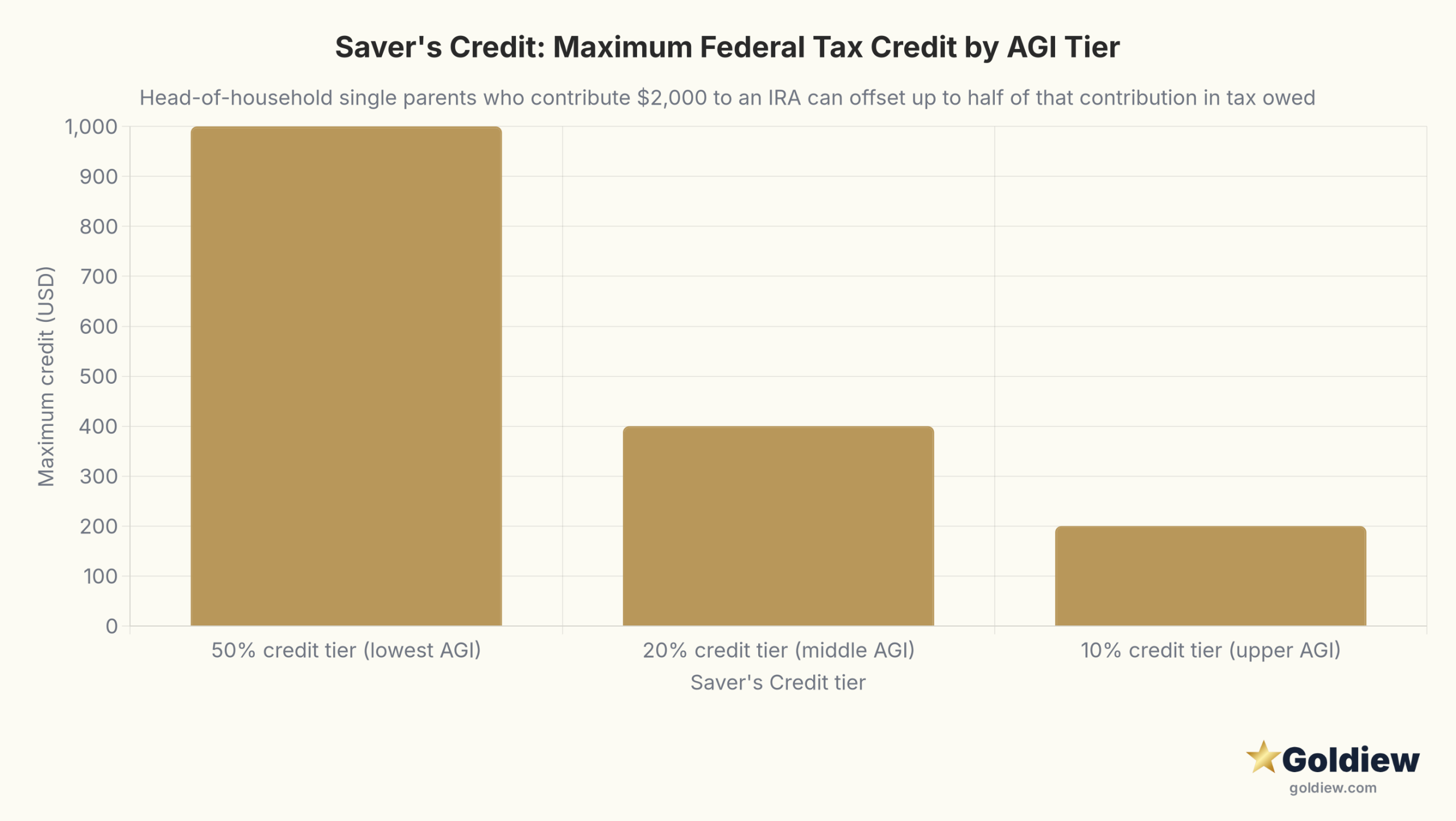
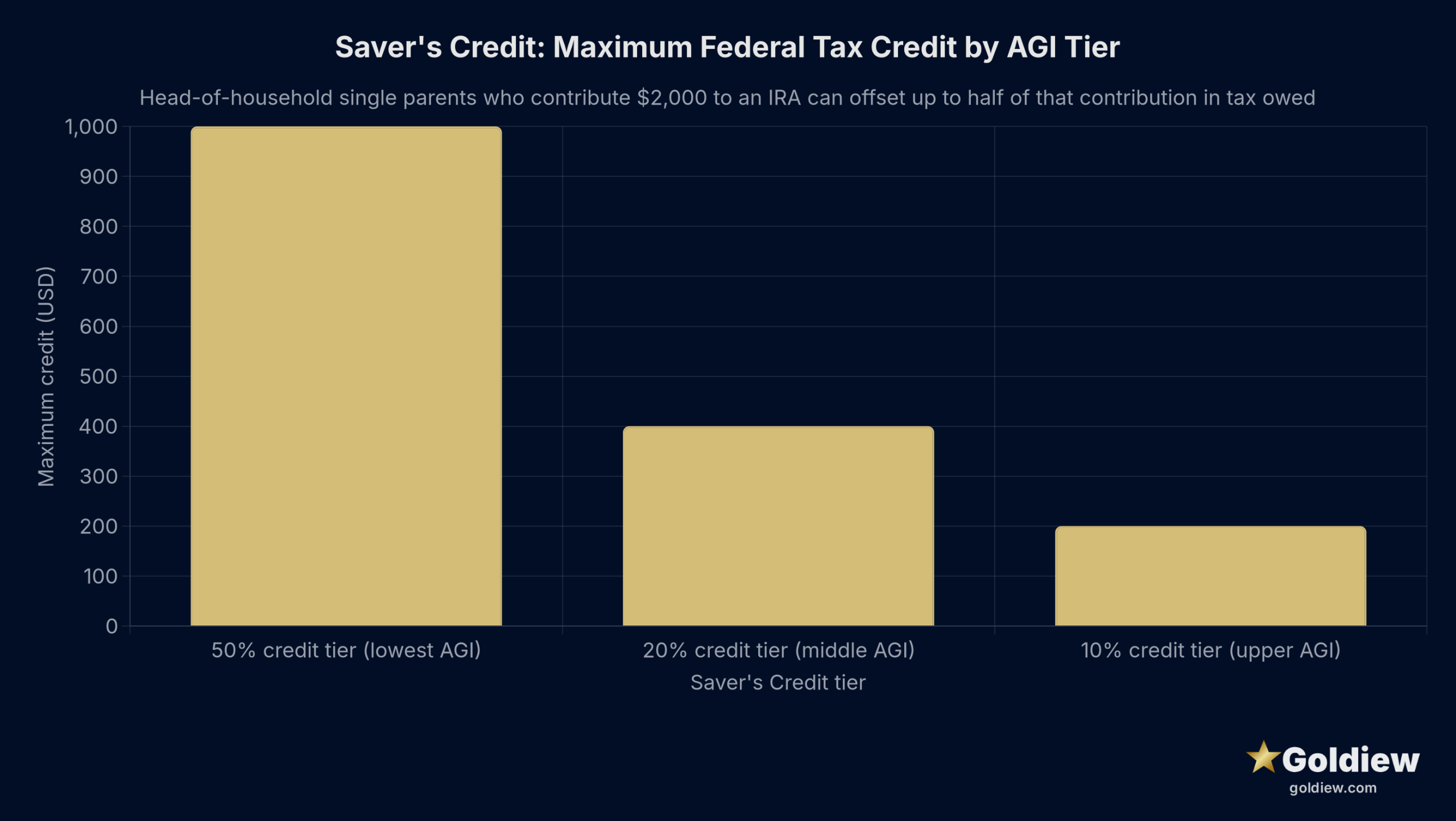
The credit is calculated as a percentage of eligible retirement contributions, capped at 2,000 dollars of contributions for single and Head of Household filers under current IRS rules. The percentage tier depends on adjusted gross income. The top tier is 50 percent of the eligible contribution, the middle tier is 20 percent, and the lower tier is 10 percent. Above the upper income threshold, the credit phases out entirely.
For a Head of Household filer at the top tier, the maximum credit is 1,000 dollars on a 2,000 dollar contribution. The credit reduces federal income tax owed dollar for dollar, but it is non-refundable, so the worker must have at least that much tax liability for the full credit to apply. SECURE 2.0 added a future Saver’s Match that replaces the credit with a federal contribution into the retirement account itself, scheduled to take effect in a later tax year. Confirm the current-year mechanics with the IRS site or your tax advisor.
Practical impact on a gold IRA strategy: the 2,000 dollar contribution cap means the Saver’s Credit primarily benefits the cash IRA contribution that builds the eventual balance, not the rollover into a gold IRA that comes later. Building the IRA balance is the prerequisite to crossing custodian minimums.
Custodian Minimums Versus Single-Parent Reality
Most established self-directed gold IRA companies set minimums on the eligible retirement funds before they will open an account. The amounts vary by provider.
| Company | Industry-reported minimum | Single-parent relevance |
|---|---|---|
| Augusta Precious Metals | Around 50,000 dollars | Typically a later-career consideration, after consolidating prior-employer plans. |
| Birch Gold Group | Around 10,000 dollars | Accessible to single parents with modest rolled-over balances from prior jobs. |
| Noble Gold Investments | Around 20,000 dollars | Middle ground. Buyback program is a public marketing point. |
For a single parent in the active child-rearing years, the more useful question is usually not which provider to choose. It is whether the IRA balance has built up to a point where the percentage custodian and storage fees do not consume a meaningful share of the account. Below custodian minimums, the percentage fees on a small balance can erode the account quickly.
Naming a Minor Child as Beneficiary: How the Custodian Form Works
The IRA beneficiary form is the legal document that controls who receives the IRA at the owner’s death. The form sits with the IRA custodian. The form, not the will, controls the IRA. A single parent who has a will leaving everything to the children but forgets to update the IRA beneficiary form leaves the IRA to whoever is listed on the form.
For a single parent with one or more minor children, the form usually lists either the children directly, the children via a UTMA account with a named adult custodian, or a trust drafted for the purpose with a named trustee. Each path has tradeoffs.
Direct minor beneficiary
Listing a minor child directly is the simplest entry on the form. The complication arrives at the IRA owner’s death. The IRA custodian cannot send funds to a minor. A court-appointed guardian or conservator typically has to be named to manage the inherited IRA until the child reaches the age of majority, which is 18 or 21 depending on the state. Court involvement adds time, cost, and public record.
UTMA custodian beneficiary
Most states have adopted some version of the Uniform Transfers to Minors Act, which allows an adult custodian to hold property for a minor without court involvement. The IRA beneficiary form lists the child’s name with a named adult custodian under the state UTMA. The custodian directs the inherited IRA during the minor years and the child takes direct control on the age set by state law, typically 18 or 21.
Trust as beneficiary
For larger balances, single parents often work with an estate planning attorney to draft a trust that serves as the IRA beneficiary. The trust must qualify as a designated beneficiary under Treasury regulations under IRC section 401(a)(9) to use favorable distribution rules. Conduit trusts and accumulation trusts have different mechanics under SECURE Act rules. The drafting matters and the attorney is the person who gets it right.
SECURE Act and SECURE 2.0 Distribution Rules for Minor Children
The SECURE Act of 2019 ended the lifetime stretch for most non-spouse inherited IRA beneficiaries and replaced it with a 10-year rule. The 10-year rule says the inherited IRA must be fully distributed within 10 years of the original owner’s death. SECURE 2.0 of 2022 refined the rules further.
A minor child of the original IRA owner is an eligible designated beneficiary under IRC section 401(a)(9)(E). The minor child can stretch required minimum distributions over life expectancy until reaching the age of majority. After reaching the age of majority, the 10-year clock starts. The total distribution timeline is therefore stretch through majority, plus 10 years after.
The rule is different for stepchildren, grandchildren, and minor children of relatives other than the IRA owner. Those beneficiaries are usually not eligible designated beneficiaries and the 10-year rule applies from the date of the owner’s death.
For a self-directed gold IRA specifically, the inherited IRA still holds metals. The successor custodian and depository continue to hold the physical bullion until distributions occur. Required minimum distributions for the inherited IRA can be funded by selling metals back to the dealer or by in-kind distribution, depending on the custodian. The mechanics are worth confirming in advance with the gold IRA company you select.
Who This Is Not a Good Fit For
A self-directed gold IRA is one option among many. It is not the right fit for every single parent. Honest disqualification helps the reader.
- Single parents in the active high-cost childcare years with no consolidated prior-employer balance. Without an existing IRA or 401(k) balance to roll, the contribution cap of 7,000 dollars for 2024 IRA contributions (8,000 dollars with age-50 catch-up) cannot quickly cross custodian minimums.
- Households relying on the IRA as a short-term emergency reserve. Physical metals are not a checking account. The buyback process takes days to weeks, and pre-59 1/2 withdrawals from a traditional IRA trigger the 10 percent additional tax under IRC section 72(t) with limited exceptions.
- Single parents who have not yet maxed the workplace 401(k) match. Employer match is the highest-yielding retirement dollar most workers will ever see. Routing money to a gold IRA before fully claiming the match is the rare case where the sequence is almost universally wrong.
- Households without a current estate plan. Naming a minor child as beneficiary without a UTMA or trust setup creates a probate complication that the parent presumably wants to avoid. Set the estate plan first, then think about the gold IRA.
- Single parents under 30 with multiple decades to retirement. The long-horizon nature of the account, combined with current custodian minimums, usually means the gold IRA decision is a later-career question. Early-career retirement saving in a workplace plan is the more pressing dollar.
A Practical Single-Parent Decision Sequence
The sequence below is the order most single parents should walk through before opening a self-directed gold IRA. It is not personalized advice. The goal is to surface the questions that change the answer.
- Confirm the estate plan basics. A current will, a guardianship designation for minor children, and a beneficiary form on every retirement account and life insurance policy. Without these, every other step is premature.
- Maximize workplace match. Confirm the employer match formula at the 401(k), 403(b), 457(b), or TSP. Contribute enough to capture the full match before any IRA contribution.
- Check Saver’s Credit eligibility. Compare adjusted gross income to the current-year Head of Household threshold. If eligible at the top tier, prioritize the IRA contribution to claim the credit.
- Build the IRA balance over multiple years. Roth and traditional IRA contributions add up over time. Roll prior-employer plans into a traditional IRA as job changes occur.
- Cross the gold IRA custodian minimum. Birch around 10,000 dollars, Noble around 20,000 dollars, Augusta around 50,000 dollars per third-party reporting. Only then does the gold IRA option become a near-term decision.
- Update the beneficiary form for the gold IRA. Coordinate with an estate planning attorney to set up UTMA or trust as the beneficiary path if minor children remain at home.
- Consult a licensed financial advisor. A planner who works with single-parent households and who understands Head of Household tax treatment is the right resource for the specific decision.
- Verify the gold itself. Once metals reach the depository, verify the assay and inventory record. Our is-your-gold-real guide walks through the verification options.
Tax Treatment Summary: Single-Parent IRA Considerations
The table below summarizes the IRS rules most relevant to a single parent considering a gold IRA. Every row assumes the worker has earned income and meets the basic IRA contribution requirements.
| Tax item | Rule for single parent | Source |
|---|---|---|
| Filing status | Head of Household if qualifying child criteria met | IRC section 2(b) |
| Roth IRA phase-out | Uses single and Head of Household bracket, lower than Married Filing Jointly | IRC section 408A(c) |
| Traditional IRA deductibility | Phase-out depends on workplace plan coverage | IRC section 219 |
| Age-50 catch-up | Available in IRA and employer plans | IRC sections 219 and 414(v) |
| Saver’s Credit | Head of Household has its own income tier | IRC section 25B |
| Child and Dependent Care Credit | Non-refundable in most cases, reduces tax owed | IRC section 21 |
| Child Tax Credit | Partial refundable, depends on income and current law | IRC section 24 |
| Child support received | Not taxable to recipient, not earned income for IRA | IRS Publication 504 |
| Alimony received (pre-2019 decree) | May be taxable, may count as earned income for IRA | IRS Publication 504 |
| Alimony received (post-2018 decree) | Not taxable to recipient under TCJA changes | Public Law 115-97 |
| Minor child as IRA beneficiary | Eligible designated beneficiary, stretch through majority, then 10-year rule | IRC section 401(a)(9)(E) |
| Stepchild as IRA beneficiary | Typically not an eligible designated beneficiary, 10-year rule from date of death | IRC section 401(a)(9)(E) |
Sequencing the Buckets: A Single-Parent Example
Consider a hypothetical single mother named Karen, age 52, raising two teenagers in Pennsylvania. She earns 78,000 dollars per year as a school district administrator and files as Head of Household. Her retirement stack is an active 403(b) with the school district holding 142,000 dollars, a Roth IRA opened in 2014 holding 31,000 dollars, an old 401(k) from a private-sector job 12 years earlier holding 38,000 dollars, and a small 529 plan for each child.
One sequence Karen might walk through with a licensed advisor: roll the old 401(k) into a traditional IRA to consolidate, capture the school district employer match in the 403(b) at the maximum contribution she can afford, claim the Saver’s Credit if Head of Household income qualifies, and continue Roth IRA contributions for tax-free growth. The 38,000 dollar consolidated traditional IRA could potentially be the future receiving account for a self-directed gold IRA when the timing makes sense.
The beneficiary side requires its own attention. Karen’s current beneficiary form likely lists her two children directly. An estate planning attorney can review whether a UTMA structure or a trust serves the family better given Pennsylvania law, given the children’s ages, and given the size of the combined retirement assets. Updating the form is a one-day administrative step that often gets postponed for years.
Neither path described above is right or wrong. The point of writing it out is to surface tradeoffs in fees, beneficiary structure, and timing. Consult a licensed advisor familiar with single-parent households before choosing a path.
Verifying the Gold Holding Before and After Rollover
Once a single parent rolls retirement funds into a self-directed gold IRA, the funds buy IRS-approved bullion that the custodian sends to an approved depository. The investor never takes physical custody while the metals are inside the IRA. Two verification steps protect the investor and the eventual heir.
First, before the metals are sent to the depository, the dealer should provide a written confirmation of the assay, the mint, the weight, and the year of the coin or bar. The IRS approved list for gold IRAs is set out in IRC section 408(m)(3). Coins and bars outside the approved list trigger an immediate taxable distribution and potentially the 10 percent additional tax.
Second, after delivery, the investor should receive an inventory statement listing the specific holdings allocated to the account. Our is-your-gold-real guide covers the verification methods available to retail investors and the role the depository inventory record plays. For valuation outside the gold IRA wrapper, our gold value calculator guide explains how spot price and premiums interact when sizing the account for a target allocation.
Frequently Asked Questions
Can a single parent open a self-directed gold IRA while still raising children?
Yes. Eligibility for a traditional or Roth IRA, including a self-directed gold IRA, depends on having earned income and meeting the IRS rules, not on marital status or family size. A single parent who works and files as Head of Household can open a gold IRA the same way any other worker can. Whether opening one fits the household budget is a separate question. Consult your tax advisor for your specific situation.
How do childcare costs change the math on retirement contributions?
Childcare is one of the largest line items in a single-parent budget. The federal Child and Dependent Care Credit under IRC section 21 offsets a portion of qualifying expenses. The Saver’s Credit under IRC section 25B offers a non-refundable credit for IRA and 401(k) contributions for households below set income thresholds. A single parent often qualifies for both. Run the numbers and consult your tax advisor.
Can I name my minor child as the beneficiary of a gold IRA?
Yes, but the practical setup matters. A minor child cannot legally take direct ownership of an inherited IRA. Most custodians require an adult custodian under a state Uniform Transfers to Minors Act account, or a trust drafted for the purpose. The SECURE Act of 2019 and SECURE 2.0 of 2022 changed inherited IRA distribution rules. Minor children of the original owner can use a stretch until the age of majority, after which the 10-year rule applies. Consult an estate planning attorney.
What is the Saver’s Credit and do single parents qualify?
The Saver’s Credit, also called the Retirement Savings Contributions Credit, is a non-refundable federal tax credit for eligible retirement contributions. The credit is set out in IRC section 25B. Single parents filing as Head of Household qualify if adjusted gross income falls below the threshold the IRS updates each year. The credit applies to IRA contributions, including those that later fund a gold IRA, and to 401(k) deferrals. Check the current-year thresholds on the IRS site.
Does Head of Household filing status affect IRA rules?
Head of Household filing status uses different income brackets for Roth IRA contribution phase-out, Saver’s Credit eligibility, and traditional IRA deductibility when the filer is covered by a workplace plan. The income thresholds are typically lower than for Married Filing Jointly. The IRS posts current thresholds on the contribution-limits page each tax year. Consult your tax advisor for your specific situation.
How does the 10-year inherited IRA rule affect my child after the SECURE Act?
The SECURE Act of 2019 ended the lifetime stretch for most non-spouse beneficiaries. A minor child of the original IRA owner qualifies as an eligible designated beneficiary and can take required minimum distributions over life expectancy until reaching the age of majority. After that age, the 10-year rule applies. SECURE 2.0 added refinements. The mechanics turn on whether the IRA is traditional or Roth and on the age of the child at the owner’s death. Consult an estate planning attorney before relying on a planning assumption.
Should I prioritize a 529 college savings account or a gold IRA?
Goldiew does not give personal financial advice. The general framework many families review is that retirement savings cannot be borrowed, while education funding has loan options. The IRS sets out 529 rules separately from IRA rules. A single parent weighing the two should consult a licensed financial advisor familiar with single-parent households and ideally one with Head of Household tax experience.
What happens to my gold IRA if I die before my child reaches adulthood?
The IRA passes to the named beneficiary under the custodian’s beneficiary form. If the named beneficiary is a minor, the custodian typically holds the account for the benefit of the child under a UTMA arrangement or a trust, with an adult custodian or trustee directing administration until the child reaches the age set by state law. The IRS rules on inherited IRAs apply alongside state custodial rules. Estate planning attorney review is the standard step.
Can child support or alimony income fund a gold IRA?
Child support is not taxable income to the recipient and is not earned income for IRA contribution purposes. Alimony received under a pre-2019 divorce decree may count as taxable income, depending on the decree language and the changes under the Tax Cuts and Jobs Act. The IRS covers the distinction in Publication 504. For IRA contributions, the contribution limit is tied to earned income from work, not to support payments. Consult your tax advisor.
Sources
- IRC section 2(b), definition of Head of Household filing status.
- IRC section 21, Child and Dependent Care Credit.
- IRC section 24, Child Tax Credit.
- IRC section 25B, Retirement Savings Contributions Credit (Saver’s Credit).
- IRC section 72(t), additional tax on early distributions.
- IRC section 219, traditional IRA contribution deduction.
- IRC section 401(a)(9), required minimum distributions and eligible designated beneficiaries.
- IRC section 402, taxation of distributions from qualified plans, including 402(c) eligible rollover distributions.
- IRC section 408, individual retirement accounts, including 408(m) on collectibles and approved bullion.
- IRC section 408A, Roth IRA rules including contribution phase-out.
- IRC section 414(v), age-50 catch-up contributions.
- IRS Publication 501, dependents, standard deduction, and filing information.
- IRS Publication 503, Child and Dependent Care Expenses.
- IRS Publication 504, divorced or separated individuals.
- IRS Publication 590-A, contributions to IRAs.
- IRS Publication 590-B, distributions from IRAs.
- IRS COLA increases page, current-year contribution limits.
- IRS Saver’s Credit page, current-year income thresholds and credit percentages.
Last reviewed: 2026-06-09. Author: Goldiew Editorial Team. Reading time: 14 minutes.