
Quick answer
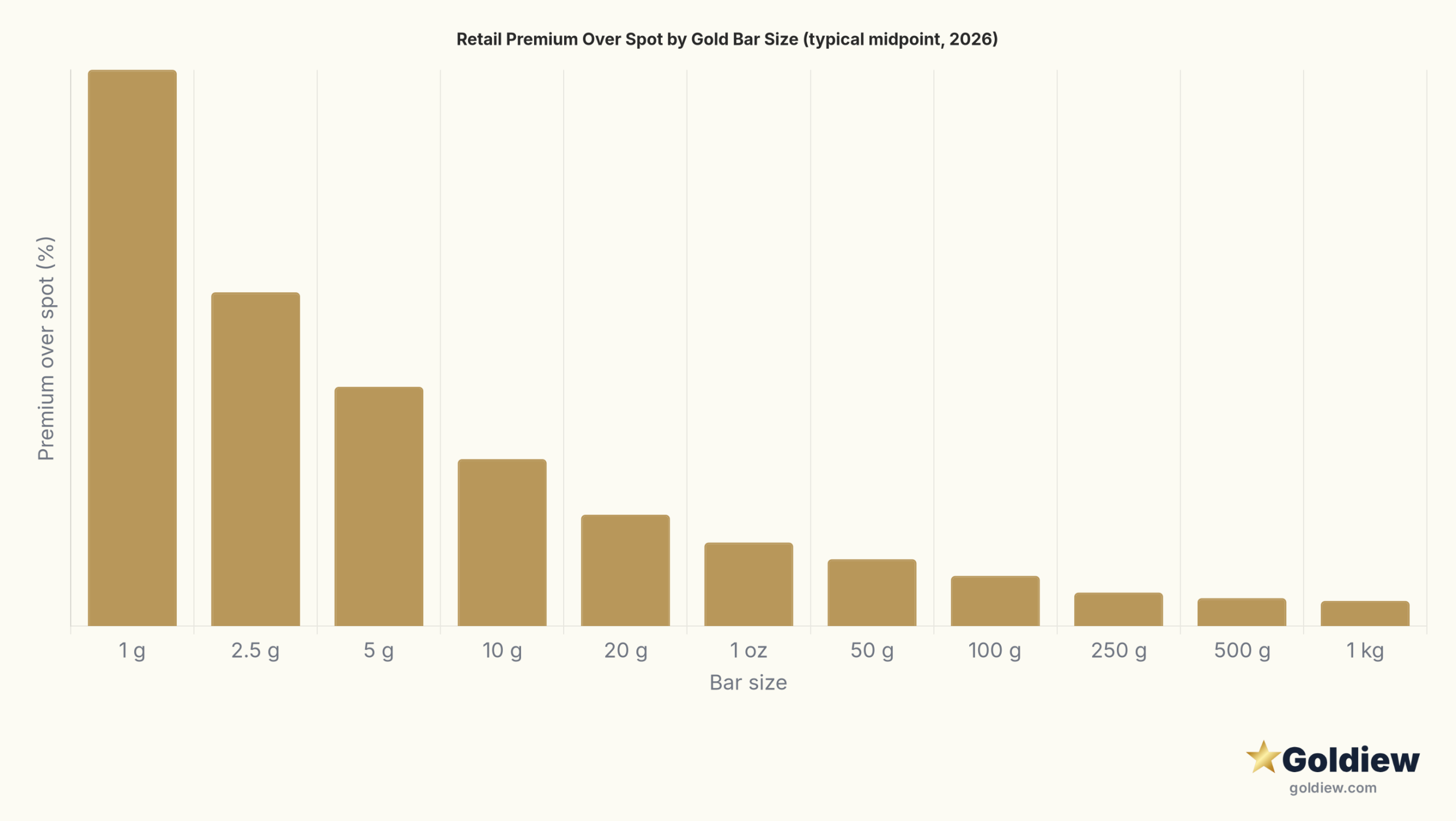
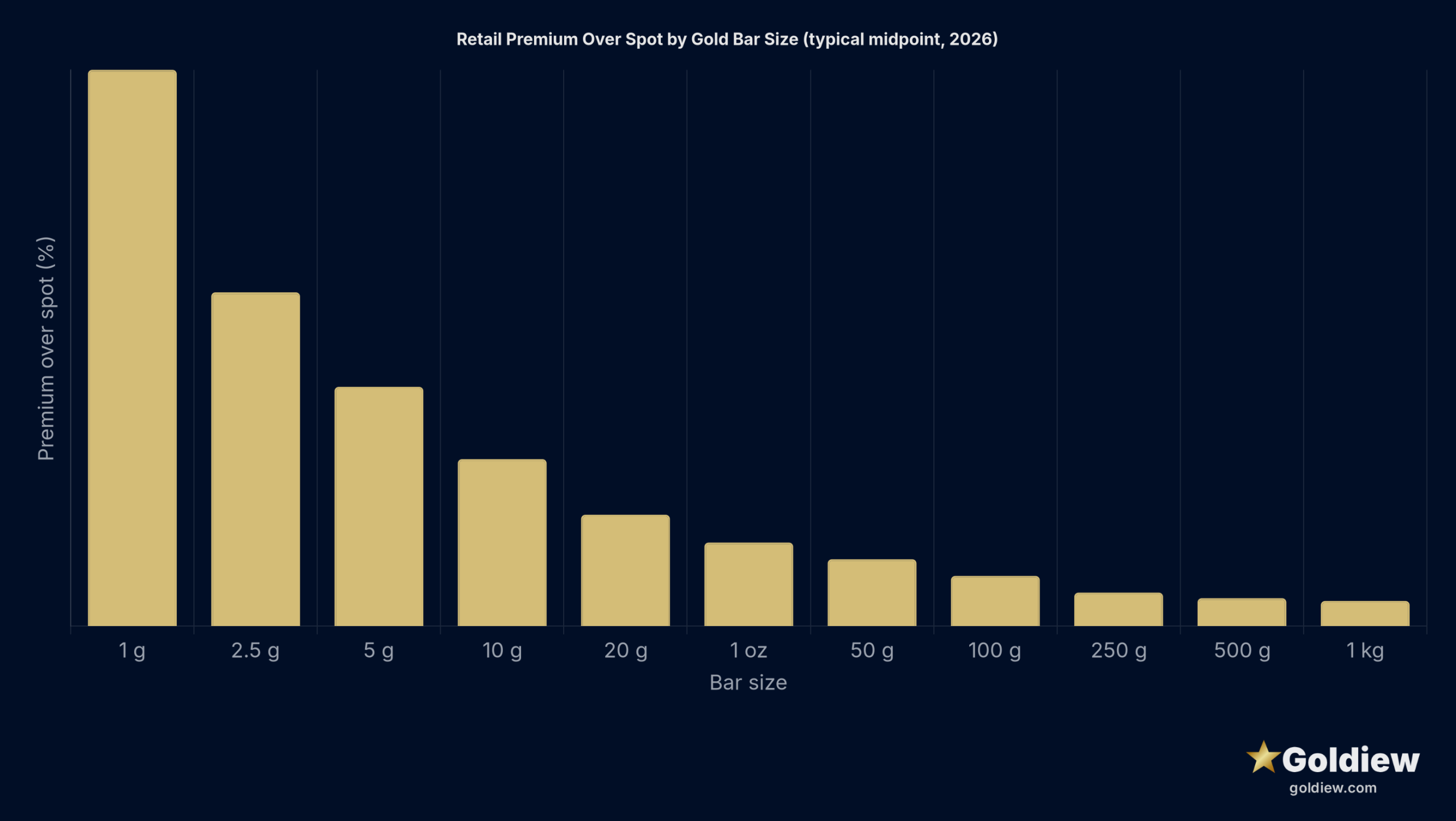
For most private buyers, the 1 troy ounce and 100 gram gold bars offer the best combination of reasonable premium and easy resale. Bars smaller than 10 grams carry premiums of 20% or more above spot price, a significant cost that works against future resale value. Bars above a kilogram trade at the lowest premiums but cannot be divided, and certain sales may require dealer-filed paperwork. Match your bar size to your liquidity horizon, not only your budget on the day of purchase.
The Full Gold Bar Size Ladder
Gold bars are produced in a wide range of sizes, from fractional gram pieces small enough to sit on a thumbnail to institutional 400-ounce bars worth over a million dollars apiece. The table below covers every size commonly available to private buyers in the United States, plus the London Good Delivery standard used in professional interbank markets.
Premium percentages shown reflect typical retail ranges observed across major US dealers. Actual premiums vary by dealer, market conditions, and quantity purchased. Verify current premiums directly with your dealer before buying. Dimensions are approximate and vary by refiner.
| Size | Metric weight | Troy oz | Typical premium over spot | Common form |
|---|---|---|---|---|
| 1 gram | 1 g | 0.032 oz | 40 to 60%+ | Minted, assay card |
| 2.5 grams | 2.5 g | 0.080 oz | 25 to 35% | Minted, assay card |
| 5 grams | 5 g | 0.161 oz | 18 to 25% | Minted, assay card |
| 10 grams | 10 g | 0.322 oz | 12 to 18% | Minted, assay card |
| 20 grams | 20 g | 0.643 oz | 8 to 12% | Minted or cast |
| 1 troy ounce | 31.103 g | 1.000 oz | 5 to 10% | Minted, assay card |
| 50 grams | 50 g | 1.608 oz | 4 to 8% | Minted or cast |
| 100 grams | 100 g | 3.215 oz | 3 to 6% | Minted or cast |
| 250 grams | 250 g | 8.038 oz | 2 to 4% | Cast (most common) |
| 500 grams | 500 g | 16.075 oz | 2 to 3% | Cast |
| 1 kilogram | 1,000 g | 32.151 oz | 1.5 to 3% | Cast or minted |
| London Good Delivery | approx. 10,900 to 13,400 g | 350 to 430 oz | Below 1% (wholesale only) | Cast, institutional |
Why Premium Percentage Drops as Bar Size Rises
The premium you pay above spot price is not arbitrary. It covers fabrication costs for turning refined gold into a finished bar, the assay and hallmarking process, packaging, dealer distribution margins, and refiner profit. These costs are largely fixed per bar regardless of weight.
A 1 gram bar requires essentially the same design process, die-cutting, assay card, blister packaging, and logistics as a 1 troy ounce bar. When you divide a $15 fabrication cost across roughly $95 worth of gold at $3,000 per troy ounce spot price, that fabrication adds about 16% to the metal’s market value. Divide the same $15 across $3,000 worth of gold in a 1-ounce bar, and it accounts for only 0.5% of the total cost.
This is why 1 gram bars consistently carry premiums of 40% or more: most of what you are paying is fabrication, not gold. At that premium level, the spot price of gold would need to rise by nearly half before a break-even resale becomes possible.
The crossover point where premiums become more reasonable for long-term holding is generally in the 10 gram to 1 troy ounce range, where typical premiums fall below 15%. Buyers who prioritize cost efficiency over flexibility find that 100 gram and kilogram bars offer the thinnest premiums available in the private retail market.
Minted Bars vs Cast Bars
Gold bars fall into two main manufacturing categories, and the distinction matters for resale, storage, and verification.
Minted bars (sometimes called pressed bars) are cut from a precisely rolled gold sheet, then stamped or die-struck to create a smooth, uniform finish. Most minted bars come sealed in a tamper-evident assay card or blister pack. PAMP Suisse, the Royal Canadian Mint, and the Perth Mint are among the most widely recognized producers of minted bars. Their uniform appearance and tamper-evident packaging make them straightforward to authenticate, and many dealers pay a slight premium for bars in original, unbroken seals.
Cast bars (sometimes called poured bars) are produced by pouring molten gold into a mold and allowing it to cool. They tend to have a rougher, more textured surface with visible grain structure and minor irregularities. Each cast bar is slightly unique in appearance. Cast bars dominate the larger size ranges (250 grams and above) because they are less expensive to produce at scale. The refiner stamps the bar directly with weight, fineness, serial number, and refiner mark.
Both types are equally valid as gold ownership at the same purity. The practical differences worth knowing:
- Minted bars in original sealed packaging typically command slightly better resale premiums because their condition is verifiable without opening the seal.
- Cast bars are generally less expensive to purchase but may require more thorough inspection by buyers who cannot rely on tamper-evident packaging.
- For self-directed IRA purposes, both minted and cast bars are eligible if they meet the minimum fineness of 995 parts per thousand (99.5% pure gold) required under IRS Publication 590-A.
Assay Cards and Serial Numbers: What They Are and Why They Matter
An assay card is a sealed certificate that encases a minted gold bar. It typically contains:
- The refiner’s name and logo
- The bar’s weight in grams and troy ounces
- The fineness (purity) expressed as a decimal or parts-per-thousand figure
- A unique serial number
- The refiner’s assay stamp confirming the purity was independently tested at the time of production
Serial numbers serve two purposes. First, they allow a bar to be traced back to a specific refining batch and assay record. Second, they deter counterfeiting: a dealer can cross-reference a bar’s serial number against the refiner’s records. Some refiners provide public databases for this purpose; PAMP Suisse, for example, offers an optical authentication system for verifying bars against registered images.
When buying, confirm that the serial number printed on the assay card matches the number stamped directly on the bar itself, which is typically visible through a window in the card. When selling, most dealers accept bars in original sealed assay cards at a slight premium over bare bars because the sealed condition reduces the verification burden.
A word on handling: opening an assay card significantly reduces a bar’s marketability with certain dealers who prefer verifiable, original packaging. Unless you have a specific reason to open the card (such as independently weighing or testing the bar), keeping it sealed preserves its convenience and resale value.
The London Good Delivery Bar: The 400-Ounce Professional Standard
The London Good Delivery bar is the international benchmark for gold traded between central banks, bullion banks, and exchange-traded funds. It is the bar type that underpins the global wholesale gold market and is what people typically mean when they refer to a “bank vault” bar.
Weight range
350 to 430 oz
LBMA specification (troy ounces)
Minimum fineness
995.0
Parts per thousand (99.5% pure gold)
Approximate mass
10.9 to 13.4 kg
Metric equivalent of the weight range
Required markings
4 required
Refiner stamp, serial number, year, fineness mark
The commonly cited “400-ounce” figure is a round-number shorthand used in financial reporting and news coverage. The actual LBMA specification allows bars between 350 and 430 troy ounces, because bars naturally vary in weight when cast. At a spot price of $3,000 per troy ounce, a single Good Delivery bar is worth roughly $1.05 million to $1.29 million, which explains why these bars do not circulate in private retail markets.
Good Delivery bars must come from a refiner on the LBMA’s approved list and must bear the refiner’s assay stamp, a unique serial number, the year of manufacture, and the fineness mark. Bars that lose their chain of custody (by leaving the approved vault network) are re-assayed before re-entering the LBMA system, adding cost and time.
Private investors encounter Good Delivery bars indirectly through gold ETFs. The SPDR Gold Trust and similar funds hold their gold as LBMA Good Delivery bars stored in approved vaults. When you buy a gold ETF share, you own a fractional claim on bars in that vault. For direct physical ownership, the largest size a private buyer will realistically purchase and resell through normal dealer channels is the 1 kilogram bar.
Selling Gold Bars: The Form 1099-B Reporting Consideration
When a private investor sells gold bars to a dealer, the dealer may be required to file Form 1099-B with the IRS reporting the transaction. This is an information report, not a new tax. The seller remains responsible for reporting any capital gain or loss on their own tax return, typically on Form 8949 and Schedule D.
Whether a gold bar sale requires a dealer-filed 1099-B depends on the specific form of bar and the quantity sold. Per the IRS Form 1099-B instructions, a sale of precious metals is reportable only when two conditions are both met:
- The metal is in a form for which the Commodity Futures Trading Commission (CFTC) has approved a regulated futures contract.
- The quantity sold meets or exceeds the minimum amount required to satisfy one such CFTC-approved contract.
Gold bars meet condition (a). For condition (b), the CME Group (which operates COMEX) offers CFTC-approved futures contracts that include both a standard 100-troy-ounce gold contract and a 1-kilogram gold contract. Because a 1-kilogram (32.151 troy ounce) gold bar can satisfy a CFTC-approved contract, a sale of a kilogram bar or bars may meet the reporting threshold and prompt a dealer-filed 1099-B.
Single bars in sizes below a kilogram (100 grams, 50 grams, 1 troy ounce, and smaller) would not meet the minimum contract size of the smallest available CFTC-approved gold contract based on the current CME Group product specifications.
This is one reason some private holders prefer to build their gold position in 1 troy ounce or 100 gram bars: individual sales below the reporting threshold may require less dealer paperwork. However, the tax owed on a realized gain is determined by the actual profit and the applicable rate, not by whether a 1099-B is filed. Filing does not create tax; it reports it. Physical gold sold at a profit is taxed at the 28% federal rate for collectibles under the Internal Revenue Code, regardless of holding period.
Consult your tax advisor for your specific situation before making any purchase or sale decisions based on tax considerations.
The Divisibility Problem: Why a Kilo Bar Cannot Be Sold in Pieces
One of the most consequential practical distinctions between bar sizes is divisibility. A 1 troy ounce bar can be sold in one transaction, delivering its full value when you need funds. A kilogram bar represents approximately the same value as 32 individual one-ounce bars, but it can only be sold as a single unit. You cannot sell 10% of it.
If you own a kilogram of gold as a single kilo bar and you need $10,000, you must sell the entire bar (worth roughly $96,000 at a $3,000 spot price) to access any of that value. You cannot shave off a fraction for the amount you need.
This liquidity asymmetry is why dealers and financial educators frequently suggest that buyers who may need to liquidate incrementally build their holdings in 1-ounce or 100-gram units rather than exclusively in larger bars. The tradeoff is real: you will pay a meaningfully higher premium to own the same total weight in 1-ounce bars versus a single kilo bar, often three to six percentage points more depending on market conditions.
A practical comparison of how bar size affects flexibility when managing the same 100-gram gold position:
| Configuration | Number of units | Typical premium (approximate) | Resale flexibility |
|---|---|---|---|
| One 100-gram bar | 1 unit | 3 to 6% | Single resale event only |
| Two 50-gram bars | 2 units | 4 to 8% | Can sell one, hold one |
| Three 1-ounce bars (93.3 g) | 3 units | 5 to 10% | Sell one at a time globally |
| Ten 10-gram bars | 10 units | 12 to 18% | Maximum flexibility, highest premium cost |
The right configuration depends on your goals. Buyers building a store-of-value position with no intention of partial liquidation benefit from larger, lower-premium bars. Buyers who view their gold as a liquid reserve may prefer accepting a higher purchase premium in exchange for the ability to sell in small, discrete increments.
If you are looking for verified gold dealers who buy and sell bars in your area, the Goldiew gold dealer directory lists dealers across the United States with information on the bar sizes they trade.
Choosing a Bar Size: A Practical Framework
There is no single correct bar size. The right choice depends on budget, time horizon, and how you expect to eventually liquidate your position. The following framework reflects how experienced buyers approach the decision; it is not financial advice, and your situation may differ.
First-time buyers
The 1 troy ounce bar from a major refiner (PAMP Suisse, Valcambi, the Royal Canadian Mint, or the Perth Mint are among the most widely recognized) is the natural starting point for most first-time buyers in the US. These bars are accepted at virtually all bullion dealers, carry a moderate but reasonable premium, and are globally recognized. Starting here creates a foundation that can be added to in any size without locking you into a position you cannot divide later.
Buyers scaling an existing position
Once you have a base of 1-ounce bars, consider adding 100-gram bars to improve your cost average per gram. Most US dealers trade 100-gram bars without hesitation, and the premium advantage over 1-ounce bars can be meaningful across a larger purchase.
Buyers prioritizing cost efficiency
The 500-gram and kilogram bars offer the lowest premiums available to private buyers in the retail market, typically 1.5% to 3% above spot. Accept that selling requires finding a buyer for a higher-value single item, and be aware of the 1099-B considerations above. For buyers who do not need liquidity flexibility, these are efficient formats.
Small bars for gifts
Bars in the 1 gram to 10 gram range are popular as gifts and symbolic purchases, but their high premiums (40% to 60%+ for 1-gram bars) make them poor vehicles for building real gold value over time. If the purpose is genuine financial accumulation, even a single 1-ounce bar delivers far more metal value per dollar spent than ten 3-gram bars at the same total cost.
Frequently Asked Questions About Gold Bar Sizes
What is the most popular gold bar size for private buyers in the US?
The 1 troy ounce (31.103 gram) gold bar is the most widely traded size among private investors in the United States. It is produced by dozens of major refiners, accepted by virtually all bullion dealers nationwide, and offers a reasonable balance of premium and resale ease. The 100 gram bar is a close second for buyers looking to reduce per-gram premium cost while maintaining good liquidity with most dealers.
Is a 1 gram gold bar worth buying?
A 1 gram gold bar contains genuine gold, but its premium over spot typically ranges from 40% to over 60%, meaning you are paying nearly half again the metal’s market value just for the bar format. For the spot price at time of purchase to be recovered at resale, gold would need to rise substantially before you break even. For meaningful gold investment, 1 gram bars are generally not cost-efficient. They function better as gifts or collector pieces. If your budget only allows small purchases, consider saving until you can afford a 10 gram or 1 troy ounce bar.
What does 999.9 fine mean on a gold bar?
The marking 999.9 fine means the bar is 99.99% pure gold, sometimes called “four nines” or “.9999 fine.” The fineness figure (999.9) represents parts per thousand of pure gold content: out of every 1,000 parts, 999.9 are gold and no more than 0.1 are other metals. This exceeds the IRS minimum of 995 parts per thousand (99.5%) required for inclusion in a self-directed gold IRA under IRS Publication 590-A. Most gold bars sold in the US from major refiners carry 999.9 fine purity.
Can I put gold bars in a gold IRA?
Yes, provided the bars meet IRS fineness standards. Per IRS Publication 590-A, gold bars eligible for IRA inclusion must have a fineness of at least 995 parts per thousand (99.5% pure). Most 999.9 fine bars from approved refiners qualify. The bars must be held by an IRS-approved custodian at an approved depository; you cannot personally store IRA gold at home. Consult your tax advisor and IRA custodian before making any retirement account decisions.
What is the difference between a 1 troy ounce bar and a regular ounce?
In the context of gold, “1 ounce” almost always means 1 troy ounce. A troy ounce is 31.103 grams, which is heavier than a standard avoirdupois ounce (28.349 grams, used in everyday US weight measurement). Gold, silver, platinum, and palladium are all measured and priced in troy ounces internationally. A bar labeled “1 oz” from a reputable refiner means 1 troy ounce (31.103 grams) unless explicitly stated otherwise on the bar or packaging.
Is a kilogram bar harder to sell than a 1 ounce bar?
Yes, for practical reasons related to transaction size and buyer pool. A kilogram bar is worth roughly 32 times as much as a 1-ounce bar at the same spot price. Most local dealers can handle a single 1-ounce bar purchase quickly and without complexity. A kilo bar sale requires a dealer with adequate cash or credit on hand, may involve wire transfer arrangements, and depending on the circumstances may require Form 1099-B paperwork. Major online dealers with buyback programs do purchase kilo bars regularly, but the pool of ready buyers is smaller than for 1-ounce bars, and negotiating the best price may take more effort.
What does London Good Delivery mean for a gold bar?
London Good Delivery (LGD) is a quality standard set by the London Bullion Market Association (LBMA) for gold bars traded between professional market participants, including central banks and bullion banks. LGD bars must weigh between 350 and 430 troy ounces, carry a minimum fineness of 995.0 parts per thousand, and come from a refiner on the LBMA’s approved list. These bars are not sold to private individuals and do not circulate in retail markets. Private buyers encounter them indirectly when investing in gold ETFs, which hold their physical gold as Good Delivery bars in LBMA-approved vaults.
Do I need to report when I sell a gold bar?
You are responsible for reporting any capital gain or loss from selling gold on your federal tax return, regardless of whether a dealer files a Form 1099-B. Physical gold is classified as a collectible under the Internal Revenue Code, and gains are taxed at the 28% federal collectibles rate rather than the lower long-term capital gains rates that apply to most stocks and bonds. If a dealer files a 1099-B, the information should match what you report on Form 8949 and Schedule D. Consult your tax advisor for your specific situation.
Should I buy minted or cast gold bars?
Both minted and cast gold bars contain the same metal at the same purity. The practical difference is that minted bars come in tamper-evident sealed packaging (assay cards) that makes authentication easy and often commands a small resale premium, while cast bars are less expensive to produce but require hands-on verification by a dealer at resale. For sizes up to 100 grams, minted bars with assay cards are the more common and convenient choice. For 250 grams and above, cast bars dominate availability and typically offer the best cost efficiency.
Sources
- Internal Revenue Service. Publication 590-A: Contributions to Individual Retirement Arrangements (IRAs). Fineness requirements for precious metals, IRC 408(m)(3)(B). Accessed 2026.
- Internal Revenue Service. Instructions for Form 1099-B: Proceeds From Broker and Barter Exchange Transactions. Precious metals reporting rules under CFTC-approved regulated futures contract standards. Accessed 2026.
- London Bullion Market Association (LBMA). Good Delivery Rules: Weight, fineness, and marking specifications for gold bars. www.lbma.org.uk. Accessed 2026.
- CME Group. COMEX Gold Futures: Contract specifications including 100-troy-ounce standard contract and 1-kilogram gold contract. www.cmegroup.com. Accessed 2026.
- Internal Revenue Code, Section 408(m). Prohibition on collectibles in IRAs; fineness exceptions for gold, silver, platinum, and palladium bullion. Available via uscode.house.gov.
- FINRA Investor Education. Precious Metals Fraud: What Investors Should Know. Red flags and due-diligence guidance for precious metals purchases. Accessed 2026.