
What the LBMA Good Delivery Standard Is
LBMA Good Delivery is the set of physical specifications and quality requirements a gold bar must satisfy to be accepted in the London wholesale gold market. A bar meeting those requirements earns the designation “Good Delivery bar.” The London Bullion Market Association (LBMA) administers the standard and maintains the public list of accredited refiners (lbma.org.uk, accessed May 2026). The LBMA oversees the global over-the-counter gold market, which clears hundreds of billions of dollars in metal daily between central banks, commercial banks, and commodity exchanges.
LBMA Good Delivery is the wholesale standard a gold bar must satisfy to clear the London over-the-counter market. The London Bullion Market Association sets the physical and quality requirements, including a 995 parts-per-thousand fineness floor that matches IRC 408(m)(3) for IRA-eligible bars. Each Good Delivery bar weighs 350 to 430 fine troy ounces, carries refiner stamping, and comes only from an LBMA-accredited refiner subject to ongoing proactive monitoring.
For anyone evaluating a gold IRA, this standard matters directly. Internal Revenue Code 408(m)(3) requires that gold bars held in a self-directed IRA come from a refiner approved by a national commodity exchange or accredited by the LBMA. The 995 parts-per-thousand fineness floor embedded in Good Delivery rules matches the IRS floor for IRA-eligible bars exactly. Understanding the certification process tells you precisely why certain bars qualify and others do not.
Physical Specifications: What a Good Delivery Bar Must Meet
The LBMA Good Delivery Rules document specifies the following requirements for gold bars (as of May 2026):
| Specification | Requirement | Notes |
|---|---|---|
| Weight range | 350 to 430 fine troy ounces | Approximately 10.9 to 13.4 kilograms per bar. This is the “London bar” format used in institutional clearing. |
| Weight tolerance | ±0.025 troy ounces from stated weight | Each bar carries a stamped weight. The actual weight must fall within this tolerance of the stamp. |
| Minimum fineness | 995.0 parts per thousand (99.5%) | The floor, not the target. Most LBMA refiners produce at 999.5 or 9999 fineness in practice. |
| Surface quality | No porosity, no undercuts, clean surface | Porosity (voids or gas pockets) signals casting impurities. Bars with surface defects fail inspection. |
| Shape | Must stack safely; trapezoid cross-section standard | Shape is not rigidly fixed but must allow stable stacking in vault conditions. |
Required Markings on Every Good Delivery Bar
Every Good Delivery bar must carry four items stamped into its surface:
- Serial number: Assigned by the refinery, unique per bar. When IRA-held metals arrive at a depository such as the Delaware Depository, the serial number is recorded against your account. This chain of identity starts here.
- Assay stamp: Fineness expressed to one decimal place (for example, “995.0” or “9999.0”).
- Refiner’s mark: The accredited refinery’s registered brand mark or hallmark.
- Year of manufacture: Four-digit calendar year the bar was cast.
These markings are not optional design choices. The LBMA’s proactive monitoring program (described below) uses the refiner’s mark to pull bars from the market and test them without advance notice. If your IRA custodian holds a bar with a traceable refiner’s mark, serial number, and year of manufacture, that bar has a verifiable provenance going back to a specific production run at a specific accredited facility.
The Refining Process: From Raw Material to 99.5% Pure Gold
Gold leaving a mine arrives at a refinery as “doré”: a semi-pure alloy containing gold, silver, copper, and other elements. The refinery’s job is to remove those impurities until gold content meets or exceeds 995 parts per thousand. Two processes dominate commercial gold refining.
Miller Chlorination: the Standard Path to Good Delivery Fineness
Developed by Francis Bowyer Miller in the 1860s, the Miller process is the industrial standard for refining doré to Good Delivery fineness:
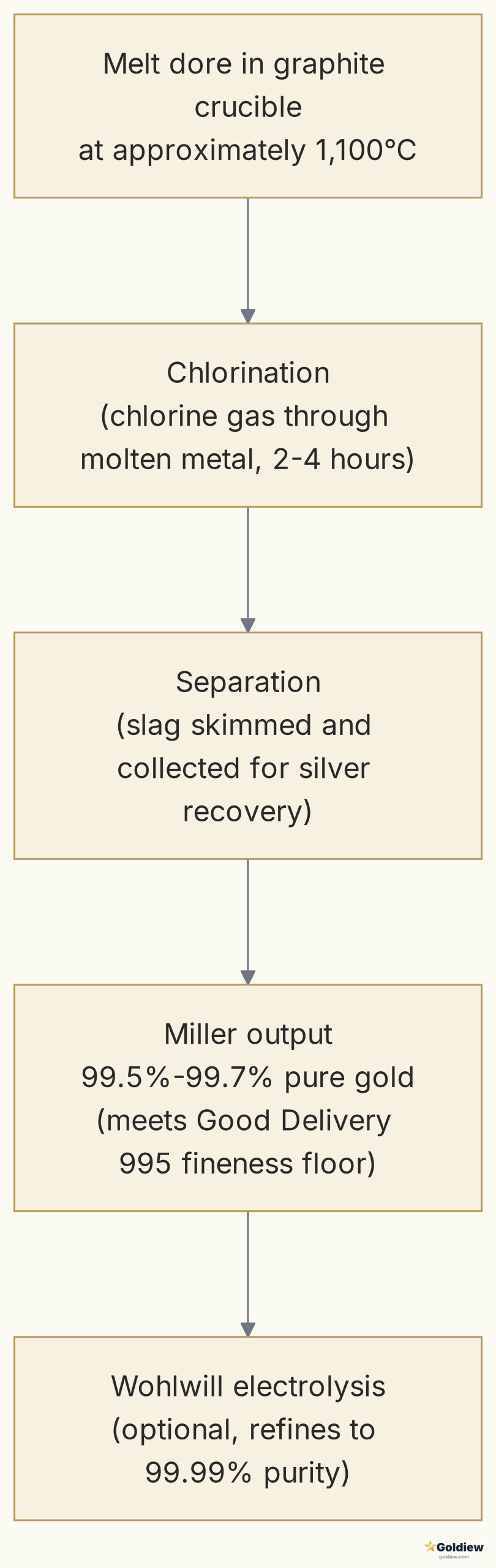
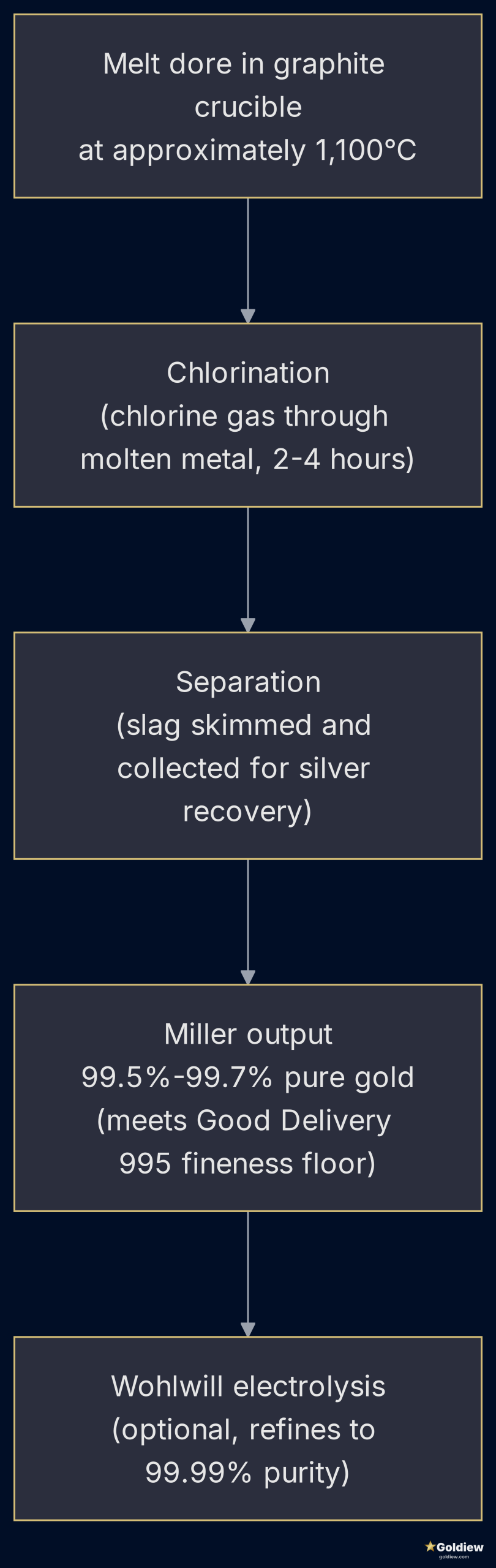
- Melt: The doré charge loads into a graphite crucible and melts in a furnace at approximately 1,100°C, just above gold’s melting point of 1,064°C.
- Chlorination: Chlorine gas is blown through the molten metal via a clay or quartz tube. Over two to four hours, the gas reacts with base metals (copper, zinc, lead) and silver, converting them to volatile chlorides.
- Separation: The chlorides either volatilize into the gas phase or float to the surface as slag. The slag is skimmed off and collected for silver recovery.
- Result: Gold remaining in the crucible reaches approximately 99.5% to 99.7% purity, meeting the Good Delivery 995 fineness floor. The bar is then cast, cooled, and inspected.
The Miller process is efficient, scalable, and cost-effective. Major LBMA refiners typically run multiple Miller furnaces in parallel to handle throughput. The process’s ceiling is roughly 99.7%. For products requiring 99.99% purity (such as 24-karat coin blanks or premium investment bars), refiners route the Miller output into a Wohlwill electrolytic cell.
Wohlwill Electrolytic Refining: the Path to 99.99%
Developed by Emil Wohlwill in 1874, the Wohlwill process takes Miller gold from 99.5% to 99.99% or higher:
- Anode preparation: Miller-refined gold is cast into anode bars.
- Electrolysis: Anode bars suspend in a heated chloroauric acid (HCl + AuCl₃) electrolyte solution alongside thin gold cathode starter sheets. Electrical current flows through the solution.
- Dissolution and deposition: Gold dissolves from the anode and deposits onto the cathode at 99.99% or higher purity. Platinum group metals and remaining impurities collect as anode slime or remain in the electrolyte.
- Collection: Cathode deposits are stripped, melted, and cast into bars or blanks at certified 9999 fineness.
Most LBMA-listed refiners run both processes in sequence. Miller brings doré to Good Delivery fineness. Wohlwill takes selected lots to the 9999 purity level used in premium bullion products. A refinery operating only a Miller circuit qualifies for the Good Delivery List at 99.5% output but cannot produce the 99.99% bars many retail gold IRA products specify.
Purity Verification: How Refiners Confirm Fineness
Producing 99.5% gold is only half the requirement. Fineness must be independently verified and stamped before the bar leaves the refinery. Two methods are standard:
Fire Assay (Cupellation): A small sample is removed from the melt or finished bar. The sample is mixed with lead and melted in a ceramic cupel at high temperature. Lead absorbs base metals; the remaining gold-silver bead is weighed (the gravimetric step). The bead is then dissolved in nitric acid (parting), which removes silver. The remaining gold is weighed, and fineness is calculated from weight ratios. Fire assay has a documented precision of ±0.1 parts per thousand and is the method of record for LBMA referee assayers. Reported in LBMA Good Delivery Rules.
ICP-MS (Inductively Coupled Plasma Mass Spectrometry): The sample dissolves in acid and passes through a plasma ionizer at approximately 6,000°C. A mass spectrometer identifies and quantifies every element present simultaneously at parts-per-billion detection thresholds. ICP-MS delivers results in minutes and detects trace elements fire assay might miss. LBMA refiners use it as routine internal quality control; fire assay remains the authoritative method for disputes and referee analysis.
Who Can Apply for LBMA Good Delivery Accreditation
Accreditation is available to metal refiners, not to bullion dealers, trading firms, or financial institutions. Per the LBMA’s published criteria, applicants must demonstrate:
- Metal refining as a primary activity: The organization must physically process raw metal into bars, not merely buy and resell existing product.
- Minimum production volume: For gold, the refinery must have refined a qualifying quantity in the period preceding application. The exact threshold is specified in the Good Delivery Rules (updated periodically by the LBMA).
- Operating track record: Minimum period of active operation required.
- Financial standing: Audited financial accounts submitted for review.
- Regulatory compliance: Adherence to applicable national and international environmental and labor regulations.
As of the time of this writing, over 60 refiners hold active accreditation on the gold list, spanning Europe, North America, Asia, Oceania, and South America. The LBMA explicitly encourages applications from developing gold-producing regions to broaden geographic representation. The current list is publicly available at lbma.org.uk/good-delivery/gold-and-silver-lists.
The Accreditation Process, Step by Step
A refinery pursuing LBMA Good Delivery status follows this sequence:
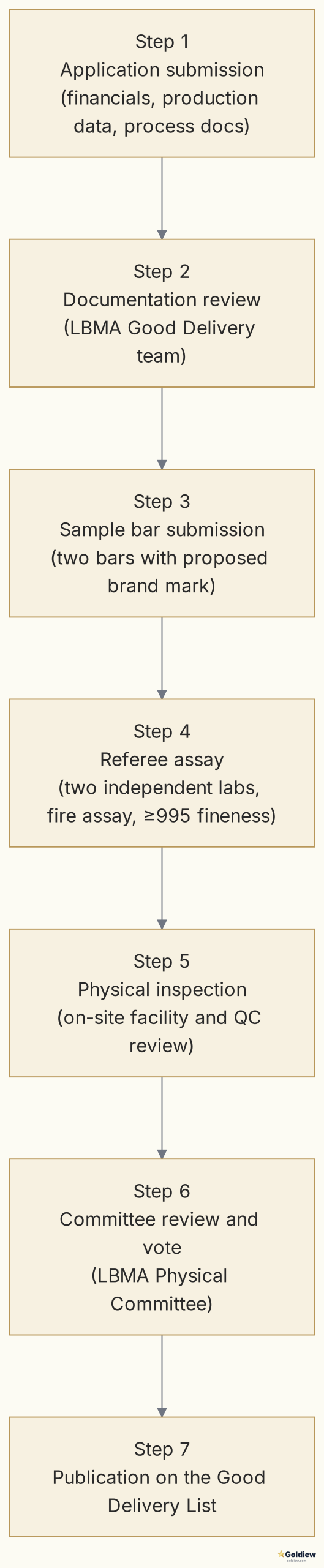
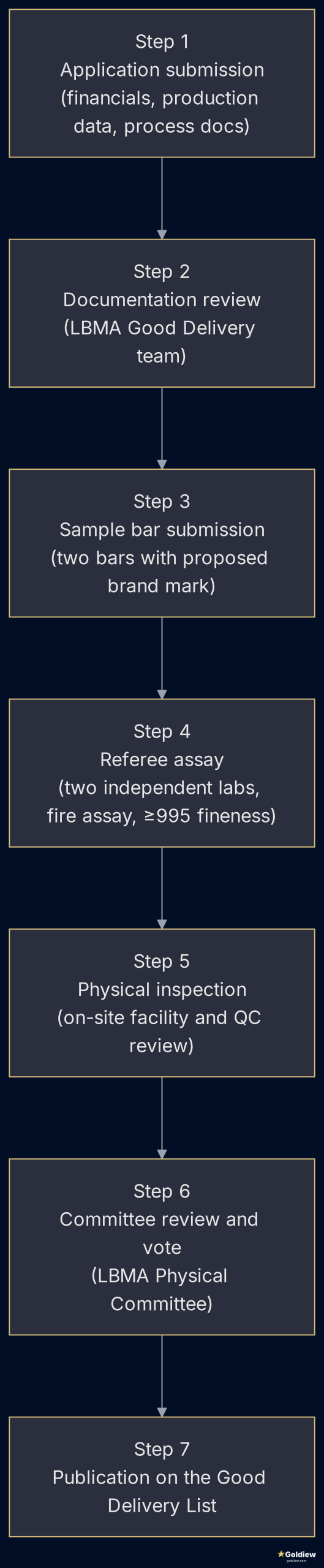
The refinery submits a formal application with company registration details, audited financials, production data, and process documentation describing its refining and quality management systems.
The LBMA’s Good Delivery team reviews the submission for completeness and confirms the refinery meets minimum eligibility thresholds before the technical phase begins. Incomplete applications are returned for clarification.
The refinery casts two sample bars bearing its proposed brand mark. These bars must meet Good Delivery physical specifications in weight (350-430 oz), shape, surface quality, and minimum fineness.
LBMA sends the submitted bars to two independent referee assay laboratories. Each laboratory assays fineness using fire assay. Both referees must independently return results at or above 995 parts per thousand. A single failure at either laboratory restarts the process.
An LBMA representative or appointed inspector may conduct an on-site review of the refinery’s facilities, process controls, quality records, and staff qualifications. The inspection scope varies by applicant profile.
The LBMA Physical Committee reviews all documentation, assay results, and inspection findings. A vote determines whether to approve accreditation.
Approved refiners are added to the public list. The full process from application to publication typically takes several months. Refiners that fail the referee assay or physical inspection may reapply after addressing identified deficiencies.
Staying on the List: LBMA Proactive Monitoring
Accreditation is not a one-time credential. The LBMA runs a proactive monitoring program that tests bars from listed refiners acquired from the open market, without advance notice to the refinery.
How it works: LBMA or appointed agents acquire bars bearing a listed refiner’s mark from vaults and market participants. The bars go to independent referee assayers. Fineness, weight, and marking are verified against Good Delivery specifications. Results are compared against the fineness stamped on each bar.
Cycle: The monitoring cycle for gold refiners is approximately every three years, though the LBMA can accelerate testing if concerns reach the association from market participants.
Consequences of shortfall:
- A refinery whose bars test below the stamped fineness receives formal notification and a defined period to investigate and resolve the issue.
- Continued failure moves the refinery to probationary status, communicated to LBMA members. Bars from probationary refiners may face additional scrutiny in clearing transactions.
- A refinery that cannot resolve quality failures is suspended. Bars produced after suspension no longer carry Good Delivery status for London clearing purposes.
This monitoring structure is what makes a Good Delivery bar mark credible as a quality signal. The refiner’s brand on the bar is backed by an independently verified, periodically tested quality regime, not just a self-attested claim.
Why Good Delivery Status Matters for Gold IRA Eligibility
Internal Revenue Code 408(m)(3) sets two conditions for gold bars held in a self-directed IRA:
- Fineness of at least .995 (995 parts per thousand).
- Production by a refiner or assayer approved by a national commodity exchange (NYMEX or COMEX), OR accredited by the LBMA.
A bar from a currently listed LBMA refiner satisfies both conditions simultaneously. The 995 fineness floor in IRC 408(m)(3) matches the Good Delivery minimum exactly. LBMA accreditation satisfies the second condition by name. According to IRS Publication 590-B (verify the current edition at IRS.gov before making any retirement account decision), these requirements have been in place since the 1997 Taxpayer Relief Act that created the gold IRA vehicle. Consult your tax advisor for specifics on your situation.
A bar from a private mint not on the LBMA Good Delivery List and not NYMEX/COMEX-approved does not qualify, regardless of the fineness claimed on its face. Both conditions in IRC 408(m)(3) are independently required. High fineness alone is not enough.
INDEPENDENT VERIFICATION
How a trusted dealer handles bar verification for your IRA
Augusta Precious Metals uses an Education-First Process (Learn, Talk, Decide) with salaried, non-commissioned educators who explain product eligibility before any purchase decision. Augusta holds a BBB A+ rating with zero complaints since accreditation in 2014 and earned the Money Magazine Best Overall Gold IRA Company designation from 2022 through 2026 (source: augustapreciousmetals.com, verified May 2026).
Get Augusta’s Free Gold IRA Education GuideWhen a gold IRA provider sources bars for your account, those bars come from refiners whose marks appear on the LBMA Good Delivery List. Common US gold IRA bar brands include PAMP Suisse (Switzerland), Valcambi (Switzerland), Argor-Heraeus (Switzerland), Heraeus (Germany), and the Royal Canadian Mint. All appear on the LBMA Good Delivery List (verified May 2026). For a full comparison of providers and the bar products they offer, see our gold IRA company rankings or browse our gold IRA company directory.
Good Delivery Bars vs. IRA-Eligible Gold Bars: the Key Distinction
The 350-to-430 troy-ounce “London bar” is the institutional clearing format. At gold prices above $3,000 per troy ounce as of 2026, a single Good Delivery bar represents more than $1 million in metal value. These are not practical for individual retirement accounts.
Gold bars held in IRAs come in smaller sizes: typically 1 troy ounce, 5 troy ounces, 10 troy ounces, or 1 kilogram (32.15 troy ounces). Technically, these smaller bars do not meet the LBMA’s 350-ounce minimum and are not “Good Delivery bars” in the strict clearing sense. They are IRA-eligible for a different reason: they are produced by refineries that hold LBMA accreditation.
The accreditation is attached to the refinery, not the bar format. When PAMP Suisse produces a 1-ounce bar alongside a 400-ounce Good Delivery bar, it applies the same refining processes, the same quality controls, and the same assay verification to both. The 1-ounce bar carries the same brand mark as the 400-ounce institutional bar, and that mark is what an IRA custodian recognizes as meeting IRC 408(m)(3)’s refiner accreditation requirement. Both PAMP and Heraeus gold bars apply the same refining standards to retail sizes as to their 400-ounce institutional output.
Commonly Recognized LBMA Refiners in US Gold IRA Products
The refiners below appear on the LBMA Good Delivery List (lbma.org.uk, accessed May 2026) and are commonly accepted by US gold IRA custodians and depositories. This is not a complete list; verify acceptance with your specific custodian before any purchase. Past performance of these companies’ products is not a guarantee of future results.
| Refiner | Country | Typical bar fineness | Notes (as of 2026-05) |
|---|---|---|---|
| PAMP Suisse | Switzerland | .9999 | Lady Fortuna series widely recognized. Strong US secondary market liquidity. |
| Valcambi | Switzerland | .9999 | CombiBars and standard cast bars common in IRA product catalogs. |
| Argor-Heraeus | Switzerland | .9999 | One of the largest Swiss gold refiners. |
| Heraeus | Germany | .9999 | Major industrial and precious metals refiner with a long production history. |
| Royal Canadian Mint | Canada | .9999 | State-owned, government-backed. Also produces IRA-eligible coins. |
| Perth Mint | Australia | .9999 | State-owned. IRA-held Perth Mint bars must go to a US-approved depository, not a digital program. |
| Johnson Matthey | UK (historical) | .9999 | No longer producing bars in primary form, but existing bars in intact original packaging remain widely accepted by US custodians. |
| Engelhard | US (historical) | .9999 | Production ceased (acquired by BASF). Existing bars in intact sealed packaging remain accepted by most custodians. |
Before your metals ship to the depository, confirm in writing that your chosen custodian accepts the specific bar brand your dealer proposes. Confirm the specific fineness and serial number format the custodian requires. Custodian approval lists can change; verify at the time of purchase, not only at account opening. For a curated look at which gold IRA companies work with these refiners, see our Augusta Precious Metals review.
Frequently Asked Questions
Can any gold bar go into a self-directed IRA?
No. Under IRC 408(m)(3), IRA-eligible gold bars must meet two independent conditions: a minimum fineness of .995 (99.5%), AND production by a refiner approved by NYMEX, COMEX, or accredited by the LBMA. A high-purity bar from a non-approved private mint fails the second condition. Both conditions must be satisfied simultaneously.
What fineness does an LBMA Good Delivery bar guarantee?
The LBMA’s minimum is 995.0 parts per thousand (99.5%). The bar must be stamped with its actual tested fineness. In practice, most LBMA refiners produce at 999.5 or 9999 fineness and stamp accordingly. The 995 threshold is the floor set by the Good Delivery Rules; it is not the typical output of modern refinery operations.
How do I verify that a bar’s refiner is on the LBMA Good Delivery List?
The LBMA publishes the list at lbma.org.uk/good-delivery/gold-and-silver-lists. Match the refiner’s mark stamped on the bar against the current list. If the mark is absent from the LBMA list, ask your IRA dealer for NYMEX or COMEX approval documentation as an alternative qualifying path under IRC 408(m)(3).
Does my IRA need to hold the large 400-ounce London bar specifically?
No. Individual IRA accounts hold smaller bars: 1 oz, 5 oz, 10 oz, or 1 kilogram. The 350-to-430 troy-ounce Good Delivery format is for institutional wholesale clearing. The IRA eligibility criterion is the refiner’s LBMA accreditation, not the bar’s weight. A 1-ounce bar from a listed refiner qualifies under IRC 408(m)(3).
What happens to bars already in my IRA if a refiner loses its LBMA status?
Bars produced and deposited during the refinery’s active accreditation period remain traceable via serial number and are generally grandfathered by custodians. Bars produced after a refinery’s suspension may face acceptance issues. Confirm the specific treatment with your custodian in writing. Consult your tax advisor to understand any implications for your account.
Does the Miller Chlorination process leave impurities in Good Delivery bars?
Yes, trace amounts. The Miller process typically achieves 99.5% to 99.7% purity, meaning up to 5 parts per thousand of the bar is non-gold (primarily residual silver). This still meets the Good Delivery 995 fineness floor. Refiners that need 99.99% output for premium products route Miller gold through a Wohlwill electrolytic cell, which reduces non-gold content to parts per million.
Sources
- LBMA Good Delivery Rules and Guidance , London Bullion Market Association (accessed May 2026)
- LBMA Good Delivery List: Gold Refiners , London Bullion Market Association (accessed May 2026)
- Internal Revenue Code 408(m)(3): IRA-approved precious metals , Cornell Law Legal Information Institute (accessed May 2026)
- IRS Publication 590-B: Distributions from Individual Retirement Arrangements , Internal Revenue Service (accessed May 2026)
- FINRA Investor Alert: Self-Directed IRAs and the Risk of Fraud , FINRA (accessed May 2026)
- SEC Investor.gov: Self-Directed IRA Risks , U.S. Securities and Exchange Commission (accessed May 2026)
Data freshness: Facts, fees, BBB ratings, regulations, and company policies referenced in this guide were verified at the time of publication. These change; verify directly with the provider, IRS.gov, or regulatory agency before any purchase or filing decision.