
The IRA contribution limit for 2026 is $7,000 per person, or $8,000 for savers aged 50 and older. That limit has not moved from 2024 or 2025. In 1974, when Congress created the IRA through the Employee Retirement Income Security Act (ERISA), the ceiling was $1,500. Fifty-two years of tax legislation later, the limit is 4.7 times higher in nominal dollars, though after adjusting for inflation, real saving capacity has actually declined from the 1974 baseline.
The IRA contribution limit for 2026 is $7,000 per person, or $8,000 with the age-50 catch-up, unchanged from 2024 and 2025. Congress set the original 1974 ERISA ceiling at $1,500, raised it to $2,000 in 1982, then left it frozen for 20 years before increases resumed under EGTRRA in 2001. Five legislative milestones (ERISA, ERTA, EGTRRA, SECURE, SECURE 2.0) and annual inflation indexing shaped the current limits.
This reference guide covers every contribution limit from 1974 through 2026, the laws that changed them, how catch-up contributions work, and why the limit went 20 years without increasing. Data is sourced from IRS Publication 590-A and IRS IRA Deduction Limits.
Quick answer: IRA contribution limits started at $1,500 in 1974, rose to $2,000 in 1982, stayed there for 20 years, then climbed in steps through legislation and inflation adjustments to today’s $7,000. The over-50 catch-up contribution of $1,000, added in 2002, has not changed since 2006.
Complete IRA contribution limit table: 1974 to 2026
The table below groups limit changes by era, matching each to the legislation or IRS adjustment that triggered the change. Highlighted rows mark legislative milestones. The bold row is the current year.
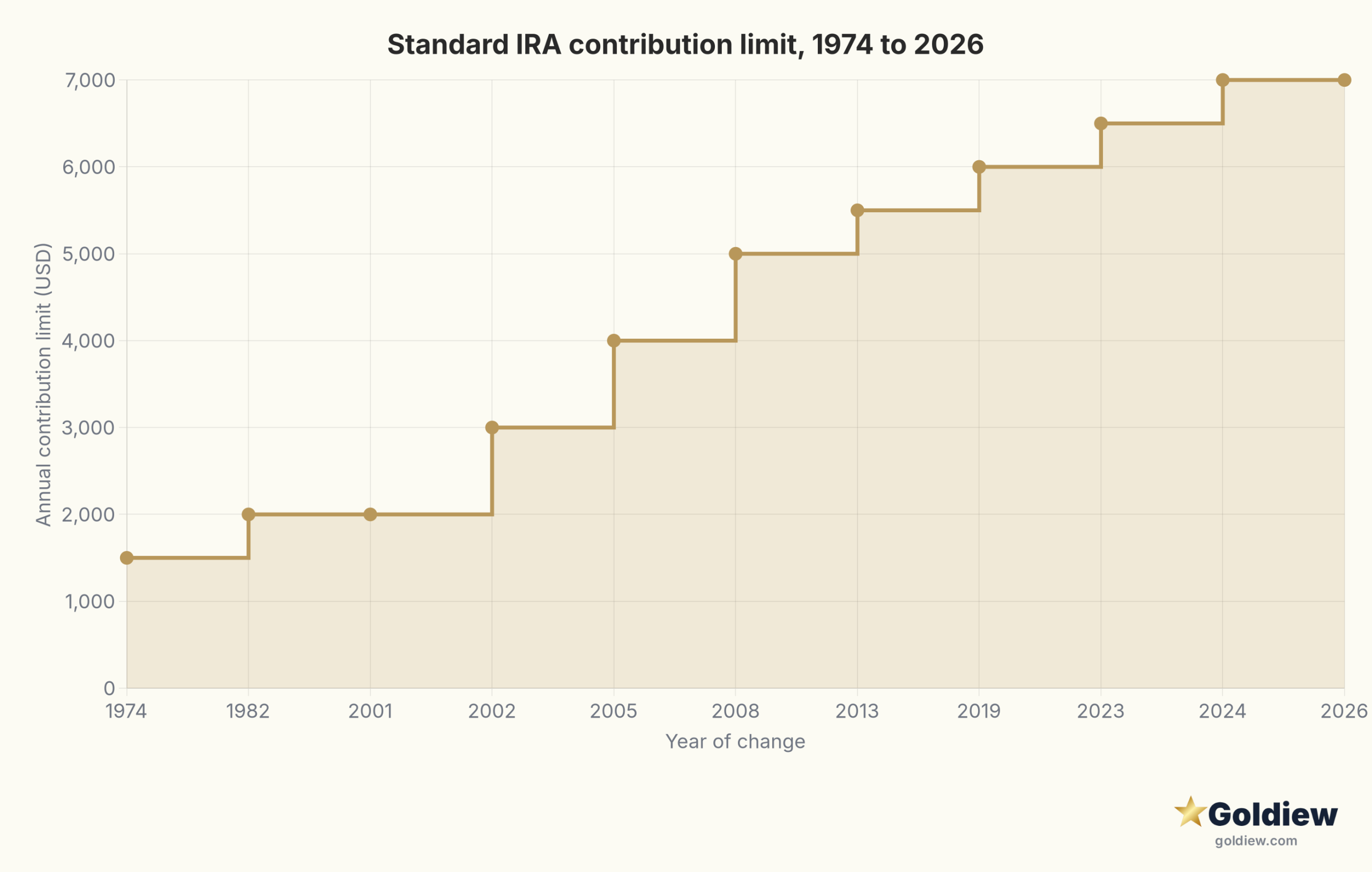
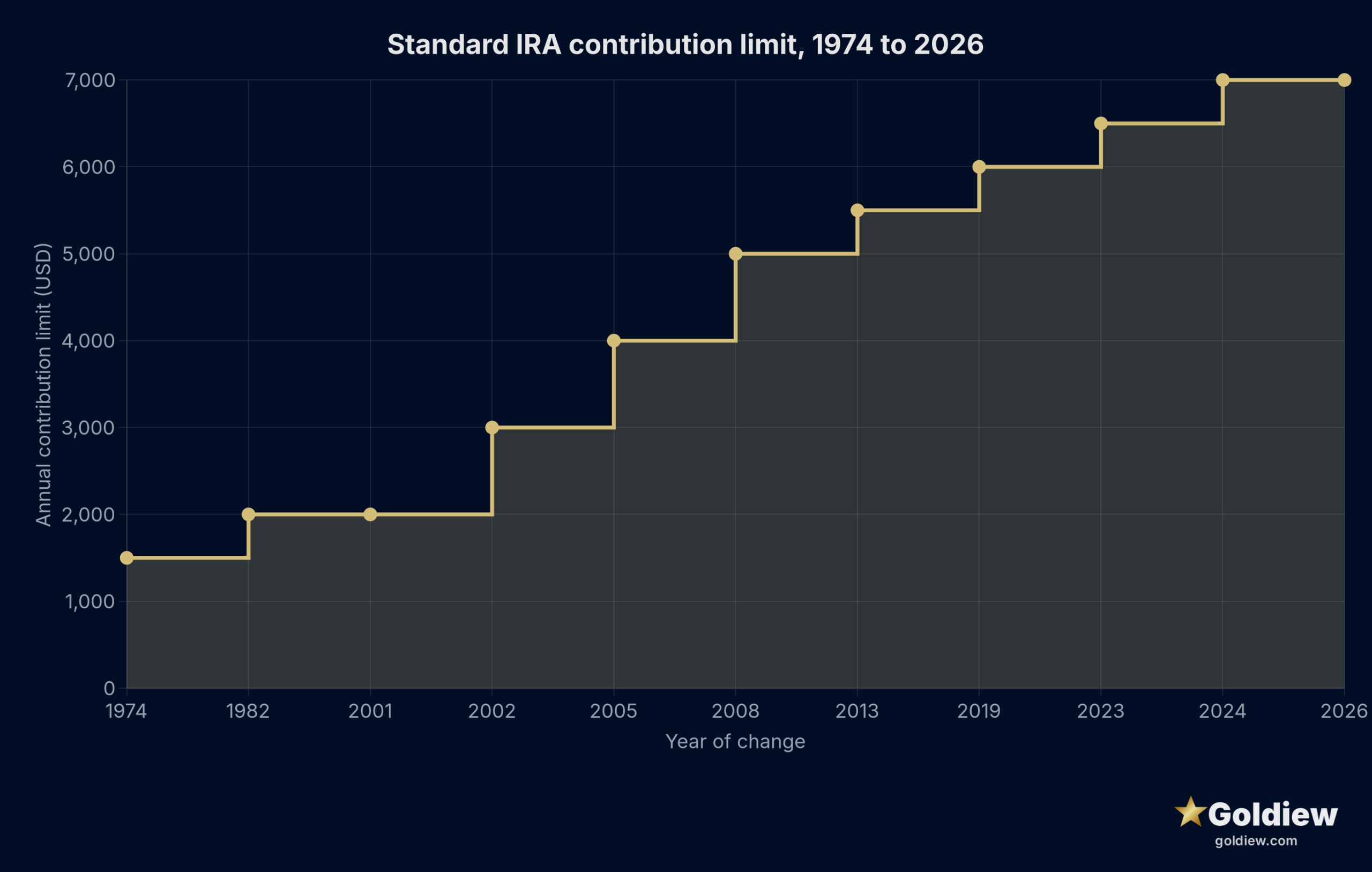
| Period | Standard limit | Catch-up (age 50+) | Max total (age 50+) | Driving law or event |
|---|---|---|---|---|
| 1974-1981 | $1,500 | None | $1,500 | ERISA 1974 (signed Sept. 2, 1974) |
| 1982-2001 | $2,000 | None | $2,000 | ERTA 1981 (signed Aug. 13, 1981) |
| 2002-2004 | $3,000 | $500 | $3,500 | EGTRRA 2001 (signed June 7, 2001) |
| 2005 | $4,000 | $500 | $4,500 | EGTRRA 2001 (scheduled step-up) |
| 2006-2007 | $4,000 | $1,000 | $5,000 | EGTRRA 2001 (catch-up step-up to $1,000) |
| 2008-2012 | $5,000 | $1,000 | $6,000 | EGTRRA 2001 (inflation-indexed at $5,000 floor) |
| 2013-2018 | $5,500 | $1,000 | $6,500 | IRS CPI adjustment (announced Oct. 2012) |
| 2019-2022 | $6,000 | $1,000 | $7,000 | IRS CPI adjustment (announced Nov. 2018) |
| 2023 | $6,500 | $1,000 | $7,500 | IRS CPI adjustment (announced Oct. 2022) |
| 2024 | $7,000 | $1,000 | $8,000 | IRS CPI adjustment (announced Nov. 2023) |
| 2025 | $7,000 | $1,000 | $8,000 | No change (inflation threshold not met) |
| 2026 | $7,000 | $1,000 | $8,000 | No change (inflation threshold not met) |
Source: IRS IRA Deduction Limits page and IRS Publication 590-A. Data verified as of 2026-05. The combined limit applies to all your traditional and Roth IRAs together. Contributing $3,500 to a Roth IRA and $3,500 to a traditional IRA in 2026 reaches the $7,000 ceiling; contributing $4,000 to each does not.
Year-by-year IRA contribution limit dataset: 1974 to 2026
For tax preparation, historical research, or retirement planning calculations, the grouped table above can be ambiguous. This year-by-year breakdown removes all ambiguity. Each row is one tax year.
| Tax year | Standard limit | Catch-up (age 50+) | Max total |
|---|---|---|---|
| 1974 | $1,500 | None | $1,500 |
| 1975 | $1,500 | None | $1,500 |
| 1976 | $1,500 | None | $1,500 |
| 1977 | $1,500 | None | $1,500 |
| 1978 | $1,500 | None | $1,500 |
| 1979 | $1,500 | None | $1,500 |
| 1980 | $1,500 | None | $1,500 |
| 1981 | $1,500 | None | $1,500 |
| 1982 | $2,000 | None | $2,000 |
| 1983 | $2,000 | None | $2,000 |
| 1984 | $2,000 | None | $2,000 |
| 1985 | $2,000 | None | $2,000 |
| 1986 | $2,000 | None | $2,000 |
| 1987 | $2,000 | None | $2,000 |
| 1988 | $2,000 | None | $2,000 |
| 1989 | $2,000 | None | $2,000 |
| 1990 | $2,000 | None | $2,000 |
| 1991 | $2,000 | None | $2,000 |
| 1992 | $2,000 | None | $2,000 |
| 1993 | $2,000 | None | $2,000 |
| 1994 | $2,000 | None | $2,000 |
| 1995 | $2,000 | None | $2,000 |
| 1996 | $2,000 | None | $2,000 |
| 1997 | $2,000 | None | $2,000 |
| 1998 | $2,000 | None | $2,000 |
| 1999 | $2,000 | None | $2,000 |
| 2000 | $2,000 | None | $2,000 |
| 2001 | $2,000 | None | $2,000 |
| 2002 | $3,000 | $500 | $3,500 |
| 2003 | $3,000 | $500 | $3,500 |
| 2004 | $3,000 | $500 | $3,500 |
| 2005 | $4,000 | $500 | $4,500 |
| 2006 | $4,000 | $1,000 | $5,000 |
| 2007 | $4,000 | $1,000 | $5,000 |
| 2008 | $5,000 | $1,000 | $6,000 |
| 2009 | $5,000 | $1,000 | $6,000 |
| 2010 | $5,000 | $1,000 | $6,000 |
| 2011 | $5,000 | $1,000 | $6,000 |
| 2012 | $5,000 | $1,000 | $6,000 |
| 2013 | $5,500 | $1,000 | $6,500 |
| 2014 | $5,500 | $1,000 | $6,500 |
| 2015 | $5,500 | $1,000 | $6,500 |
| 2016 | $5,500 | $1,000 | $6,500 |
| 2017 | $5,500 | $1,000 | $6,500 |
| 2018 | $5,500 | $1,000 | $6,500 |
| 2019 | $6,000 | $1,000 | $7,000 |
| 2020 | $6,000 | $1,000 | $7,000 |
| 2021 | $6,000 | $1,000 | $7,000 |
| 2022 | $6,000 | $1,000 | $7,000 |
| 2023 | $6,500 | $1,000 | $7,500 |
| 2024 | $7,000 | $1,000 | $8,000 |
| 2025 | $7,000 | $1,000 | $8,000 |
| 2026 | $7,000 | $1,000 | $8,000 |
Source: IRS Publication 590-A and IRS Revenue Procedures for each applicable year. Catch-up amounts apply only to taxpayers aged 50 or older at any point during the tax year. “None” indicates the catch-up contribution category did not exist for those years.
ERISA 1974: the law that created the IRA
President Gerald Ford signed the Employee Retirement Income Security Act on September 2, 1974. ERISA was primarily a pension reform law: it set minimum funding standards, fiduciary requirements, and vesting rules for employer-sponsored plans. The individual retirement account was a secondary feature, added so that workers without access to an employer pension could save on a tax-deductible basis.
The original rules were tight. The $1,500 annual limit represented 15% of compensation, whichever was lower, which meant a worker earning $10,000 could contribute $1,500, but a worker earning $8,000 was capped at $1,200. Contributions were deductible from income for federal tax purposes. Gains inside the account grew tax-deferred. Withdrawals in retirement were taxed as ordinary income. That basic structure has not changed in 52 years.
Workers covered by an employer pension could not use an IRA at all under the original ERISA rules. That restriction lasted until 1982.
Five laws that changed contribution limits
1. ERTA 1981: limit doubled to $2,000, IRAs opened to all workers
The Economic Recovery Tax Act of 1981, signed by President Reagan on August 13, 1981, made two structural changes that defined the IRA for the next two decades.
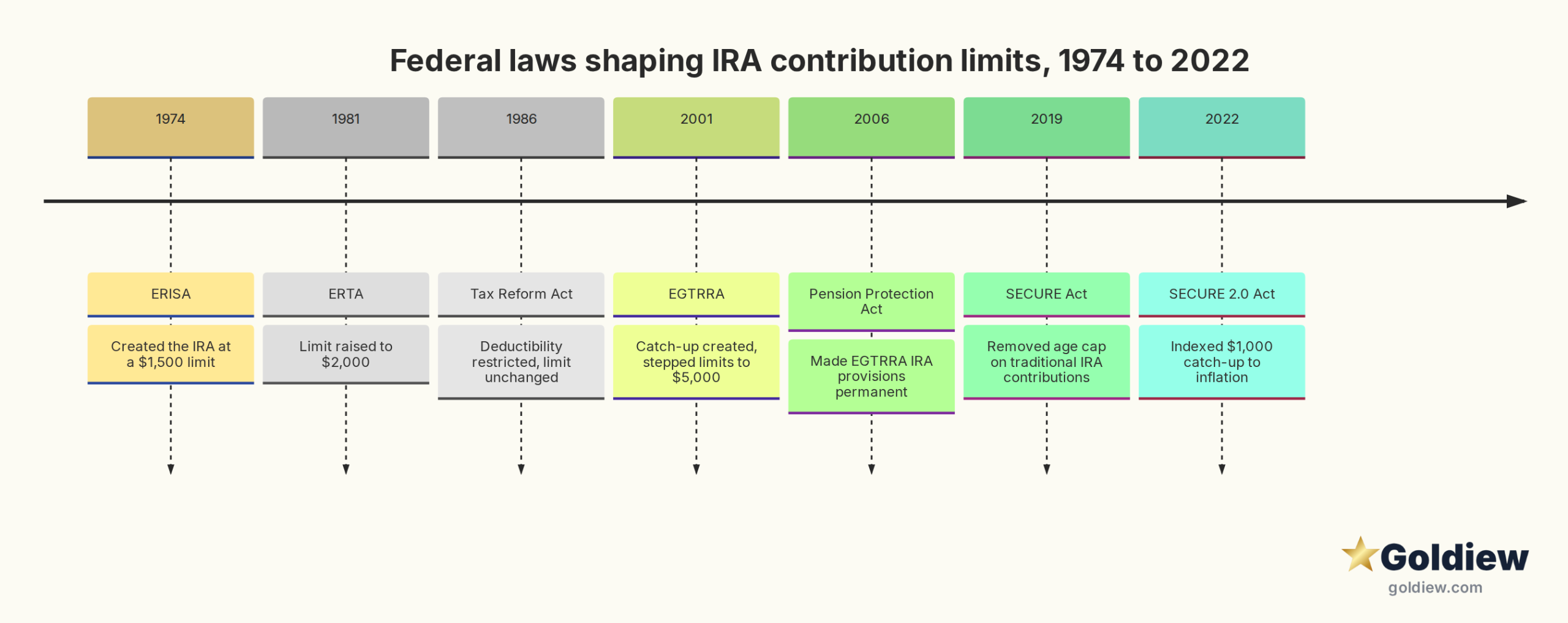
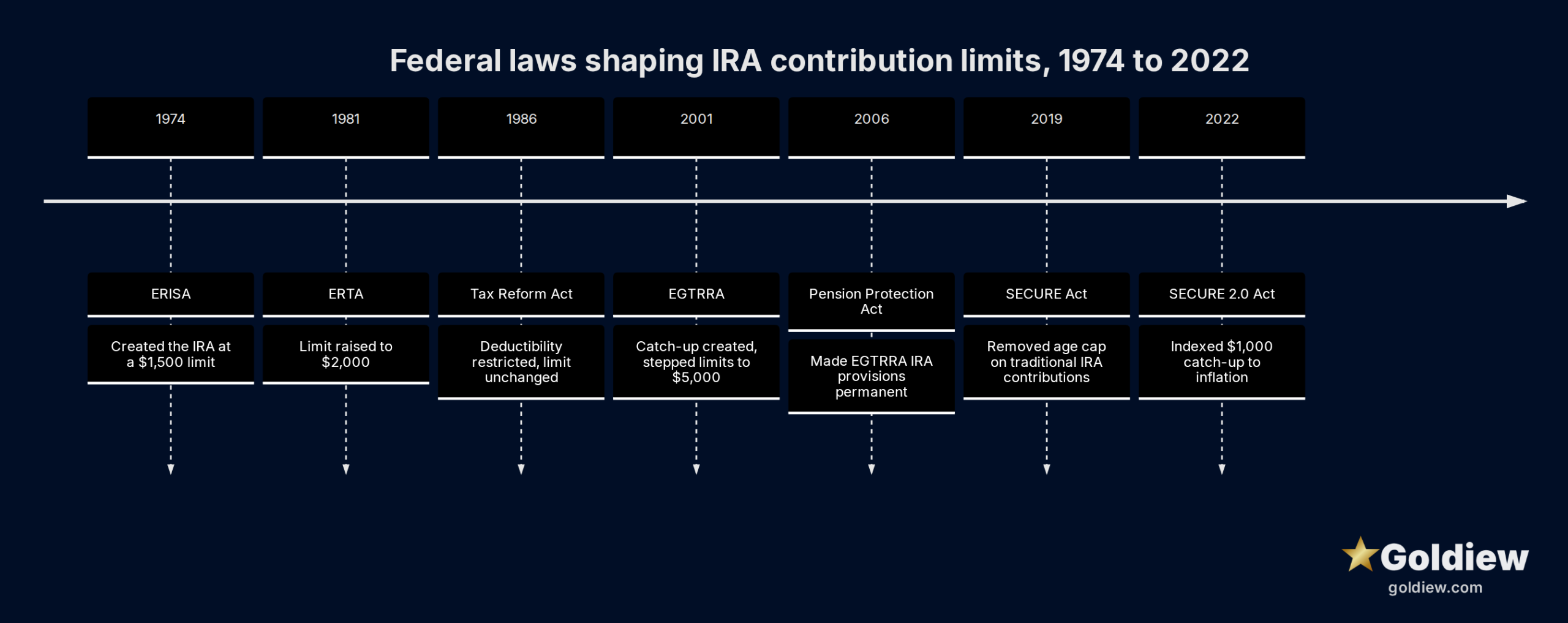
First, the contribution limit jumped from $1,500 to $2,000. Second, and more importantly, Congress removed the restriction that had blocked workers with employer pension coverage from opening IRAs. Starting in 1982, any worker with earned income could contribute up to $2,000 per year. IRA participation exploded: annual IRA contributions rose from roughly $5 billion in 1981 to over $38 billion by 1986, according to IRS Statistics of Income data.
The spousal IRA rule also expanded: a non-working spouse could contribute to a separate IRA, with the combined couple limit set at $2,250 ($2,000 for the working spouse, $250 for the non-working spouse). That split changed in 1997, when Congress equalized the limit so a non-working spouse could contribute the full annual amount based on the working spouse’s earned income.
2. Tax Reform Act of 1986: deductibility restricted, limits unchanged
The Tax Reform Act of 1986 did not touch the $2,000 contribution limit. What it did was restrict the tax deduction for contributions by workers already covered by an employer retirement plan. Above certain income thresholds, the IRA contribution was still allowed but the deduction phased out. This distinction between contribution eligibility and deductibility is a source of ongoing confusion that the IRS addresses directly in Publication 590-A.
The 1986 changes dampened IRA enthusiasm. Annual contributions dropped sharply after 1986 as millions of workers with employer plans lost the deduction and saw reduced incentive to contribute. The $2,000 limit sat unchanged from 1982 through 2001, a 20-year freeze discussed in more detail below.
3. EGTRRA 2001: the biggest reform since ERISA
The Economic Growth and Tax Relief Reconciliation Act of 2001, signed by President George W. Bush on June 7, 2001, was the most significant IRA reform since ERISA. It scheduled a multi-year increase in contribution limits and created the catch-up contribution for older savers.
The EGTRRA schedule:
- 2002-2004: $3,000 standard limit, $500 catch-up for age 50+
- 2005-2007: $4,000 standard limit, $500 catch-up (increasing to $1,000 in 2006)
- 2008+: $5,000 standard limit (then inflation-indexed in $500 increments), $1,000 catch-up
EGTRRA also had a sunset provision: without further legislation, all its changes would expire after 2010. The Pension Protection Act of 2006 made the EGTRRA IRA provisions permanent.
4. SECURE Act 2019: eligibility rules, not limits
The Setting Every Community Up for Retirement Enhancement Act, signed December 20, 2019, did not change contribution limits. Its primary IRA-related changes were removing the age cap on traditional IRA contributions (previously you could not contribute after age 70.5) and pushing the required minimum distribution (RMD) age from 70.5 to 72. Those changes affected who can contribute and for how long, not how much they can contribute.
For a gold IRA specifically, the SECURE Act’s removal of the age cap matters: a 72-year-old with earned income can now fund a self-directed IRA up to the annual limit. For a full overview of companies that offer self-directed gold IRAs, see the gold IRA company directory on Goldiew.
5. SECURE 2.0 Act 2022: indexed catch-up, new super catch-up for 401k
The SECURE 2.0 Act, signed December 29, 2022 as part of the Consolidated Appropriations Act 2023, made further changes to retirement account rules. For IRAs, the key provision was indexing the $1,000 catch-up contribution to inflation starting in 2024. In practice, the catch-up for IRA accounts has remained at $1,000 through 2026, because the inflation adjustment has not yet triggered a $500 increment.
SECURE 2.0 also created a “super catch-up” for 401(k) and 403(b) participants aged 60 to 63, allowing contributions of up to $11,250 above the standard 401(k) limit starting in 2025. That provision does not apply to IRAs.
Catch-up contributions: when they started and how they work
Before 2002, there was no such thing as a catch-up contribution. Every account holder faced the same ceiling regardless of age. EGTRRA 2001 changed that by letting workers aged 50 and older contribute an additional amount on top of the standard limit.
The catch-up has gone through two phases:
- 2002 to 2005: $500 additional. Workers 50+ could contribute $3,000 + $500 = $3,500 in 2002, for example.
- 2006 to present: $1,000 additional. The catch-up doubled to $1,000 starting in 2006 and has not changed since, remaining at $1,000 through 2026.
Three rules govern catch-up eligibility. First, you must turn 50 at any point during the tax year. If your 50th birthday falls on December 31, 2026, you can use the catch-up for the entire 2026 tax year. Second, you must have earned income at least equal to your total contribution. Third, the catch-up applies per person, not per account: if you hold both a traditional IRA and a Roth IRA, your combined contributions across both accounts cannot exceed $8,000 in 2026 (assuming you are 50+).
Consulting a tax advisor matters here. Whether to use a traditional or Roth IRA for your catch-up contributions depends on your current and expected future tax rates. Consult your tax advisor for guidance specific to your situation. Goldiew covers the mechanics; tax strategy is beyond our scope.
Why the limit froze for 20 years
From 1982 through 2001, the IRA limit sat at $2,000. That is a 20-year freeze. In 1982 dollars, $2,000 had real purchasing power. By 2001, inflation had eroded that considerably: $2,000 in 1982 was worth roughly $4,900 in 2001 dollars, meaning the real IRA contribution limit fell by more than half during the freeze period.
Three factors explain the freeze. First, the 1986 Tax Reform Act restricted deductibility and reduced the political and economic salience of IRAs for middle-income workers with employer plans. The constituency pushing for higher limits shrank. Second, deficit concerns from the late 1980s through the 1990s made any tax break expansion politically expensive: each dollar of IRA deduction was a dollar of forgone federal revenue. Third, the introduction of the 401(k) plan in the early 1980s created a competing vehicle with higher limits ($8,728 in 1987, rising to $10,500 by 2000), which diverted some political attention away from IRA reform.
EGTRRA 2001 finally broke the freeze, partly because the late 1990s budget surplus made the revenue cost more acceptable politically, and partly because the retirement savings adequacy problem had become increasingly visible in policy research.
How the IRS calculates annual limit adjustments
Post-EGTRRA, the IRA contribution limit adjusts annually based on the Consumer Price Index for Urban Consumers (CPI-U). The IRS announces the next year’s limits each October or November via a Cost of Living Adjustments news release.
The mechanics: the IRS calculates the percentage increase in the CPI-U for the 12-month period ending in August of each year. It applies that percentage to the base limit and rounds down to the nearest $500 increment. This rounding rule explains why the limit can go several years without changing: even if inflation is running at 1 to 2%, the $500 rounding threshold may not be met.
Example: the limit jumped from $6,000 to $6,500 in 2023 (a $500 increase), then from $6,500 to $7,000 in 2024 (another $500 increase), reflecting two consecutive years of inflation high enough to trigger a step. In 2025 and again in 2026, inflation was not sufficient to trigger another $500 step, so the limit held at $7,000.
Traditional vs. Roth IRA: same limit, different tax treatment
The Roth IRA was created by the Taxpayer Relief Act of 1997 and became available for tax year 1998. From its inception, the Roth has shared the same annual contribution limit as the traditional IRA. In 1998, that was $2,000. In 2026, it is $7,000 (or $8,000 for savers 50+).
The key distinction is timing of the tax benefit. Traditional IRA contributions may be deductible in the year you make them (depending on your income and whether you have an employer plan), and withdrawals in retirement are taxed as ordinary income. Roth contributions use after-tax dollars, with no deduction up front, but qualified withdrawals in retirement are tax-free.
The $7,000 limit is a combined ceiling across both account types. You could split it ($3,500 to each, or any other combination), but the total cannot exceed $7,000. The same rule applies to the $1,000 catch-up.
Roth IRA contributions are subject to income limits that traditional IRA contributions are not. In 2026, the Roth phase-out starts at $150,000 modified adjusted gross income (MAGI) for single filers and $236,000 for married filing jointly. Above those thresholds, the maximum Roth contribution phases out and reaches zero at $165,000 (single) and $246,000 (married). Consult IRS Publication 590-A for current phase-out figures, or speak with a tax advisor about your specific situation.
A related option for retirement savers is the self-directed IRA, which follows the same contribution rules but holds alternative assets such as physical gold and silver. For an overview of IRA eligibility requirements and rules, Goldiew maintains a dedicated reference section. For those researching gold IRA providers, our Augusta Precious Metals review covers one of the most-reviewed companies in the space.
Income limits and deductibility (traditional IRA)
Whether your traditional IRA contribution is deductible depends on two things: your income and whether you (or your spouse) participate in an employer retirement plan. The IRS sets income phase-out ranges each year and publishes them at irs.gov/retirement-plans/ira-deduction-limits.
For 2026, the phase-out ranges for traditional IRA deductibility:
| Filing status | Covered by workplace plan? | Phase-out range (MAGI) |
|---|---|---|
| Single or head of household | Yes | $79,000-$89,000 |
| Married filing jointly | Yes (contributing spouse covered) | $126,000-$146,000 |
| Married filing jointly | No (but non-contributing spouse covered) | $236,000-$246,000 |
| Married filing separately | Yes | $0-$10,000 |
| Single or married | No (neither spouse covered) | No income limit on deductibility |
Source: IRS IRA Deduction Limits, as of 2026-05. Income limits adjust annually. “Phase-out” means the deduction reduces proportionally across the range; above the upper limit, no deduction is allowed, though contributions are still permitted (the contribution is then non-deductible, tracked on IRS Form 8606).
An income above the phase-out range does not stop you from contributing to a traditional IRA; it stops you from deducting that contribution. The contribution still grows tax-deferred inside the account, and the non-deductible basis is tracked for tax purposes. Consult your tax advisor for your specific situation.
Frequently asked questions
What is the IRA contribution limit for 2026?
The IRA contribution limit for 2026 is $7,000 for savers under age 50. Savers who turn 50 at any point during 2026 can contribute up to $8,000, which includes the $1,000 catch-up contribution. This limit applies to the total contributions across all your traditional and Roth IRAs combined. Source: IRS IRA Deduction Limits.
Has the IRA contribution limit ever gone down?
No. The IRA contribution limit has never decreased. It has either stayed the same or increased in every year since 1974. The longest stretch without an increase was the 20-year period from 1982 through 2001, when the limit held at $2,000. Since EGTRRA 2001 introduced inflation indexing, the limit has risen steadily, though it does not move every year (the $500 rounding rule requires significant accumulated inflation before each step).
When were catch-up contributions first allowed for IRAs?
Catch-up contributions for IRA accounts were introduced by the Economic Growth and Tax Relief Reconciliation Act of 2001 (EGTRRA), effective for the 2002 tax year. The initial catch-up amount was $500. It increased to $1,000 in 2006, where it has remained through 2026. The SECURE 2.0 Act of 2022 indexed the IRA catch-up to inflation starting in 2024, but no inflation-triggered increase has occurred through 2026.
Can I contribute to both a traditional and Roth IRA in the same year?
Yes, but your combined contributions to all IRAs cannot exceed the annual limit. In 2026, that is $7,000 total (or $8,000 if you are 50+). For example, you could contribute $4,000 to a Roth IRA and $3,000 to a traditional IRA, totaling $7,000. You cannot contribute $7,000 to each. Note that Roth IRA contributions are subject to separate income limits, which may reduce or eliminate your Roth eligibility depending on your modified adjusted gross income. Consult your tax advisor for your specific situation.
Why didn’t the IRA limit increase in 2025 or 2026?
The IRS adjusts the IRA limit in $500 increments based on CPI-U inflation. For a change to occur, cumulative inflation since the last adjustment must be enough to round up to the next $500 step. After the limit reached $7,000 in 2024, inflation in the August 2024 and August 2025 measurement periods was not high enough to push the cumulative threshold to $7,500. The limit remained at $7,000 for both 2025 and 2026. Consult the annual IRS Cost of Living Adjustment release each October or November to confirm the limit for future years.
What was the original IRA contribution limit in 1974?
The original IRA contribution limit under ERISA 1974 was the lesser of $1,500 or 15% of compensation. A worker earning $10,000 or more could contribute the full $1,500. A worker earning $8,000 was capped at $1,200. The $1,500 ceiling lasted from 1974 through 1981, when ERTA raised it to $2,000 and removed the percentage-of-compensation cap.
Do IRA contribution limits apply to SIMPLE IRAs and SEP-IRAs?
No. The $7,000 limit (and the $1,000 catch-up) applies only to traditional and Roth IRAs. SIMPLE IRAs and SEP-IRAs have separate, higher limits set by the IRS each year. For 2026, the SEP-IRA limit is 25% of compensation up to a much higher ceiling, and the SIMPLE IRA limit is $16,500 ($20,000 with catch-up for age 50+). The IRS publishes all plan limits at Retirement Topics: Contributions.
Sources
- IRS Publication 590-A: Contributions to Individual Retirement Arrangements (IRAs)
- IRS IRA Deduction Limits (current and historical)
- IRS Cost of Living Adjustments news releases (annual)
- IRS Retirement Topics: Contributions (all plan types)
- ERISA: Public Law 93-406, 88 Stat. 829, signed September 2, 1974
- ERTA: Public Law 97-34, signed August 13, 1981
- Tax Reform Act of 1986: Public Law 99-514, signed October 22, 1986
- EGTRRA: Public Law 107-16, signed June 7, 2001
- Pension Protection Act of 2006: Public Law 109-280, signed August 17, 2006
- SECURE Act 2019: Division O of the Further Consolidated Appropriations Act, 2020, signed December 20, 2019
- SECURE 2.0 Act 2022: Division T of the Consolidated Appropriations Act, 2023, signed December 29, 2022
Data freshness: Facts, fees, BBB ratings, regulations, and company policies referenced in this guide were verified at the time of publication. These change; verify directly with the provider, IRS.gov, or regulatory agency before any purchase or filing decision.