
Quick answer
Junk silver means circulated US dimes, quarters, and half dollars minted before 1965, made of 90% silver. Every $1.00 in face value contains about 0.715 troy oz of silver after normal wear. Dealers price these coins in multiples of face value that track the silver spot price. Because junk silver trades near melt with minimal collector premium, it is one of the lowest-cost ways to buy physical silver in small, divisible increments.
What “Junk Silver” Actually Means
The word “junk” is a market term, not a quality judgment. In coin dealer shorthand, junk silver means US coins with recognized silver content that carry no meaningful collector value above their metal weight. Nobody cares whether you have a 1958 Roosevelt dime or a 1963 Franklin half dollar in well-worn condition. What matters is the silver content.
The three coin series that form the core of the junk silver market are:
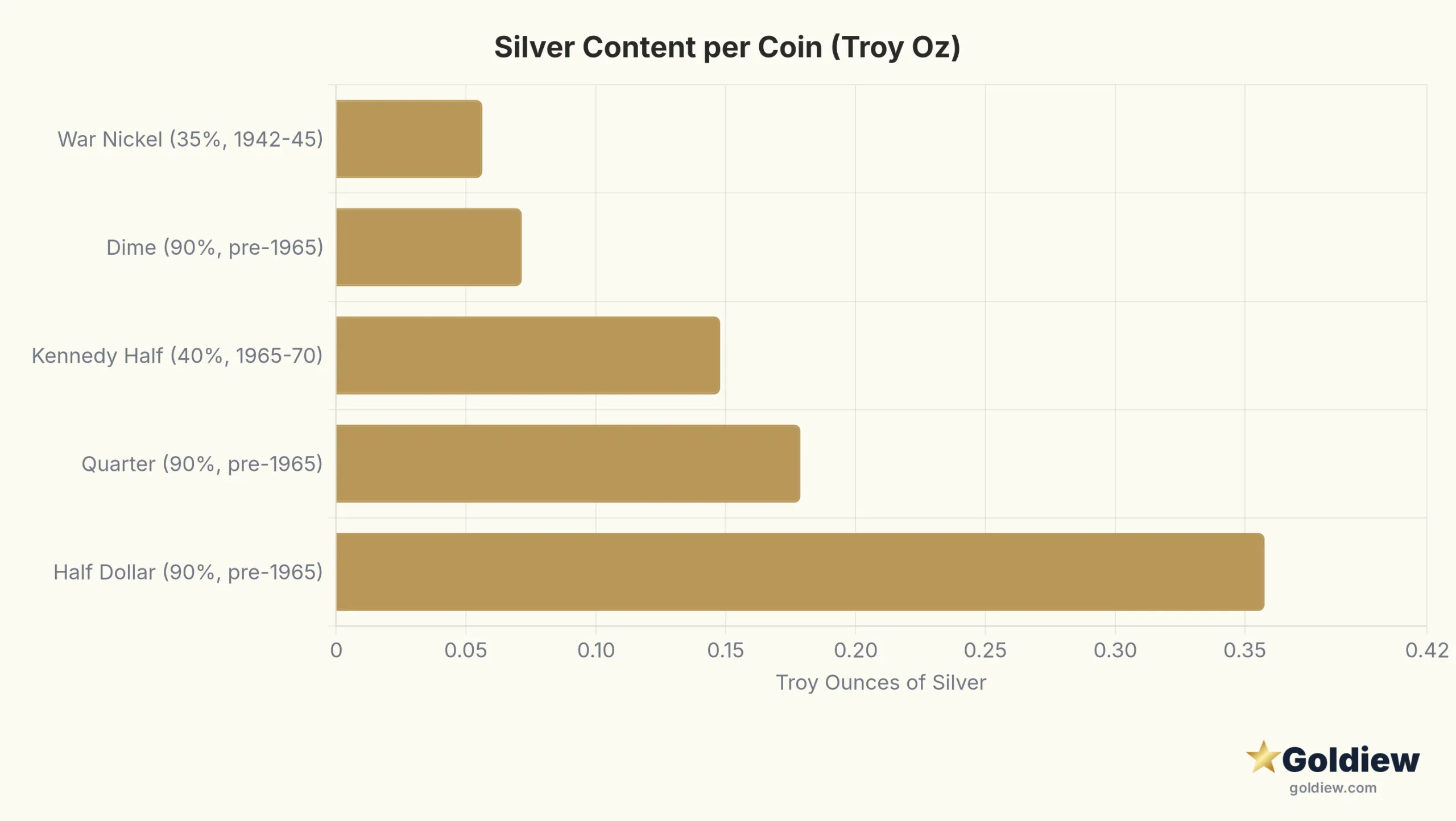
- Roosevelt dimes (1946-1964): 90% silver, 10% copper. Each dime weighs 2.5 grams and contains 0.07234 troy oz of silver at mint specification.
- Washington quarters (1932-1964): 90% silver, 10% copper. Each quarter weighs 6.25 grams and contains 0.18084 troy oz of silver at mint specification.
- Franklin and 1964 Kennedy half dollars: Franklin halves (1948-1963) and the 1964 Kennedy half are both 90% silver. Each weighs 12.5 grams and contains 0.36169 troy oz of silver at mint specification.
Earlier coin series trade the same way. Mercury dimes (1916-1945), Barber dimes, quarters, and halves, and Walking Liberty half dollars are all 90% silver when worn in circulated grades. Some specific dates within these series carry numismatic premiums; bulk bags with random dates are generally priced at melt regardless of series.
Morgan and Peace silver dollars are sometimes listed alongside junk silver, but they nearly always trade above melt because of collector demand. Treat them as a separate category when comparing cost per ounce.
The Face Value Math: How Much Silver Each Coin Contains
Junk silver is measured by face value rather than piece count. A “$100 face bag” contains $100 in face value of coins, which could be 400 quarters, 1,000 dimes, 200 half dollars, or any mix that totals $100 in stamped denomination. Knowing the silver content per dollar of face value is the core piece of math for every buying decision.
Theoretical vs. Circulated Silver Content
The US Mint’s design specifications give a theoretical silver content of 0.7234 troy oz per $1.00 in face value for freshly struck 90% silver coins. But coins that circulated from the 1940s through 1964 lost a small amount of metal to wear. The market convention, used by most dealers and pricing benchmarks, is 0.715 troy oz per $1.00 in face value for circulated coins.
The difference is small. On a $100 face bag: 0.715 oz per face dollar gives 71.5 troy oz; 0.7234 oz gives 72.34 troy oz. That gap of 0.84 oz represents roughly 1.2% of the bag’s total silver content. Well-worn coins average closer to 0.715 oz; coins in better circulated condition approach the theoretical 0.7234 oz. Use 0.715 oz per face dollar as the conservative baseline for all your calculations.
Calculating Melt Value
To find the melt value of a junk silver lot:
- Take the face value of the coins in dollars.
- Multiply by 0.715 oz per face dollar to get total troy oz.
- Multiply by the current silver spot price per troy oz.
Example: A $100 face bag at a silver spot price of $30.00 per troy oz gives $100 x 0.715 x $30.00 = $2,145 in melt value.
The silver value calculator on Goldiew can run this math with live spot data.
Per-Coin Silver Content Reference
| Coin Type | Face Value | Purity | Troy Oz (new, per Mint spec) | Troy Oz (circulated, market convention) |
|---|---|---|---|---|
| Dime (Roosevelt, Mercury, Barber) | $0.10 | 90% | 0.07234 | ~0.0715 |
| Quarter (Washington, Standing Liberty, Barber) | $0.25 | 90% | 0.18084 | ~0.1788 |
| Half Dollar (Franklin, 1964 Kennedy, Walking Liberty) | $0.50 | 90% | 0.36169 | ~0.3575 |
| Kennedy Half Dollar (1965-1970) | $0.50 | 40% | 0.14792 | ~0.1479 |
| Jefferson Nickel, wartime (1942-1945) | $0.05 | 35% | 0.05626 | ~0.0563 |
Adjacent Categories: 40% Halves and War Nickels
Two other US coin types contain silver and sell in the same bulk-bag market as 90% junk silver, but at different price multiples because their silver content per coin is lower.
Kennedy Half Dollars, 1965-1970 (40% Silver)
When Congress passed the Coinage Act of 1965, the US Mint removed silver from dimes and quarters entirely and reduced the Kennedy half dollar from 90% to 40% silver. These “40% halves” ran from 1965 through 1970. Each coin weighs 11.5 grams and contains 0.1479 troy oz of silver.
Per $1.00 in face value (two Kennedy halves), the silver content is 2 x 0.1479 = 0.2958 troy oz, which is about 41% of the 0.715 oz found in 90% junk silver. Dealers price 40% halves at proportionally lower multiples of face value. When comparing a bag of 90% quarters and a bag of 40% halves priced at the same “times face” multiple, the 40% bag contains less than half the silver per dollar paid.
Forty-percent halves are widely available and easy to buy in rolls. For buyers who want silver at or near melt value and are comfortable with the lower silver density, they are a legitimate choice. Just make sure you are comparing $/oz paid, not times-face multiples directly.
War Nickels, 1942-1945 (35% Silver)
During World War II, the US Mint needed copper and nickel for military production. From 1942 through 1945, certain Jefferson nickels were struck in a 35% silver alloy (56% copper, 35% silver, 9% manganese). Each war nickel weighs 5 grams and contains 0.05626 troy oz of silver.
The reliable identifier is on the reverse (tails) side: war nickels carry a large mint mark letter (P, D, or S) positioned above the dome of Monticello. Pre-war and post-war Jefferson nickels have no large mark above the dome. If you see that large letter in that position, the coin is 35% silver regardless of date (as long as it falls between 1942 and 1945).
War nickels are typically sold by the roll (40 coins) or in bulk lots. At 40 coins per roll, a single roll contains 40 x 0.05626 = 2.25 troy oz of silver. Because the face value per coin is only $0.05, the “times face” multiple for war nickels is much higher than for dimes or quarters at the same $/oz price. Most buyers find 90% silver coins simpler to compare and trade.
How Dealers Price Junk Silver
Times-Face Pricing
“Times face” means the price stated as a multiple of the coins’ stamped face value. If a dealer quotes “20x face” on Roosevelt dimes, a $1.00 face value lot costs $20.00. A $100 face bag costs $2,000.
The fair market times-face multiple tracks silver spot prices. For 90% junk silver at 0.715 oz per face dollar, the at-melt multiple equals the silver spot price multiplied by 0.715. At $30.00 per troy oz: $30.00 x 0.715 = $21.45 per face dollar, or 21.45x face at melt. Dealers charge above melt to cover their costs and margin. Retail premiums on 90% junk silver at established online dealers typically range from 5% to 15% over calculated melt in normal market conditions. The silver price today page shows the live spot rate and the current at-melt multiple for junk silver.
Over-Spot Pricing
Some dealers quote junk silver as a premium above silver spot per troy oz. “Spot + $2.00/oz” means you pay the live silver price plus $2.00 for every troy oz of silver content in the coins.
To compare a times-face quote and an over-spot quote, convert both to effective $/oz paid:
- Times face to $/oz: Divide the times-face multiple by 0.715. Example: 23x face divided by 0.715 = $32.17/oz effective cost.
- Over spot to $/oz: Add the spot price and the premium. Example: $30.00 spot + $2.00/oz = $32.00/oz effective cost.
Whichever gives a lower $/oz paid is the better deal for coins of equal quality.
Why 90% Coins Often Cost Less Per Ounce Than Rounds
Generic silver rounds (private mint, one-ounce) typically carry premiums of $2 to $4 per ounce above spot in a normal market. Junk silver premiums, when markets are liquid, can run $1 to $3 per ounce. The gap exists because junk silver is visually variable, harder to authenticate for some buyers, and comes in non-uniform lots. That lower premium is the advantage for buyers who primarily want silver content at minimal cost above spot.

Premium Behavior: Why Junk Silver Prices Spike
Junk silver premiums are not fixed. They widen significantly when physical silver demand surges faster than the secondary coin market can supply inventory.
The most pronounced recent example came in 2020 and early 2021, when a rapid increase in silver spot prices pulled large numbers of buyers into the physical market simultaneously. Premiums on 90% junk silver reached $6 to $10 per ounce above spot at some dealers, temporarily eliminating the cost advantage over silver rounds. Shortage periods can last weeks to months.
Three factors tend to drive junk silver premiums higher:
- Rapid spot price increases: A fast move in silver’s paper market brings buyers to physical dealers before coin supply can catch up.
- General silver product shortages: When rounds and bars are also scarce, buyers turn to junk silver as an alternative, raising premiums on both categories simultaneously.
- Thin secondary market supply: Junk silver enters the market through individuals and local coin shops, not through mints on demand. When fewer sellers bring coins in, dealers run low regardless of spot prices.
If premiums are unusually high when you want to buy, there is no obligation to transact. Comparing current quotes from two or three separate dealers, online and local, takes minutes and may reveal meaningful price differences. Our guide on how to buy silver covers the broader market context if you are still deciding between junk silver, rounds, and bars.
What to Inspect When Buying Bags
Junk silver is sold in standard lot sizes. The most common retail increments are rolls ($10 face per roll, one denomination), small bags ($100 face), and larger bags ($500 face). The standard wholesale trading unit is the $1,000 face “monster bag,” which contains approximately 715 troy oz of silver and weighs roughly 54.7 pounds.
Culls vs. Sliders
“Culls” are coins in very poor condition: heavily worn to the point where details are obliterated, bent, holed, or corroded in ways that affect metal integrity. Culls still contain silver, but holed or deeply damaged coins can be difficult to resell at full market prices and may be declined by some dealers. When buying a bag described simply as “90% silver,” ask whether it contains unsorted raw material or has been culled for problem coins.
“Sliders” are coins that appear uncirculated or nearly so at a glance but show slight rub on the highest design points. For junk silver purposes, sliders are fine. A bag that trends toward sliders rather than heavily worn examples contains slightly more silver than average and should be equally saleable.
Weight Verification
A $1,000 face bag of 90% silver coins has a total coin weight of approximately 803 troy oz (silver content plus the copper alloy component). A $100 face bag should weigh roughly 80.3 troy oz or about 5.5 pounds. A postal or kitchen scale can verify lot weight against expected specifications. Significant underweight relative to what the denomination math predicts suggests non-silver coins mixed into the bag or, in extreme cases, outright substitution.
Per-coin weight specifications from the US Mint: Roosevelt dime = 2.5 grams, Washington quarter = 6.25 grams, Franklin or Kennedy half = 12.5 grams. A coin notably lighter than specification is either heavily worn (lower silver, less serious) or not what it appears to be (serious). A basic US Mint coin specifications table gives the official design weights for reference.
Basic Authentication Checks
Counterfeit junk silver coins exist but are less common than fake gold coins or premium silver rounds because the cost to produce convincing fakes approaches or exceeds the metal value. For bulk purchases from established dealers, the practical risk is low. For peer-to-peer or private transactions, three quick tests cover most risks: a magnet check (silver is not magnetic; a coin that sticks to a magnet is not silver), a scale check against mint specifications, and visual inspection of the coin’s edge for reeding depth and consistency.
The Divisibility Argument, Stated Honestly
Junk silver’s most practical advantage is granularity. A $100 face bag of Roosevelt dimes contains 1,000 individual coins, each with a melt value of roughly $2.15 when silver trades at $30 per troy oz. A single one-ounce silver round is one unit worth roughly $30 at the same spot price. The coins can be sold or bartered in increments far smaller than the round.
This is a straightforward liquidity consideration, not a crisis scenario. Selling silver in a functioning market means contacting a dealer or posting a request for bids. A one-ounce round sells in one transaction. Ten ounces of junk silver can be divided into any smaller lot you choose, sold across multiple transactions, at multiple dealers, or on different dates. Whether that flexibility matters depends on your own timeline and how you plan to exit the position.
For buyers focused primarily on cost per ounce, junk silver’s granularity comes at a tradeoff: handling and storage of thousands of small coins is more cumbersome than a handful of one-ounce bars. Dimes offer the finest divisibility but generally carry slightly higher premiums per ounce than quarters or half dollars because the per-unit handling cost is spread across a smaller denomination. Quarters are the middle ground most budget stackers settle on: larger than dimes, smaller than halves, and widely available in $10 rolls.
Where to Buy Junk Silver
The main sourcing options for junk silver in the US are:
- Local coin dealers: Most coin dealers carry 90% silver in rolls or bags. Buying locally lets you inspect coins before paying and avoids shipping and insurance risk. The Goldiew coin dealer directory lists verified dealers searchable by state and city.
- Online precious metals dealers: Major online dealers publish live spot-based prices and typically offer competitive premiums on larger lots. Shipping costs and insurance fees offset some of the price advantage on small orders. Always review return and dispute policies before ordering.
- Coin shows: Individual sellers at coin shows sometimes price below dealer retail when liquidating personal collections. Prices are often negotiable. Our coin show first-visit guide covers what to expect when shopping for bullion at shows.
- Private sales: Peer-to-peer transactions can reduce premiums further but require careful due diligence: verify weights, check coin authenticity, and use secure payment methods before releasing funds or coins.
When comparing sources, convert all quoted prices to a single metric: effective $/oz of silver paid, after shipping, insurance, and any transaction fees. A locally quoted price that appears higher than an online listing may still be the lower total cost once shipping on a $500 face bag is factored in.
Selling Junk Silver: The IRS Reporting Threshold
When you sell junk silver, specific quantity thresholds trigger a dealer reporting requirement. Under federal regulations implementing IRC Section 6045, dealers are generally required to file Form 1099-B when a customer sells $1,000 or more in face value of 90% silver US coins in a single transaction. Selling a standard monster bag ($1,000 face) will trigger a 1099-B filing by the buying dealer.
Selling smaller lots below that threshold in a single transaction generally does not trigger the 1099-B requirement. However, deliberately breaking a sale into multiple smaller transactions specifically to avoid the reporting threshold is illegal under federal anti-structuring statutes (31 USC 5324). The $1,000 face threshold is a dealer reporting requirement, not a tax exemption: all capital gains from silver sales are taxable regardless of reporting.
Physical silver is taxed as a collectible under the US tax code, subject to a maximum long-term capital gains rate of 28% (rather than the standard 15% or 20% rate for most securities). Your cost basis is what you paid for the coins, including any premium above melt. For a full breakdown of which specific bullion items trigger 1099-B reporting and at what quantities, see our guide on IRS-reportable bullion sales.
Consult your tax advisor for your specific situation before selling significant holdings.
For sellers comparing buy offers before committing: posting a free request on Goldiew’s sell page allows you to receive sealed bids from up to 15 verified buyers without obligation. You choose whether to accept any offer.
Own a Coin Dealership or Precious Metals Shop?
If your business buys and sells junk silver, a free Goldiew business profile connects you with local customers searching for coin dealers in your area. Verified listings appear in the coin dealer directory and on state and city search pages that rank for local precious metals queries. Claim or register your listing to start receiving inquiries from buyers and sellers near you.
Frequently Asked Questions
What is the difference between junk silver and numismatic silver coins?
Junk silver coins trade at or near their melt value because they carry no meaningful collector premium. A circulated 1956 Roosevelt dime in average condition is simply its silver content. Numismatic coins trade above melt because of date scarcity, condition grade, mintmark, or collector demand. Morgan and Peace dollars are the common example: even heavily worn examples often sell at premiums above melt because of collector interest. For buyers who want physical silver at the lowest possible premium, junk silver is more cost-effective than numismatic coins unless you also collect as a hobby. Buyers planning to hold silver inside a retirement account should note that junk silver coins are not eligible for IRAs under IRS fineness rules.
Should I use 0.715 oz or 0.7234 oz per face dollar when calculating junk silver value?
Use 0.715 oz per face dollar as your baseline for circulated 90% coins. The 0.7234 oz figure is the theoretical silver content based on US Mint coin specifications for newly struck coins. The 0.715 oz figure accounts for the average wear on coins that circulated from the 1940s through 1964 before leaving the banking system. Most dealers and industry pricing benchmarks use 0.715 oz for circulated material. If you are buying coins in clearly better condition, 0.7234 oz may be closer to the actual silver content, but 0.715 oz gives the conservative and widely accepted estimate for average circulated lots.
How do I identify a war nickel by looking at the coin?
Check the reverse (tails) side of any Jefferson nickel dated 1942 through 1945. On a war nickel, you will see a large mint mark letter (P, D, or S) positioned above the dome of Monticello. No other Jefferson nickel has a mint mark in that position. Pre-war and post-war Jefferson nickels either have no mint mark, or have a small mark on the right side of Monticello, never above the dome. If the large letter above the dome is present, the coin is 35% silver regardless of which mint produced it. The Philadelphia P mint mark on the war nickel is notable because Philadelphia had never previously used a mint mark on US coinage.
Can junk silver coins be held in a precious metals IRA?
No. The IRS requires coins included in a self-directed precious metals IRA to meet a minimum purity of 99.9% fine silver, per IRC Section 408(m)(3)(B). Pre-1965 US 90% silver coins fall well below that threshold and are not eligible for IRA inclusion. Forty-percent Kennedy halves and 35% war nickels are also ineligible for the same reason. IRA-eligible silver coins include the American Silver Eagle (0.999 fine), the Canadian Silver Maple Leaf (0.9999 fine), and several other sovereign bullion coins that meet the statutory fineness requirement. Junk silver is a physical ownership strategy held outside retirement accounts. Consult your tax advisor for your specific situation.
What is a monster bag of junk silver?
A monster bag is the standard wholesale trading unit for 90% junk silver: $1,000 in face value. In Roosevelt dimes, that is 10,000 coins. In Washington quarters, it is 4,000 coins. In half dollars, it is 2,000 coins. At 0.715 oz per face dollar, a monster bag contains approximately 715 troy oz of silver. The total coin weight (silver plus copper alloy) is approximately 803 troy oz, or about 54.7 pounds. Individual retail buyers typically start with smaller units such as $10 face rolls or $100 face bags. Monster bags trade at the lowest premiums per ounce because of their volume and the minimal handling involved in wholesale transactions.
Why did junk silver premiums spike during 2020 and 2021?
During 2020 and into 2021, a rapid increase in the silver spot price combined with broad retail investor demand cleared out physical silver inventories faster than dealers could replenish them. Junk silver supply comes from individuals and coin shops reselling existing coins, not from mints producing new inventory. When large numbers of buyers entered the market simultaneously, premiums on 90% junk silver rose to $6 to $10 per ounce above spot at some dealers. Rounds and bars, which can be manufactured on demand, saw premiums spike as well, eliminating the normal cost advantage of junk silver for a period of several months. Premium spikes of this kind are temporary but can persist long enough to affect buyers who cannot wait for conditions to normalize.
Are 1964 Kennedy half dollars 90% silver like other pre-1965 halves?
Yes. The 1964 Kennedy half dollar is 90% silver and trades as junk silver in circulated condition, with approximately 0.3575 troy oz of silver per coin. Kennedy half dollars dated 1965 through 1970 are a different product: 40% silver, 0.1479 troy oz each. Starting in 1971, Kennedy halves became copper-nickel clad with no silver content. The date on the coin is the only reliable way to determine which category a Kennedy half falls into. Always check the year before pricing or buying Kennedy halves in bulk.
Sources
- US Mint. Coin Specifications. Official design weights and alloy composition for all current and historical US coin series.
- IRS. Publication 544: Sales and Other Dispositions of Assets. Treatment of collectibles, including physical silver, under the 28% maximum long-term capital gains rate.
- IRS. IRC Section 408(m)(3): Precious metal eligibility requirements for self-directed individual retirement accounts.
- Congressional Research Service / Public Law 89-81. Coinage Act of 1965. Legislation authorizing removal of silver from dimes and quarters and reduction in Kennedy half dollar silver content.
- FinCEN / US Treasury. Bank Secrecy Act, 31 USC 5324. Anti-structuring provisions applicable to precious metals transactions.
- Treasury Regulations Section 1.6045-1. Reporting requirements for brokers and dealers, including Form 1099-B obligations on specified precious metals transactions.