
Utah taxes IRA distributions at a flat 4.45%, but a retirement credit that phases out quickly helps only lower-income retirees
Utah residents can open a self-directed gold IRA under the same federal IRS rules that apply in all 50 states. At the state level, traditional IRA distributions are subject to Utah’s flat 4.45% income tax rate. A state retirement tax credit of up to $450 per qualifying individual exists, but it phases out completely for single filers earning above roughly $43,000 and for married joint filers above roughly $68,000. Utah has no estate tax, and no state inheritance tax on gold IRA assets passing to heirs. The full process of opening, funding, and managing a gold IRA is remote.
Utah applies a single flat income tax rate to virtually all income, including IRA and 401(k) distributions. That simplicity is useful for planning, but it also means the state offers fewer carve-outs for retirement income than states with graduated exemptions. The retirement tax credit available under Utah Code Annotated §59-10-1019 sounds significant on paper, but its rapid phase-out makes it most relevant for retirees at the lower end of the income spectrum. This guide covers exactly who qualifies, how to calculate the credit for your situation, how Utah’s no-estate-tax rule affects beneficiaries of gold IRAs, and how Utah public employees can roll retirement savings into a gold IRA.
Not tax, legal, or financial advice. This guide provides factual information about IRS rules and Utah tax law as published by the Utah State Tax Commission and Utah Code Annotated. Consult your tax advisor for your specific situation. We are not financial advisors.
- How Utah Taxes Gold IRA Distributions
- The Retirement Tax Credit: Who Benefits
- Social Security Is Taxable in Utah
- No Utah Estate Tax
- Utah Retirement Systems and Gold IRA Rollovers
- IRS Rules That Apply in Every State
- Opening a Gold IRA as a Utah Resident
- Who a Gold IRA Is Not Right For
- Companies Goldiew Has Reviewed
- Frequently Asked Questions
- Sources
How Utah Taxes Gold IRA Distributions
Utah applies a flat income tax rate to all taxable income, including distributions from traditional IRAs, 401(k) plans, 403(b) plans, and other pre-tax retirement accounts. According to the Tax Foundation’s 2026 data, Utah’s individual income tax rate is 4.45%. This flat rate applies regardless of how much you earn: a retiree withdrawing $30,000 from a gold IRA and one withdrawing $200,000 pay the same percentage at the state level, unlike states with graduated rate structures where lower amounts face lower rates. North Carolina uses a comparable flat rate; Gold IRA for North Carolina Residents details how its rules and exemptions differ from Utah’s structure.
When you take a distribution from a traditional gold IRA, the distributed amount is recognized as ordinary income at both the federal and Utah state levels in the year you receive it. Federal rates range from 10% to 37% depending on your total taxable income. Utah adds its flat 4.45% on top of that federal obligation. A Utah retiree withdrawing $50,000 from a traditional gold IRA would owe federal income tax at their applicable bracket plus approximately $2,225 in Utah state income tax on that amount, before any credits are applied.
Roth gold IRA distributions are treated differently. Contributions to a Roth IRA are made with after-tax dollars, and qualified distributions are generally tax-free at both the federal level and in Utah. A qualified distribution requires that the account has been open for at least five years and the account holder is age 59½ or older (among other qualifying circumstances listed in IRS Publication 590-B). Utah conforms to the federal treatment of qualified Roth distributions, meaning a qualifying Roth gold IRA distribution is not subject to Utah’s 4.45% income tax.
How Utah’s Flat Rate Compares to Neighboring States
Context helps when evaluating Utah’s tax treatment. Nevada and Wyoming, which border Utah, levy no state income tax. Colorado applies a flat 4.4% rate. Idaho uses a graduated system with a top rate of 5.8%. Arizona uses a graduated system with a top rate of 2.5%. The practical effect for a Utah retiree taking $60,000 in traditional IRA distributions annually is approximately $2,670 in state income tax at 4.45%, before credits. That burden is meaningful but not extreme relative to higher-rate states. What matters is whether the retirement credit reduces it for your income level. Alaska has no state income tax at all; Gold IRA for Alaska Residents covers how that removes the flat-rate layer from the distribution calculation.
The Retirement Tax Credit: Who Benefits and Who Does Not
Utah offers a retirement tax credit under Utah Code Annotated §59-10-1019, administered by the Utah State Tax Commission. The credit directly reduces your Utah income tax liability, dollar for dollar, up to the maximum amount. Here is what the credit actually delivers, and where it falls short for higher-income retirees.
Eligibility Requirements
To claim the Utah retirement tax credit, you must have been born on or before December 31, 1952. That means the credit is available to individuals who are at least 73 years old as of 2025. A retiree who turned 70 in 2025 (born in 1955) does not qualify under the current rule. The credit is available on the Utah individual income tax return (Form TC-40, Schedule A or TC-40A depending on the credit type claimed).
You cannot claim the retirement tax credit in the same year you claim either the Social Security Benefits Credit or the Military Retirement Credit on the same return. You can choose whichever credit provides the greatest benefit for your situation. For retirees whose primary income is Social Security, the Social Security Benefits Credit may be more valuable. Consult your tax advisor to determine which credit applies to your return.
Credit Amount and Phase-Out Calculation
The maximum credit is $450 per qualifying individual. A married couple filing jointly where both spouses qualify (both born on or before December 31, 1952) may claim a combined maximum of $900.
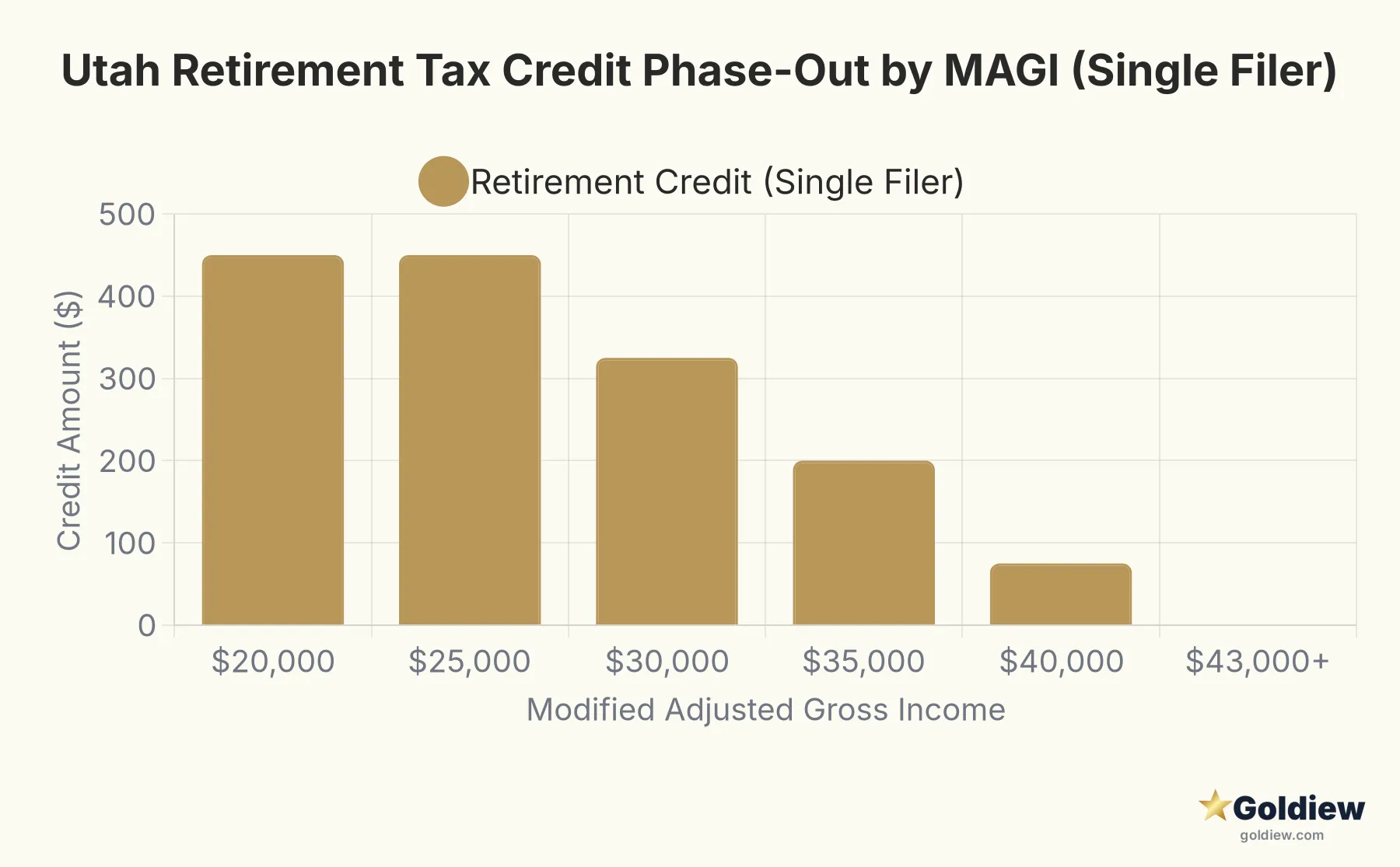
The credit phases out based on your modified adjusted gross income (MAGI). Once your MAGI exceeds the threshold for your filing status, the credit decreases by 2.5 cents for every dollar of income above that threshold. The thresholds are:
| Filing Status | Phase-Out Starts at MAGI | Credit Fully Eliminated at MAGI | Max Credit |
|---|---|---|---|
| Single | $25,000 | ~$43,000 | $450 |
| Married Filing Jointly (both qualify) | $32,000 | ~$68,000 | $900 |
| Married Filing Jointly (one qualifies) | $32,000 | ~$50,000 | $450 |
| Head of Household / Qualifying Surviving Spouse | $32,000 | ~$50,000 | $450 |
| Married Filing Separately | $16,000 | ~$34,000 | $450 |
The elimination threshold is calculated as: threshold + (maximum credit / 0.025). For a single filer: $25,000 + ($450 / 0.025) = $25,000 + $18,000 = $43,000. For a married filing jointly couple where both qualify: $32,000 + ($900 / 0.025) = $32,000 + $36,000 = $68,000. Once your MAGI reaches or exceeds these amounts, you receive no retirement credit at all.
What This Means for Gold IRA Investors
For most retirees actively taking distributions from a gold IRA, the retirement tax credit provides little or no benefit. A gold IRA investor taking $50,000 in annual distributions from a traditional account and collecting Social Security has a MAGI that almost certainly exceeds $43,000 if single, or $68,000 if married (where both spouses qualify). At those income levels, the credit phases out entirely.
The credit is most useful for retirees in their early drawdown years who keep total income below the phase-out thresholds, or for those whose primary income is from a small pension plus Social Security with limited additional IRA distributions. If you are considering a gold IRA rollover at the $50,000 minimum investment level typically associated with this account type, consult your tax advisor to calculate your expected MAGI once distributions begin and determine how much credit, if any, you would actually receive. The credit is worth planning around, not banking on at higher income levels.
Social Security Is Taxable in Utah
Utah taxes Social Security benefits as ordinary income at the state level, subject to the same 4.45% flat rate. This is important context for gold IRA planning because Social Security income counts toward your MAGI for purposes of the retirement tax credit phase-out calculation.
A retiree collecting $24,000 in annual Social Security benefits and taking $30,000 in annual traditional gold IRA distributions has a combined income of approximately $54,000. After applying the federal rules for how much of Social Security is includable in federal adjusted gross income (up to 85% of Social Security benefits are includable for many filers, under Internal Revenue Code Section 86), the Utah MAGI for the retirement credit calculation could be in the $45,000 to $50,000 range for a single filer. At that level, the retirement credit is substantially reduced or eliminated.
Utah does offer a separate Social Security Benefits Credit, also administered by the Utah State Tax Commission. As noted above, you cannot claim both the retirement tax credit and the Social Security Benefits Credit in the same year. If Social Security is your primary retirement income source and your IRA distributions are modest, the Social Security Benefits Credit may deliver more value than the retirement credit. Your tax advisor can calculate which applies in your year. For the specifics of how Utah conforms to federal Social Security inclusion rules, see the Utah State Tax Commission guidance at incometax.utah.gov.
No Utah Estate Tax: What It Means for Gold IRA Beneficiaries
Utah does not impose a state estate tax or a state inheritance tax. When a Utah resident with a gold IRA passes away, the estate is not subject to any Utah-level estate levy. The federal estate tax may apply depending on the total gross estate value, but for most individual retirees, the federal exemption (adjusted annually by the IRS) is large enough that no federal estate tax is owed either. For 2025 and 2026, consult the IRS directly for the applicable federal estate tax exemption amounts. New Mexico’s community property rules alter how IRA assets reach a surviving spouse; Gold IRA for New Mexico Residents covers those state-specific details.
For gold IRA beneficiaries who inherit the account, the IRS rules governing inherited IRAs apply. Under the SECURE Act of 2019 (Public Law 116-94), most non-spouse beneficiaries are required to fully distribute an inherited traditional IRA within ten years of the original account holder’s death. Those distributions are subject to ordinary income tax at the federal level and at Utah’s flat 4.45% state rate in the year they are received by the beneficiary. There is no Utah estate tax added on top of that income tax.
Surviving spouses have more flexibility. A spouse who inherits a gold IRA can generally treat it as their own account, continuing to defer distributions according to standard IRA rules, or roll it into their own IRA. These decisions involve considerations beyond state tax law; a licensed estate planning attorney or tax advisor familiar with Utah inheritance law can evaluate your specific situation.
Utah Retirement Systems and Gold IRA Rollovers
Utah public employees are covered by the Utah Retirement Systems (URS), which administers retirement benefits for state and local government workers, public safety employees, firefighters, and educators. Understanding how URS benefits interact with gold IRA rollovers requires distinguishing between the type of plan you hold.
Defined Benefit vs. Defined Contribution Plans
Most Utah public employees are enrolled in one of URS’s defined benefit (DB) pension plans. A defined benefit plan promises a specific monthly payment at retirement, calculated by a formula based on years of service and final average salary. You cannot roll an active or vested defined benefit pension into a gold IRA while you remain employed. The pension’s value is tied to a future payment stream, not an individual account balance that can be transferred out.
However, if a URS member separates from public employment before reaching retirement eligibility, they may have the option to receive a lump-sum refund of their own employee contributions (not the employer contributions) rather than waiting for a future pension payment. This refund may be eligible for rollover into a traditional IRA, including a self-directed gold IRA, if processed as a direct rollover before you receive the funds. Consult URS directly at urs.org and your tax advisor before making any election, as the timing and method of the rollover affect whether it is treated as a taxable event.
URS 401(k) and 457(b) Plans
URS also administers voluntary 401(k) and 457(b) defined contribution plans available to Utah public employees. Unlike the defined benefit pension, these plans hold individual account balances. Upon separation from public employment, or in some cases while still employed depending on the plan rules, account balances in a URS 401(k) or 457(b) plan can be rolled directly into a self-directed IRA, including a gold IRA.
A direct rollover from a URS 401(k) or 457(b) plan to a gold IRA avoids the 20% mandatory withholding that applies to indirect rollovers (where the distribution is first paid to you). Contact URS at urs.org to request a distribution election form and confirm which rollover method is available for your account type. Your gold IRA custodian can then receive the funds directly from URS and apply them to your new account.
One rollover per 12 months. Under Bobrow v. Commissioner (T.C. Memo 2014-21), the one-IRA-to-IRA rollover limitation applies across all your IRAs combined, not per individual account. Direct trustee-to-trustee transfers between custodians are not subject to this limitation and are generally the preferred method for moving funds between IRA accounts.
IRS Rules That Apply to Gold IRAs in Every State
Gold IRAs are self-directed IRAs governed by federal law. Utah’s tax rules layer on top of federal requirements but do not replace them. The following federal rules apply equally to Utah residents and to residents of any other state.
What Qualifies as IRA-Eligible Gold
Internal Revenue Code Section 408(m)(3) establishes minimum purity standards for precious metals held in an IRA. Gold must be at least 99.5% pure (0.9950 fineness). One statutory exception: the American Gold Eagle coin is expressly permitted under IRC Section 408(m)(3)(A)(i) despite its 91.67% gold content. All other gold coins and bars must meet the 99.5% minimum.
| Metal | Minimum IRS Purity | Common Eligible Examples |
|---|---|---|
| Gold | 99.5% fineness | American Gold Buffalo, PAMP Suisse bars, Credit Suisse bars |
| Silver | 99.9% fineness | American Silver Eagle, 100-oz silver bars, Canadian Silver Maple Leaf |
| Platinum | 99.95% fineness | American Platinum Eagle, PAMP Suisse platinum bars |
| Palladium | 99.95% fineness | American Palladium Eagle, Canadian Palladium Maple Leaf |
Collectible coins are explicitly excluded under IRC Section 408(m)(2). A gold coin marketed as rare or numismatic is generally a collectible regardless of gold content. Verify eligibility with your custodian before any purchase for an IRA account.
Contribution Limits for 2025
For 2025, the IRS annual contribution limit across all IRAs combined is $7,000. Investors aged 50 and older may contribute an additional $1,000 catch-up contribution, bringing their annual maximum to $8,000. This applies to the combined total across all IRA accounts, not per account. Rollovers from 401(k), 403(b), 457(b), and other qualified retirement plans are not counted against this annual limit.
Required Minimum Distributions
Traditional gold IRAs are subject to Required Minimum Distribution (RMD) rules under IRC Section 401(a)(9), as modified by the SECURE 2.0 Act of 2022 (Public Law 117-328). RMD starting ages under the current schedule:
- Age 73: Individuals born between January 1, 1951 and December 31, 1959
- Age 75: Individuals born on or after January 1, 1960
Roth gold IRAs carry no RMD requirement during the original account holder’s lifetime. For Utah residents, RMD distributions from a traditional gold IRA are included in Utah taxable income at the flat 4.45% rate. IRS Publication 590-B provides the RMD calculation tables and life expectancy factors.
Custody and Storage Requirements
Under IRC Section 408(m), precious metals held in an IRA must be in the physical possession of a US bank or IRS-approved nonbank trustee. Self-storage by the account holder (at home or in a personal safe) is not permitted. The Tax Court confirmed in McNulty v. Commissioner (157 T.C. 1, 2021) that personal custody of IRA gold constitutes an impermissible distribution, triggering full income tax plus a 10% early withdrawal penalty on the entire account. Utah residents store their IRA gold at an IRS-approved depository in the contiguous United States; the custodian coordinates all logistics.
Opening a Gold IRA as a Utah Resident: Step by Step
The process is fully remote. Utah residents in Salt Lake City, Provo, Ogden, or rural parts of the state complete every step without visiting a custodian’s office or a depository facility.
Select an IRS-approved custodian that handles self-directed IRAs holding physical precious metals. Verify that the custodian is licensed through a state banking authority or qualifies as a nonbank trustee under IRS Revenue Procedure 2013-18. Request a written fee schedule: setup fees, annual administration fees, and storage fees should all be disclosed before you open an account.
Submit a government-issued ID for identity verification, designate beneficiaries, select your account type (traditional or Roth), and specify your funding method. Most custodians offer electronic applications; paper forms can be completed by mail from a Utah address.
Fund the account by rolling over an existing 401(k), 403(b), 457(b), URS defined contribution plan, or another IRA; or contribute directly up to the 2025 annual limit of $7,000 ($8,000 for ages 50 and older). For rollovers, your gold IRA custodian coordinates the paperwork with the sending institution. A direct rollover (trustee-to-trustee) avoids mandatory 20% withholding and the 60-day rollover deadline. Transfers between institutions typically take two to four weeks.
Work with the custodian or a metals dealer they partner with to select products meeting IRS purity standards. Review per-ounce pricing, dealer premiums above spot price, and product availability at the time of purchase. Receive written purchase confirmation before any order is placed.
The dealer ships your metals directly to the depository your custodian designates. You receive a depository receipt confirming the type, weight, and storage location. The metals never pass through your hands. Common depository locations include facilities in Delaware, Texas, Nevada, and Utah.
Access holdings, valuations, and transaction history through the custodian’s online portal or by requesting paper statements. The custodian files all required IRS forms on your behalf: Form 5498 for contributions and Form 1099-R for distributions. Utah income from distributions is reported on your Utah individual income tax return (Form TC-40) for the year you receive them.
Who a Gold IRA Is Not Right For
A gold IRA is a long-term, illiquid account with custodian, storage, and dealer fees that outweigh the benefits on small balances. Evaluating fit requires looking honestly at where this account type may not serve your interests.
May be worth exploring if you:
- Have eligible retirement funds meeting the custodian’s minimum investment threshold (typically $10,000 to $50,000+ depending on the company, based on industry-reported data)
- Are 55 or older with a retirement horizon of 10 or more years
- Want IRS-approved physical metal exposure within a tax-advantaged account
- Have other liquid assets available for short-term needs
- Understand how Utah’s 4.45% flat rate will apply to future traditional IRA distributions
Likely not a good fit if you:
- Need access to your retirement funds within the next five years
- Have a retirement balance below the custodian’s minimum threshold
- Are under 50 and still in peak earning and accumulation years
- Cannot absorb annual custodian and storage fees on a smaller account balance
- Are counting on the retirement tax credit to offset distributions, but your MAGI exceeds the phase-out threshold
We are not financial advisors. The factors above are factual considerations, not a recommendation to open or avoid any specific account type. A licensed financial advisor familiar with self-directed IRAs can evaluate whether a gold IRA fits your specific retirement picture in Utah.
Companies Goldiew Has Reviewed for Gold IRAs
Goldiew covers companies offering self-directed gold IRA services through our review process. Our methodology is identical for every company we cover, independent of any commercial relationship.
Augusta Precious Metals
Featured Company Education-first process. Founded 2012. Beverly Hills, CA and Casper, WY.Augusta Precious Metals was founded in 2012 and built its process around what it calls an education-first approach: prospective customers speak one-on-one with a salaried, non-commissioned educator before deciding whether to proceed. The company received Money Magazine recognition as Best Overall Gold IRA Company from 2022 through 2026 and Investopedia recognition as Most Transparent Gold IRA Company for the same period. Augusta holds a BBB A+ rating with accreditation since 2014, and reports over 4,000 five-star ratings across Trustpilot, Google, and Consumer Affairs. Industry-reported minimum investment is around $50,000.
For Utah residents, Augusta’s process is conducted by phone and web conference. No in-person visit to any office is required. The multi-year fee waiver available on qualifying rollover accounts should be confirmed directly during the free consultation, as current terms vary. Augusta’s Casper, Wyoming office location may be relevant for some northern Utah investors given proximity.
Read the full Augusta Precious Metals review Get Augusta’s free investor guide
Birch Gold Group
Covered Company Broad metals selection. Founded 2011. Headquartered in Iowa.Birch Gold Group was founded in 2011 and reports serving over 40,000 customers. The company offers gold, silver, platinum, and palladium IRA options and connects clients with IRS-approved custodians and a range of depositories including Delaware Depository, Brink’s Global Services, Texas Precious Metals Depository, and International Depository Services. Birch holds a BBB A+ rating and a AAA Business Consumer Alliance rating. Industry-reported minimum investment is around $10,000. The company processes accounts by phone and postal mail, accessible from any Utah address.
Noble Gold Investments
Covered Company Texas depository option. Encino, CA. $2.5B in assets safeguarded.Noble Gold Investments, headquartered in Encino, California, cites $2.5 billion in assets safeguarded for over 16,000 investors. Noble’s marketing references industry experience going back to 2003. The company operates its own Texas-based depository, which it positions as a differentiator for clients who prefer Texas storage. Industry-reported minimum investment is around $20,000. Noble’s process is phone and paperwork-based and can be completed from Utah.
Goldiew verifies company facts against publicly available sources: company websites, BBB profiles, SEC and FINRA public databases, and IRS-approved precious metals product lists. Ratings in our reviews reflect verified submissions in our moderated user review database.
Frequently Asked Questions
Does Utah tax gold IRA distributions?
Yes. Utah taxes traditional IRA distributions as ordinary income at the state’s flat 4.45% income tax rate. A retiree taking $50,000 in annual traditional gold IRA distributions owes federal income tax at their applicable bracket plus approximately $2,225 in Utah state income tax on that amount, before any credits are applied. Qualified Roth IRA distributions are generally not subject to Utah’s income tax because contributions were already made with after-tax dollars. Consult your tax advisor for your specific situation.
Who qualifies for the Utah retirement tax credit?
The Utah retirement tax credit under Utah Code Annotated §59-10-1019 is available to individuals born on or before December 31, 1952 (age 73 or older in 2025). The maximum credit is $450 per qualifying individual, or $900 for married couples filing jointly where both spouses qualify. The credit phases out at a rate of 2.5% per dollar of MAGI above $25,000 for single filers and $32,000 for married filing jointly filers, eliminating entirely at roughly $43,000 (single) and $68,000 (joint, both qualifying). You cannot claim this credit in the same year you claim the Social Security Benefits Credit or Military Retirement Credit.
Does the retirement tax credit help gold IRA investors?
It depends on your total income. The credit phases out completely once your MAGI exceeds roughly $43,000 (single filer) or $68,000 (married filing jointly, both qualifying). Retirees taking substantial traditional IRA distributions combined with Social Security benefits often have MAGI above those thresholds. For those investors, the credit provides zero benefit. The credit is most useful for retirees with modest total income who keep MAGI below the phase-out ceiling. Consult your tax advisor to calculate your specific MAGI and expected credit amount.
Is there a Utah estate tax on an inherited gold IRA?
No. Utah has no state estate tax and no state inheritance tax. When a Utah resident with a gold IRA dies, the estate is not subject to any Utah estate levy. Federal estate tax may apply depending on the total gross estate value relative to the current federal exemption. Beneficiaries who inherit a traditional gold IRA generally must pay ordinary federal and Utah income tax on distributions they take from the inherited account. Under the SECURE Act of 2019, most non-spouse beneficiaries are required to fully distribute an inherited IRA within ten years of the original owner’s death. Consult your tax advisor for the specifics of your situation.
Can I roll over a URS pension or 401(k) into a gold IRA?
It depends on your plan type. URS defined benefit pension plans do not have a portable individual account balance that can be transferred to an IRA while you are actively employed. Upon separation from public employment, some lump-sum refund options for employee contributions may be eligible for rollover. URS 401(k) and 457(b) defined contribution plan balances can generally be rolled into a self-directed IRA, including a gold IRA, upon separation from employment. Contact URS directly at urs.org to verify your plan type, vesting status, and available distribution elections before contacting a gold IRA custodian. Use a direct rollover (trustee-to-trustee transfer) to avoid the 20% mandatory withholding on indirect distributions.
Where is IRA gold physically stored for Utah investors?
IRA gold must be held at an IRS-approved depository facility, not at your home or in a personal safe deposit box. Common depository locations include facilities in Delaware, Texas, Nevada, and Utah itself. IRS Section 408(m) requires that IRA precious metals remain in the custody of a qualified trustee or custodian. Your gold IRA custodian designates and coordinates storage on your behalf. The Tax Court confirmed in McNulty v. Commissioner (2021) that personal custody of IRA gold constitutes an impermissible taxable distribution.
How much can I contribute to a gold IRA in 2025?
For 2025, the IRS annual contribution limit for all IRAs combined is $7,000. Investors aged 50 and older may contribute an additional $1,000 catch-up contribution for a maximum of $8,000. This limit applies across all your IRAs combined, not per individual account. Rollovers from 401(k) plans, 403(b) plans, URS 457(b) plans, and other qualified retirement accounts do not count against this annual limit. Source: IRS Publication 590-A.
When must Utah residents start taking required minimum distributions from a gold IRA?
Under the SECURE 2.0 Act of 2022 (Public Law 117-328), RMDs from a traditional gold IRA begin at age 73 for individuals born between January 1, 1951 and December 31, 1959, and at age 75 for individuals born on or after January 1, 1960. Roth gold IRAs have no RMD requirement during the original account holder’s lifetime. For Utah residents, RMD distributions from a traditional gold IRA are subject to federal income tax at your applicable bracket plus Utah’s flat 4.45% state income tax in the year you receive them. IRS Publication 590-B provides the RMD calculation worksheets and applicable life expectancy tables.
Does Utah tax gold and silver purchases?
For purchases of physical precious metals outside of an IRA, Utah applies its state sales tax to most retail transactions. Utah has exempted certain sales of gold and silver coin and bullion from state sales tax under Utah Code, but the specifics depend on the form of the metal and the transaction type. For metals purchased for a gold IRA, the metals are delivered directly from the dealer to an IRS-approved depository, not to your Utah address, which affects the sales tax treatment of that transaction. Consult your tax advisor for guidance on in-state retail purchases of precious metals made for personal possession outside of an IRA context.
Sources
- Utah State Tax Commission: Retirement Credit (incometax.utah.gov). Official guidance on eligibility, credit amount, MAGI phase-out thresholds, and the TC-40A filing instruction for Utah Code Annotated §59-10-1019.
- Utah Code Annotated §59-10-1019: Statutory authority for the Utah retirement tax credit. Text available at the Utah Legislature website at le.utah.gov.
- Tax Foundation: Utah Tax Profile (2026). Source for Utah’s 4.45% flat individual income tax rate and confirmation of no state estate tax.
- IRS Publication 590-A: Contributions to Individual Retirement Arrangements. Annual IRA contribution limits, rollover rules, and the one-rollover-per-12-month limitation.
- IRS Publication 590-B: Distributions from Individual Retirement Arrangements. RMD rules, early withdrawal exceptions, required beginning dates, and life expectancy tables.
- Internal Revenue Code Section 408(m): Statutory purity requirements for IRA-eligible precious metals and the qualified trustee custody requirement. Text at uscode.house.gov.
- Internal Revenue Code Section 72(t): Early distribution penalty and qualifying exceptions. Available at uscode.house.gov.
- SECURE 2.0 Act of 2022, Public Law 117-328: Modified RMD starting ages to 73 (born 1951 through 1959) and 75 (born 1960 or later). Text at congress.gov.
- SECURE Act of 2019, Public Law 116-94: Established the 10-year distribution rule for most non-spouse beneficiaries of inherited IRAs. Text at congress.gov.
- Utah Retirement Systems (urs.org). Official source for URS defined benefit and defined contribution plan types, vesting schedules, distribution options, and rollover procedures for Utah public employees.
- McNulty v. Commissioner, 157 T.C. 1 (2021): US Tax Court ruling that personal custody of IRA precious metals by the account holder constitutes an impermissible distribution, triggering full income tax and early withdrawal penalties.
- Bobrow v. Commissioner, T.C. Memo 2014-21: Tax Court ruling that the one-IRA-rollover-per-12-months limitation applies across all of a taxpayer’s IRAs combined, not per individual account.
- FINRA Investor Education Foundation. Resources on avoiding financial fraud, including risks in the precious metals and self-directed IRA sector.